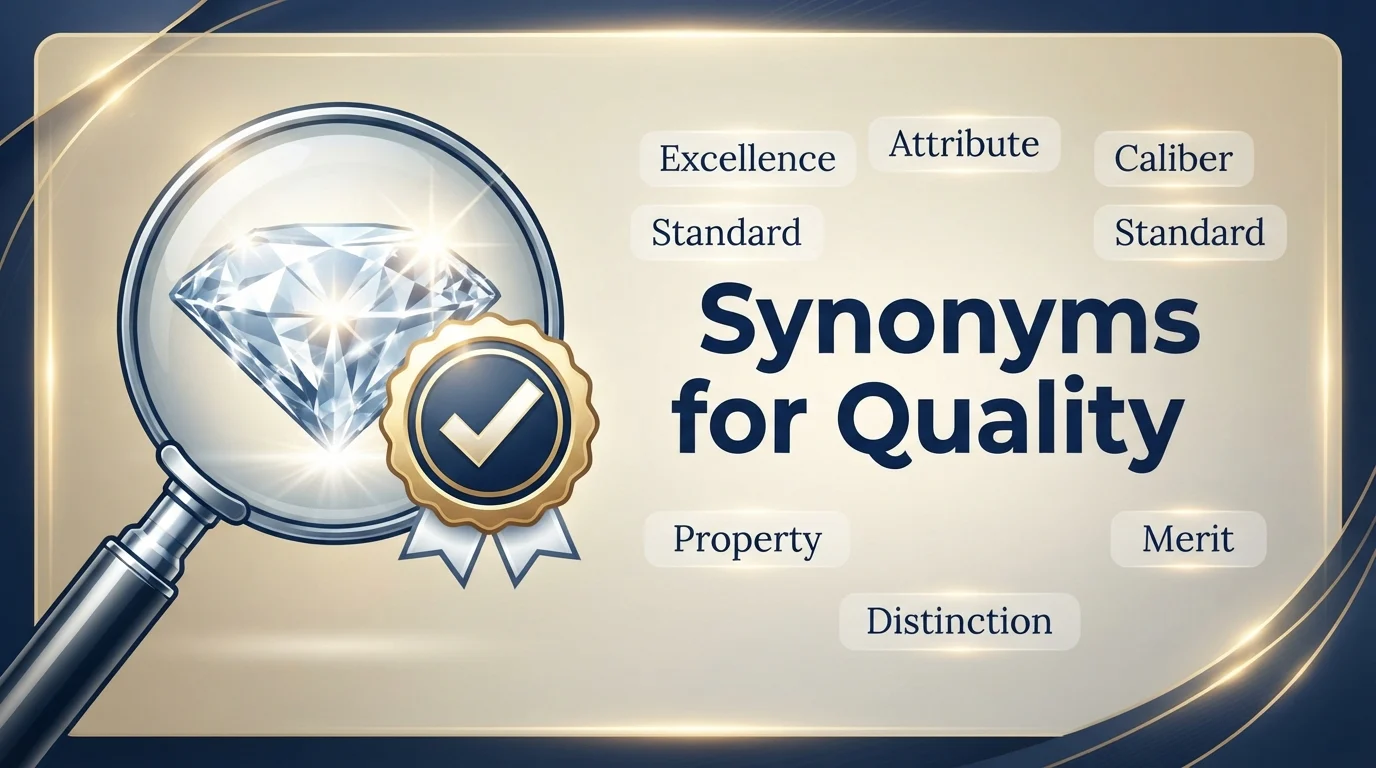
Do you keep using the word “quality” in essays, business reports, product descriptions, performance reviews, or everyday conversation? While it is a highly useful word, repeating it can make your writing feel vague or lack nuance.
The good news is that the best alternative depends on what you actually mean. “Quality” has two primary meanings: it can refer to a distinguishing characteristic or feature of someone or something, or it can refer to a degree of excellence or standard. You might be describing a person’s traits, a product’s grade, a distinguishing attribute, or an inherent property.
This guide explains synonyms for “quality” by meaning, tone, context, and usage. You will learn which alternatives work best in academic writing, professional communication, creative expression, technical contexts, and everyday conversation.
Quick Answer: What Does “Quality” Mean?
“Quality” can mean either a distinguishing characteristic or feature of a person or thing, or a degree of excellence or standard. Depending on context, alternatives for the first meaning include attribute, characteristic, trait, property, and feature. For the second meaning, alternatives include excellence, caliber, merit, standard, and superiority.
Meaning, Tone, and Context
Simple Definition
“Quality” generally refers to:
- A distinguishing characteristic or feature: an essential or distinctive property of someone or something (e.g., “She has many good qualities.”)
- Degree of excellence or grade: a level of value or superiority (e.g., “This is a high-quality product.”)
- The basic character or nature of something (e.g., “The quality of the sound was unique.”)
Part of Speech
“Quality” is primarily a noun.
Examples:
- “Kindness is a quality I admire.” (characteristic)
- “The quality of the fabric is excellent.” (degree of excellence)
As an adjective, “quality” can mean “of high quality” (e.g., “This is a quality product.”).
Related Forms:
- Qualities (plural): multiple characteristics
- Qualitative (adjective): relating to quality rather than quantity
Positive, Negative, or Neutral Tone
“Quality” is generally neutral. However, the tone depends heavily on context and the words surrounding it:
- Negative: “Poor quality,” “low quality,” “inferior quality”
- Positive: “High quality,” “superior quality,” “excellent quality”
- Neutral: “The quality of the sound,” “a distinguishing quality”
Formality Level
“Quality” is a standard word that works in both formal and informal English. However, more formal alternatives like attribute, characteristic, property, excellence, and caliber are often preferred in academic and professional contexts.
Common Use Cases
“Quality” commonly refers to:
- Personal traits: characteristics or attributes of a person
- Product standards: degree of excellence, craftsmanship, or materials
- Data or work: the standard of research, output, or performance
- Inherent properties: physical or chemical characteristics of materials
- Distinguishing features: what makes something unique or identifiable
Important Word Forms
- Quality (noun): the degree of excellence or distinguishing characteristic
- Qualities (plural): multiple characteristics
- Qualitative (adjective): concerning quality
- Qualitatively (adverb): in terms of quality
When and How to Use “Quality”
Use “quality” when you want to describe the standard of something or a distinguishing feature. More specific alternatives can add precision depending on the context.
Professional
“This candidate possesses the leadership qualities we are looking for.”
This works naturally in performance reviews and professional communication.
Academic
“The researchers assessed the quality of the data before proceeding.”
The term is appropriate in academic research.
Business
“We are known for the high quality of our customer service.”
Here, “quality” describes the standard of service.
Technical/Scientific
“The chemical properties of the substance determine its quality.”
The term describes inherent characteristics.
Personal
“Honesty is one of her best qualities.”
The word sounds natural in everyday conversation.
Creative
“The haunting quality of the music stayed with me.”
The term describes an intangible character or feel.
Another Word for “Quality”
There is no single perfect synonym because “quality” has two primary meanings:
For a distinguishing characteristic:
For degree of excellence:
If you need one broad alternative, “standard” works for discussing the degree of excellence, while “attribute” works for discussing a distinguishing characteristic.
When Not to Use “Quality”
“Quality” can become too vague when you need to be specific about what kind of feature or standard you are describing.
Consider:
“He has good qualities.”
This statement does not tell readers whether he is honest, hardworking, kind, or something else.
A more precise sentence could be:
“He possesses commendable leadership and integrity traits.”
Similarly, avoid using “quality” when you mean “feature” or “attribute” in a technical context. Use the more specific term instead.
Words Commonly Confused With “Quality”
Quality vs. Attribute
Both describe characteristics, but attribute often implies something inherent or fundamental to a thing or person.
Example:
“Patience is an important quality for teachers.” (desirable feature)
“Patience is an important attribute for teachers.” (inherent characteristic)
Quality vs. Characteristic
Characteristic is a typical or distinctive feature. Quality can be more general.
Example:
“A characteristic of mammals is warm-bloodedness.” (defining feature)
“The quality of the wool is excellent.” (standard)
Quality vs. Property
Property describes an inherent, often physical, characteristic of a thing.
Example:
“Water has unique properties.” (inherent physical characteristics)
“The quality of the sound was rich.” (general perception)
Quality vs. Trait
Trait often describes a personal or behavioral characteristic.
Example:
“Creativity is a human trait.” (personal characteristic)
“The company is known for product quality.” (standard of excellence)
Quality vs. Caliber
Caliber specifically refers to the degree of excellence or ability.
Example:
“The quality of the products was impressive.” (general standard)
“The caliber of the candidates was outstanding.” (level of ability)
Quality vs. Merit
Merit emphasizes worthiness or value based on quality.
Example:
“The artistic quality of the film was recognized.” (standard)
“The artistic merit of the film was recognized.” (value/worth)
Best Synonym by Context for “Quality”
Which Synonym Should You Choose?
Start by identifying what kind of “quality” you are describing.
- Personal characteristics: trait, attribute, characteristic, virtue, feature
- Inherent features: property, characteristic, attribute, composition, nature
- Level of excellence: excellence, caliber, grade, standard, superiority
- Evaluating worth: merit, value, worth, distinction
- Distinguishing identification: hallmark, mark, peculiarity, quirk, signature
- Intangible character: essence, character, nature, feel, tone
10 Key Synonyms for “Quality”
The table below includes accurate alternatives with clear meanings and usage contexts.
Synonym Groups and Usage Differences
Professional vs. Personal Synonyms
Professional writing benefits from specific terms such as attribute, trait, caliber, and competency.
Personal communication often uses quality itself or casual alternatives like feature or virtue.
Compare:
“Her leadership qualities are strong.” (personal)
“Her leadership attributes include strategic vision and team building.” (professional)
Formal vs. Conversational Synonyms
Quality works in both formal and conversational English.
Formal alternatives: attribute, property, caliber, merit, distinction
Conversational alternatives: feature, trait, virtue, class, character
Examples:
“The candidate possesses remarkable attributes.” (formal)
“She’s got great character.” (conversational)
Academic Synonyms
Academic writing should distinguish between characteristic (identifying feature), property (inherent feature), attribute (essential feature), and standard (measure of excellence).
For example, research papers often use “characteristics” for describing study populations and “properties” for describing materials.
Professional and Business Synonyms
Business writing often benefits from phrases such as standard of excellence, performance indicator, quality benchmark, and competitive differentiator.
Instead of:
“The quality of our products is excellent.”
Consider:
“Our products are recognized for their superior craftsmanship and reliability.”
Creative or Literary Synonyms
Creative writing can use essence, character, nature, tone, feel, and aura depending on the context.
For example:
“There was a dreamy quality to the music that captivated him.”
“The essence of her character was kindness.”
Slang or Modern Synonyms
Class is a casual term for quality or sophistication.
Grade is used in casual contexts (e.g., “top grade”).
Top-notch is informal for high quality.
Solid is slang for reliable quality.
Examples:
“That’s a class piece of work.” (casual)
“The service was top-notch.” (informal)
Strongest vs. Weaker Synonyms
“Quality” synonyms vary in intensity:
Milder: acceptable, decent, passable
Moderate: good, fine, satisfactory
Strong: excellent, superior, outstanding, exceptional
Very Strong: premium, elite, first-rate, world-class, superb
Emotional vs. Neutral Synonyms
“Quality” is generally neutral.
Positive emotional alternatives: excellence, superiority, distinction, merit
Neutral alternatives: attribute, characteristic, property, feature
Negative: poor quality, inferior, substandard
Examples:
“The product quality is good.” (neutral/positive)
“She has the quality of patience.” (neutral)
“The distinction of his work is widely recognized.” (positive)
Antonyms of “Quality”
“Quality” has several antonyms depending on context:
| Antonym | Context | Meaning | Example Sentence |
|---|---|---|---|
| Defect | Characteristics | A flaw or imperfection | The product had a serious defect. |
| Flaw | Characteristics | An imperfection or fault | There was a flaw in the design. |
| Fault | Characteristics | A defect or weakness | His major fault is impatience. |
| Inferiority | Excellence | Lower quality or value | The inferiority of the product was apparent. |
| Mediocrity | Excellence | Average or ordinary quality | The team settled for mediocrity. |
| Worthlessness | Value | No value or merit | The item was deemed worthless. |
| Deficiency | Standard | A lack of quality | There is a deficiency in the training material. |
Comparison: “Quality” vs. Similar Words
Quality vs. Attribute
Main difference: Attribute often implies an inherent or essential characteristic.
Examples:
“Kindness is a quality I admire.” (desirable feature)
“Patience is an important attribute for teachers.” (essential characteristic)
Quality vs. Characteristic
Main difference: Characteristic is a typical or identifying feature.
Examples:
“The quality of the wool is excellent.” (standard)
“A characteristic of mammals is warm-bloodedness.” (identifying feature)
Quality vs. Property
Main difference: Property describes an inherent, often physical characteristic.
Examples:
“The quality of the sound is rich.” (general)
“Water has unique properties.” (physical characteristics)
Quality vs. Trait
Main difference: Trait often describes a personal or behavioral characteristic.
Examples:
“The product is known for its quality.” (standard)
“Creativity is a human trait.” (personal characteristic)
Quality vs. Caliber
Main difference: Caliber specifically refers to the degree of excellence or ability.
Examples:
“The quality of the products was impressive.” (general standard)
“The caliber of the candidates was outstanding.” (level of ability)
Quality vs. Merit
Main difference: Merit emphasizes worthiness or value based on quality.
Examples:
“The artistic quality of the film was recognized.” (standard)
“The artistic merit of the film was recognized.” (value/worth)
Common Phrases and Expressions with “Quality”
1. High quality
Meaning:
A superior standard of excellence.
Example:
“We are committed to producing high-quality products.”
2. Quality of life
Meaning:
The degree to which life is comfortable, healthy, and enjoyable.
Example:
“The city offers a high quality of life for its residents.”
3. Quality time
Meaning:
Time spent with someone in a meaningful and enjoyable way.
Example:
“Parents are encouraged to spend quality time with their children.”
4. Of high quality
Meaning:
Excellent, superior.
Example:
“The materials used in this product are of high quality.”
5. Quality assurance
Meaning:
A process to ensure that products or services meet standards.
Example:
“The quality assurance team checks every product before shipment.”
6. Quality control
Meaning:
The process of ensuring that products meet quality standards.
Example:
“Quality control is essential in manufacturing.”
7. Personal quality
Meaning:
A characteristic or trait of a person.
Example:
“Patience is a valuable personal quality.”
8. Quality education
Meaning:
Education of a high standard.
Example:
“Every child deserves access to quality education.”
9. Quality service
Meaning:
Service of a high standard.
Example:
“The hotel is known for its quality service.”
10. Good quality
Meaning:
Pleasant or satisfactory standard.
Example:
“These shoes are good quality and will last for years.”
Common Mistakes to Avoid
1. Using “quality” when “attribute” or “characteristic” is more precise
If you are referring to a specific feature rather than a general standard, use attribute or characteristic.
Vague: “His qualities include patience and honesty.”
Precise: “His attributes include patience and honesty.”
2. Using “quality” in business without specifying
Business communication benefits from specific terms like standard, caliber, excellence, or benchmark.
Vague: “We need to improve quality.”
Specific: “We need to improve our quality standards to meet industry benchmarks.”
3. Using “quality” as a positive adjective without evidence
In resumes or performance reviews, “quality” can sound vague without support.
Vague: “I produce quality work.”
Specific: “I have a proven track record of delivering high-caliber results that exceed client expectations.”
4. Overusing “quality” in writing
Repetition can make content feel dull. Use alternatives such as excellence, standard, caliber, attribute, characteristic, and merit.
5. Confusing “quality” with “quantity”
Quality means excellence or characteristics; quantity means amount or number. They are not interchangeable.
6. Choosing a synonym that changes the meaning
Do not replace quality with property unless you mean an inherent physical characteristic.
Do not replace quality with merit unless you mean value or worthiness.
Neutral: “The quality of the sound was unusual.” (general)
Different: “The properties of the sound wave were measured.” (physical)
FAQs
What is the best synonym for “quality”?
The best synonym depends on context. Attribute, characteristic, trait, or property works for distinguishing features. Excellence, caliber, merit, or standard works for degree of excellence.
What is a formal synonym for “quality”?
Attribute, trait, property, characteristic, excellence, caliber, and merit are formal synonyms. These work well in academic papers, business reports, and professional documents.
What is another word for “quality” in a resume?
Expertise, proficiency, competency, skill, attribute, and achievement work well. Caliber and excellence are also useful when describing previous work.
What is the difference between “quality” and “attribute”?
Quality is a broad term for a characteristic or standard. Attribute is a specific, inherent, or essential characteristic of a person or thing.
What is the opposite of “quality”?
Depending on context, opposites include defect, flaw, inferiority, mediocrity, and worthlessness.
What does “quality” mean in a business context?
In business, quality often refers to a standard of excellence, customer satisfaction, product reliability, or performance metrics.
Conclusion
“Quality” is a versatile word that can describe distinguishing characteristics, inherent properties, and standards of excellence. The best synonym depends on what you actually mean.
Choose attribute, trait, or characteristic for personal features; property for inherent physical features; caliber, excellence, or standard for levels of achievement; and merit or value for evaluating worth.
Most importantly, do not replace “quality” simply to avoid repetition. First identify what kind of quality—a characteristic, an inherent property, or a level of excellence—you are actually describing. Then choose the alternative that communicates that idea most clearly.
For academic, professional, and formal writing, precision is usually more valuable than vocabulary variety. A specific term such as attribute, characteristic, excellence, or caliber can tell readers much more than the broad word quality.
Before publishing a vocabulary guide, verify definitions and usage with trusted dictionaries such as Cambridge, Oxford, Merriam-Webster, Collins, or Dictionary.com. This helps ensure that each alternative accurately matches its intended meaning and context.
The practical takeaway is simple: when “quality” feels too vague, ask yourself whether you are describing a feature or a standard of excellence. Then use the most precise word available
Discover More:-
- 50+ Synonyms for “Is”: Meanings, Examples, and Best Alternatives
- 50+ Synonyms for Pride: Meanings, Examples, and Best Alternatives

2 thoughts on “50+ Synonyms for Quality: Meanings, Examples, and Best Alternatives”