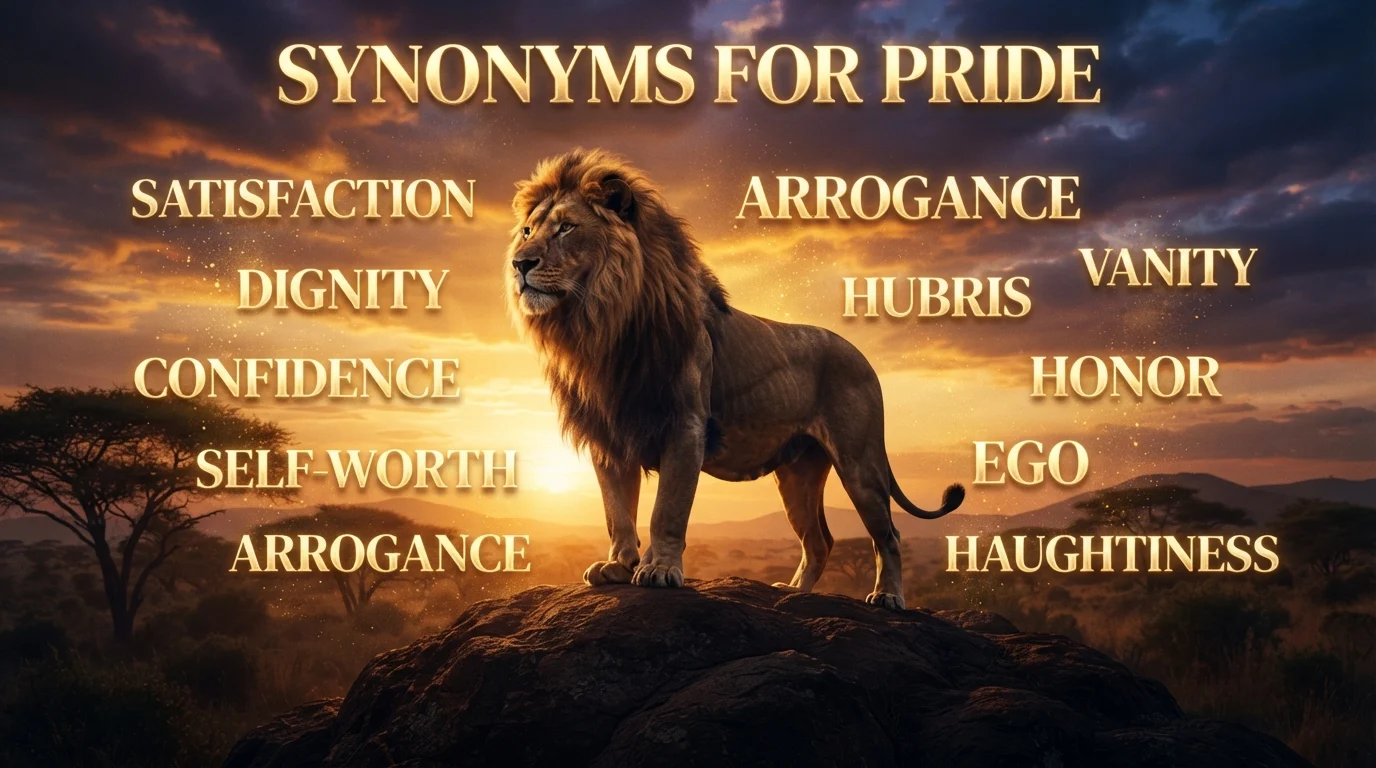
Do you keep using the word “pride” in essays, speeches, creative writing, or everyday conversation? While it is a powerful and meaningful word, it can convey very different thingsfrom a healthy sense of self-respect to an arrogant overestimation of one’s importance. Repeating it can make your writing feel one-dimensional or imprecise.
The best alternative depends on what you actually mean. You might be describing a feeling of satisfaction in an achievement, a sense of personal dignity, an overly high opinion of oneself, or even the best part of a collection.
This guide explains synonyms for pride by meaning, tone, context, and usage. You will learn which alternatives work best in academic writing, professional communication, creative expression, and casual conversation .
Quick Answer: What Does “Pride” Mean?
Pride is a complex word with several distinct meanings. It can refer to a feeling of deep pleasure or satisfaction derived from one’s achievements, qualities, or possessions. It can also mean a sense of one’s own dignity and worth, or—in a negative sense—an excessively high opinion of oneself . Depending on context, alternatives include satisfaction, self-esteem, dignity, arrogance, conceit, and treasure.
Meaning, Tone, and Context
Simple Definition
Pride generally refers to:
- Satisfaction & Achievement: A positive feeling from personal or shared success (e.g., pride in a job well done)
- Self-Respect & Dignity: A sense of one’s own worth and value (e.g., swallowing one’s pride)
- Arrogance & Vanity: An excessive, conceited overestimation of one’s importance (e.g., the sin of pride)
- The Best of a Group: The finest or most valuable part of something (e.g., the pride of the collection)
Part of Speech
Pride is primarily a noun. It can also function as a verb.
Noun Examples:
Verb Examples:
Positive, Negative, or Neutral Tone
Pride can be positive, negative, or neutral, depending entirely on the context.
Positive: “a sense of pride in a job well done” (satisfaction)
Neutral/Positive: “a sense of dignity and self-respect” (self-worth)
Negative: “an excessively high opinion of oneself” (arrogance)
Formality Level
Pride is a standard word used in both formal and informal English. It’s suitable for academic writing, business reports, literature, and casual conversation.
Common Use Cases
Pride is commonly used to describe:
- Feelings about personal accomplishments and skills
- Satisfaction in the achievements of family, friends, or a team
- A sense of dignity and self-respect
- Loyalty and belonging to a group (e.g., national pride, Gay Pride)
- The object of great satisfaction (e.g., “her garden is her pride and joy”)
- The best individual in a group (e.g., “the pride of the team”)
- An excessive and arrogant sense of self-importance, often viewed as a vice or “the sin of pride”
Important Related Forms
- Proud (adjective): feeling pride.
- Proudly (adverb): in a proud manner.
- Prideful (adjective): having or showing an excessively high opinion of oneself .
- Pridefulness (noun): the quality of being prideful .
When and How to Use “Pride”
Use pride when discussing feelings of satisfaction, self-worth, or superiority. Because the word is nuanced, choosing the right context and synonyms is key.
Positive Achievement
“Her pride in winning the award was evident.”
This works naturally when discussing accomplishment.
Self-Respect
“He had too much pride to ask for a handout.”
Here, pride refers to dignity and self-respect .
Negative Arrogance
“His pride was his downfall; he refused to listen to anyone.”
This usage aligns with the “pride comes before a fall” proverb .
Professional
“The team takes pride in delivering high-quality results.”
This is a standard and professional way to express dedication.
Creative
“The old warrior’s pride was a scarred shield against the world.”
A literary use emphasizing pride as a protective, defining trait.
Another Word for “Pride”
There is no single perfect synonym because “pride” has such different facets.
- Satisfaction Context: satisfaction, gratification, fulfillment, pleasure, joy, delight
- Self-Respect Context: self-esteem, dignity, honor, self-respect, self-worth, self-regard
- Excessive Pride Context: arrogance, conceit, vanity, hubris, egotism, self-importance, vainglory
- The Best of a Group Context: cream, pick, flower, jewel, gem, treasure, elite
- Object of Pride Context: pride and joy, treasure, gem, jewel in the crown
If you need one broad alternative, satisfaction works for positive pride, while arrogance works for negative pride.
When Not to Use “Pride”
Pride can become too vague when the reader needs to know if you mean positive self-worth or negative arrogance.
Consider: “His pride was a problem.”
This statement does not tell readers whether he was too arrogant to accept help or too dignified to compromise his values. A more precise sentence could be: “His arrogance alienated his colleagues” or “His dignity prevented him from begging.”
Words Commonly Confused With “Pride”
Pride vs. Arrogance
Arrogance is the negative, overbearing form of pride, implying a superior and contemptuous attitude towards others. Pride can be positive, but arrogance is always negative .
Example:
“His pride in his work was admirable.” (positive)
“His arrogance made him impossible to work with.” (negative)
Pride vs. Vanity
Vanity is an excessive pride in one’s appearance or achievements, often with a desire for admiration from others. It is a specific, often shallow, form of pride .
Example:
“Her vanity was fed by the constant compliments on her looks.” (shallow)
“His pride was wounded by the professional criticism.” (self-worth)
Pride vs. Self-Esteem
Self-esteem is a more neutral and clinical term for one’s overall sense of self-worth. Pride is the feeling associated with that worth .
Example:
“Healthy self-esteem is important for mental health.” (clinical)
“She felt a surge of pride after completing the marathon.” (emotional)
Best Synonym by Context for “Pride”
Which Synonym Should You Choose?
Start by identifying the nature of the pride you are describing.
- Positive, healthy pride: satisfaction, gratification, fulfillment, pleasure, joy
- Self-respect: dignity, self-esteem, self-worth, honor
- Overbearing, negative pride: arrogance, conceit, vanity, hubris, egotism, haughtiness
- The finest example: cream, elite, flower, pick, jewel, gem, treasure
Real Life Examples of “Pride” in Sentences
Positive Achievement
“The Olympic champion felt immense pride as she stood on the podium.”
A more specific version: “She felt a profound sense of satisfaction.”
Self-Respect
“He had to swallow his pride and ask for directions.”
A more precise version: “He had to set aside his dignity and ask for directions.”
Negative Arrogance
“His pride was his greatest weakness; he refused to acknowledge his mistakes.”
A more specific version: “His arrogance was his greatest weakness.”
Treasure
“This antique vase is the pride of my collection.”
A more specific version: “This antique vase is the jewel of my collection.”
10 Key Synonyms for “Pride”
The table below includes accurate alternatives for different contexts.
Synonym Groups and Usage Differences
Positive vs. Negative Pride
This is the most critical distinction. Positive pride is about satisfaction and self-worth; negative pride is about arrogance and conceit.
Positive: satisfaction, self-esteem, dignity, fulfillment, honor, self-respect
Negative: arrogance, conceit, vanity, hubris, egotism, haughtiness, vainglory
Professional vs. Personal Synonyms
Professional communication often uses neutral-to-positive terms like satisfaction, fulfillment, and self-confidence. Business writing might also use best-in-class or top-tier to describe the “pride of” a group.
Example:
“Taking pride in one’s work.” (personal)
“We take satisfaction in delivering high-quality service.” (professional)
Formal vs. Conversational Synonyms
Pride and satisfaction are common in both formal and conversational contexts. Hubris and vainglory are more formal and literary. Swagger and big-headedness are informal slang for negative pride.
Academic Synonyms
Academic writing often uses self-esteem (psychology), hubris (classics/literature), dignity (philosophy/law), and satisfaction (sociology). The seven deadly sins context calls it the sin of pride or vainglory .
Slang or Modern Synonyms
- Big-headed: An informal term for someone with an excessive sense of their own importance.
- Swagger: A confident, often arrogant, way of behaving.
- Cockiness: Overly self-confident in a way that is annoying to others.
“Pride of” (The Best)
This specific context has its own set of elegant synonyms.
- Cream: “The cream of the crop” .
- Elite: “The elite of society” .
- Flower: “The flower of the nation’s youth” .
- Pick: “The pick of the litter” .
- Jewel: “The jewel of the crown” .
Antonyms of “Pride”
Common Phrases and Expressions with “Pride”
1. Pride and Joy
Meaning:
A person or thing that is a source of great pride and happiness .
Example:
“His classic car was his pride and joy.”
2. Take Pride In
Meaning:
To feel satisfaction and pleasure from something one has done or is associated with .
Example:
“She takes pride in her work.”
3. Pride Comes Before a Fall
Meaning:
A warning that excessive pride leads to a downfall .
Example:
“He was so sure he would win, but pride comes before a fall.”
4. Swallow One’s Pride
Meaning:
To humble oneself and accept a situation that is embarrassing .
Example:
“He had to swallow his pride and ask for help.”
5. Wounded Pride
Meaning:
A feeling of shame or a loss of self-respect .
Example:
“She refused to admit she was wrong, her wounded pride getting in the way.”
Common Mistakes to Avoid
1. Confusing Positive and Negative Pride
The most common mistake is not distinguishing between healthy self-respect and negative arrogance. This can completely change the meaning of a sentence. Understanding that pride can be a virtue or a vice is key .
2. Using “pride” when a specific term is available
If you mean satisfaction, say satisfaction. Specific vocabulary is always more precise.
3. Overusing “pride” in writing
Repetition can make content feel generic. Instead, identify whether you mean satisfaction, self-respect, or arrogance, and choose the most appropriate alternative.
FAQs
What is the best synonym for “pride”?
The best synonym depends on context. Satisfaction works for positive pride, self-esteem for self-worth, and arrogance for negative pride.
What is a formal synonym for “pride”?
Hubris (for excessive pride), dignity (for self-respect), satisfaction (for achievement), and cream (for the best) are formal synonyms.
What is an informal synonym for “pride”?
Big-headedness, swagger, and cockiness are informal, negative synonyms. Glow or delight can be informal positive synonyms.
What is the opposite of “pride”?
The antonyms of pride are humility (being humble) and shame (feeling dishonor) .
What does “pride” mean in a group of lions?
A group of lions is called a pride .
What is the difference between “pride” and “vanity”?
Pride can be a general feeling of satisfaction or self-respect. Vanity is a specific, shallow, and excessive pride in one’s appearance or achievements, often with a desire for admiration .
What does “swallowing your pride” mean?
It means to humble yourself and accept help or a situation that you might find embarrassing or beneath you .
Conclusion
Pride is a multifaceted word with positive and negative connotations. The best synonym depends on what you actually mean: satisfaction for healthy achievement, self-esteem for self-worth, arrogance or hubris for excessive self-importance, and cream or jewel for the best of a group.
Most importantly, do not replace pride simply to avoid repetition. First identify whether you are discussing a positive virtue or a negative vice, and then choose the alternative that communicates that idea most clearly.
The practical takeaway is simple: when pride feels too vague, ask yourself if you are describing a healthy sense of self-respect, a feeling of satisfaction, or a negative trait like arrogance. Then use the most precise word available.
Discover More:-
- 50+ Synonyms for Stop: Meanings, Examples, and Best Alternatives
- 50+ Synonyms for White: Meanings, Examples, and Best Alternatives

1 thought on “50+ Synonyms for Pride: Meanings, Examples, and Best Alternatives”