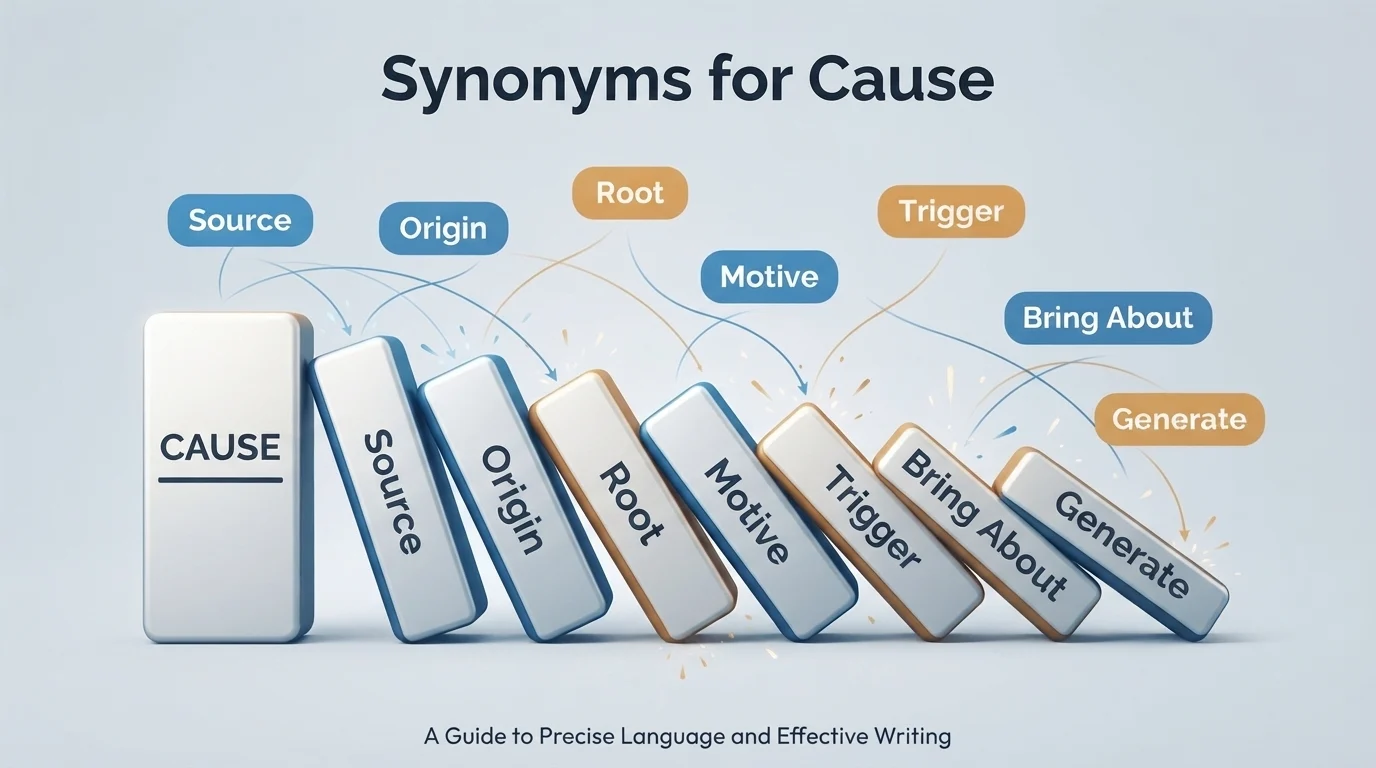
Do you keep using the word “cause” in essays, research papers, business reports, or everyday conversations? While it is one of the most important words for explaining reasons and effects, repeating it can make your writing feel predictable or imprecise.
The good news is that the best alternative depends on what you actually mean. You might be referring to the source of a problem, an explanation for an event, a motivating reason for action, a belief you support, or the act of making something happen.
This guide explains synonyms for “cause” by meaning, tone, context, and usage. You will learn which alternatives work best in academic writing, professional communication, creative writing, and casual conversation.
Quick Answer: What Does “Cause” Mean?
Cause has two main uses in English. As a noun, it refers to the source or reason something happens, a motive or justification, or a principle or movement that one supports . As a verb, it means to make something happen or bring about an effect . Depending on context, alternatives include source, reason, origin, motive, movement, bring about, generate, and trigger.
Meaning, Tone, and Context
Simple Definition
“Cause” generally refers to:
- As a noun: the source, reason, or origin of an event or situation; a motive or justification for action; a principle, movement, or goal that people support
- As a verb: to make something happen; to bring about an effect or result
Part of Speech
Cause functions as both a noun and a verb.
Noun Examples:
- “The cause of the fire was faulty wiring.” (source)
- “She donated to a cause she believed in.” (principle or movement)
- “There is no cause for concern.” (reason or justification)
Verb Examples:
Positive, Negative, or Neutral Tone
Cause is generally neutral. The tone depends on the context:
- Neutral: “The cause of the reaction was unknown.”
- Negative: “The cause of the accident was driver error.”
- Positive: “She devoted her life to a worthy cause.”
Formality Level
Cause is standard English that works in both formal and informal settings. It is widely used in academic papers, professional documents, news articles, and everyday conversation .
Common Use Cases
Cause commonly appears in:
- Scientific and academic writing (identifying causes and effects)
- Legal and professional contexts (establishing reasons and justifications)
- Social and political contexts (charitable causes, social movements)
- Everyday conversation (explaining reasons for events)
- Business communication (identifying root causes of problems)
Important Word Forms
- Cause (noun): source, reason, principle
- Cause (verb): to bring about
- Caused (verb past tense): brought about
- Causing (verb present participle): bringing about
- Causative (adjective): acting as a cause
- Causally (adverb): relating to cause and effect
When and How to Use “Cause”
Use cause when discussing the source of an event, a reason for action, a principle you support, or the act of making something happen.
Because the word has multiple uses, choosing the right alternative depends on your intended meaning.
Professional
“We need to identify the root cause of the production delay.”
This works naturally in business communication.
Academic
“Researchers are still investigating the cause of the disease.”
The term is standard in academic writing.
Personal
“I have no cause to distrust her.”
The word sounds natural in everyday conversation.
Creative
“The cause of his despair remained hidden.”
The term works well in descriptive writing.
Social/Political
“She dedicated her career to the cause of environmental justice.”
Here, cause refers to a principle or movement .
Another Word for “Cause”
There is no single perfect synonym because cause has multiple meanings. The best alternative depends on context .
- Source of an event: source, origin, root, beginning, genesis
- Explanation/reason: reason, justification, explanation, grounds
- Motive for action: motivation, incentive, inducement, motive
- Principle or movement: purpose, objective, ideal, aim
- To make something happen: bring about, generate, create, produce, engender
- To trigger: provoke, prompt, induce, precipitate, trigger
- Legal context: lawsuit, action, case
When Not to Use “Cause”
Cause can become vague when you need to specify exactly what you mean.
Consider:
“The cause of the problem was unknown.”
This does not tell readers whether the problem was a faulty process, a human error, an external factor, or something else.
A more precise sentence could be:
“The origin of the problem was a software glitch.”
Similarly, avoid using cause when you mean a complete explanation—use reason or explanation instead. Avoid using cause for a principle if you mean a specific goal—use objective or aim .
Words Commonly Confused With “Cause”
Cause vs. Reason
Cause refers to what produces an effect. Reason refers to an explanation or justification .
Example:
“The cause of the crash was mechanical failure.” (what produced it)
“The reason for the delay was bad weather.” (explanation)
Cause vs. Origin
Origin emphasizes the starting point of something. Cause emphasizes what produces an effect.
Example:
“The origin of the river is in the mountains.” (starting point)
“The cause of the flood was heavy rainfall.” (what produced it)
Cause vs. Motive
Motive refers to an internal reason for behavior. Cause can be external or internal.
Example:
“Police ruled out robbery as a motive for the killing.”
“The cause of the killing was a heated argument.”
Cause vs. Purpose
Purpose refers to an intended goal. Cause can refer to a goal or principle one supports .
Example:
“The purpose of the project is to raise funds.” (goal)
“She works for a charitable cause.” (principle supported)
Best Synonym by Context for “Cause”
Which Synonym Should You Choose?
Start by identifying what kind of cause you are expressing.
- Source of an event: source, origin, root, beginning, genesis, foundation
- Explanation/reason: reason, justification, explanation, grounds, basis
- Motive/Incentive: motivation, motive, incentive, inducement, stimulus
- Principle or movement: purpose, objective, aim, ideal, cause
- To create: bring about, generate, create, produce, engender
- To trigger: provoke, prompt, induce, precipitate, trigger, spark
- Root cause focus: root, source, origin, foundation, fountainhead
- Legal proceedings: action, lawsuit, case
- Originator: author, creator, originator, prime mover
10 Key Synonyms for “Cause”
The table below includes accurate alternatives with clear meanings and usage contexts .
Synonym Groups and Usage Differences
Professional vs. Personal Synonyms
Professional writing benefits from specific terms such as origin, source, root, factor, and bring about.
Personal communication often uses reason, source, or cause itself.
Compare:
“The cause of the error was human oversight.” (personal)
“The root cause of the error was human oversight.” (professional)
Formal vs. Conversational Synonyms
Cause works in both formal and conversational English.
Formal alternatives: genesis, induce, effectuate, engender, originator, prime mover
Conversational alternatives: reason, source, trigger, spark
Examples:
“The policies will effectuate substantial changes.” (formal)
“The policies will trigger big changes.” (conversational)
Academic Synonyms
Academic writing distinguishes between cause, factor, variable, origin, causality, and causal relationship .
Examples:
“The causal relationship between smoking and lung cancer is well-documented.”
“Age was a significant variable in the study.”
Professional and Business Synonyms
Business writing often uses root cause, source, origin, factor, and bring about .
Instead of:
“The cause of the problem was the supply chain.”
Consider:
“The root cause of the problem was a breakdown in the supply chain.”
Creative or Literary Synonyms
Creative writing can use fountainhead, mainspring, wellspring, genesis, and prime mover .
For example:
“Music has always been the mainspring of his existence.”
“The wellspring of her inspiration was the beauty of nature.”
Strongest vs. Weaker Synonyms
Cause-related words vary in intensity:
Milder: factor, element, condition, component
Moderate: reason, source, origin, motive, produce
Strong: root, genesis, induce, provoke, precipitate, engender
Emphatic: prime mover, fountainhead, catalyst
Related Terms: Cause and Effect
The phrase “cause and effect” describes the process where one event leads to another, or a series of effects, each caused by the last . Common synonyms include:
Common Mistakes to Avoid
1. Confusing “cause” with “reason”
Cause refers to what produces an effect. Reason refers to an explanation or justification .
Incorrect: “The reason of the crash was mechanical failure.” (meaning cause)
Correct: “The cause of the crash was mechanical failure.”
2. Using “cause” when “origin” or “source” is more precise
If you mean the starting point of something, use origin or source .
Vague: “The cause of the tradition is unclear.”
Precise: “The origin of the tradition is unclear.”
3. Using “cause” for “motive” in psychology contexts
Motive implies internal reasoning; cause is more general.
Example: “The motive behind his behavior was fear.” (internal)
Example: “The cause of his behavior was childhood trauma.” (external or internal)
4. Overusing “cause” in writing
Repetition can make content feel dull. Instead, use a variety of alternatives such as source, origin, reason, motive, and bring about.
5. Using “cause” when you mean a complete list of factors
If you mean all contributing elements, use factors, elements, or components .
FAQs
What is the best synonym for “cause”?
The best synonym depends on context. Source and origin work for the source of an event, reason for an explanation, motive for a personal reason, purpose for a principle or goal, and bring about for the verb form.
What is a formal synonym for “cause”?
Origin, genesis, induce, effectuate, engender, originator, and prime mover are formal synonyms .
What is an informal synonym for “cause”?
Reason, source, trigger, and spark are common informal alternatives.
What is another word for “cause” in creative writing?
Fountainhead, mainspring, wellspring, genesis, and prime mover work well in creative writing .
What is the difference between “cause” and “origin”?
Cause refers to what produces an effect. Origin refers to the starting point of something .
What does “cause and effect” mean?
Cause and effect refers to the process where a cause leads to an effect, or a series of events where each is caused by the last .
What is a synonym for “cause and effect”?
Causality, causal relationship, ripple effect, domino effect, and chain of events .
Conclusion
Cause is a versatile word with multiple meanings. The best synonym depends on what you actually mean: the source of an event, an explanation, a motive, a principle you support, or the act of making something happen.
Choose source or origin for the source of an event, reason for an explanation, motive for a personal reason, purpose for a principle or movement, and bring about or trigger for the verb form .
Most importantly, do not replace cause simply to avoid repetition. First identify whether you are referring to a source, a reason, a principle, or an action. Then choose the alternative that communicates that idea most clearly.
For academic, professional, and technical writing, precision is usually more valuable than vocabulary variety. A specific term such as origin, motive, induce, or genesis can tell readers much more than the broad word cause.
The practical takeaway is simple: when cause feels too general, ask yourself what you are actually describing—the source of something, the reason for it, the action of making it happen, or a principle you support. Then use the most precise word available
Discover More:-
- 50+ Synonyms for Motivation: Meanings, Examples, and Best Alternatives
- 50+ Synonyms for Light: Meanings, Examples, and Best Alternatives

1 thought on “50+ Synonyms for “Cause”: Meanings, Examples, and Best Alternatives”