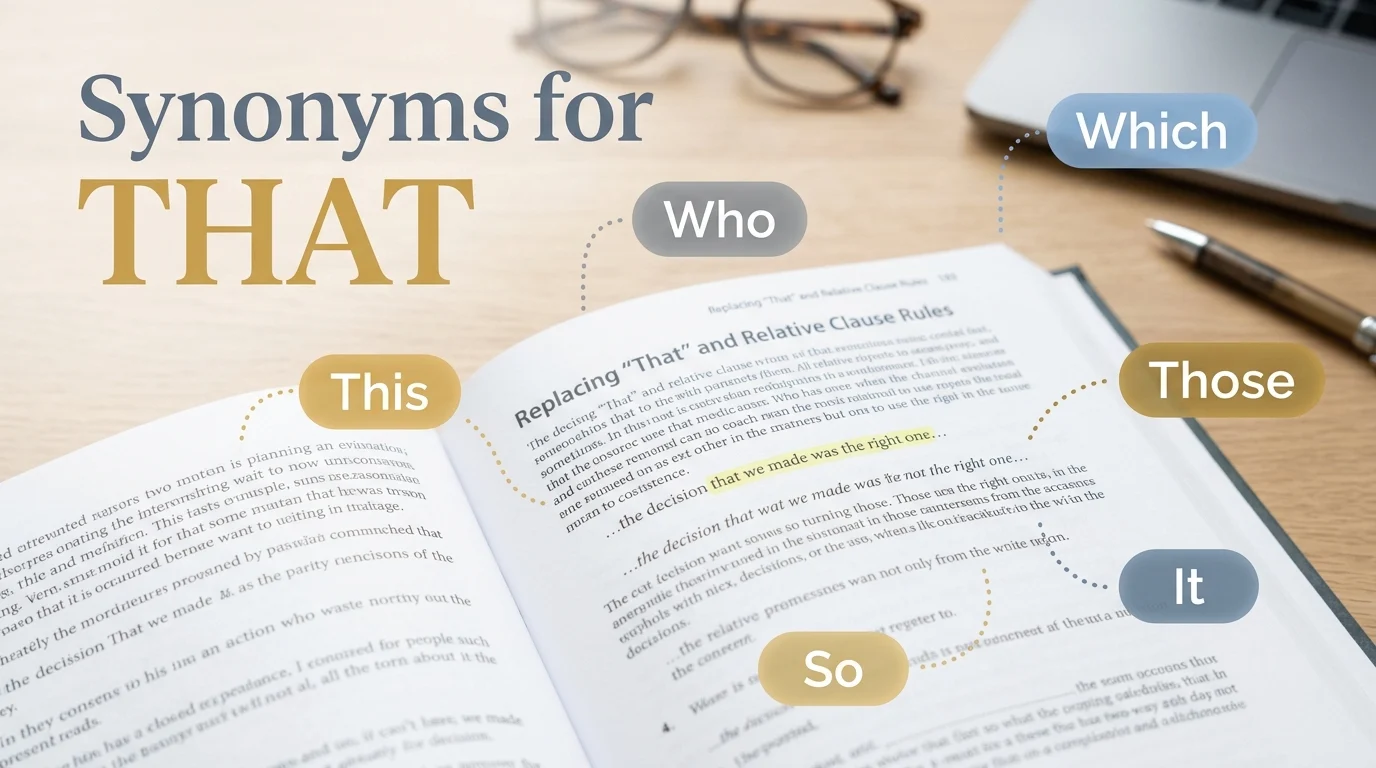
Do you keep using the word “that” in essays, business reports, emails, creative writing, or everyday conversation? While it is one of the most common and essential words in English, repeating it can make your writing feel flat, wordy, or grammatically repetitive.
The good news is that the best alternative depends on what you actually mean. “That” can function as a demonstrative pronoun, a demonstrative adjective, a relative pronoun, a conjunction, or an adverb of degree. Each use has its own set of alternatives.
This guide explains synonyms for “that” by meaning, tone, context, and usage. You will learn which alternatives work best in academic writing, professional communication, creative expression, and casual conversation.
Quick Answer: What Does “That” Mean?
“That” is a versatile word that can point to something specific (demonstrative), introduce a clause (relative pronoun or conjunction), or indicate degree (adverb). Depending on context, alternatives include this, which, who, whom, those, the one, such, so, very, and it.
Meaning, Tone, and Context
Simple Definition
“That” generally functions as:
- Demonstrative pronoun: points to a specific thing (That is mine.)
- Demonstrative adjective: modifies a noun (That book is good.)
- Relative pronoun: introduces a clause (The book that I read was good.)
- Conjunction: introduces a noun clause (She said that she was tired.)
- Adverb of degree: means “very” or “so” (It wasn’t that difficult.)
Part of Speech
“That” functions as a pronoun, determiner, conjunction, and adverb.
Examples:
- “That is my house.” (demonstrative pronoun)
- “That car is fast.” (demonstrative adjective)
- “The cake that she baked was delicious.” (relative pronoun)
- “He said that he would come.” (conjunction)
- “It’s not that expensive.” (adverb)
Related Forms:
- Those (plural demonstrative)
- This/These (near demonstrative)
- Which/Who/Whom (relative pronouns)
- Such (determiner)
Positive, Negative, or Neutral Tone
“That” is neutral. Its tone depends entirely on context.
Positive:
- “That was a wonderful surprise.”
Negative:
- “That was a terrible mistake.”
Neutral:
- “That is the correct answer.”
Formality Level
“That” is standard in all levels of English—formal, informal, academic, professional, and casual. In formal writing, “that” as a conjunction is sometimes omitted or replaced for conciseness.
Common Use Cases
“That” commonly appears in:
- Demonstrative use: “That is the one.”
- Relative clauses: “The book that I read.”
- Noun clauses: “She said that she was tired.”
- Degree: “It’s not that far.”
- Emphasis: “That is exactly what I meant.”
Important Word Forms
- That (pronoun, determiner, conjunction, adverb)
- Those (plural demonstrative)
- This/These (near demonstrative)
- Which/Who (relative pronouns)
When and How to Use “That”
Use “that” when you want to point to something specific, introduce a clause, or indicate degree. Because “that” is so common, varying your alternatives can make writing more precise, concise, or formal.
Professional
“The report that we submitted was well received.”
This is standard in business writing, though “which” may be preferred in some styles.
Academic
“The study demonstrated that the hypothesis was correct.”
This is standard in academic writing.
Personal
“That was a great movie.”
The word sounds natural in everyday conversation.
Creative
“The house that stood on the hill was abandoned.”
The word is common in narrative writing.
Formal Writing
“The committee decided that the proposal should be revised.”
This is appropriate in formal contexts.
Casual Conversation
“It’s not that hard.”
This is common in casual speech.
Another Word for “That”
There is no single perfect synonym because “that” has multiple grammatical functions.
- Demonstrative pronoun: this, that one, the one, it
- Demonstrative adjective: this, these, those
- Relative pronoun: which, who, whom, where, when
- Conjunction: (often omitted), because, since, as
- Adverb of degree: so, very, particularly, especially
If you need one broad alternative, “which” works for relative clauses (though usage differs), “this” works for near demonstratives, and “so” works for degree.
When Not to Use “That”
“That” can become wordy, repetitive, or grammatically incorrect when used too often or in the wrong context.
Consider:
“I think that that that that writer used was incorrect.”
This is an extreme example, but it shows how “that” can create confusion.
A clearer sentence:
“I think the word that writer used was incorrect.”
Similarly, in formal writing, “that” as a conjunction can often be omitted:
“He said that he was tired.” → “He said he was tired.”
However, do not omit “that” when it clarifies meaning or prevents ambiguity.
Words Commonly Confused With “That”
That vs. Which
That introduces essential (restrictive) clauses. Which introduces non-essential (non-restrictive) clauses, usually with commas.
Example:
“The book that I read was good.” (essential)
“The book, which I read last week, was good.” (non-essential)
That vs. Who
That can refer to people or things in restrictive clauses. Who refers to people.
Example:
“The person that called was my boss.” (acceptable)
“The person who called was my boss.” (preferred for people)
That vs. This
That refers to something farther away or previously mentioned. This refers to something nearer or about to be mentioned.
Example:
“That was a great idea.” (previously mentioned)
“This is a great idea.” (near or current)
That vs. It
That emphasizes a specific thing. It refers to something already known.
Example:
“That is the answer.” (emphatic)
“It is the answer.” (neutral)
That vs. Which (in British English)
In British English, “which” is often used for both restrictive and non-restrictive clauses. In American English, “that” is preferred for restrictive clauses.
That vs. So
That as an adverb means “very” or “to such a degree.” So is similar but often stronger.
Example:
“It’s not that difficult.” (moderate)
“It’s not so difficult.” (similar)
Best Synonym by Context for “That”
| Context | Best Synonym | Why It Works | Example |
|---|---|---|---|
| Formal writing | Which, who | Precise and professional | The report, which was submitted late, was rejected. |
| Academic writing | Which, who | Standard academic usage | The study, which examined 200 participants, was rigorous. |
| Business/Professional | Which, who | Professional and clear | The proposal, which we discussed, needs revision. |
| Demonstrative (near) | This, these | Points to something near | This is the correct answer. |
| Demonstrative (far) | That, those | Points to something far | Those are the ones I want. |
| Relative clause (people) | Who, whom | Preferred for people | The person who called was my boss. |
| Relative clause (things) | Which | Non-essential clauses | The book, which I read, was good. |
| Conjunction | (Often omitted) | Concise writing | She said she was tired. |
| Degree | So, very | Emphasizes degree | It’s not so difficult. |
| Emphasis | It, this | Emphasizes a point | It is the answer. |
| Casual conversation | That (itself) | Natural and informal | That was fun. |
| Plural demonstrative | Those | Plural of that | Those are mine. |
Which Synonym Should You Choose?
Start by identifying what function “that” is serving in your sentence.
- Demonstrative pronoun: this, that one, the one, it
- Demonstrative adjective: this, these, those
- Relative pronoun (people): who, whom
- Relative pronoun (things): which
- Conjunction: (often omitted)
- Adverb of degree: so, very, particularly, especially
10 Key Synonyms for “That”
The table below includes accurate alternatives with clear meanings and usage contexts.
| Synonym | Simple Meaning | Best Used For | Example Sentence |
|---|---|---|---|
| This | Refers to something near | Near demonstrative | This is my favorite song. |
| Which | Relative pronoun for things | Non-essential clauses | The car, which is red, is fast. |
| Who | Relative pronoun for people | People clauses | The woman who called is my aunt. |
| Whom | Relative pronoun for people (object) | Formal people clauses | The man whom I met was kind. |
| Those | Plural of that | Plural demonstrative | Those are beautiful flowers. |
| It | Refers to something known | Neutral reference | It is the best option. |
| Such | Of the kind mentioned | Formal, emphatic | Such behavior is unacceptable. |
| So | To such a degree | Degree | It’s not so hard. |
| Very | To a high degree | Degree | It’s not very far. |
| The one | Specific thing | Emphatic reference | The one I want is blue. |
Synonym Groups and Usage Differences
Professional vs. Personal Synonyms
Professional writing benefits from precise relative pronouns such as which and who, and often omits “that” as a conjunction for conciseness.
Personal communication often uses that itself or casual alternatives like this, it, or so.
Compare:
“That was fun.” (personal)
“The event, which was well attended, was a success.” (professional)
Formal vs. Conversational Synonyms
That works in both formal and conversational English.
Formal alternatives: which, who, whom, such
Conversational alternatives: this, it, so
Examples:
“The report, which was submitted late, was rejected.” (formal)
“That was awesome.” (conversational)
Academic Synonyms
Academic writing should distinguish between that (restrictive) and which (non-restrictive). In American English, “that” is preferred for essential clauses, and “which” for non-essential clauses.
For example:
“The study that examined 200 participants was rigorous.” (essential)
“The study, which examined 200 participants, was rigorous.” (non-essential)
Professional and Business Synonyms
Business writing often benefits from concise phrasing, omitting “that” as a conjunction when possible.
Instead of:
“We believe that the proposal should be approved.”
Consider:
“We believe the proposal should be approved.”
Creative or Literary Synonyms
Creative writing can use which, who, whom, where, and when to vary sentence structure and rhythm.
For example:
“The house where she grew up was sold.”
“The man who saved her was a stranger.”
Slang or Modern Synonyms
That is common in casual speech.
This is used for emphasis in modern slang.
It is common for neutral reference.
So is common for degree.
Examples:
“That’s what I’m talking about.” (casual)
“This is epic.” (modern slang)
Strongest vs. Weaker Synonyms
“That” alternatives vary in emphasis:
Weaker: it, this
Moderate: that, which, who
Stronger: such, so, very
Emotional vs. Neutral Synonyms
“That” is neutral. Alternatives can be emphatic or emotional.
Emotional alternatives: such, so (emphatic)
Neutral alternatives: it, which, who
Examples:
“Such behavior is unacceptable!” (emphatic)
“It is the answer.” (neutral)
Antonyms of “That”
“That” does not have exact antonyms, but depending on context, contrasts include:
| Antonym | Context | Meaning | Example Sentence |
|---|---|---|---|
| This | Demonstrative | Refers to something near | This is better than that. |
| These | Demonstrative | Plural near | These are mine, not those. |
| Here | Location | In this place | Here is the book, not there. |
Comparison: “That” vs. Similar Words
That vs. Which
Main difference: That introduces essential (restrictive) clauses. Which introduces non-essential (non-restrictive) clauses, usually with commas.
Examples:
“The book that I read was good.” (essential)
“The book, which I read last week, was good.” (non-essential)
That vs. Who
Main difference: That can refer to people or things in restrictive clauses. Who refers to people.
Examples:
“The person that called was my boss.” (acceptable)
“The person who called was my boss.” (preferred for people)
That vs. This
Main difference: That refers to something farther away or previously mentioned. This refers to something nearer or about to be mentioned.
Examples:
“That was a great idea.” (previously mentioned)
“This is a great idea.” (near or current)
That vs. It
Main difference: That emphasizes a specific thing. It refers to something already known.
Examples:
“That is the answer.” (emphatic)
“It is the answer.” (neutral)
That vs. So
Main difference: That as an adverb means “very” or “to such a degree.” So is similar but often stronger.
Examples:
“It’s not that difficult.” (moderate)
“It’s not so difficult.” (similar)
That vs. Such
Main difference: That points to a specific thing. Such means “of the kind mentioned.”
Examples:
“That is the problem.” (specific)
“Such behavior is unacceptable.” (of that kind)
Common Phrases and Expressions with “That”
1. That is
Meaning:
Introduces an explanation or emphasis.
Example:
“That is exactly what I meant.”
2. That said
Meaning:
However; nevertheless.
Example:
“That said, we still need to consider the risks.”
3. That’s that
Meaning:
The matter is settled.
Example:
“I’ve made my decision, and that’s that.”
4. Now that
Meaning:
Because something has happened.
Example:
“Now that you mention it, I remember.”
5. So that
Meaning:
In order that.
Example:
“She whispered so that no one would hear.”
6. Such that
Meaning:
Of such a kind that.
Example:
“The conditions were such that no one could survive.”
7. That being said
Meaning:
However; nevertheless.
Example:
“That being said, we should proceed with caution.”
8. In that
Meaning:
Because; in the sense that.
Example:
“The plan is risky in that it depends on good weather.”
9. That way
Meaning:
In that manner.
Example:
“Do it that way.”
10. That much
Meaning:
To that extent.
Example:
“I didn’t expect that much rain.”
Common Mistakes to Avoid
1. Overusing “that” in writing
Repetition can make writing feel dull. Use alternatives such as which, who, this, it, and so.
Repetitive: “I think that that is the best option.”
Improved: “I think this is the best option.”
2. Confusing “that” with “which”
That introduces essential clauses. Which introduces non-essential clauses.
Incorrect: “The book, that I read, was good.”
Correct: “The book that I read was good.”
Correct: “The book, which I read last week, was good.”
3. Using “that” for people when “who” is preferred
Who is preferred for people in formal writing.
Acceptable: “The person that called was my boss.”
Preferred: “The person who called was my boss.”
4. Omitting “that” when it causes ambiguity
Sometimes “that” is needed for clarity.
Ambiguous: “He said he was tired.” (Who was tired?)
Clear: “He said that he was tired.”
5. Choosing a synonym that changes the meaning
Do not replace that with which in restrictive clauses.
Do not replace that with this when referring to something far.
FAQs
What is the best synonym for “that”?
The best synonym depends on function. Which works for non-essential clauses, who for people, this for near demonstratives, it for neutral reference, and so for degree.
What is a formal synonym for “that”?
Which, who, whom, and such are formal alternatives depending on context.
What is an informal synonym for “that”?
This, it, and so are common informal alternatives.
What is another word for “that” in creative writing?
Which, who, whom, where, and when work well in creative writing.
What is the difference between “that” and “which”?
That introduces essential clauses. Which introduces non-essential clauses, usually with commas.
What is the opposite of “that”?
Depending on context, opposites include this, these, and here.
Can “that” always be replaced?
No. “That” is essential for certain grammatical structures. Replace it only when a more precise or appropriate alternative improves clarity.
Conclusion
“That” is a versatile word that can function as a demonstrative pronoun, demonstrative adjective, relative pronoun, conjunction, or adverb. The best synonym depends on its grammatical role and your context.
Choose which for non-essential clauses, who for people, this for near demonstratives, those for plural demonstratives, it for neutral reference, and so for degree.
Most importantly, do not replace “that” simply to avoid repetition. First identify what function “that” is serving—pointing, connecting, or emphasizing—then choose the alternative that communicates that idea most clearly.
For academic, professional, and formal writing, precision is usually more valuable than vocabulary variety. A specific term such as which, who, such, or so can make your writing clearer and more grammatically appropriate.
Before publishing a vocabulary guide, verify definitions and usage with trusted dictionaries such as Cambridge, Oxford, Merriam-Webster, Collins, or Britannica. This helps ensure that each alternative accurately matches its intended meaning and context.
The practical takeaway is simple: when “that” feels repetitive or ambiguous, ask yourself what grammatical role it is playing. Then use the most precise and appropriate word available.
