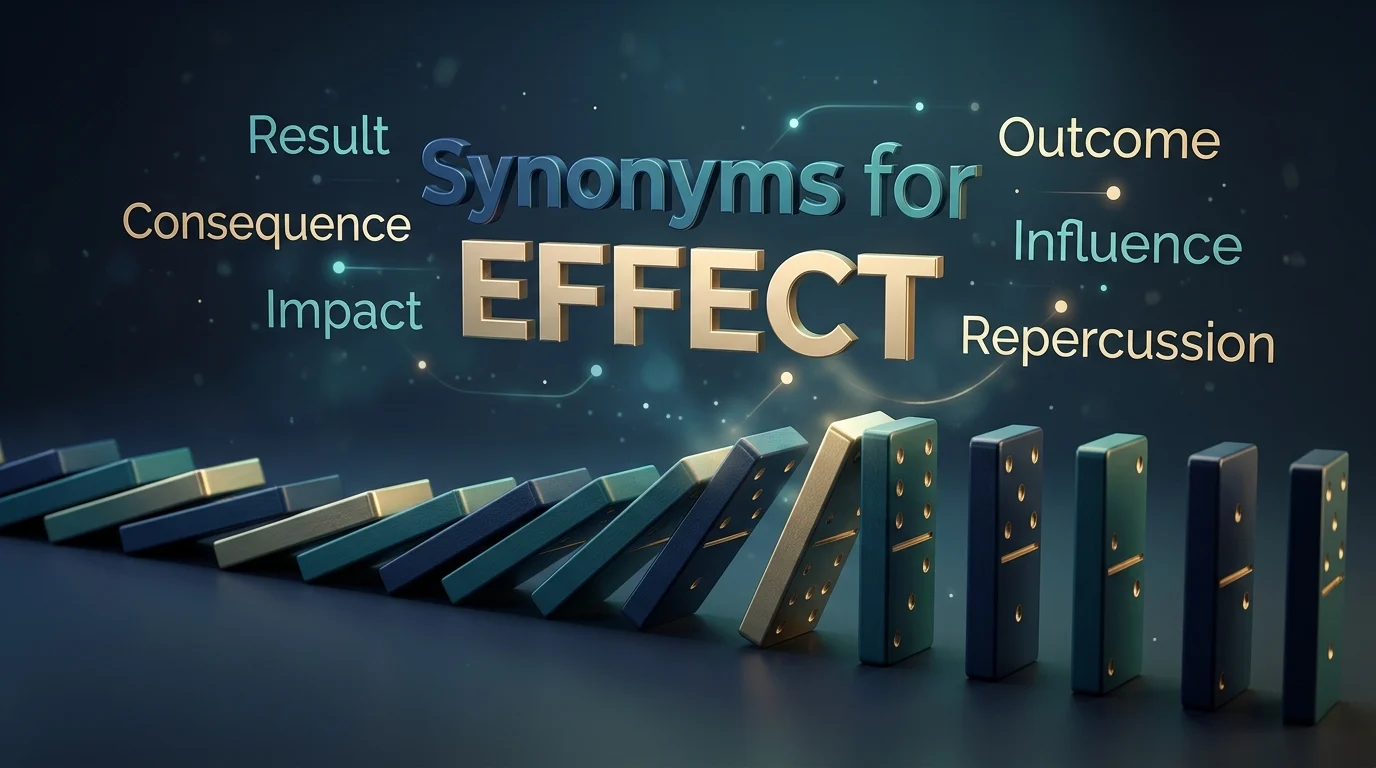
Do you keep using the word “effect” in essays, business reports, academic papers, presentations, or everyday conversation? While it is one of the most useful and precise nouns in English, repeating it can make your writing feel flat, repetitive, or overly academic.
The good news is that the best alternative depends on what you actually mean. You might be describing a result, a consequence, an impact, an influence, an outcome, or a lasting impression.
This guide explains synonyms for “effect” by meaning, tone, context, and usage. You will learn which alternatives work best in academic writing, professional communication, scientific content, creative expression, and casual conversation.
Quick Answer: What Does “Effect” Mean?
“Effect” refers to a change that is a result or consequence of an action, event, or cause. It can also mean the power to produce a result (influence), a lasting impression, or a physical phenomenon. Depending on context, alternatives include result, consequence, impact, outcome, influence, repercussion, ramification, upshot, aftermath, and impression.
Meaning, Tone, and Context
Simple Definition
“Effect” generally refers to:
- Result: something produced by a cause
- Consequence: an outcome, often unintended
- Impact: a strong or significant effect
- Outcome: the final result of a process
- Influence: the power to affect someone or something
- Impression: a lasting effect on the mind or feelings
Part of Speech
“Effect” functions primarily as a noun and as a verb (formal).
Noun Examples:
- “The effect of the policy was immediate.”
- “The medicine had a calming effect.”
Verb Examples:
- “The manager effected several changes.” (formal: brought about)
- “They effected a peaceful transition.”
Related Forms:
- Effective (adjective): producing a desired result
- Effectively (adverb): in an effective manner
- Effectiveness (noun): the quality of being effective
- Affect (verb): to influence (often confused with effect)
- Affect (noun): emotion or feeling (psychology)
Positive, Negative, or Neutral Tone
“Effect” is generally neutral. Its tone depends on context and modifiers.
Positive:
- “The policy had a positive effect on employment.”
Negative:
- “The side effects were severe.”
Neutral:
- “The effect was measurable.”
Formality Level
“Effect” is a standard word that works in both formal and informal English. It is especially common in academic, scientific, business, and legal contexts.
However, more specific alternatives can add precision and variety depending on the context.
Common Use Cases
“Effect” commonly refers to:
- Cause and effect: the effect of an action
- Scientific writing: the effect of a variable
- Business: the effect of a policy or decision
- Medicine: side effects, therapeutic effects
- Psychology: the effect of an experience
- Art and media: special effects, sound effects
Important Word Forms
- Effect (noun): a result or consequence
- Effect (verb): to bring about (formal)
- Effective (adjective): producing a result
- Effectively (adverb): in an effective manner
- Effectiveness (noun): the quality of being effective
- Affect (verb): to influence
- Side effect (noun): a secondary, usually unwanted effect
When and How to Use “Effect”
Use “effect” when you want to describe a result, consequence, impact, or influence. Because the word is broad, more specific alternatives can add precision depending on the context.
Professional
“The new policy had a significant effect on productivity.”
This works naturally in business communication.
Academic
“The study examined the effect of temperature on enzyme activity.”
The term is standard in academic research.
Medical
“The medication’s side effects include drowsiness.”
This is appropriate in medical contexts.
Personal
“The news had a profound effect on her.”
The word sounds natural in everyday conversation.
Creative
“The lighting created a dramatic effect on stage.”
The word is common in creative and artistic contexts.
Scientific
“The effect was measured using precise instruments.”
This is standard in scientific writing.
Another Word for “Effect”
There is no single perfect synonym because “effect” can refer to a result, consequence, impact, influence, or impression.
- Result context: result, outcome, upshot, conclusion
- Consequence context: consequence, repercussion, ramification, aftermath
- Impact context: impact, influence, sway, force
- Impression context: impression, mark, imprint, trace
- Scientific context: phenomenon, reaction, response
- Artistic context: effect, illusion, appearance
If you need one broad alternative, “result” works in most contexts, “impact” works for strong effects, and “consequence” works for negative or unintended effects.
When Not to Use “Effect”
“Effect” can become too vague when you need to specify exactly what kind of effect you are describing.
Consider:
“The change had an effect.”
This statement does not tell readers whether the effect was positive, negative, large, small, intended, or unintended.
A more precise sentence could be:
“The change had a significant positive effect on employee morale.”
Similarly, avoid confusing “effect” (noun) with “affect” (verb).
Words Commonly Confused With “Effect”
Effect vs. Affect
Effect is usually a noun meaning result. Affect is usually a verb meaning to influence.
Example:
“The weather affected the crops.” (verb)
“The effect of the weather was devastating.” (noun)
Effect vs. Result
Result is a general term. Effect often implies a cause-and-effect relationship.
Example:
“The result was a success.” (general)
“The effect of the medicine was immediate.” (cause and effect)
Effect vs. Consequence
Consequence often implies a negative or unintended result. Effect is neutral.
Example:
“He faced the consequences of his actions.” (negative)
“The effect of the policy was neutral.” (neutral)
Effect vs. Impact
Impact implies a strong or significant effect. Effect is more general.
Example:
“The policy had a significant impact.” (strong)
“The policy had an effect.” (general)
Effect vs. Influence
Influence emphasizes the power to affect. Effect emphasizes the result.
Example:
“She has great influence over the committee.” (power)
“Her speech had a powerful effect on the audience.” (result)
Effect vs. Outcome
Outcome emphasizes the final result of a process. Effect is broader.
Example:
“The outcome of the election was surprising.” (final result)
“The effect of the campaign was significant.” (impact)
Best Synonym by Context for “Effect”
| Context | Best Synonym | Why It Works | Example |
|---|---|---|---|
| Formal writing | Consequence, outcome | Precise and professional | The consequences of the decision were far-reaching. |
| Academic writing | Effect, impact | Standard academic usage | The study examined the impact of the policy. |
| Business/Professional | Impact, result | Professional and clear | The initiative had a positive impact on revenue. |
| Scientific writing | Effect, response | Scientifically accurate | The response to the treatment was measured. |
| Medical writing | Side effect, reaction | Medical context | The side effects were mild. |
| Negative context | Consequence, repercussion | Emphasizes negativity | The repercussions of the scandal were severe. |
| Positive context | Benefit, result | Positive outcome | The benefits of the program were clear. |
| Cause and effect | Result, outcome | Emphasizes causation | The result was directly caused by the change. |
| Artistic context | Impression, illusion | Artistic effect | The lighting created a dramatic impression. |
| Casual conversation | Result, impact | Natural and informal | The result was amazing. |
| Legal writing | Consequence, penalty | Legal context | The consequences of the violation were severe. |
| Emotional context | Impression, mark | Emotional impact | The experience left a lasting impression. |
Which Synonym Should You Choose?
Start by identifying what kind of “effect” you are describing.
- Result: result, outcome, upshot, conclusion
- Consequence: consequence, repercussion, ramification, aftermath
- Impact: impact, influence, sway, force
- Impression: impression, mark, imprint, trace
- Scientific: phenomenon, reaction, response
- Artistic: effect, illusion, appearance
10 Key Synonyms for “Effect”
The table below includes accurate alternatives with clear meanings and usage contexts.
| Synonym | Simple Meaning | Best Used For | Example Sentence |
|---|---|---|---|
| Result | Outcome of an action | General, cause and effect | The result of the experiment was clear. |
| Consequence | Result, often negative | Negative outcomes | The consequences of his actions were severe. |
| Impact | Strong effect | Business, social | The policy had a major impact on the economy. |
| Outcome | Final result | Processes, events | The outcome of the negotiations was positive. |
| Influence | Power to affect | Personal, social | She had a strong influence on the team. |
| Repercussion | Indirect negative effect | Negative, formal | The repercussions of the decision were felt for years. |
| Ramification | Complex consequence | Formal, analytical | The ramifications of the policy were far-reaching. |
| Upshot | Final result (informal) | Casual, summary | The upshot was that we had to start over. |
| Aftermath | Period following an event | Disasters, conflicts | In the aftermath of the storm, many were homeless. |
| Impression | Lasting effect | Emotional, artistic | The speech left a lasting impression. |
Synonym Groups and Usage Differences
Professional vs. Personal Synonyms
Professional writing benefits from specific terms such as impact, outcome, consequence, ramification, and repercussion.
Personal communication often uses effect itself or casual alternatives like result, upshot, or impact.
Compare:
“The result was good.” (personal)
“The initiative had a measurable impact on revenue.” (professional)
Formal vs. Conversational Synonyms
Effect works in both formal and conversational English.
Formal alternatives: consequence, ramification, repercussion, outcome
Conversational alternatives: result, upshot, impact
Examples:
“The ramifications of the decision were significant.” (formal)
“The upshot was that we had to start over.” (conversational)
Academic Synonyms
Academic writing should distinguish between effect (general), impact (strong effect), outcome (final result), and consequence (often negative).
For example:
“The study examined the effect of temperature on reaction rate.”
“The outcome of the experiment was unexpected.”
Professional and Business Synonyms
Business writing often benefits from phrases such as impact, result, outcome, and consequence.
Instead of:
“The policy had an effect on sales.”
Consider:
“The policy had a measurable impact on sales.”
Creative or Literary Synonyms
Creative writing can use impression, mark, imprint, trace, and aftermath depending on the context.
For example:
“The experience left an indelible mark on her.”
“The aftermath of the war was devastating.”
Slang or Modern Synonyms
Upshot is casual for result.
Fallout is casual for negative consequences.
Ripple effect is modern for indirect consequences.
Vibe can mean effect or feeling in modern slang.
Examples:
“The upshot was that we won.” (casual)
“The fallout from the decision was huge.” (casual)
Strongest vs. Weaker Synonyms
“Effect” synonyms vary in intensity:
Milder: result, outcome, upshot
Moderate: effect, impact, influence
Strong: consequence, repercussion, ramification
Very Strong: aftermath, fallout, ripple effect
Emotional vs. Neutral Synonyms
“Effect” is generally neutral.
Emotional alternatives: impression, mark, aftermath (often negative)
Neutral alternatives: result, outcome, effect
Examples:
“The speech left a lasting impression.” (emotional)
“The result was measurable.” (neutral)
Antonyms of “Effect”
“Effect” has several antonyms depending on context:
| Antonym | Context | Meaning | Example Sentence |
|---|---|---|---|
| Cause | Cause/effect | Something that produces an effect | The cause of the fire was faulty wiring. |
| Ineffectiveness | General | Lack of effect | The ineffectiveness of the policy was clear. |
| Insignificance | General | Lack of importance | The insignificance of the change was noted. |
| Origin | Cause/effect | The source of something | The origin of the problem was unknown. |
| Source | Cause/effect | Where something comes from | The source of the rumor was unclear. |
Comparison: “Effect” vs. Similar Words
Effect vs. Affect
Main difference: Effect is usually a noun meaning result. Affect is usually a verb meaning to influence.
Examples:
“The weather affected the crops.” (verb)
“The effect of the weather was devastating.” (noun)
Effect vs. Result
Main difference: Result is a general term. Effect often implies a cause-and-effect relationship.
Examples:
“The result was a success.” (general)
“The effect of the medicine was immediate.” (cause and effect)
Effect vs. Consequence
Main difference: Consequence often implies a negative or unintended result. Effect is neutral.
Examples:
“He faced the consequences of his actions.” (negative)
“The effect of the policy was neutral.” (neutral)
Effect vs. Impact
Main difference: Impact implies a strong or significant effect. Effect is more general.
Examples:
“The policy had a significant impact.” (strong)
“The policy had an effect.” (general)
Effect vs. Influence
Main difference: Influence emphasizes the power to affect. Effect emphasizes the result.
Examples:
“She has great influence over the committee.” (power)
“Her speech had a powerful effect on the audience.” (result)
Effect vs. Outcome
Main difference: Outcome emphasizes the final result of a process. Effect is broader.
Examples:
“The outcome of the election was surprising.” (final result)
“The effect of the campaign was significant.” (impact)
Common Phrases and Expressions with “Effect”
1. Cause and effect
Meaning:
The relationship between an action and its result.
Example:
“The study examined the cause and effect of the policy.”
2. Take effect
Meaning:
To begin to produce results.
Example:
“The new law takes effect next month.”
3. In effect
Meaning:
Essentially; in practice.
Example:
“The rule is, in effect, a ban.”
4. Side effect
Meaning:
A secondary, usually unwanted effect.
Example:
“Drowsiness is a common side effect.”
5. Ripple effect
Meaning:
Indirect consequences that spread over time.
Example:
“The decision had a ripple effect across the industry.”
6. To that effect
Meaning:
With that general meaning.
Example:
“She said something to that effect.”
7. For effect
Meaning:
Done to impress or influence.
Example:
“He paused for effect before announcing the winner.”
8. Sound effects
Meaning:
Artificial sounds used in media.
Example:
“The movie used realistic sound effects.”
9. Special effects
Meaning:
Visual illusions created for film.
Example:
“The special effects were stunning.”
10. Come into effect
Meaning:
To become valid or active.
Example:
“The new regulations come into effect in January.”
Common Mistakes to Avoid
1. Confusing “effect” with “affect”
Effect is usually a noun. Affect is usually a verb.
Incorrect: “The policy will effect the economy.”
Correct: “The policy will affect the economy.”
Correct: “The policy will have an effect on the economy.”
2. Using “effect” when a more precise term is available
If you mean result, impact, consequence, or outcome, use the more specific word.
Vague: “The change had an effect.”
Precise: “The change had a significant positive impact.”
3. Overusing “effect” in writing
Repetition can make content feel dull. Use alternatives such as result, impact, outcome, consequence, and influence.
4. Using “effect” in academic writing when “impact” or “outcome” is needed
Academic writing benefits from precision.
Vague: “The effect was significant.”
Precise: “The impact was statistically significant (p < .05).”
5. Choosing a synonym that changes the meaning
Do not replace effect with cause unless you mean the source.
Do not replace effect with affect unless you mean to influence.
FAQs
What is the best synonym for “effect”?
The best synonym depends on context. Result works for general use, impact for strong effects, consequence for negative outcomes, outcome for final results, and influence for power to affect.
What is a formal synonym for “effect”?
Consequence, ramification, repercussion, outcome, and upshot are formal synonyms.
What is an informal synonym for “effect”?
Result, upshot, and fallout are common informal alternatives.
What is another word for “effect” in academic writing?
Impact, outcome, result, and consequence work well in academic writing.
What is the difference between “effect” and “affect”?
Effect is usually a noun meaning result. Affect is usually a verb meaning to influence.
What is the opposite of “effect”?
Depending on context, opposites include cause, ineffectiveness, insignificance, origin, and source.
What does “effect” mean in a scientific context?
In science, effect often refers to the measurable result of a variable or treatment.
Conclusion
“Effect” is a versatile and important word that can describe results, consequences, impacts, outcomes, influences, and impressions. The best synonym depends on what you actually mean.
Choose result for general use, impact for strong effects, consequence for negative outcomes, outcome for final results, influence for power to affect, and impression for lasting effects.
Most importantly, do not replace “effect” simply to avoid repetition. First identify what kind of effect—result, consequence, impact, or impression—you are actually describing. Then choose the alternative that communicates that idea most clearly.
For academic, professional, and formal writing, precision is usually more valuable than vocabulary variety. A specific term such as impact, outcome, consequence, or ramification can tell readers much more than the broad word effect.
Before publishing a vocabulary guide, verify definitions and usage with trusted dictionaries such as Cambridge, Oxford, Merriam-Webster, Collins, or Britannica. This helps ensure that each alternative accurately matches its intended meaning and context.
The practical takeaway is simple: when “effect” feels too general, ask yourself what kind of result, consequence, or impact you are actually describing. Then use the most precise word available.
