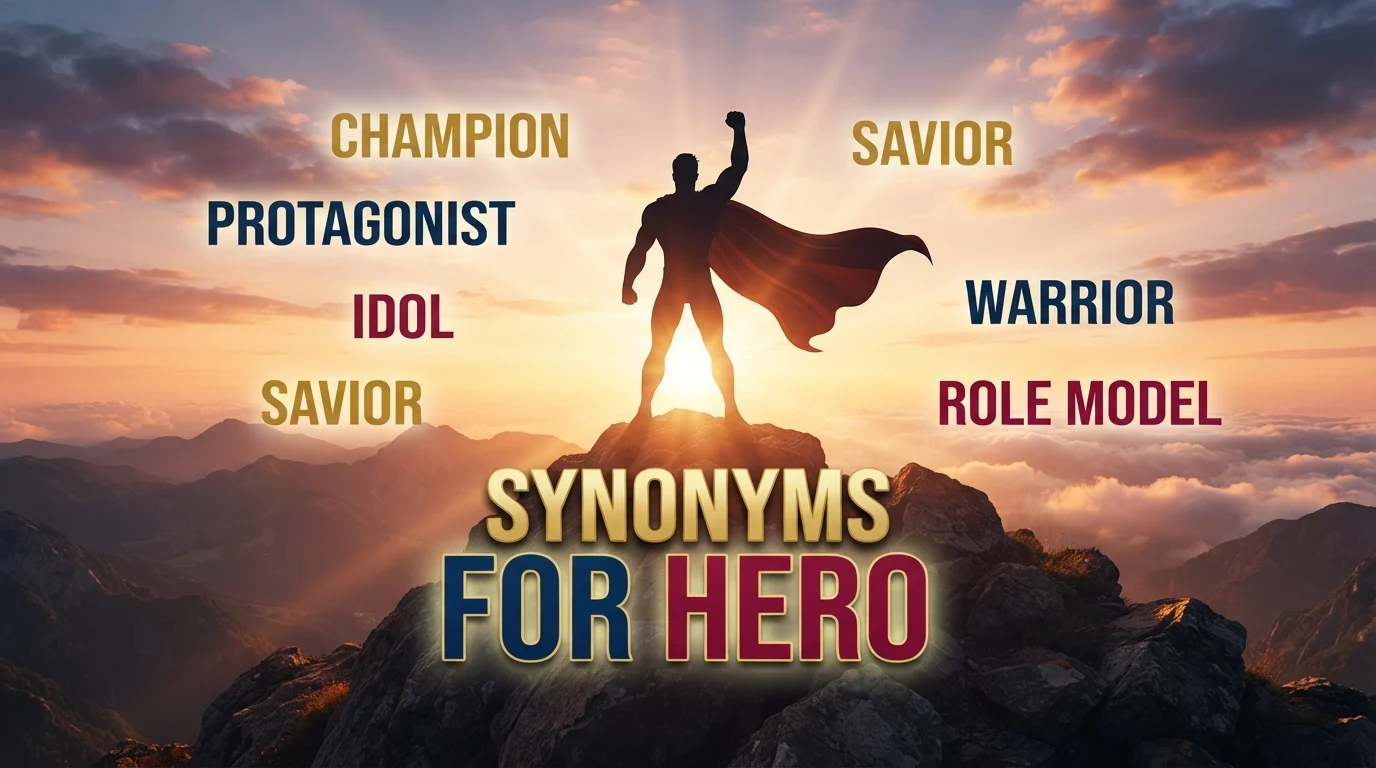
Do you keep using the word “hero” in essays, blog posts, social media captions, speeches, or everyday conversation? It is one of the most powerful words in English—but repeating it can make your writing feel flat and predictable.
Here is the truth: the best alternative depends on what kind of hero you actually mean. Are you talking about a fearless warrior? A quiet everyday hero? A protagonist in a story? A role model? A lifesaver? A champion of a cause?
This guide breaks down synonyms for “hero” by meaning, tone, context, and usage. You will learn which alternatives work best in academic writing, professional content, creative storytelling, social media, and casual conversation.
Quick Answer: What Does “Hero” Mean?
“Hero” refers to a person admired for courage, outstanding achievements, noble qualities, or brave acts. It can also mean the main character in a story. Depending on context, alternatives include champion, protagonist, idol, role model, savior, warrior, legend, lionheart, benefactor, and everyday hero.
Meaning, Tone, and Context
Simple Definition
“Hero” generally refers to:
- Brave person: someone who shows courage in danger
- Admired figure: a person respected for achievements or character
- Protagonist: the main character in a story, film, or play
- Role model: someone others look up to
- Savior: someone who rescues or helps others in need
- Champion: a defender of a cause or group
Part of Speech
“Hero” is primarily a noun.
Examples:
- “The firefighter was hailed as a hero.”
- “She is the hero of the novel.”
Related Forms:
- Heroine (noun): a female hero
- Heroic (adjective): showing courage
- Heroism (noun): great bravery
- Heroically (adverb): in a heroic manner
- Antihero (noun): a protagonist without traditional heroic qualities
Positive, Negative, or Neutral Tone
“Hero” is strongly positive.
Positive associations:
- “He saved three children from the fire—a true hero.”
- “She is a hero to her community.”
Neutral or literary contexts:
- “The hero of the story faces many challenges.”
- “The antihero is a popular literary device.”
Formality Level
“Hero” works in both formal and informal English. It appears in academic writing, journalism, speeches, creative writing, and everyday conversation. More formal alternatives include champion, benefactor, and luminary.
Common Use Cases
“Hero” commonly refers to:
- Real-life bravery: firefighters, soldiers, medical workers, rescuers
- Admired figures: celebrities, activists, leaders, mentors
- Literary characters: protagonists, main characters
- Everyday heroes: teachers, parents, volunteers, good Samaritans
- Sports figures: athletes who perform exceptionally
- Cultural icons: legends, idols, role models
Important Word Forms
- Hero (noun): a brave or admired person; protagonist
- Heroes (plural): multiple brave or admired people
- Heroine (noun): a female hero
- Heroic (adjective): brave or noble
- Heroism (noun): great bravery
- Antihero (noun): a protagonist lacking heroic qualities
- Superhero (noun): a fictional hero with powers
When and How to Use “Hero”
Use “hero” when describing someone admired for courage, achievement, or noble qualities—or the main character in a story.
Professional
“The surgeon was praised as a hero for her lifesaving work.”
This works naturally in news and professional communication.
Academic
“The study examines the role of the hero in classical literature.”
The term is appropriate in academic contexts.
Personal
“My father is my hero.”
The word sounds natural in everyday conversation.
Creative
“The hero embarks on a dangerous quest to save the kingdom.”
This is standard in storytelling.
Social Media
“Teachers are the real heroes.”
This works well for inspirational posts.
Sports
“The team’s hero scored the winning goal in the final seconds.”
This is common in sports journalism.
Another Word for “Hero”
There is no single perfect synonym because “hero” can refer to many different kinds of people.
- Brave person: braveheart, lionheart, warrior, valiant
- Admired figure: idol, icon, legend, luminary, role model
- Protagonist: main character, lead, central figure
- Savior: rescuer, lifesaver, deliverer, guardian
- Champion: defender, advocate, protector, supporter
- Everyday hero: good Samaritan, do-gooder, benefactor
If you need one broad alternative, “champion” works for cause-driven heroes, “protagonist” for literary contexts, “idol” for admired figures, and “rescuer” for lifesavers.
When Not to Use “Hero”
“Hero” can become too strong or vague when you need to be specific about what someone did or represents.
Consider:
“He is a hero.”
This statement does not tell readers whether he saved lives, stood up for a cause, or is simply admired.
A more precise sentence could be:
“He is a hero who saved three people from the burning building.”
“She is a champion of children’s rights.”
Similarly, avoid using “hero” for people who are simply famous or successful. Use “idol”, “icon”, or “role model” instead.
Words Commonly Confused With “Hero”
Hero vs. Protagonist
Protagonist is the main character in a story. A hero is admired for bravery or noble qualities. Not every protagonist is a hero.
Example:
“The protagonist of the novel is a flawed but relatable character.” (literary)
“The hero saved the village from the dragon.” (brave act)
Hero vs. Idol
Idol is someone admired or worshipped, often for talent or fame. Hero implies courage or noble qualities.
Example:
“She is a pop idol.” (fame)
“He is a hero who risked his life.” (courage)
Hero vs. Role Model
Role model is someone whose behavior is emulated. Hero implies bravery or sacrifice.
Example:
“My teacher is my role model.” (behavior)
“The soldier was a hero.” (bravery)
Hero vs. Champion
Champion is someone who defends a cause or person. Hero is broader.
Example:
“She is a champion of women’s rights.” (cause)
“He is a hero who saved lives.” (bravery)
Hero vs. Legend
Legend is a famous person, often exaggerated. Hero implies noble qualities.
Example:
“The musician is a legend.” (fame)
“The firefighter is a hero.” (courage)
Best Synonym by Context for “Hero”
| Context | Best Synonym | Why It Works | Example |
|---|---|---|---|
| Literary writing | Protagonist, main character | Describes story leads | The protagonist faces a moral dilemma. |
| Brave acts | Braveheart, lionheart, warrior | Emphasizes courage | The warrior defended the village. |
| Admired figures | Idol, icon, legend | Emphasizes fame | The athlete is a national icon. |
| Role models | Role model, inspiration | Emphasizes influence | She is a role model for young girls. |
| Lifesavers | Rescuer, lifesaver, guardian | Emphasizes saving lives | The lifeguard was a rescuer. |
| Cause defenders | Champion, advocate, defender | Emphasizes advocacy | He is a champion of education. |
| Everyday heroes | Good Samaritan, benefactor | Emphasizes kindness | The good Samaritan helped the stranded family. |
| Formal writing | Luminary, paragon | Formal praise | The luminary inspired a generation. |
| Casual conversation | Hero (itself), legend | Natural and warm | You’re a legend for helping me. |
| Sports | Star, standout, match-winner | Sports context | The star scored the winning goal. |
Which Synonym Should You Choose?
Start by identifying what kind of hero you are describing.
- Brave fighter: warrior, braveheart, lionheart, valiant
- Admired figure: idol, icon, legend, luminary, star
- Protagonist: main character, lead, central figure
- Savior: rescuer, lifesaver, deliverer, guardian
- Champion: defender, advocate, protector, supporter
- Everyday hero: good Samaritan, benefactor, do-gooder
- Role model: inspiration, mentor, guiding light
10 Key Synonyms for “Hero”
The table below includes accurate alternatives with clear meanings and usage contexts.
| Synonym | Simple Meaning | Best Used For | Example Sentence |
|---|---|---|---|
| Champion | Defender of a cause | Advocacy, sports | She is a champion of equal rights. |
| Protagonist | Main character | Literature, film | The protagonist must overcome her fears. |
| Idol | Admired person | Fame, admiration | He became an idol for millions of fans. |
| Role Model | Person to emulate | Mentorship, inspiration | She is a role model for young athletes. |
| Savior | Person who rescues | Life-saving, rescue | The doctor was hailed as a savior. |
| Warrior | Brave fighter | Courage, battle | The warrior led the charge into battle. |
| Legend | Famous admired person | Fame, legacy | The musician is a legend in his field. |
| Lifesaver | One who saves lives | Emergency, rescue | The lifeguard was a lifesaver. |
| Benefactor | One who helps others | Charity, generosity | The benefactor funded the new hospital. |
| Good Samaritan | Helpful stranger | Everyday heroism | A good Samaritan helped the injured man. |
Synonym Groups and Usage Differences
Professional vs. Personal Synonyms
Professional writing benefits from terms like champion, benefactor, luminary, and advocate.
Personal communication often uses hero, idol, legend, or star.
Compare:
“He is my hero.” (personal)
“She is a champion of educational reform.” (professional)
Formal vs. Conversational Synonyms
Hero works in both formal and conversational English.
Formal alternatives: luminary, paragon, benefactor, champion
Conversational alternatives: legend, star, idol
Examples:
“The luminary was honored for her contributions.” (formal)
“You’re a legend!” (casual)
Academic Synonyms
Academic writing should distinguish between hero (admired figure), protagonist (main character), antihero (flawed protagonist), and epic hero (classical hero).
For example:
“The epic hero embodies the values of his culture.”
“The protagonist’s journey follows the hero’s arc.”
Professional and Business Synonyms
Business and professional writing often uses champion, advocate, leader, and innovator.
Instead of:
“She is a hero in the company.”
Consider:
“She is a champion of innovation.”
Creative or Literary Synonyms
Creative writing can use protagonist, heroine, antihero, warrior, champion, savior, and legend.
For example:
“The antihero struggles with his own morality.”
“The heroine rallied the people against tyranny.”
Slang or Modern Synonyms
Legend is slang for someone admirable or impressive.
GOAT (Greatest of All Time) is modern slang for an outstanding figure.
MVP (Most Valuable Player) means the most important person.
Real one means a genuine, admirable person.
Examples:
“You’re an absolute legend.” (casual praise)
“He’s the GOAT.” (sports slang)
“Thanks for helping—you’re a real one.” (casual)
Strongest vs. Weaker Synonyms
“Hero” synonyms vary in intensity:
Milder: star, standout, good Samaritan
Moderate: hero, champion, idol
Strong: legend, icon, luminary
Very Strong: savior, warrior, paragon
Emotional vs. Neutral Synonyms
“Hero” is generally positive and emotional.
Emotional alternatives: savior, warrior, legend
Neutral alternatives: protagonist, main character, figure
Examples:
“The savior rescued the children from the fire.” (emotional)
“The protagonist is the central figure of the novel.” (neutral)
Antonyms of “Hero”
“Hero” has several antonyms depending on context:
| Antonym | Context | Meaning | Example Sentence |
|---|---|---|---|
| Villain | General | Evil character | The villain plotted against the hero. |
| Coward | Bravery | Lacking courage | He was branded a coward for running away. |
| Traitor | Loyalty | Betrayer | The traitor revealed secrets to the enemy. |
| Antagonist | Literature | Opponent of protagonist | The antagonist challenges the protagonist. |
| Antihero | Literature | Flawed protagonist | The antihero lacks traditional heroic traits. |
Comparison: “Hero” vs. Similar Words
Hero vs. Protagonist
Main difference: Protagonist is the main character in a story; hero is admired for bravery or noble qualities. Not every protagonist is a hero.
Examples:
“The protagonist of the novel is a flawed but relatable character.” (literary)
“The hero saved the village from the dragon.” (brave act)
Hero vs. Idol
Main difference: Idol is someone admired or worshipped, often for talent or fame. Hero implies courage or noble qualities.
Examples:
“She is a pop idol.” (fame)
“He is a hero who risked his life.” (courage)
Hero vs. Role Model
Main difference: Role model is someone whose behavior is emulated. Hero implies bravery or sacrifice.
Examples:
“My teacher is my role model.” (behavior)
“The soldier was a hero.” (bravery)
Hero vs. Champion
Main difference: Champion is someone who defends a cause or person. Hero is broader.
Examples:
“She is a champion of women’s rights.” (cause)
“He is a hero who saved lives.” (bravery)
Hero vs. Legend
Main difference: Legend is a famous person, often exaggerated. Hero implies noble qualities.
Examples:
“The musician is a legend.” (fame)
“The firefighter is a hero.” (courage)
Common Phrases and Expressions with “Hero”
1. Unsung hero
Meaning:
Someone whose good deeds go unrecognized.
Example:
“The volunteers are the unsung heroes of the community.”
2. Everyday hero
Meaning:
An ordinary person who does something brave or kind.
Example:
“Teachers are everyday heroes.”
3. Hero’s welcome
Meaning:
An enthusiastic greeting for someone returning from a brave act.
Example:
“The soldiers received a hero’s welcome.”
4. Hero worship
Meaning:
Excessive admiration for someone.
Example:
“His hero worship of the celebrity was obvious.”
5. Local hero
Meaning:
Someone admired in their community.
Example:
“The local hero saved a family from the flood.”
6. Reluctant hero
Meaning:
Someone who becomes a hero unwillingly.
Example:
“He was a reluctant hero who acted on instinct.”
7. Tragic hero
Meaning:
A protagonist with a fatal flaw who meets a downfall.
Example:
“Macbeth is a classic tragic hero.”
8. Superhero
Meaning:
A fictional hero with extraordinary powers.
Example:
“Superhero movies dominate the box office.”
Common Mistakes to Avoid
1. Using “hero” when “protagonist” is more precise
Protagonist is the main character; hero implies bravery or noble qualities.
Vague: “The hero of the novel is selfish.”
Precise: “The protagonist of the novel is selfish.”
2. Using “hero” when “role model” or “idol” is meant
Role model emphasizes emulation; idol emphasizes fame. Hero implies courage.
Vague: “My hero is my teacher.”
Precise: “My role model is my teacher.”
3. Overusing “hero” in writing
Repetition can make content feel dull. Use alternatives like champion, protagonist, idol, legend, savior, warrior, and role model.
4. Calling someone a hero for minor achievements
Reserve “hero” for genuine bravery or sacrifice. Use star, standout, or MVP for achievements.
Overstated: “He’s a hero for finishing the project.”
Better: “He’s a star for finishing the project.”
5. Confusing “hero” with “antihero”
An antihero lacks traditional heroic qualities. Do not use “hero” for a character who is selfish or immoral.
Incorrect: “The hero of the story is a selfish criminal.”
Correct: “The antihero of the story is a selfish criminal.”
FAQs
What is the best synonym for “hero”?
The best synonym depends on context. Champion works for cause-driven heroes, protagonist for literary contexts, idol for admired figures, rescuer for lifesavers, and role model for mentors.
What is a formal synonym for “hero”?
Champion, benefactor, luminary, paragon, and advocate are formal synonyms.
What is an informal synonym for “hero”?
Legend, star, GOAT, and MVP are common informal alternatives.
What is another word for “hero” in a story?
Protagonist, main character, lead, and central figure work well in literary contexts.
What is the difference between “hero” and “protagonist”?
Protagonist is the main character in a story; hero is admired for bravery or noble qualities. Not every protagonist is a hero.
What is the opposite of “hero”?
Depending on context, opposites include villain, coward, traitor, antagonist, and antihero.
What does “unsung hero” mean?
An unsung hero is someone whose good deeds go unrecognized or uncelebrated.
Conclusion
“Hero” is a powerful word that can describe brave rescuers, admired figures, literary protagonists, champions of causes, and everyday good Samaritans. The best synonym depends on what you actually mean.
Choose champion for cause defenders, protagonist for literary contexts, idol for admired figures, savior for lifesavers, role model for mentors, warrior for brave fighters, and good Samaritan for everyday heroes.
Most importantly, do not replace “hero” simply to avoid repetition. First identify what kind of hero—brave, admired, literary, or everyday—you are actually describing. Then choose the alternative that communicates that idea most clearly.
For academic, professional, and creative writing, precision is usually more valuable than vocabulary variety. A specific term such as protagonist, champion, or benefactor can tell readers much more than the broad word hero.
Before publishing a vocabulary guide, verify definitions and usage with trusted dictionaries such as Cambridge, Oxford, Merriam-Webster, Collins, or Britannica. This helps ensure that each alternative accurately matches its intended meaning and context.
The practical takeaway is simple: when “hero” feels too general, ask yourself what kind of courage, admiration, or achievement you are actually describing. Then use the most precise word available.

1 thought on “60+ Synonyms for Hero: Meanings, Examples, and Best Alternatives”