Do you keep using the word “travel” in essays, blog posts, business reports, creative writing, or everyday conversation? While it is one of the most common words in modern English, repeating it can make your writing feel flat or predictable.
The good news is that the best alternative depends on what you actually mean. You might be referring to a long journey, a short trip, daily commuting, business travel, wandering for pleasure, or the movement of goods and people.
This guide explains synonyms for “travel” by meaning, tone, context, and usage. You will learn which alternatives work best in academic writing, professional communication, creative content, casual conversation, and social media.
Quick Answer: What Does “Travel” Mean?
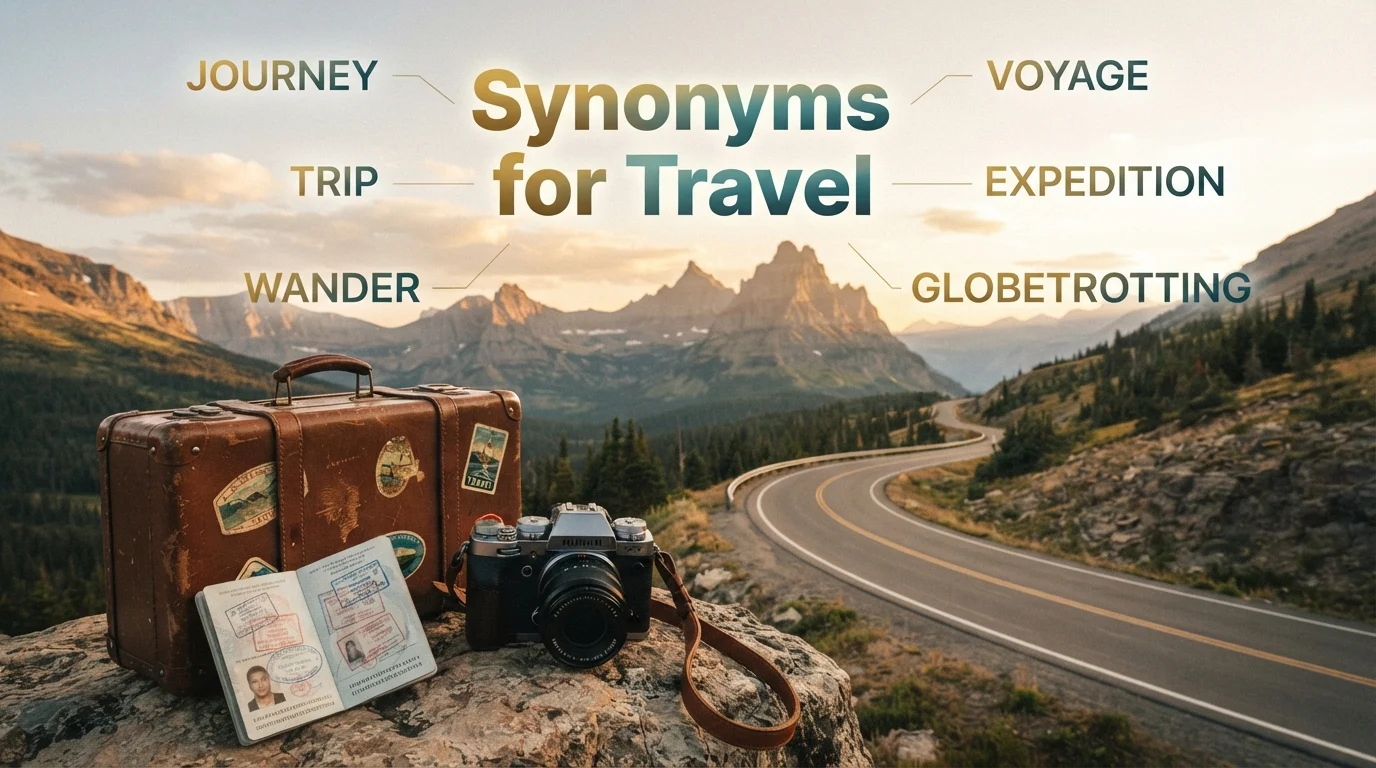
“Travel” refers to the act of going from one place to another, often over a significant distance. It can describe physical movement, journeys, trips, exploration, or the general activity of moving between locations. Depending on context, alternatives include journey, trip, voyage, excursion, expedition, commute, tour, wander, roam, and globetrotting.
Meaning, Tone, and Context
Simple Definition
Travel generally refers to:
- Moving from one place to another
- Taking a journey or trip
- Exploring new destinations
- Commuting for work or daily life
- Touring for pleasure or business
Part of Speech
“Travel” functions as both a verb and a noun.
Verb Examples:
- “She travels to Europe every summer.”
- “Light travels faster than sound.”
Noun Examples:
- “Travel broadens the mind.”
- “Air travel has become more affordable.”
Related Forms:
- Traveler (noun): a person who travels
- Traveling (adjective/verb): moving from place to place
- Traveled (adjective): experienced in travel
- Travelogue (noun): a talk or book about travel
Positive, Negative, or Neutral Tone
Travel is generally positive or neutral.
Positive associations:
- “Travel opens your mind to new cultures.”
- “Her travels inspired her writing.”
Neutral or negative contexts:
- “Business travel can be exhausting.”
- “The daily commute is a form of travel.”
Formality Level
Travel is a standard word that works in both formal and informal English. It is appropriate for academic papers, business reports, casual conversation, and creative writing.
Common Use Cases
Travel commonly refers to:
- Vacation and leisure trips
- Business travel and commuting
- Exploration and adventure
- Migration and movement of people
- Transportation of goods
- Tourism and hospitality
Important Word Forms
- Travel (verb/noun): to go from one place to another
- Traveler (noun): a person who travels
- Traveling (adjective/verb): on a journey
- Traveled (adjective): experienced in many places
- Travelogue (noun): a narrative of travels
- Travel agency (noun): a business that arranges trips
When and How to Use “Travel”
Use “travel” when discussing movement between places, journeys, trips, or exploration. Because the word is broad, more specific alternatives can add precision.
Professional
“Business travel has increased significantly this quarter.”
This works naturally in professional communication.
Academic
“The study examines how travel influences cultural exchange.”
The term is appropriate in academic research.
Personal
“I love to travel and experience new cultures.”
The word sounds natural in everyday conversation.
Business
“The company reimburses employees for travel expenses.”
Here, travel refers to business-related movement.
Creative
“Her travels took her to places she had only dreamed of.”
The term works well in storytelling.
Social Media
“Travel is the only thing you buy that makes you richer.”
This works well for inspirational travel content.
Another Word for “Travel”
There is no single perfect synonym because travel can refer to many different things.
- Long journey context: journey, voyage, expedition, odyssey
- Short trip context: trip, excursion, outing, jaunt
- Leisure context: tour, vacation, getaway, globetrotting
- Business context: commute, business trip, travel for work
- Exploration context: wander, roam, explore, adventure
- Movement context: motion, transit, passage, locomotion
If you need one broad alternative, “journey” works well for long or meaningful travel, while “trip” works for shorter, casual travel.
When Not to Use “Travel”
Travel can become too vague when the reader needs to know exactly what kind of movement is involved.
Consider:
“She is traveling.”
This statement does not tell readers whether she is on vacation, commuting to work, going on a business trip, or backpacking across a continent.
A more precise sentence could be:
“She is backpacking through Southeast Asia.”
“She is commuting to her office in the city.
Similarly, avoid using travel when you mean commute in a daily work context or voyage for sea travel.
Words Commonly Confused With “Travel”
Travel vs. Journey
Journey emphasizes the process of traveling from one place to another, often with a sense of purpose or significance. Travel is broader.
Example:
“The journey took three days.” (process, significant)
“She travels frequently for work.” (general)
Travel vs. Trip
Trip emphasizes a specific instance of traveling to a destination and returning. Travel is the general activity.
Example:
“We took a trip to Paris.” (specific instance)
“She loves to travel.” (general activity)
Travel vs. Voyage
Voyage specifically refers to a long journey, especially by sea or space. Travel is broader.
Example:
“The voyage across the Atlantic took weeks.” (sea journey)
“Air travel is faster than sea travel.” (general)
Travel vs. Commute
Commute specifically refers to regular travel between home and work. Travel is broader.
Example:
“He commutes to work by train.” (daily, work-related)
“She travels to different cities for conferences.” (general)
Travel vs. Tour
Tour emphasizes visiting multiple places for pleasure, often with a guide or organized itinerary.
Example:
“They toured Europe in two weeks.” (organized, multiple destinations)
“He traveled to Europe for business.” (general)
Best Synonym by Context for “Travel”
| Context | Best Synonym | Why It Works | Example |
|---|---|---|---|
| Formal writing | Journey, voyage | Sounds precise and literary | The journey took them across three continents. |
| Academic writing | Migration, mobility | Scholarly and accurate | Human mobility has shaped modern societies. |
| Professional or business | Business trip, commute | Clear and specific | She is on a business trip to Tokyo. |
| Resume | Travel for work, business travel | Clear and professional | Experienced in international business travel. |
| Casual conversation | Trip, getaway, vacation | Natural and concise | We’re planning a weekend getaway. |
| Creative writing | Odyssey, expedition, wanderings | Evocative and literary | His odyssey took him to distant lands. |
| Short trip | Excursion, outing, jaunt | Specific and clear | They took a short excursion to the coast. |
| Long journey | Expedition, pilgrimage, quest | Emphasizes purpose | The expedition reached the summit. |
| Sea travel | Voyage, sailing, cruise | Specific to water | The cruise sailed through the Caribbean. |
| Exploration | Wander, roam, adventure | Emphasizes freedom | They wandered through the countryside. |
| Daily travel | Commute, daily journey | Work-related | His commute takes an hour each way. |
| Global travel | Globetrotting, world travel | Emphasizes international | She spent years globetrotting. |
Which Synonym Should You Choose?
Start by identifying what kind of travel you are describing.
- Long or meaningful journey: journey, voyage, odyssey, expedition
- Short trip: trip, excursion, outing, jaunt, getaway
- Leisure travel: tour, vacation, globetrotting
- Business travel: business trip, commute, travel for work
- Exploration: wander, roam, adventure, explore
- Sea or space travel: voyage, cruise, sailing, spaceflight
- Daily travel: commute, daily journey
- Movement in general: motion, transit, passage
10 Key Synonyms for “Travel”
The table below includes accurate alternatives with clear meanings and usage contexts.
| Synonym | Simple Meaning | Best Used For | Example Sentence |
|---|---|---|---|
| Journey | An act of traveling from one place to another | Long or meaningful travel | The journey across the desert took five days. |
| Trip | A short journey to a destination and back | Casual or specific travel | We took a weekend trip to the mountains. |
| Voyage | A long journey by sea or space | Sea, space, or epic travel | The voyage to the New World was treacherous. |
| Excursion | A short trip for pleasure | Leisure, group travel | The hotel offers daily excursions to nearby ruins. |
| Expedition | An organized journey for a specific purpose | Exploration, adventure | The expedition aimed to reach the summit. |
| Commute | Regular travel between home and work | Daily, work-related travel | Her commute takes forty minutes by train. |
| Tour | A journey visiting multiple places | Leisure, organized travel | They took a guided tour of Italy. |
| Wander | To travel without a fixed route | Exploration, freedom | He wandered through the streets of Prague. |
| Roam | To move around without a fixed purpose | Exploration, freedom | They roamed the countryside for weeks. |
| Globetrotting | Traveling widely around the world | International, frequent travel | Her globetrotting lifestyle inspired many. |
Synonym Groups and Usage Differences
Professional vs. Personal Synonyms
Professional writing benefits from specific terms such as business trip, commute, travel for work, and international travel.
Personal communication often uses trip, vacation, getaway, or travel itself.
Compare:
“I’m going on a trip.” (personal)
“I’m traveling for business.” (professional)
Formal vs. Conversational Synonyms
Travel works in both formal and conversational English.
Formal alternatives: journey, voyage, expedition, pilgrimage
Conversational alternatives: trip, getaway, vacation, jaunt
Examples:
“The expedition reached the South Pole.” (formal)
“We’re planning a quick getaway.” (conversational)
Academic Synonyms
Academic writing should distinguish between travel, migration, mobility, tourism, and transit.
For example, “migration” refers to moving to a new place permanently, while “travel” is temporary.
Professional and Business Synonyms
Business writing often benefits from phrases such as business travel, commute, corporate travel, and travel expenses.
Instead of:
“She travels for work.”
Consider:
“She frequently travels for business meetings.”
Creative or Literary Synonyms
Creative writing can use odyssey, expedition, pilgrimage, wanderings, sojourn, and quest.
For example:
“Their odyssey took them across oceans and deserts.”
“He embarked on a pilgrimage to the holy city.”
Slang or Modern Synonyms
Globetrotting means traveling widely.
Jet-setting means traveling frequently, often luxuriously.
Backpacking means traveling cheaply with a backpack.
Road tripping means traveling by car.
Examples:
“She’s been globetrotting for years.” (modern, international)
“They went backpacking through Asia.” (casual, budget travel)
Strongest vs. Weaker Synonyms
“Travel” synonyms vary in intensity:
Milder: trip, outing, jaunt
Moderate: travel, journey, tour
Strong: expedition, voyage, odyssey
Very Strong: pilgrimage, quest
Emotional vs. Neutral Synonyms
“Travel” is generally neutral or positive.
Emotional alternatives: odyssey, pilgrimage, quest, wanderings
Neutral alternatives: trip, commute, transit
Examples:
“Her pilgrimage to India changed her life.” (emotional)
“She commutes to work daily.” (neutral)
Antonyms of “Travel”
“Travel” has several antonyms depending on context:
| Antonym | Context | Meaning | Example Sentence |
|---|---|---|---|
| Stay | Movement | Remain in one place | We decided to stay home this weekend. |
| Remain | Movement | Stay in place | He remained in the city. |
| Settle | Movement | Stop moving and stay | They settled in a small town. |
| Stay put | Movement | Not move | I told him to stay put. |
| Stationary | Movement | Not moving | The car remained stationary. |
Comparison: “Travel” vs. Similar Words
Travel vs. Journey
Main difference: Journey emphasizes the process of traveling, often with purpose or significance. Travel is broader.
Examples:
“The journey took three days.” (process, significant)
“She travels frequently for work.” (general)
Travel vs. Trip
Main difference: Trip emphasizes a specific instance of traveling to a destination and back. Travel is the general activity.
Examples:
“We took a trip to Paris.” (specific instance)
“She loves to travel.” (general activity)
Travel vs. Voyage
Main difference: Voyage specifically refers to a long journey, especially by sea or space. Travel is broader.
Examples:
“The voyage across the Atlantic took weeks.” (sea journey)
“Air travel is faster than sea travel.” (general)
Travel vs. Commute
Main difference: Commute specifically refers to regular travel between home and work. Travel is broader.
Examples:
“He commutes to work by train.” (daily, work-related)
“She travels to different cities for conferences.” (general)
Travel vs. Tour
Main difference: Tour emphasizes visiting multiple places for pleasure, often with a guide. Travel is broader.
Examples:
“They toured Europe in two weeks.” (organized, multiple destinations)
“He traveled to Europe for business.” (general)
Common Phrases and Expressions with “Travel”
1. Travel light
Meaning:
To travel with very little luggage.
Example:
“I always travel light to avoid baggage fees.”
2. Travel broadens the mind
Meaning:
Traveling helps you learn and grow.
Example:
“They say travel broadens the mind, and I agree.”
3. Safe travels
Meaning:
A wish for a safe journey.
Example:
“Safe travels! Let me know when you arrive.”
4. Travel off the beaten path
Meaning:
To visit places not commonly visited by tourists.
Example:
“We prefer to travel off the beaten path.”
5. Travel in style
Meaning:
To travel luxuriously or elegantly.
Example:
“They traveled in style on a private jet.”
6. Travel companion
Meaning:
A person you travel with.
Example:
“She was the perfect travel companion.”
7. Travel bug
Meaning:
A strong desire to travel.
Example:
“He caught the travel bug after his first trip abroad.”
8. Travel plans
Meaning:
Arrangements for a journey.
Example:
“Our travel plans include stops in Paris and Rome.”
9. Business travel
Meaning:
Travel for work purposes.
Example:
“Business travel can be exhausting but rewarding.”
10. Time travel
Meaning:
The concept of moving between different points in time.
Example:
“Time travel is a popular theme in science fiction.”
Common Mistakes to Avoid
1. Using “travel” when “trip” or “journey” is more precise
If you mean a specific instance of traveling, use trip. If you mean a significant journey, use journey.
Vague: “I’m going on a travel.”
Precise: “I’m going on a trip.”
2. Confusing “travel” with “commute”
Commute specifically refers to regular travel between home and work.
Incorrect: “I travel to work every day.” (unless emphasizing the journey)
Correct: “I commute to work every day.”
3. Using “travel” for “voyage” in sea contexts
Voyage specifically refers to long sea or space journeys.
Example:
“The voyage across the Pacific took a month.” (sea journey)
4. Overusing “travel” in writing
Repetition can make content feel dull. Use alternatives such as journey, trip, voyage, excursion, expedition, tour, and wander.
5. Choosing a synonym that changes the meaning
Do not replace travel with migration unless you mean permanent relocation.
Do not replace travel with tourism unless you mean leisure travel specifically.
FAQs
What is the best synonym for “travel”?
The best synonym depends on context. Journey works for long or meaningful travel, trip for short travel, voyage for sea travel, expedition for adventure, and commute for daily work travel.
What is a formal synonym for “travel”?
Journey, voyage, expedition, and pilgrimage are formal synonyms.
What is an informal synonym for “travel”?
Trip, getaway, vacation, jaunt, and globetrotting are common informal alternatives.
What is another word for “travel” in business contexts?
Business trip, commute, corporate travel, and travel for work are common in business contexts.
What is the difference between “travel” and “journey”?
Travel is the general activity of going from place to place. Journey emphasizes the process, often with purpose or significance.
What is the opposite of “travel”?
Depending on context, opposites include stay, remain, settle, and stay put.
What does “travel light” mean?
“Travel light” means to travel with very little luggage.
Conclusion
Travel is a broad word that can describe journeys, trips, voyages, commuting, exploration, and tourism. The best synonym depends on what you actually mean.
Choose journey for long or meaningful travel, trip for short travel, voyage for sea travel, excursion for leisure outings, expedition for adventure, commute for daily work travel, tour for organized sightseeing, wander for free exploration, and globetrotting for international travel.
Most importantly, do not replace travel simply to avoid repetition. First identify what kind of movement, journey, or exploration you are actually describing. Then choose the alternative that communicates that idea most clearly.
For academic, professional, and formal writing, precision is usually more valuable than vocabulary variety. A specific term such as commute, expedition, or business trip can tell readers much more than the broad word travel.
Before publishing a vocabulary guide, verify definitions and usage with trusted dictionaries such as Cambridge, Oxford, Merriam-Webster, Collins, or Britannica. This helps ensure that each alternative accurately matches its intended meaning and context.
The practical takeaway is simple: when travel feels too general, ask yourself what type of journey, trip, or movement you are actually describing. Then use the most precise word available.

3 thoughts on “50+ Synonyms for Travel: Meanings, Examples, and Best Alternatives”