Do you keep using the word “creepy” in essays, horror stories, reviews, social media posts, or everyday conversation? While it is one of the most expressive and useful adjectives in modern English, repeating it can make your writing feel flat, vague, or overly casual.
The good news is that the best alternative depends on what you actually mean. You might be describing something frightening, unsettling, sinister, eerie, or just plain strange.
This guide explains synonyms for “creepy” by meaning, tone, context, and usage. You will learn which alternatives work best in creative writing, horror fiction, academic writing, professional communication, reviews, and casual conversation.
Quick Answer: What Does “Creepy” Mean?
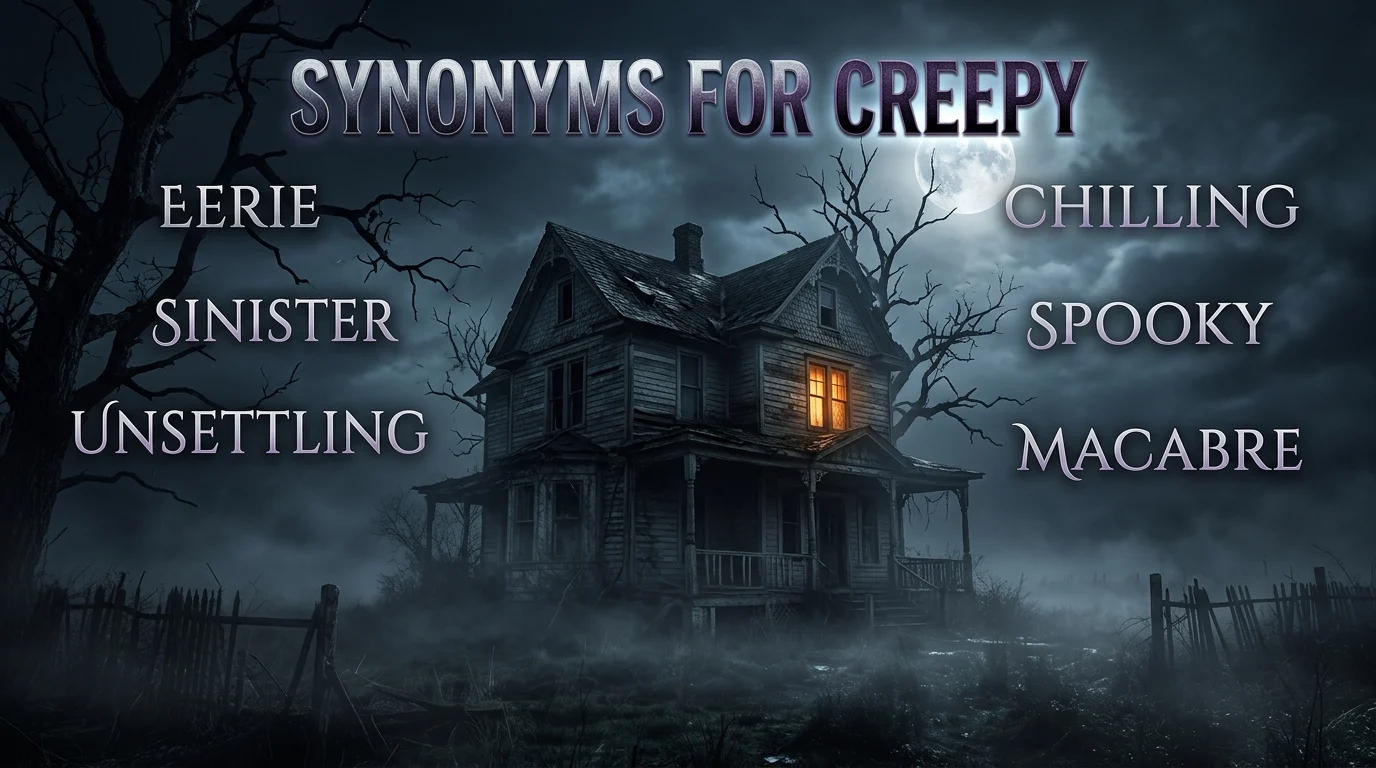
“Creepy” describes something that causes an uneasy feeling of fear, revulsion, or unease. It often refers to people, places, or things that feel sinister, unsettling, or strange in a disturbing way. Depending on context, alternatives include eerie, sinister, unsettling, chilling, spooky, macabre, ominous, disturbing, unnerving, and ghastly.
Meaning, Tone, and Context
Simple Definition
“Creepy” generally refers to:
- Unsettling fear: causing a feeling of unease or dread
- Sinister quality: suggesting something evil or threatening
- Strange behavior: odd or inappropriate in a disturbing way
- Eerie atmosphere: a place or situation that feels haunted or wrong
- Revulsion: causing a physical reaction of disgust or shivering
Part of Speech
“Creepy” functions primarily as an adjective.
Examples:
- “That house gives me a creepy feeling.”
- “He was acting creepy toward her.”
- “The forest was dark and creepy at night.”
Related Forms:
- Creep (verb): to move slowly and quietly; to feel fear
- Creepily (adverb): in a creepy manner
- Creepiness (noun): the quality of being creepy
- Creeper (noun): a person who behaves in a creepy way (informal)
Positive, Negative, or Neutral Tone
“Creepy” is negative. It expresses discomfort, fear, or revulsion.
Negative associations:
- “The stalker’s behavior was creepy.”
- “The abandoned hospital was incredibly creepy.”
Neutral or playful contexts:
- “The Halloween decorations were delightfully creepy.”
- “That movie was so creepy—I loved it!”
Formality Level
“Creepy” is an informal word. It works well in casual conversation, creative writing, reviews, and social media, but it is generally avoided in formal academic or professional writing.
More formal alternatives include sinister, ominous, unsettling, and macabre.
Common Use Cases
“Creepy” commonly refers to:
- People: creepy stranger, creepy behavior, creepy guy
- Places: creepy house, creepy forest, creepy basement
- Atmosphere: creepy silence, creepy feeling, creepy vibe
- Objects: creepy doll, creepy painting, creepy mask
- Media: creepy movie, creepy story, creepy soundtrack
- Situations: creepy coincidence, creepy timing
Important Word Forms
- Creepy (adjective): causing unease or fear
- Creepily (adverb): in a creepy manner
- Creepiness (noun): the quality of being creepy
- Creep (verb/noun): to move slowly; an unpleasant person
- Creeper (noun): a creepy person (informal)
When and How to Use “Creepy”
Use “creepy” when you want to describe something that causes an uneasy, fearful, or unsettling feeling. Because the word is informal, more formal alternatives are better for academic or professional writing.
Creative Writing
“The old mansion had a creepy atmosphere that made her skin crawl.”
This creates a vivid, unsettling image.
Horror Fiction
“The doll’s eyes followed him around the room—it was deeply creepy.”
The word is standard in horror.
Personal
“That guy at the bar was really creepy.”
The word sounds natural in casual conversation.
Reviews
“The abandoned asylum is one of the creepiest places I’ve ever visited.”
This is common in travel or horror reviews.
Social Media
“This scene gave me the creeps—so creepy!”
The word is casual and expressive.
Informal Professional (Rare)
“The email had a creepy tone that made me uncomfortable.”
This is acceptable in informal professional contexts, though more formal alternatives are usually better.
Another Word for “Creepy”
There is no single perfect synonym because “creepy” can refer to fear, unease, strangeness, or sinister intent.
- Fear context: frightening, terrifying, chilling, scary, horrifying
- Unease context: unsettling, unnerving, disturbing, disquieting, troubling
- Sinister context: sinister, ominous, menacing, threatening, foreboding
- Strange context: eerie, weird, odd, bizarre, uncanny
- Revulsion context: repulsive, grotesque, macabre, ghastly, sickening
- Atmosphere context: spooky, haunted, ghostly, spectral, unearthly
If you need one broad alternative, “eerie” works for atmosphere, “sinister” works for intent, and “unsettling” works for general unease.
When Not to Use “Creepy”
“Creepy” can become too vague or informal when you need to be precise or professional.
Consider:
“The situation was creepy.”
This statement does not tell readers whether the situation was frightening, strange, threatening, or unsettling.
A more precise sentence could be:
“The situation was deeply unsettling and felt vaguely threatening.”
Similarly, avoid using “creepy” in formal academic or professional writing. Use “sinister”, “ominous”, “unsettling”, or “macabre” instead.
Words Commonly Confused With “Creepy”
Creepy vs. Scary
Scary means causing fear. Creepy means causing unease or a sense of dread, often less immediate than fear.
Example:
“The roller coaster was scary.” (fear)
“The abandoned house was creepy.” (unease)
Creepy vs. Eerie
Eerie describes a strange, mysterious atmosphere. Creepy is broader and can describe people or behavior.
Example:
“The forest was eerie in the fog.” (atmosphere)
“He gave me a creepy look.” (person)
Creepy vs. Sinister
Sinister implies evil intent. Creepy can be unsettling without evil intent.
Example:
“The villain had a sinister plan.” (evil)
“The doll was creepy.” (unsettling)
Creepy vs. Unsettling
Unsettling means causing unease. Creepy is more informal and often stronger.
Example:
“The news was unsettling.” (unease)
“The basement was creepy.” (fear/unease)
Creepy vs. Spooky
Spooky is often used for Halloween or playful fear. Creepy is more serious and disturbing.
Example:
“The decorations were spooky.” (playful)
“His behavior was creepy.” (serious)
Creepy vs. Macabre
Macabre refers to death or gruesome subjects. Creepy is broader.
Example:
“The painting had a macabre theme.” (death)
“The painting was creepy.” (unsettling)
Best Synonym by Context for “Creepy”
| Context | Best Synonym | Why It Works | Example |
|---|---|---|---|
| Formal writing | Sinister, ominous | Precise and professional | The ominous silence filled the room. |
| Academic writing | Macabre, uncanny | Standard academic usage | The novel explores macabre themes. |
| Creative writing | Eerie, chilling, haunting | Adds literary depth | An eerie silence fell over the house. |
| Horror fiction | Ghastly, terrifying, nightmarish | Intense horror | The ghastly figure emerged from the shadows. |
| Reviews | Spooky, unsettling | Casual and expressive | The abandoned asylum is deeply unsettling. |
| People/behavior | Sinister, menacing, predatory | Describes threatening intent | His menacing stare made her uncomfortable. |
| Places | Haunted, eerie, foreboding | Atmospheric | The haunted mansion loomed ahead. |
| Objects | Uncanny, grotesque | Strange and disturbing | The uncanny doll seemed to watch her. |
| Atmosphere | Eerie, ominous, foreboding | Creates tension | A foreboding atmosphere hung over the town. |
| Casual conversation | Creepy (itself), weird | Natural and informal | That was so creepy! |
| Playful/Halloween | Spooky, chilling | Fun fear | The spooky decorations were perfect. |
| Revulsion | Grotesque, repulsive | Physical disgust | The grotesque mask made her shudder. |
Which Synonym Should You Choose?
Start by identifying what kind of “creepy” you are describing.
- Fear: frightening, terrifying, chilling, scary, horrifying
- Unease: unsettling, unnerving, disturbing, disquieting
- Sinister: sinister, ominous, menacing, threatening, foreboding
- Strange: eerie, weird, odd, bizarre, uncanny
- Revulsion: repulsive, grotesque, macabre, ghastly, sickening
- Atmosphere: spooky, haunted, ghostly, spectral, unearthly
10 Key Synonyms for “Creepy”
The table below includes accurate alternatives with clear meanings and usage contexts.
| Synonym | Simple Meaning | Best Used For | Example Sentence |
|---|---|---|---|
| Eerie | Strange and frightening | Atmosphere, places | An eerie silence filled the forest. |
| Sinister | Suggesting evil | People, intentions | The sinister figure watched from the shadows. |
| Unsettling | Causing unease | General, situations | The news was deeply unsettling. |
| Chilling | Frightening and cold | Horror, stories | The chilling scream echoed through the night. |
| Spooky | Frightening but playful | Halloween, casual | The spooky decorations were a hit. |
| Macabre | Gruesome, death-related | Art, literature | The film’s macabre imagery stayed with me. |
| Ominous | Suggesting something bad will happen | Atmosphere, warnings | The ominous clouds gathered overhead. |
| Disturbing | Causing anxiety or unease | General, media | The documentary was deeply disturbing. |
| Unnerving | Making someone lose confidence | General, situations | The unnerving silence made her nervous. |
| Ghastly | Horrifying and shocking | Horror, descriptions | The ghastly scene was hard to forget. |
Synonym Groups and Usage Differences
Professional vs. Personal Synonyms
Professional writing benefits from specific terms such as sinister, ominous, unsettling, and macabre.
Personal communication often uses creepy itself or casual alternatives like spooky, weird, or scary.
Compare:
“That was so creepy!” (personal)
“The atmosphere was distinctly ominous.” (professional)
Formal vs. Conversational Synonyms
Creepy is informal. In formal contexts, use more formal alternatives.
Formal alternatives: sinister, ominous, unsettling, macabre, uncanny
Conversational alternatives: creepy, spooky, weird, scary
Examples:
“The sinister undertones of the novel were subtle.” (formal)
“That doll is so creepy!” (conversational)
Academic Synonyms
Academic writing should distinguish between creepy (informal), uncanny (psychological), macabre (death-related), and sinister (evil intent).
For example:
“The novel explores the uncanny through its use of doubling.”
“The artist’s macabre themes challenge the viewer.”
Professional and Business Synonyms
Business writing rarely uses “creepy.” In professional contexts, use unsettling, concerning, inappropriate, or disturbing.
Instead of:
“The email was creepy.”
Consider:
“The email contained inappropriate and unsettling language.”
Creative or Literary Synonyms
Creative writing can use eerie, chilling, haunting, spectral, ghostly, uncanny, and foreboding depending on the context.
For example:
“The haunting melody drifted through the empty halls.”
“A foreboding sense of dread settled over her.”
Slang or Modern Synonyms
Creepy is common casual.
Sketchy means suspicious or creepy (informal).
Cursed means creepy or unsettling (internet slang).
Sus means suspicious (modern slang).
Examples:
“That guy seems sketchy.” (casual)
“This photo is cursed.” (internet slang)
Strongest vs. Weaker Synonyms
“Creepy” synonyms vary in intensity:
Milder: odd, weird, unsettling
Moderate: creepy, eerie, spooky
Strong: sinister, ominous, chilling
Very Strong: terrifying, horrifying, nightmarish
Emotional vs. Neutral Synonyms
“Creepy” is emotional and negative.
Emotional alternatives: terrifying, horrifying, chilling, disturbing
Neutral alternatives: odd, strange, unusual
Examples:
“The scene was terrifying.” (strong emotion)
“The behavior was odd.” (neutral)
Antonyms of “Creepy”
“Creepy” has several antonyms depending on context:
| Antonym | Context | Meaning | Example Sentence |
|---|---|---|---|
| Comforting | Atmosphere | Providing comfort | The warm fire was comforting. |
| Reassuring | Feeling | Making someone feel better | Her smile was reassuring. |
| Pleasant | General | Enjoyable | The garden was pleasant. |
| Cheerful | Atmosphere | Happy and bright | The cheerful room lifted her spirits. |
| Inviting | Place | Welcoming | The cozy cabin was inviting. |
| Normal | Behavior | Ordinary | His behavior was completely normal. |
| Wholesome | General | Good and healthy | The family movie was wholesome. |
Comparison: “Creepy” vs. Similar Words
Creepy vs. Scary
Main difference: Scary means causing fear. Creepy means causing unease or dread.
Examples:
“The roller coaster was scary.” (fear)
“The abandoned house was creepy.” (unease)
Creepy vs. Eerie
Main difference: Eerie describes a strange, mysterious atmosphere. Creepy is broader and can describe people or behavior.
Examples:
“The forest was eerie in the fog.” (atmosphere)
“He gave me a creepy look.” (person)
Creepy vs. Sinister
Main difference: Sinister implies evil intent. Creepy can be unsettling without evil intent.
Examples:
“The villain had a sinister plan.” (evil)
“The doll was creepy.” (unsettling)
Creepy vs. Unsettling
Main difference: Unsettling means causing unease. Creepy is more informal and often stronger.
Examples:
“The news was unsettling.” (unease)
“The basement was creepy.” (fear/unease)
Creepy vs. Spooky
Main difference: Spooky is often used for Halloween or playful fear. Creepy is more serious and disturbing.
Examples:
“The decorations were spooky.” (playful)
“His behavior was creepy.” (serious)
Creepy vs. Macabre
Main difference: Macabre refers to death or gruesome subjects. Creepy is broader.
Examples:
“The painting had a macabre theme.” (death)
“The painting was creepy.” (unsettling)
Common Phrases and Expressions with “Creepy”
1. Creepy crawlies
Meaning:
Insects or small creatures that give people the creeps.
Example:
“The basement was full of creepy crawlies.”
2. Give someone the creeps
Meaning:
To make someone feel uneasy or frightened.
Example:
“That house gives me the creeps.”
3. Creepy vibe
Meaning:
An unsettling atmosphere.
Example:
“The place had a creepy vibe.”
4. Creepy coincidence
Meaning:
An unsettling coincidence.
Example:
“It was a creepy coincidence that they both said the same thing.”
5. Creepy smile
Meaning:
A smile that seems sinister or unsettling.
Example:
“He gave her a creepy smile.”
6. Creepy doll
Meaning:
A doll that looks unsettling.
Example:
“The creepy doll seemed to follow her with its eyes.”
7. Creepy silence
Meaning:
A silence that feels unsettling.
Example:
“A creepy silence fell over the room.”
8. Creepy stalker
Meaning:
A person who follows or watches someone in a disturbing way.
Example:
“She felt like she had a creepy stalker.”
9. Creepy atmosphere
Meaning:
An unsettling mood or environment.
Example:
“The old church had a creepy atmosphere.”
10. Creepy pasta
Meaning:
Internet horror stories (from “copypasta”).
Example:
“She loves reading creepy pasta at night.”
Common Mistakes to Avoid
1. Using “creepy” when a more precise term is available
If you mean sinister, eerie, unsettling, or macabre, use the more specific word.
Vague: “The place was creepy.”
Precise: “The place had an eerie, unsettling atmosphere.”
2. Confusing “creepy” with “scary”
Scary means causing fear. Creepy means causing unease.
Incorrect: “The roller coaster was creepy.” (if fear)
Correct: “The roller coaster was scary.”
3. Using “creepy” in formal or academic writing
“Creepy” is informal. Use more formal alternatives like sinister, uncanny, or macabre.
Informal: “The book was creepy.”
Formal: “The book explores uncanny and macabre themes.”
4. Overusing “creepy” in writing
Repetition can make content feel dull. Use alternatives such as eerie, sinister, unsettling, chilling, and ominous.
5. Choosing a synonym that changes the meaning
Do not replace creepy with macabre unless you mean death-related.
Do not replace creepy with spooky unless you mean playful fear.
FAQs
What is the best synonym for “creepy”?
The best synonym depends on context. Eerie works for atmosphere, sinister for evil intent, unsettling for general unease, chilling for horror, and spooky for playful fear.
What is a formal synonym for “creepy”?
Sinister, ominous, unsettling, macabre, and uncanny are formal synonyms.
What is an informal synonym for “creepy”?
Sketchy, weird, spooky, and sus are common informal alternatives.
What is another word for “creepy” in creative writing?
Eerie, chilling, haunting, spectral, ghostly, uncanny, and foreboding work well in creative writing.
What is the difference between “creepy” and “scary”?
Scary means causing fear. Creepy means causing unease or dread, often more subtle than fear.
What is the opposite of “creepy”?
Depending on context, opposites include comforting, reassuring, pleasant, cheerful, inviting, and wholesome.
What does “creepy” mean in a social context?
In social contexts, creepy often describes behavior that is inappropriate, invasive, or makes someone feel uncomfortable or unsafe.
Conclusion
“Creepy” is a versatile and expressive word that can describe fear, unease, strangeness, sinister intent, and revulsion. The best synonym depends on what you actually mean.
Choose eerie for atmosphere, sinister for evil intent, unsettling for general unease, chilling for horror, spooky for playful fear, and macabre for death-related themes.
Most importantly, do not replace “creepy” simply to avoid repetition. First identify what kind of creepiness—atmospheric, behavioral, or emotional—you are actually describing. Then choose the alternative that communicates that idea most clearly.
For academic, professional, and formal writing, precision is usually more valuable than vocabulary variety. A specific term such as sinister, uncanny, ominous, or macabre can tell readers much more than the informal word creepy.
Before publishing a vocabulary guide, verify definitions and usage with trusted dictionaries such as Cambridge, Oxford, Merriam-Webster, Collins, or Britannica. This helps ensure that each alternative accurately matches its intended meaning and context.
The practical takeaway is simple: when “creepy” feels too general or informal, ask yourself what kind of unease—atmospheric, behavioral, or emotional—you are actually describing. Then use the most precise word available.
