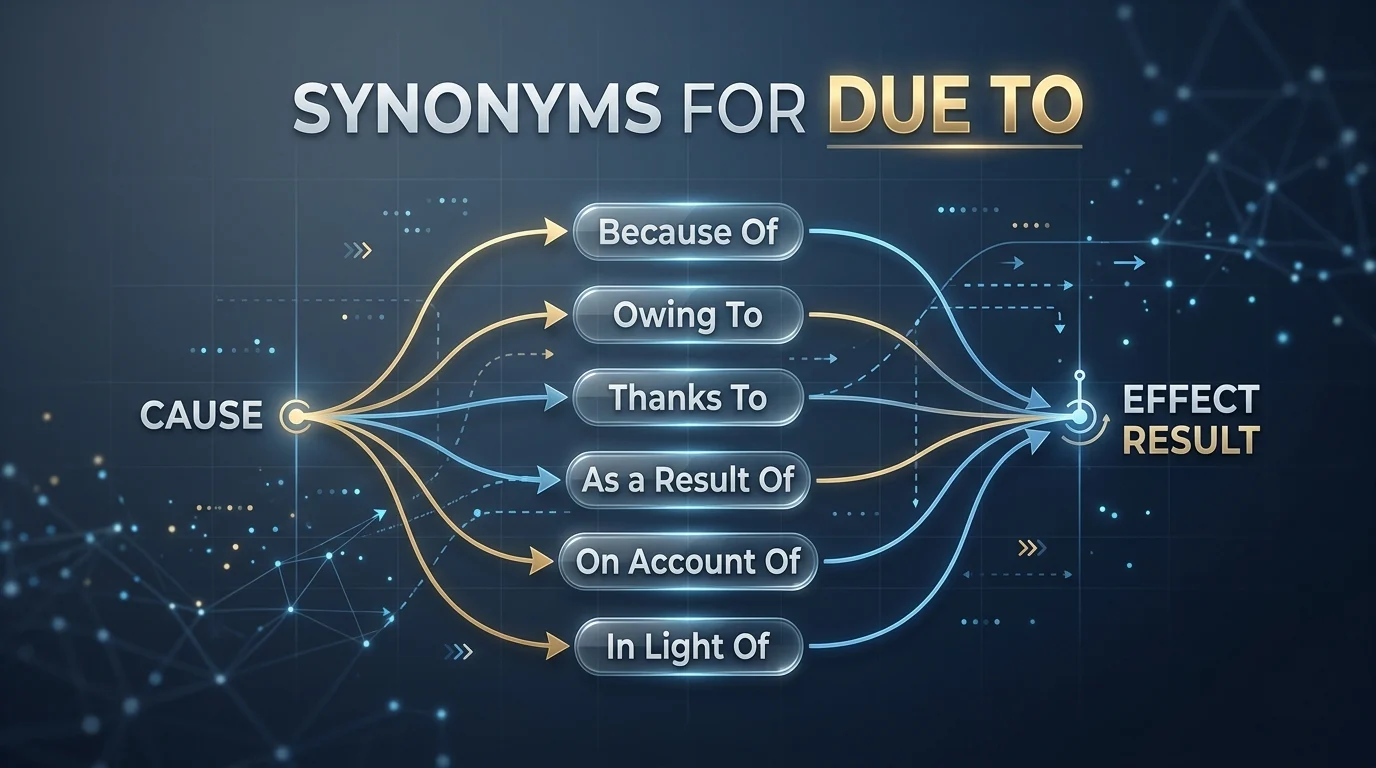
Do you keep using the phrase “due to” in essays, business reports, emails, academic writing, or everyday conversation? While it is one of the most common and useful phrases in English for showing cause, repeating it can make your writing feel flat, repetitive, or overly formal.
The good news is that the best alternative depends on what you actually mean. You might be explaining a cause, assigning responsibility, showing a reason, indicating a result, or describing the source of something.
This guide explains synonyms for “due to” by meaning, tone, context, and usage. You will learn which alternatives work best in academic writing, professional communication, creative expression, and casual conversation.
Quick Answer: What Does “Due To” Mean?
“Due to” is a prepositional phrase that means “because of,” “caused by,” or “as a result of.” It introduces the cause or reason for something. Depending on context, alternatives include because of, owing to, on account of, thanks to, as a result of, as a consequence of, by reason of, through, from, and in light of.
Meaning, Tone, and Context
Simple Definition
“Due to” generally means:
- Because of: indicating a cause
- Caused by: attributing something to a source
- As a result of: showing a consequence
- Owing to: formal way to express cause
- On account of: indicating a reason
- Thanks to: positive cause (often ironic)
Part of Speech
“Due to” functions as a prepositional phrase (compound preposition).
Examples:
- “The cancellation was due to bad weather.”
- “Due to the strike, the factory closed.”
Related Forms:
- Due (adjective): owed; expected
- Duly (adverb): in the proper manner
- Owing to (preposition): because of
Positive, Negative, or Neutral Tone
“Due to” is generally neutral. Its tone depends on the context.
Neutral:
- “The delay was due to traffic.”
Positive:
- “The success was due to hard work.”
Negative:
- “The accident was due to negligence.”
Formality Level
“Due to” is a standard phrase that works in both formal and informal English. It is especially common in academic, business, and professional writing.
However, more specific alternatives can add precision and variety depending on the context.
Common Use Cases
“Due to” commonly appears in:
- Academic writing: due to the results, due to the evidence
- Business writing: due to the delay, due to the increase
- News reporting: due to the storm, due to the strike
- Everyday conversation: due to the traffic, due to the weather
- Formal writing: due to circumstances, due to unforeseen events
Important Word Forms
- Due to (preposition): because of
- Owing to (preposition): because of
- Because of (preposition): as a result of
- On account of (preposition): because of
- Thanks to (preposition): because of (positive/ironic)
When and How to Use “Due To”
Use “due to” when you want to introduce a cause or reason for something. Because the phrase is common, more specific alternatives can add precision and variety.
Professional
“The delay was due to unforeseen circumstances.”
This works naturally in business communication.
Academic
“The increase in temperature is due to greenhouse gas emissions.”
The phrase is appropriate in academic research.
Personal
“I was late due to traffic.”
The phrase sounds natural in everyday conversation.
News
“Flights were cancelled due to the storm.”
This is standard in news reporting.
Formal Writing
“Due to the nature of the case, additional evidence was required.”
This is appropriate in formal contexts.
Business
“The decline in sales was due to increased competition.”
This is standard in business writing.
Another Word for “Due To”
There is no single perfect synonym because “due to” can introduce causes, reasons, results, or sources.
- General cause: because of, owing to, on account of
- Positive cause: thanks to
- Result context: as a result of, as a consequence of
- Formal context: by reason of, by virtue of, in light of
- Source context: through, from, via
- Emphasis context: in view of, considering
If you need one broad alternative, “because of” works in almost all contexts, while “owing to” is more formal. “Thanks to” works for positive causes.
When Not to Use “Due To”
“Due to” can become ambiguous or grammatically questionable when used incorrectly.
Traditional grammar distinguishes:
- Due to modifies a noun: “The delay was due to rain.” (due to modifies “delay”)
- Owing to or because of modifies a verb: “The game was cancelled owing to rain.”
In modern usage, “due to” is widely accepted as a preposition, but in formal writing, “owing to” or “because of” may be preferred when modifying a verb.
Similarly, avoid overusing “due to” in a single paragraph. Vary with alternatives such as because of, owing to, as a result of, and thanks to.
Words Commonly Confused With “Due To”
Due To vs. Because Of
Because of is the most common alternative and can modify verbs. Due to traditionally modifies nouns but is now widely used as a preposition.
Example:
“She was late because of traffic.” (modifies verb)
“The delay was due to traffic.” (modifies noun)
Due To vs. Owing To
Owing to is more formal and can modify verbs or nouns. Due to traditionally modifies nouns.
Example:
“Owing to the weather, the event was cancelled.” (formal)
“The cancellation was due to the weather.” (standard)
Due To vs. Thanks To
Thanks to often implies a positive cause, though it can be used ironically.
Example:
“Thanks to her help, we finished on time.” (positive)
“Thanks to the rain, the picnic was ruined.” (ironic)
Due To vs. As a Result Of
As a result of emphasizes the consequence more than the cause.
Example:
“As a result of the strike, production halted.” (consequence)
“Production halted due to the strike.” (cause)
Due To vs. On Account Of
On account of is more formal and often used in legal or official contexts.
Example:
“On account of the evidence, the case was dismissed.” (formal)
Due To vs. Through
Through can indicate a means or cause, often personal effort.
Example:
“He succeeded through hard work.” (means)
“He succeeded due to hard work.” (cause)
Best Synonym by Context for “Due To”
| Context | Best Synonym | Why It Works | Example |
|---|---|---|---|
| Formal writing | Owing to, by reason of | Precise and formal | Owing to the circumstances, the event was cancelled. |
| Academic writing | As a result of, owing to | Standard academic usage | As a result of the experiment, new data emerged. |
| Business/Professional | Because of, owing to | Professional and clear | The delay was because of supply chain issues. |
| News reporting | Due to, because of | Standard news usage | Flights were cancelled due to the storm. |
| Positive cause | Thanks to | Positive and appreciative | Thanks to her efforts, the project succeeded. |
| Negative cause | Because of, owing to | Negative or neutral | The accident was because of negligence. |
| Result context | As a result of, as a consequence of | Emphasizes result | As a consequence of the policy, sales increased. |
| Formal/legal | By reason of, by virtue of | Very formal | By reason of his age, he was exempt. |
| Casual conversation | Because of, due to | Natural and informal | I was late because of traffic. |
| Emphasis | In light of, in view of | Emphasizes consideration | In light of the evidence, the decision was reversed. |
| Source/means | Through, from | Emphasizes source | He succeeded through determination. |
| Considering context | Considering, given | Emphasizes context | Given the circumstances, the result was good. |
Which Synonym Should You Choose?
Start by identifying what kind of cause or reason you are describing.
- General cause: because of, owing to, on account of
- Positive cause: thanks to
- Result: as a result of, as a consequence of
- Formal context: by reason of, by virtue of, in light of
- Source: through, from, via
- Emphasis: in view of, considering, given
10 Key Synonyms for “Due To”
The table below includes accurate alternatives with clear meanings and usage contexts.
| Synonym | Simple Meaning | Best Used For | Example Sentence |
|---|---|---|---|
| Because of | As a result of | General, all contexts | She was late because of traffic. |
| Owing to | Because of (formal) | Formal writing | Owing to the weather, the event was cancelled. |
| On account of | Because of (formal) | Legal, official | On account of the evidence, the case was dismissed. |
| Thanks to | Because of (positive) | Positive causes | Thanks to her help, we finished on time. |
| As a result of | Because of (result) | Result emphasis | As a result of the policy, sales increased. |
| As a consequence of | Because of (result) | Formal, result emphasis | As a consequence of the delay, costs rose. |
| By reason of | Because of (very formal) | Legal, very formal | By reason of his age, he was exempt. |
| Through | By means of | Source, means | He succeeded through hard work. |
| From | Originating in | Source | She suffered from exhaustion. |
| In light of | Considering | Emphasis, consideration | In light of the evidence, the decision was reversed. |
Synonym Groups and Usage Differences
Professional vs. Personal Synonyms
Professional writing benefits from specific terms such as owing to, as a result of, by reason of, and in light of.
Personal communication often uses because of or due to itself.
Compare:
“I was late because of traffic.” (personal)
“The delay was owing to unforeseen circumstances.” (professional)
Formal vs. Conversational Synonyms
Due to works in both formal and conversational English.
Formal alternatives: owing to, by reason of, by virtue of, in light of
Conversational alternatives: because of, thanks to
Examples:
“Owing to the circumstances, the event was cancelled.” (formal)
“I was late because of traffic.” (conversational)
Academic Synonyms
Academic writing should distinguish between due to (cause), as a result of (result), and owing to (formal cause).
For example:
“The increase in temperature is due to greenhouse gas emissions.”
“As a result of the experiment, new data emerged.”
Professional and Business Synonyms
Business writing often benefits from phrases such as owing to, because of, as a result of, and in light of.
Instead of:
“Sales declined due to competition.”
Consider:
“Sales declined owing to increased competition.”
Creative or Literary Synonyms
Creative writing can use through, from, by means of, and thanks to depending on the context.
For example:
“Through sheer determination, she succeeded.”
“From his mistakes, he learned valuable lessons.”
Slang or Modern Synonyms
Because of is the most common casual alternative.
Thanks to is casual and positive.
On account of is slightly formal but still used casually.
Examples:
“I’m tired because of the long day.” (casual)
“Thanks to you, I missed my bus!” (ironic)
Strongest vs. Weaker Synonyms
“Due to” synonyms vary in formality:
Milder: because of, thanks to
Moderate: due to, owing to, on account of
Strong: as a result of, as a consequence of
Very Strong: by reason of, by virtue of
Emotional vs. Neutral Synonyms
“Due to” is generally neutral.
Emotional alternatives: thanks to (positive/ironic)
Neutral alternatives: because of, owing to, as a result of
Examples:
“Thanks to her generosity, we survived.” (positive, emotional)
“The delay was due to traffic.” (neutral)
Antonyms of “Due To”
“Due to” does not have exact antonyms, but depending on context, contrasts include:
| Antonym | Context | Meaning | Example Sentence |
|---|---|---|---|
| Despite | Contrast | In spite of | Despite the rain, we went out. |
| Regardless of | Contrast | Without considering | Regardless of the cost, we proceeded. |
| In spite of | Contrast | Notwithstanding | In spite of the delay, we arrived on time. |
| Notwithstanding | Contrast | Despite | Notwithstanding the challenges, we succeeded. |
Comparison: “Due To” vs. Similar Words
Due To vs. Because Of
Main difference: Because of is the most common alternative and can modify verbs. Due to traditionally modifies nouns but is now widely used as a preposition.
Examples:
“She was late because of traffic.” (modifies verb)
“The delay was due to traffic.” (modifies noun)
Due To vs. Owing To
Main difference: Owing to is more formal and can modify verbs or nouns. Due to traditionally modifies nouns.
Examples:
“Owing to the weather, the event was cancelled.” (formal)
“The cancellation was due to the weather.” (standard)
Due To vs. Thanks To
Main difference: Thanks to often implies a positive cause, though it can be used ironically.
Examples:
“Thanks to her help, we finished on time.” (positive)
“Thanks to the rain, the picnic was ruined.” (ironic)
Due To vs. As a Result Of
Main difference: As a result of emphasizes the consequence more than the cause.
Examples:
“As a result of the strike, production halted.” (consequence)
“Production halted due to the strike.” (cause)
Due To vs. On Account Of
Main difference: On account of is more formal and often used in legal or official contexts.
Examples:
“On account of the evidence, the case was dismissed.” (formal)
Due To vs. Through
Main difference: Through can indicate a means or cause, often personal effort.
Examples:
“He succeeded through hard work.” (means)
“He succeeded due to hard work.” (cause)
Common Phrases and Expressions with “Due To”
1. Due to circumstances
Meaning:
Because of events or situations.
Example:
“Due to circumstances beyond our control, the event was cancelled.”
2. Due to popular demand
Meaning:
Because many people want it.
Example:
“Due to popular demand, the show was extended.”
3. Due to unforeseen circumstances
Meaning:
Because of unexpected events.
Example:
“Due to unforeseen circumstances, the meeting was postponed.”
4. Due to the fact that
Meaning:
Because (wordy alternative).
Example:
“Due to the fact that it was raining, we stayed inside.”
5. Due to lack of
Meaning:
Because there is not enough.
Example:
“Due to lack of funding, the project was cancelled.”
6. Due to time constraints
Meaning:
Because of limited time.
Example:
“Due to time constraints, we could not discuss everything.”
7. Due to high demand
Meaning:
Because many people want it.
Example:
“Due to high demand, tickets sold out quickly.”
8. Due to technical difficulties
Meaning:
Because of technical problems.
Example:
“Due to technical difficulties, the broadcast was interrupted.”
9. Due to a misunderstanding
Meaning:
Because of a failure to understand.
Example:
“Due to a misunderstanding, the order was delayed.”
10. Due to the weather
Meaning:
Because of weather conditions.
Example:
“Due to the weather, flights were cancelled.”
Common Mistakes to Avoid
1. Using “due to” when “because of” or “owing to” is grammatically preferred
In traditional grammar, “due to” modifies nouns, while “because of” and “owing to” modify verbs.
Traditional: “The delay was due to rain.” (modifies noun)
Traditional: “The game was cancelled owing to rain.” (modifies verb)
Modern usage: Both are widely accepted.
2. Overusing “due to”
Repetition can make content feel dull. Use alternatives such as because of, owing to, as a result of, and thanks to.
Repetitive: “Due to the rain, due to the traffic, due to the delay…”
Improved: “Because of the rain, owing to the traffic, as a result of the delay…”
3. Confusing “due to” with “thanks to”
Thanks to often implies a positive cause. Use due to for neutral or negative causes.
Incorrect: “Thanks to the accident, he was late.” (if negative)
Correct: “Due to the accident, he was late.”
4. Using “due to the fact that” when “because” is more concise
“Due to the fact that” is wordy. Use “because” instead.
Wordy: “Due to the fact that it was raining, we stayed inside.”
Concise: “Because it was raining, we stayed inside.”
5. Choosing a synonym that changes the meaning
Do not replace due to with despite unless you mean contrast.
Do not replace due to with thanks to unless you mean a positive cause.
FAQs
What is the best synonym for “due to”?
The best synonym depends on context. Because of works for general use, owing to for formal contexts, thanks to for positive causes, as a result of for results, and in light of for emphasis.
What is a formal synonym for “due to”?
Owing to, by reason of, by virtue of, as a consequence of, and in light of are formal synonyms.
What is an informal synonym for “due to”?
Because of and thanks to are common informal alternatives.
What is another word for “due to” in academic writing?
Owing to, as a result of, and as a consequence of work well in academic writing.
What is the difference between “due to” and “because of”?
Because of is the most common alternative and can modify verbs. Due to traditionally modifies nouns but is now widely used as a preposition.
What is the opposite of “due to”?
Depending on context, opposites include despite, regardless of, in spite of, and notwithstanding.
Can “due to” start a sentence?
Yes, “due to” can start a sentence in modern English, though some traditional grammarians prefer “owing to” or “because of” in that position.
Conclusion
“Due to” is a versatile and common phrase that can introduce causes, reasons, results, and sources. The best synonym depends on what you actually mean.
Choose because of for general use, owing to for formal contexts, thanks to for positive causes, as a result of for results, by reason of for very formal writing, and in light of for emphasis.
Most importantly, do not replace “due to” simply to avoid repetition. First identify what kind of cause—neutral, positive, formal, or result-oriented—you are actually describing. Then choose the alternative that communicates that idea most clearly.
For academic, professional, and formal writing, precision is usually more valuable than vocabulary variety. A specific term such as owing to, as a result of, by virtue of, or in light of can tell readers much more than the broad phrase due to.
Before publishing a vocabulary guide, verify definitions and usage with trusted dictionaries such as Cambridge, Oxford, Merriam-Webster, Collins, or Britannica. This helps ensure that each alternative accurately matches its intended meaning and context.
The practical takeaway is simple: when “due to” feels repetitive or grammatically questionable, ask yourself what kind of cause, reason, or result you are actually describing. Then use the most precise word available.
