Do you keep using the word “lastly” in essays, presentations, reports, speeches, or everyday conversation? While it is a useful and clear transition word, repeating it can make your writing feel mechanical, predictable, or overly formal.
The good news is that the best alternative depends on what you actually mean. You might be concluding a list, adding a final point, summarizing your argument, or bringing a discussion to a close.
This guide explains synonyms for “lastly” by meaning, tone, context, and usage. You will learn which alternatives work best in academic writing, professional communication, presentations, creative expression, and casual conversation.
Quick Answer: What Does “Lastly” Mean?
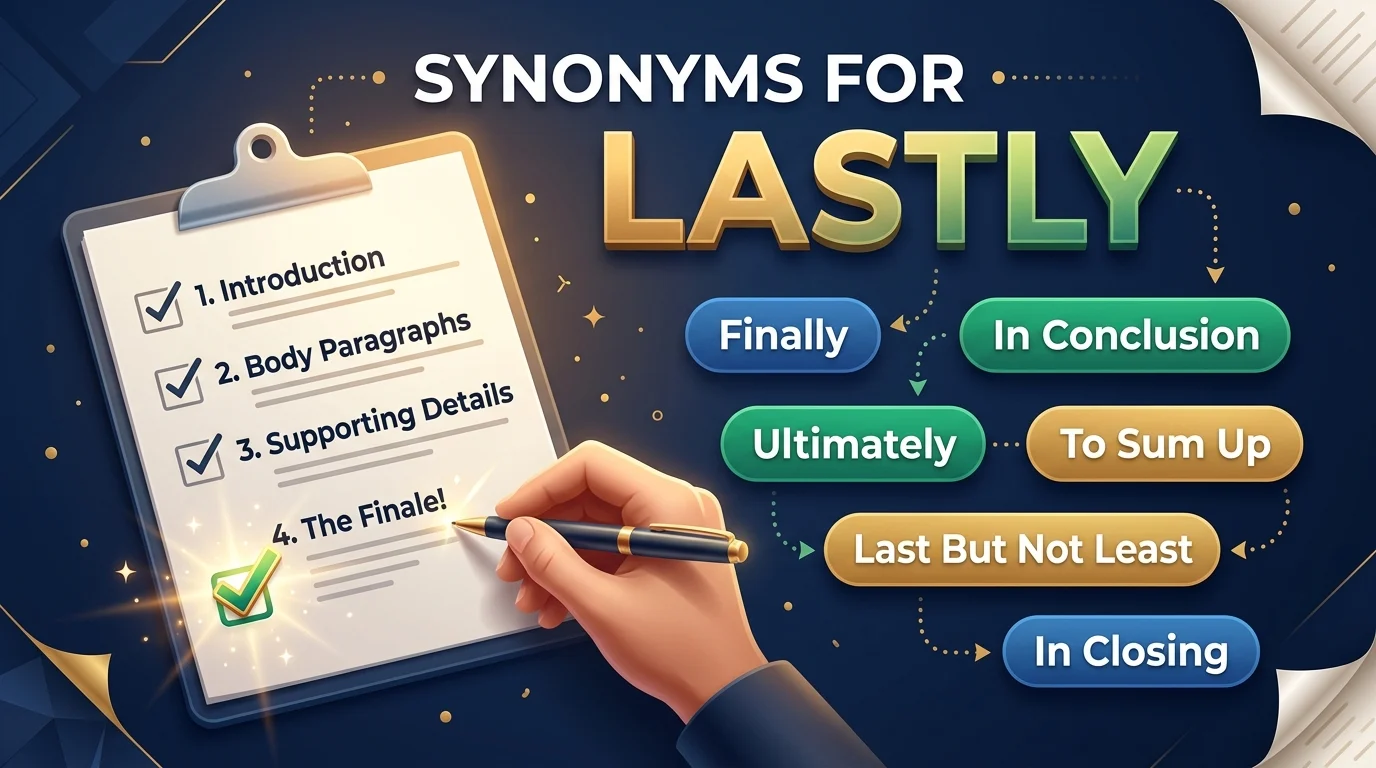
“Lastly” is an adverb used to introduce the final point in a list, sequence, or argument. It signals that what follows is the last item or the concluding thought. Depending on context, alternatives include finally, lastly, in conclusion, to conclude, ultimately, in the end, last but not least, to sum up, in summary, and as a final point.
Meaning, Tone, and Context
Simple Definition
“Lastly” generally refers to:
- Final item in a list: the last point in a series
- Concluding thought: the final idea in an argument or discussion
- Sequence marker: indicating the end of a process
- Summarizing transition: signaling that a conclusion is coming
- Closing statement: the final remark in a speech or presentation
Part of Speech
“Lastly” functions primarily as an adverb (specifically, a transition word or conjunctive adverb).
Examples:
- “Firstly, we need to gather data. Secondly, we analyze it. Lastly, we present our findings.”
- “Lastly, I would like to thank everyone for their support.”
Related Forms:
- Last (adjective/adverb): final
- Lastly (adverb): finally
- Finally (adverb): after a long time; in conclusion
- Ultimately (adverb): in the end
Positive, Negative, or Neutral Tone
“Lastly” is generally neutral. It is a functional word that organizes information.
Positive associations:
- “Lastly, I want to thank everyone for their hard work.”
Neutral contexts:
- “Lastly, the report recommends further research.”
Formality Level
“Lastly” is a standard word that works in both formal and informal English. It is especially common in academic writing, presentations, business reports, and speeches.
However, more specific alternatives can add variety and precision depending on the context.
Common Use Cases
“Lastly” commonly appears in:
- Academic writing: concluding an essay or argument
- Presentations: the final point on a slide
- Business reports: the last recommendation
- Speeches: closing remarks
- Instructional writing: the final step in a process
- Everyday conversation: the last item in a list
Important Word Forms
- Lastly (adverb): finally; as the last point
- Last (adjective/adverb): final
- Finally (adverb): after a long time; in conclusion
- Ultimately (adverb): in the end
- In conclusion (phrase): as a final summary
When and How to Use “Lastly”
Use “lastly” when you want to introduce the final point in a list, sequence, or argument. Because the word is functional, more specific alternatives can add variety depending on the context.
Professional
“Lastly, I want to emphasize the importance of meeting the deadline.”
This works naturally in business communication.
Academic
“Lastly, the study acknowledges several limitations.”
The term is appropriate in academic writing.
Personal
“Lastly, don’t forget to bring your ID.”
The word sounds natural in everyday conversation.
Presentations
“Lastly, let’s discuss the budget.”
This is standard in presentations.
Speeches
“Lastly, I want to thank my family for their support.”
This is common in speeches and closing remarks.
Instructional Writing
“Lastly, bake the cake for 30 minutes.”
This is standard in recipes and instructions.
Another Word for “Lastly”
There is no single perfect synonym because “lastly” can introduce a final list item, a concluding thought, a summary, or a closing statement.
- Final list item: finally, last, last but not least, as a final point
- Concluding thought: in conclusion, to conclude, ultimately, in the end
- Summarizing: to sum up, in summary, to summarize, all in all
- Closing statement: in closing, as a final note, before I close
- Sequence marker: finally, and finally, as the last step
If you need one broad alternative, “finally” is the most common and versatile, while “in conclusion” works for formal academic writing. “Last but not least” works for people or important final points.
When Not to Use “Lastly”
“Lastly” can become repetitive or mechanical if overused, especially in short pieces of writing.
Consider:
“Firstly, we need to plan. Secondly, we need to budget. Lastly, we need to execute.”
This is fine for a simple list, but in longer writing, varying your transitions sounds more natural:
“First, we need to plan. Next, we need to budget. Finally, we need to execute.”
Similarly, avoid using “lastly” when you mean “finally” in the sense of “after a long time.” Use “finally” for that meaning.
Example:
“After hours of waiting, the bus finally arrived.” (not “lastly”)
Words Commonly Confused With “Lastly”
Lastly vs. Finally
Finally can mean “at last” (after a long time) or “lastly” (in conclusion). Lastly only means “in conclusion.”
Example:
“Finally, the train arrived.” (after a long time)
“Lastly, I want to thank everyone.” (in conclusion)
Lastly vs. Ultimately
Ultimately means “in the end” or “fundamentally.” Lastly means “as the final point.”
Example:
“Ultimately, the decision is yours.” (in the end)
“Lastly, the decision is yours.” (final point)
Lastly vs. In Conclusion
In conclusion is more formal and signals a summary. Lastly is simpler and more list-oriented.
Example:
“In conclusion, the study proves the hypothesis.” (summary)
“Lastly, the study recommends further research.” (final point)
Lastly vs. At Last
At last means “finally” in the sense of after a long wait. Lastly does not carry this meaning.
Example:
“At last, we arrived home.” (after a long wait)
“Lastly, we arrived home.” (incorrect usage)
Lastly vs. In Summary
In summary signals a summary of the whole. Lastly signals the last point.
Example:
“In summary, the project was a success.” (summary)
“Lastly, the project was a success.” (final point)
Lastly vs. Last
Last is an adjective or adverb meaning “final.” Lastly is an adverb meaning “as the final point.”
Example:
“This is the last chapter.” (adjective)
“Lastly, we should consider the cost.” (adverb)
Best Synonym by Context for “Lastly”
| Context | Best Synonym | Why It Works | Example |
|---|---|---|---|
| Formal writing | In conclusion, to conclude | Precise and professional | In conclusion, the evidence supports the claim. |
| Academic writing | Finally, ultimately | Standard academic usage | Finally, the study acknowledges its limitations. |
| Business/Professional | Lastly, as a final point | Professional and clear | Lastly, I want to emphasize the deadline. |
| Presentations | Finally, and finally | Presentation-friendly | Finally, let’s discuss the budget. |
| Speeches | In closing, last but not least | Speech-friendly | In closing, I want to thank everyone. |
| Summarizing | To sum up, in summary | Summarizing | To sum up, the project was a success. |
| Instructional writing | Finally, as the last step | Instructional | Finally, bake the cake for 30 minutes. |
| Casual conversation | Lastly, finally | Natural and informal | Lastly, don’t forget your keys. |
| Essays | Ultimately, in the end | Essay-friendly | Ultimately, the decision rests with you. |
| Reports | In conclusion, to conclude | Report-friendly | In conclusion, the data supports the recommendation. |
| Emphasis on final item | Last but not least | Emphasizing importance | Last but not least, I want to thank my family. |
| Sequence marker | And finally | Simple sequence | And finally, add the salt. |
Which Synonym Should You Choose?
Start by identifying what kind of “lastly” you are expressing.
- Final list item: finally, last, last but not least, as a final point
- Concluding thought: in conclusion, to conclude, ultimately, in the end
- Summarizing: to sum up, in summary, to summarize, all in all
- Closing statement: in closing, as a final note, before I close
- Sequence marker: finally, and finally, as the last step
10 Key Synonyms for “Lastly”
The table below includes accurate alternatives with clear meanings and usage contexts.
| Synonym | Simple Meaning | Best Used For | Example Sentence |
|---|---|---|---|
| Finally | At last; in conclusion | General, all contexts | Finally, I want to thank everyone. |
| In conclusion | As a final summary | Formal, academic | In conclusion, the evidence is clear. |
| To conclude | As a final point | Formal, speeches | To conclude, the project was a success. |
| Ultimately | In the end | Essays, arguments | Ultimately, the choice is yours. |
| In the end | Finally; after all | General, reflective | In the end, it was worth it. |
| Last but not least | Finally, and importantly | People, important items | Last but not least, I thank my family. |
| To sum up | As a summary | Summarizing, presentations | To sum up, we need more funding. |
| In summary | As a summary | Formal, reports | In summary, the results are positive. |
| As a final point | As the last item | Professional, formal | As a final point, I want to mention the budget. |
| In closing | As a final statement | Speeches, formal | In closing, I want to thank you all. |
Synonym Groups and Usage Differences
Professional vs. Personal Synonyms
Professional writing benefits from specific terms such as in conclusion, to conclude, as a final point, and in summary.
Personal communication often uses lastly itself or casual alternatives like finally, last, or and finally.
Compare:
“Lastly, don’t forget your keys.” (personal)
“In conclusion, the data supports the recommendation.” (professional)
Formal vs. Conversational Synonyms
Lastly works in both formal and conversational English.
Formal alternatives: in conclusion, to conclude, ultimately, in summary
Conversational alternatives: finally, last, and finally
Examples:
“In conclusion, the evidence supports the claim.” (formal)
“Finally, let’s grab some lunch.” (conversational)
Academic Synonyms
Academic writing should distinguish between finally (sequence), in conclusion (summary), ultimately (end result), and lastly (final point).
For example:
“Finally, the study acknowledges several limitations.”
“In conclusion, the evidence supports the hypothesis.”
Professional and Business Synonyms
Business writing often benefits from phrases such as in conclusion, to conclude, as a final point, and in summary.
Instead of:
“Lastly, I want to emphasize the deadline.”
Consider:
“As a final point, I want to emphasize the importance of meeting the deadline.”
Creative or Literary Synonyms
Creative writing can use in the end, ultimately, at last, and finally depending on the context.
For example:
“In the end, they found their way home.”
“At last, the sun broke through the clouds.”
Slang or Modern Synonyms
Lastly is common in casual speech.
Last is casual for lastly.
And finally is common in casual lists.
Last thing is casual.
Examples:
“Last thing, don’t forget to lock up.” (casual)
“And finally, add the salt.” (casual)
Strongest vs. Weaker Synonyms
“Lastly” synonyms vary in formality and emphasis:
Milder: last, and finally
Moderate: lastly, finally
Strong: in conclusion, to conclude
Very Strong: last but not least, in closing
Emotional vs. Neutral Synonyms
“Lastly” is generally neutral.
Emotional alternatives: last but not least (warmth), in closing (formality)
Neutral alternatives: finally, lastly, last
Examples:
“Last but not least, I thank my family.” (emotional, warm)
“Lastly, the report recommends further research.” (neutral)
Antonyms of “Lastly”
“Lastly” has several antonyms depending on context:
| Antonym | Context | Meaning | Example Sentence |
|---|---|---|---|
| Firstly | Sequence | The first point | Firstly, we need to plan. |
| First | Sequence | Initial point | First, let’s review the data. |
| Initially | Sequence | At the beginning | Initially, we were unsure. |
| To begin with | Sequence | At the start | To begin with, let’s define the terms. |
| First of all | Sequence | Before anything else | First of all, I want to thank you. |
Comparison: “Lastly” vs. Similar Words
Lastly vs. Finally
Main difference: Finally can mean “at last” (after a long time) or “lastly” (in conclusion). Lastly only means “in conclusion.”
Examples:
“Finally, the train arrived.” (after a long time)
“Lastly, I want to thank everyone.” (in conclusion)
Lastly vs. Ultimately
Main difference: Ultimately means “in the end” or “fundamentally.” Lastly means “as the final point.”
Examples:
“Ultimately, the decision is yours.” (in the end)
“Lastly, the decision is yours.” (final point)
Lastly vs. In Conclusion
Main difference: In conclusion is more formal and signals a summary. Lastly is simpler and more list-oriented.
Examples:
“In conclusion, the study proves the hypothesis.” (summary)
“Lastly, the study recommends further research.” (final point)
Lastly vs. At Last
Main difference: At last means “finally” in the sense of after a long wait. Lastly does not carry this meaning.
Examples:
“At last, we arrived home.” (after a long wait)
“Lastly, we arrived home.” (incorrect usage)
Lastly vs. In Summary
Main difference: In summary signals a summary of the whole. Lastly signals the last point.
Examples:
“In summary, the project was a success.” (summary)
“Lastly, the project was a success.” (final point)
Lastly vs. Last
Main difference: Last is an adjective or adverb meaning “final.” Lastly is an adverb meaning “as the final point.”
Examples:
“This is the last chapter.” (adjective)
“Lastly, we should consider the cost.” (adverb)
Common Phrases and Expressions with “Lastly”
1. Last but not least
Meaning:
Finally, and equally important.
Example:
“Last but not least, I want to thank my family.”
2. And lastly
Meaning:
As the final item.
Example:
“And lastly, add a pinch of salt.”
3. Lastly, but importantly
Meaning:
As the final and important point.
Example:
“Lastly, but importantly, we must consider safety.”
4. In closing
Meaning:
As a final statement.
Example:
“In closing, I want to thank you all.”
5. To conclude
Meaning:
As a final point.
Example:
“To conclude, the project was a success.”
6. In conclusion
Meaning:
As a final summary.
Example:
“In conclusion, the evidence is clear.”
7. To sum up
Meaning:
As a summary.
Example:
“To sum up, we need more funding.”
8. In summary
Meaning:
As a summary.
Example:
“In summary, the results are positive.”
9. As a final point
Meaning:
As the last item.
Example:
“As a final point, I want to mention the budget.”
10. Ultimately
Meaning:
In the end.
Example:
“Ultimately, the choice is yours.”
Common Mistakes to Avoid
1. Overusing “lastly” in writing
Repetition can make content feel mechanical. Use alternatives such as finally, in conclusion, ultimately, and in summary.
Repetitive: “Firstly… Secondly… Lastly…”
Improved: “First… Next… Finally…”
2. Confusing “lastly” with “finally”
Finally can mean “at last” (after a long time). Lastly only means “in conclusion.”
Incorrect: “Lastly, the bus arrived.” (if after a long wait)
Correct: “Finally, the bus arrived.”
3. Using “lastly” in academic writing when “in conclusion” is needed
Academic writing often benefits from more formal conclusions.
Informal: “Lastly, the study has limitations.”
Formal: “In conclusion, the study acknowledges several limitations.”
4. Using “lastly” when “last but not least” is more appropriate
For people or important final points, “last but not least” is warmer.
Flat: “Lastly, I thank my family.”
Warm: “Last but not least, I thank my family.”
5. Choosing a synonym that changes the meaning
Do not replace lastly with ultimately unless you mean “in the end.”
Do not replace lastly with at last unless you mean “after a long time.”
FAQs
What is the best synonym for “lastly”?
The best synonym depends on context. Finally works for general use, in conclusion for formal writing, ultimately for arguments, last but not least for people, and to sum up for summaries.
What is a formal synonym for “lastly”?
In conclusion, to conclude, ultimately, and in summary are formal synonyms.
What is an informal synonym for “lastly”?
Finally, last, and and finally are common informal alternatives.
What is another word for “lastly” in creative writing?
In the end, ultimately, at last, and finally work well in creative writing.
What is the difference between “lastly” and “finally”?
Finally can mean “at last” (after a long time) or “lastly” (in conclusion). Lastly only means “in conclusion.”
What is the opposite of “lastly”?
Depending on context, opposites include firstly, first, initially, to begin with, and first of all.
What does “last but not least” mean?
“Last but not least” means “finally, and equally important”—used to introduce the last item in a list while emphasizing its importance.
Conclusion
“Lastly” is a useful and functional word that can introduce a final list item, a concluding thought, a summary, or a closing statement. The best synonym depends on what you actually mean.
Choose finally for general use, in conclusion for formal writing, ultimately for arguments, last but not least for people, to sum up for summaries, and in closing for speeches.
Most importantly, do not replace “lastly” simply to avoid repetition. First identify what kind of conclusion—list item, summary, or closing statement—you are actually making. Then choose the alternative that communicates that idea most clearly.
For academic, professional, and formal writing, precision and variety are usually more valuable than repetition. A specific transition such as in conclusion, ultimately, or in summary can make your writing clearer and more sophisticated.
Before publishing a vocabulary guide, verify definitions and usage with trusted dictionaries such as Cambridge, Oxford, Merriam-Webster, Collins, or Britannica. This helps ensure that each alternative accurately matches its intended meaning and context.
The practical takeaway is simple: when “lastly” feels repetitive or mechanical, ask yourself what kind of conclusion you are actually making. Then use the most precise and appropriate transition word available.
