Do you keep using the word “blue” in essays, creative writing, product descriptions, design content, or everyday conversation? While it is one of the most common and universally understood color words in English, repeating it can make your writing feel flat, repetitive, or overly simple.
The good news is that the best alternative depends on what you actually mean. You might be describing a specific shade of blue, a mood or emotion, a style of humor, a type of music, or a symbolic meaning.
This guide explains synonyms for “blue” by meaning, tone, context, and usage. You will learn which alternatives work best in creative writing, design and fashion, academic writing, professional communication, and casual conversation.
Quick Answer: What Does “Blue” Mean?
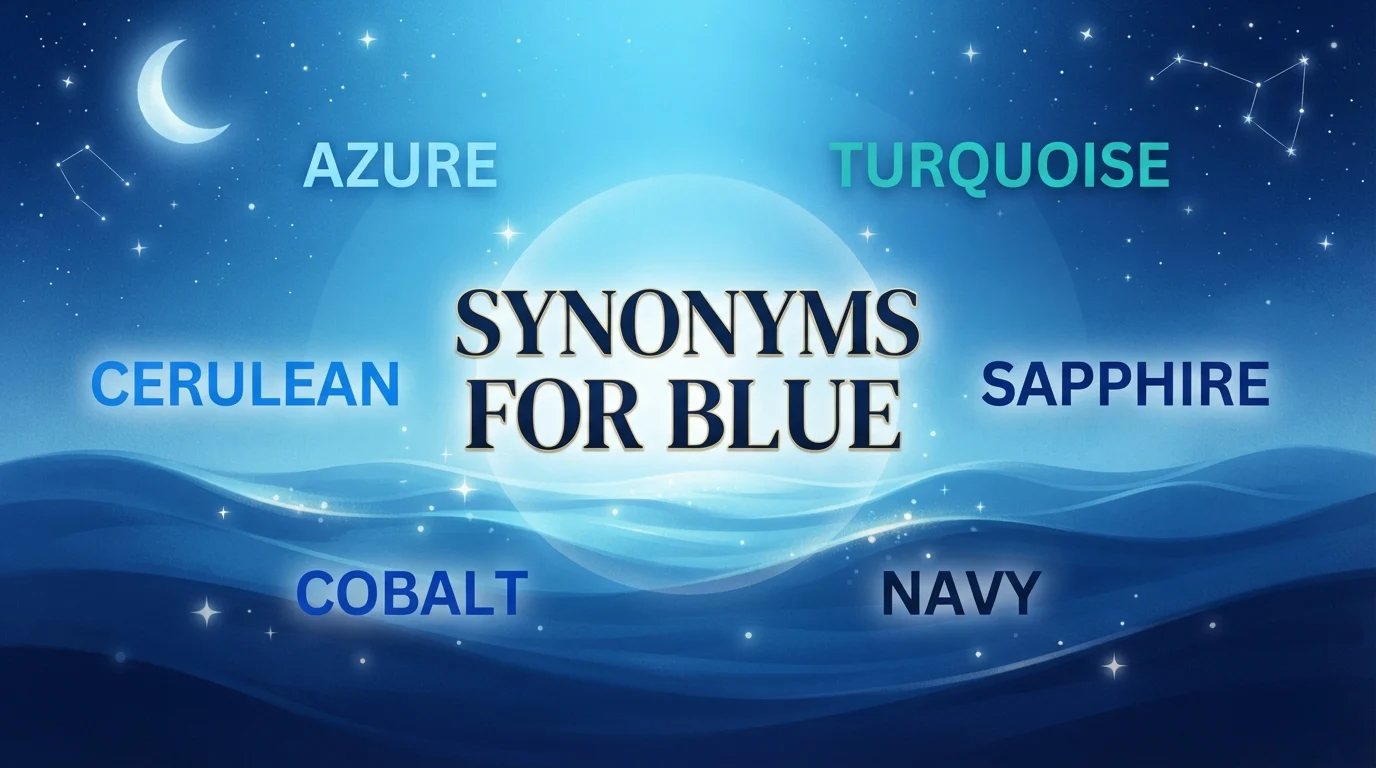
“Blue” refers to the color between green and violet in the spectrum, but it can also describe a mood (sadness), a type of humor (off-color), a genre of music (blues), or a symbolic meaning (loyalty, calm, or nobility). Depending on context, alternatives include azure, cobalt, navy, sapphire, cerulean, indigo, turquoise, downcast, melancholy, gloomy, risqué, and depressed.
Meaning, Tone, and Context
Simple Definition
“Blue” generally refers to:
- A color: the hue between green and violet
- A mood: sadness, melancholy, or depression
- A type of humor: risqué, indecent, or off-color
- A music genre: blues music
- A symbol: loyalty, calm, trust, or nobility
Part of Speech
“Blue” functions primarily as an adjective and a noun, and occasionally as a verb.
Adjective Examples:
- “She wore a blue dress.”
- “He felt blue after the news.”
Noun Examples:
- “Blue is my favorite color.”
- “The sky was a deep blue.”
Verb Examples:
- “They blued the metal.” (to treat with a blue coating)
- “The sky blued as the sun set.” (less common)
Related Forms:
- Bluish (adjective): somewhat blue
- Bluely (adverb): in a blue manner (rare)
- Blueness (noun): the quality of being blue
- Bluey (adjective): somewhat blue (informal)
Positive, Negative, or Neutral Tone
“Blue” is generally neutral in its color sense, but it can be positive or negative in other contexts.
Positive associations:
- “Blue represents calm and trust.”
- “The blue sky was beautiful.”
Negative contexts:
- “He felt blue after losing his job.” (sadness)
- “The comedian told blue jokes.” (risqué)
Neutral contexts:
- “The blue car is parked outside.”
- “She painted the wall blue.”
Formality Level
“Blue” is a standard word that works in both formal and informal English. It is appropriate in academic papers, business reports, creative writing, design content, and casual conversation.
However, more specific alternatives can add precision and variety, especially in creative and design contexts.
Common Use Cases
“Blue” commonly refers to:
- Color: blue sky, blue dress, blue paint
- Mood: feeling blue, blue Monday
- Humor: blue comedy, blue language
- Music: blues music, blue notes
- Symbolism: blue ribbon, blue blood, blue chip
- Nature: blue ocean, blue whale, blue jay
Important Word Forms
- Blue (adjective): having the color blue; sad
- Blue (noun): the color blue; sadness
- Blue (verb): to make blue; to treat with blue
- Bluish (adjective): somewhat blue
- Blueness (noun): the quality of being blue
- Blues (noun): a music genre; sadness
When and How to Use “Blue”
Use “blue” when you want to describe the color, a mood, a type of humor, or a symbolic meaning. Because the word is broad, more specific alternatives can add precision depending on the context.
Creative Writing
“The blue of the ocean stretched endlessly to the horizon.”
This creates a vivid, expansive image.
Design and Fashion
“The designer chose a deep navy blue for the collection.”
This is precise and professional in design contexts.
Academic
“The study examined the psychological effects of the color blue.”
The term is appropriate in academic research.
Personal
“I’m feeling a bit blue today.”
The word sounds natural in everyday conversation.
Business
“Blue-chip stocks are considered safe investments.”
This is standard in financial contexts.
Music
“The blues originated in the African American communities of the Deep South.”
This is appropriate in music history contexts.
Another Word for “Blue”
There is no single perfect synonym because “blue” can refer to a specific color shade, a mood, a type of humor, a music genre, or a symbolic meaning.
- Light blue: sky blue, baby blue, powder blue, azure, cerulean
- Medium blue: cobalt, sapphire, royal blue, cornflower
- Dark blue: navy, indigo, midnight blue, Prussian blue
- Greenish blue: turquoise, teal, aqua, cyan
- Purplish blue: periwinkle, violet-blue, lavender-blue
- Mood: sad, downcast, melancholy, gloomy, depressed
- Humor: risqué, indecent, off-color, coarse, vulgar
- Symbolism: loyal, calm, trustworthy, noble
If you need one broad alternative, “azure” works for light blue, “navy” for dark blue, and “melancholy” for the mood.
When Not to Use “Blue”
“Blue” can become too vague when you need to specify exactly which shade or meaning you are describing.
Consider:
“She wore a blue dress.”
This statement does not tell readers whether the dress was light blue, navy, turquoise, or royal blue.
A more precise sentence could be:
“She wore a navy blue dress with silver accents.”
Similarly, avoid using “blue” when you mean “sad” in a formal context. Use “melancholy”, “despondent”, or “dejected” instead.
Words Commonly Confused With “Blue”
Blue vs. Azure
Azure is a bright, light blue, often associated with the sky. Blue is the general term.
Example:
“The azure sky was cloudless.” (specific shade)
“The blue sky was beautiful.” (general)
Blue vs. Navy
Navy is a dark blue. Blue is the general term.
Example:
“He wore a navy suit.” (specific shade)
“He wore a blue suit.” (general)
Blue vs. Sad
Sad is a general emotion. Blue is a milder, more casual term for sadness.
Example:
“She felt sad after the movie.” (general)
“She felt blue after the movie.” (milder, casual)
Blue vs. Melancholy
Melancholy is a deep, pensive sadness. Blue is milder and more casual.
Example:
“A melancholy mood settled over him.” (deep)
“He felt a bit blue.” (mild)
Blue vs. Risqué
Risqué means slightly indecent or suggestive. Blue can mean the same but is more informal.
Example:
“The comedian told risqué jokes.” (formal)
“The comedian told blue jokes.” (informal)
Blue vs. Teal
Teal is a greenish-blue. Blue is the general term.
Example:
“She painted the room teal.” (specific shade)
“She painted the room blue.” (general)
Best Synonym by Context for “Blue”
| Context | Best Synonym | Why It Works | Example |
|---|---|---|---|
| Formal writing | Azure, cerulean | Precise and elegant | The azure sky stretched endlessly. |
| Academic writing | Blue (itself) | Standard academic usage | The study examined the color blue. |
| Creative writing | Azure, cerulean, sapphire, cobalt | Adds vivid imagery | The cerulean waves crashed on the shore. |
| Design/fashion | Navy, cobalt, royal blue, turquoise | Precise color terms | The designer chose a cobalt blue. |
| Mood | Melancholy, downcast, dejected | Emotional and precise | He felt melancholy after the news. |
| Humor | Risqué, off-color, coarse | Describes adult humor | The comedian told off-color jokes. |
| Music | Blues | Music genre | The blues originated in the Deep South. |
| Symbolism | Loyal, trustworthy, calm | Symbolic meaning | Blue represents trust and stability. |
| Nature | Azure, cerulean, turquoise | Describes natural beauty | The turquoise waters of the lagoon. |
| Casual conversation | Blue (itself), down | Natural and informal | I’m feeling a bit down today. |
| Business | Blue-chip, corporate | Financial context | Blue-chip stocks are considered safe. |
| Fashion | Navy, indigo, sapphire | Fashion and style | She wore a stunning sapphire gown. |
Which Synonym Should You Choose?
Start by identifying what kind of “blue” you are describing.
- Light blue: sky blue, baby blue, powder blue, azure, cerulean
- Medium blue: cobalt, sapphire, royal blue, cornflower
- Dark blue: navy, indigo, midnight blue, Prussian blue
- Greenish blue: turquoise, teal, aqua, cyan
- Purplish blue: periwinkle, violet-blue, lavender-blue
- Mood: sad, downcast, melancholy, gloomy, depressed
- Humor: risqué, indecent, off-color, coarse, vulgar
- Symbolism: loyal, calm, trustworthy, noble
10 Key Synonyms for “Blue”
The table below includes accurate alternatives with clear meanings and usage contexts.
| Synonym | Simple Meaning | Best Used For | Example Sentence |
|---|---|---|---|
| Azure | Bright, light blue | Sky, creative writing | The azure sky was cloudless. |
| Cobalt | Deep, vivid blue | Design, fashion | She chose a cobalt blue dress. |
| Navy | Dark blue | Fashion, business | He wore a navy suit. |
| Sapphire | Rich, deep blue | Jewelry, fashion | The sapphire gown was stunning. |
| Cerulean | Sky blue | Creative, literary | The cerulean waves crashed on the shore. |
| Indigo | Deep blue-violet | Design, nature | The indigo night sky was breathtaking. |
| Turquoise | Greenish-blue | Nature, fashion | The turquoise waters were crystal clear. |
| Melancholy | Deep sadness | Mood, literary | A melancholy mood settled over him. |
| Downcast | Sad, dejected | Mood, general | He looked downcast after the news. |
| Risqué | Slightly indecent | Humor, informal | The comedian told risqué jokes. |
Synonym Groups and Usage Differences
Professional vs. Personal Synonyms
Professional writing, especially in design and fashion, benefits from specific terms such as azure, cobalt, navy, sapphire, and turquoise.
Personal communication often uses blue itself or casual alternatives like down, blue, or melancholy.
Compare:
“I’m feeling blue today.” (personal)
“She chose a navy blue dress.” (professional)
Formal vs. Conversational Synonyms
Blue works in both formal and conversational English.
Formal alternatives: azure, cerulean, sapphire, melancholy
Conversational alternatives: blue, down, navy
Examples:
“The azure sky was breathtaking.” (formal)
“The sky was a beautiful blue.” (conversational)
Academic Synonyms
Academic writing should distinguish between blue (general), azure (light blue), navy (dark blue), and melancholy (mood).
For example:
“The study examined the psychological effects of the color blue.”
“Azure and cerulean are shades of blue.”
Professional and Business Synonyms
Business writing often benefits from phrases such as blue-chip, corporate blue, navy, and royal blue.
Instead of:
“The company uses blue in its branding.”
Consider:
“The company uses a deep navy blue in its branding to convey trust.”
Creative or Literary Synonyms
Creative writing can use azure, cerulean, sapphire, indigo, cobalt, and turquoise depending on the context.
For example:
“The cerulean waves crashed against the sapphire cliffs.”
“The indigo night sky was filled with stars.”
Slang or Modern Synonyms
Blue is common in casual speech for sadness.
Down is a common casual alternative.
Feeling blue is a common idiom.
Blue can mean risqué in comedy contexts.
Examples:
“I’m feeling a bit blue today.” (casual)
“The comedian told blue jokes.” (informal)
Strongest vs. Weaker Synonyms
“Blue” synonyms vary in intensity:
Milder: down, blue, melancholic
Moderate: melancholy, dejected
Strong: despondent, depressed
Very Strong: despairing, grief-stricken
Emotional vs. Neutral Synonyms
“Blue” is generally neutral in color contexts but emotional in mood contexts.
Emotional alternatives: melancholy, downcast, dejected, despondent
Neutral alternatives: azure, cobalt, navy, cerulean
Examples:
“He felt deeply melancholy.” (emotional)
“The azure sky was clear.” (neutral)
Antonyms of “Blue”
“Blue” has several antonyms depending on context:
| Antonym | Context | Meaning | Example Sentence |
|---|---|---|---|
| Orange | Color | Complementary color | Orange is opposite blue on the color wheel. |
| Yellow | Color | Warm color | Yellow is a cheerful color. |
| Happy | Mood | Feeling joy | She felt happy after the news. |
| Cheerful | Mood | Positive and upbeat | He was cheerful all day. |
| Elated | Mood | Extremely happy | She was elated by the results. |
| Decent | Humor | Proper and modest | The comedian told decent jokes. |
Comparison: “Blue” vs. Similar Words
Blue vs. Azure
Main difference: Azure is a bright, light blue, often associated with the sky. Blue is the general term.
Examples:
“The azure sky was cloudless.” (specific shade)
“The blue sky was beautiful.” (general)
Blue vs. Navy
Main difference: Navy is a dark blue. Blue is the general term.
Examples:
“He wore a navy suit.” (specific shade)
“He wore a blue suit.” (general)
Blue vs. Sad
Main difference: Sad is a general emotion. Blue is a milder, more casual term for sadness.
Examples:
“She felt sad after the movie.” (general)
“She felt blue after the movie.” (milder, casual)
Blue vs. Melancholy
Main difference: Melancholy is a deep, pensive sadness. Blue is milder and more casual.
Examples:
“A melancholy mood settled over him.” (deep)
“He felt a bit blue.” (mild)
Blue vs. Risqué
Main difference: Risqué means slightly indecent or suggestive. Blue can mean the same but is more informal.
Examples:
“The comedian told risqué jokes.” (formal)
“The comedian told blue jokes.” (informal)
Blue vs. Teal
Main difference: Teal is a greenish-blue. Blue is the general term.
Examples:
“She painted the room teal.” (specific shade)
“She painted the room blue.” (general)
Common Phrases and Expressions with “Blue”
1. Feeling blue
Meaning:
Feeling sad or depressed.
Example:
“She’s been feeling blue since the breakup.”
2. Out of the blue
Meaning:
Suddenly and unexpectedly.
Example:
“The news came out of the blue.”
3. Blue Monday
Meaning:
A depressing Monday, often the third Monday in January.
Example:
“Blue Monday is considered the most depressing day of the year.”
4. Blue-chip
Meaning:
Reliable and profitable (stocks).
Example:
“Blue-chip stocks are considered safe investments.”
5. Blue blood
Meaning:
Noble or aristocratic ancestry.
Example:
“She comes from blue blood.”
6. Once in a blue moon
Meaning:
Very rarely.
Example:
“He visits once in a blue moon.”
7. Blue ribbon
Meaning:
First prize; highest quality.
Example:
“The pie won a blue ribbon at the fair.”
8. Blue-collar
Meaning:
Relating to manual labor.
Example:
“He comes from a blue-collar family.”
9. Blue in the face
Meaning:
Exhausted from effort.
Example:
“I argued until I was blue in the face.”
10. Blue comedy
Meaning:
Risqué or indecent humor.
Example:
“The comedian was known for his blue comedy.”
Common Mistakes to Avoid
1. Using “blue” when a more precise color term is available
If you mean azure, navy, cobalt, or turquoise, use the more specific word.
Vague: “She wore a blue dress.”
Precise: “She wore a navy blue dress.”
2. Confusing “blue” with “sad” in formal writing
In formal writing, use melancholy, despondent, or dejected instead of blue.
Informal: “He felt blue.”
Formal: “He felt despondent.”
3. Using “blue” for “risqué” in professional contexts
In professional contexts, use risqué, off-color, or indecent instead of blue.
Informal: “He told blue jokes.”
Formal: “He told risqué jokes.”
4. Overusing “blue” in writing
Repetition can make content feel dull. Use alternatives such as azure, cobalt, navy, sapphire, and cerulean.
5. Choosing a synonym that changes the meaning
Do not replace blue with sad unless you mean the mood.
Do not replace blue with navy unless you mean the dark shade.
FAQs
What is the best synonym for “blue”?
The best synonym depends on context. Azure works for light blue, navy for dark blue, sapphire for rich blue, melancholy for mood, and risqué for humor.
What is a formal synonym for “blue”?
Azure, cerulean, cobalt, sapphire, and melancholy are formal synonyms.
What is an informal synonym for “blue”?
Down, blue, and feeling blue are common informal alternatives for sadness.
What is another word for “blue” in creative writing?
Azure, cerulean, sapphire, indigo, cobalt, and turquoise work well in creative writing.
What is the difference between “blue” and “azure”?
Azure is a bright, light blue, often associated with the sky. Blue is the general term.
What is the opposite of “blue”?
Depending on context, opposites include orange, yellow, happy, cheerful, and decent.
What does “blue” mean in a business context?
In business, blue often refers to blue-chip stocks (reliable, profitable companies) or blue-collar workers (manual labor).
Conclusion
“Blue” is a versatile and essential word that can describe a color, a mood, a type of humor, a music genre, or a symbolic meaning. The best synonym depends on what you actually mean.
Choose azure or cerulean for light blue, navy or indigo for dark blue, cobalt or sapphire for rich blue, turquoise for greenish-blue, melancholy for sadness, and risqué for adult humor.
Most importantly, do not replace “blue” simply to avoid repetition. First identify what kind of blue—color, mood, humor, or symbol—you are actually describing. Then choose the alternative that communicates that idea most clearly.
For academic, professional, and design writing, precision is usually more valuable than vocabulary variety. A specific term such as azure, navy, cobalt, or turquoise can tell readers much more than the broad word blue.
Before publishing a vocabulary guide, verify definitions and usage with trusted dictionaries such as Cambridge, Oxford, Merriam-Webster, Collins, or Britannica. This helps ensure that each alternative accurately matches its intended meaning and context.
The practical takeaway is simple: when “blue” feels too general, ask yourself what kind of blue—color, mood, humor, or symbol—you are actually describing. Then use the most precise word available.
