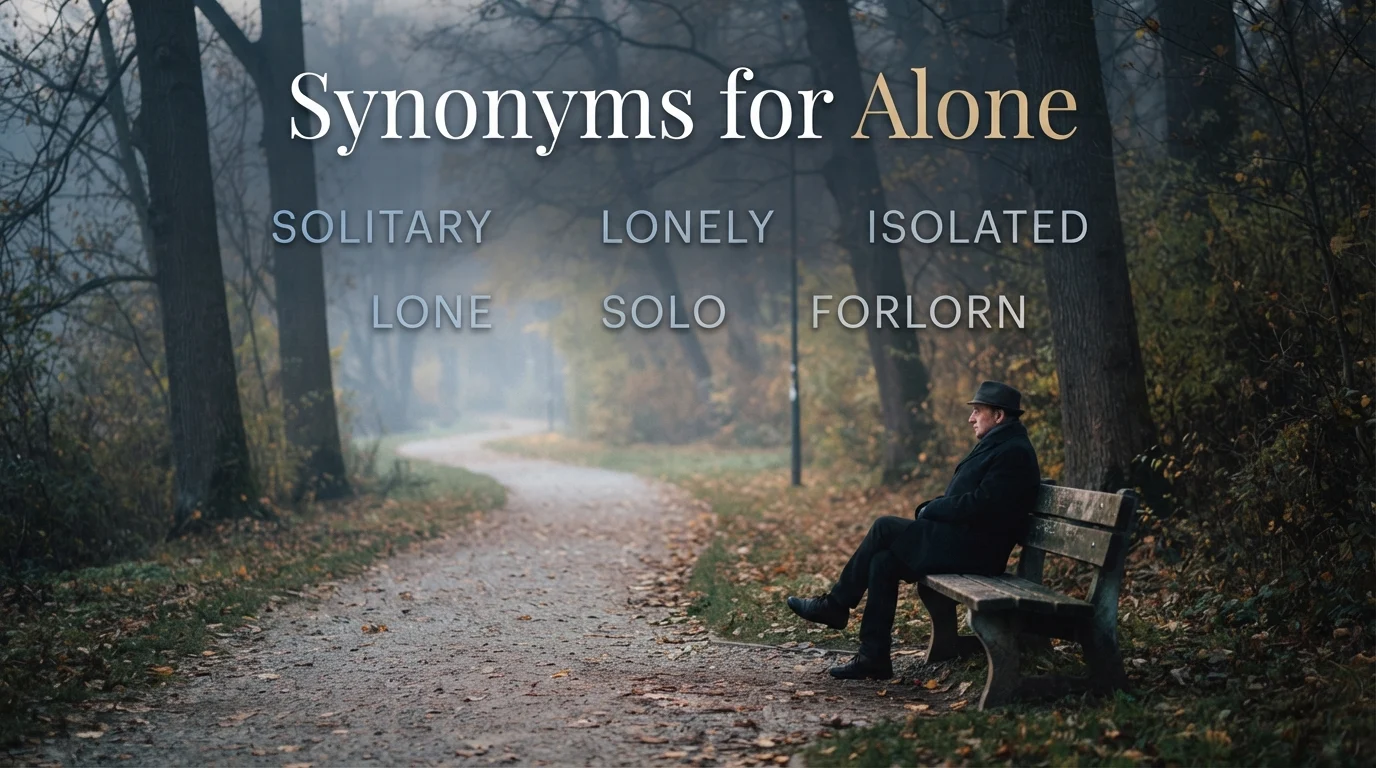
Do you keep using the word “alone” in essays, blog posts, creative writing, mental health content, or everyday conversation? While it is one of the most common and emotionally powerful words in English, repeating it can make your writing feel flat, vague, or overly simplistic.
The good news is that the best alternative depends on what you actually mean. You might be describing physical solitude, emotional isolation, independence, loneliness, or being the only one in a situation.
This guide explains synonyms for “alone” by meaning, tone, context, and usage. You will learn which alternatives work best in academic writing, creative expression, mental health content, professional communication, and casual conversation.
Quick Answer: What Does “Alone” Mean?
“Alone” describes being without other people, having no one else present, or being the only one in a situation. It can be neutral (solitude), positive (independence), or negative (loneliness). Depending on context, alternatives include solitary, lone, isolated, solitude, unaccompanied, single-handedly, by oneself, solo, friendless, and desolate.
Meaning, Tone, and Context
Simple Definition
“Alone” generally refers to:
- Physical solitude: being without other people
- Emotional isolation: feeling disconnected or lonely
- Independence: doing something without help
- Exclusivity: being the only one involved
- Uniqueness: standing apart from others
Part of Speech
“Alone” functions as an adjective and an adverb.
Adjective Examples:
- “She was alone in the house.”
- “He felt alone in his beliefs.”
Adverb Examples:
- “She did it alone.”
- “He lived alone for years.”
Related Forms:
- Lonely (adjective): sad because of being alone
- Loneliness (noun): the state of being lonely
- Solitude (noun): the state of being alone
- Solitary (adjective): done alone; preferring to be alone
- Lonesome (adjective): sad from being alone
Positive, Negative, or Neutral Tone
“Alone” is generally neutral, but it can be positive or negative depending on context.
Positive associations:
- “She enjoyed being alone with her thoughts.”
- “He built the company alone.”
Negative contexts:
- “He felt alone and abandoned.”
- “She was alone in a foreign country.”
Neutral contexts:
- “She lives alone.”
- “The house stood alone on the hill.”
Formality Level
“Alone” is a standard word that works in both formal and informal English. It is appropriate in academic papers, business reports, creative writing, and casual conversation.
However, more specific alternatives can add precision and variety depending on the context.
Common Use Cases
“Alone” commonly refers to:
- Physical solitude: living alone, being alone in a room
- Emotional isolation: feeling alone, feeling abandoned
- Independence: doing something alone, working alone
- Exclusivity: you alone can do it, she alone knew
- Nature: a lone tree, a solitary flower
Important Word Forms
- Alone (adjective/adverb): without others
- Lonely (adjective): sad because of being alone
- Loneliness (noun): the state of being lonely
- Solitude (noun): the state of being alone
- Solitary (adjective): done alone; preferring to be alone
- Lonesome (adjective): sad from being alone
- Solitary (noun): a person who lives alone
When and How to Use “Alone”
Use “alone” when you want to describe being without other people or being the only one in a situation. Because the word is broad, more specific alternatives can add precision depending on the context.
Professional
“She completed the project alone.”
This works naturally in business communication.
Academic
“The study examined the effects of living alone on mental health.”
The term is appropriate in academic research.
Personal
“I just want to be alone right now.”
The word sounds natural in everyday conversation.
Creative
“The lone figure walked through the empty streets.”
The word creates a vivid, atmospheric image.
Mental Health
“Many senior people experience loneliness and isolation.”
This is appropriate in mental health contexts.
Nature
“A solitary tree stood on the hilltop.”
The word creates a peaceful, natural image.
Another Word for “Alone”
There is no single perfect synonym because “alone” can refer to physical solitude, emotional isolation, independence, exclusivity, or uniqueness.
- Physical solitude: solitary, lone, unaccompanied, by oneself, solo
- Emotional isolation: lonely, isolated, friendless, desolate, forlorn
- Independence: independently, single-handedly, on one’s own, solo
- Exclusivity: solely, exclusively, only, uniquely
- Uniqueness: unique, singular, apart, distinct
If you need one broad alternative, “solitary” works for physical solitude, while “lonely” works for emotional isolation. “Solo” works for independence.
When Not to Use “Alone”
“Alone” can become too vague or emotionally loaded when you need to specify exactly what kind of aloneness you are describing.
Consider:
“She was alone.”
This statement does not tell readers whether she was physically alone, emotionally lonely, independent, or isolated.
A more precise sentence could be:
“She was physically alone, but she felt deeply lonely.”
Similarly, avoid using “alone” when you mean “lonely” in emotional contexts. Use “lonely” or “isolated” instead.
Words Commonly Confused With “Alone”
Alone vs. Lonely
Alone means without others. Lonely means sad because of being alone.
Example:
“She lives alone but doesn’t feel lonely.” (physical vs. emotional)
“He felt lonely even in a crowd.” (emotional)
Alone vs. Solitary
Solitary means done alone or preferring to be alone. Alone is broader.
Example:
“He enjoys solitary walks.” (preference)
“She lives alone.” (fact)
Alone vs. Isolated
Isolated means separated from others, often forcefully or geographically. Alone is broader.
Example:
“The village was isolated by the flood.” (separated)
“She was alone in the house.” (without others)
Alone vs. Lone
Lone means being the only one; solitary. It is often used before a noun.
Example:
“A lone wolf howled in the distance.” (only one)
“She was alone in the forest.” (without others)
Alone vs. Solo
Solo means done alone, especially in performance or adventure. Alone is broader.
Example:
“She performed solo.” (performance)
“She traveled alone.” (general)
Alone vs. Solely
Solely means only or exclusively. Alone can mean without others.
Example:
“The decision was solely hers.” (exclusively)
“She made the decision alone.” (without help)
Best Synonym by Context for “Alone”
| Context | Best Synonym | Why It Works | Example |
|---|---|---|---|
| Formal writing | Solitary, unaccompanied | Precise and professional | The solitary figure walked through the streets. |
| Academic writing | Isolated, solitary | Standard academic usage | The study examined isolated individuals. |
| Business/Professional | Independently, single-handedly | Professional and clear | She completed the project independently. |
| Emotional context | Lonely, forlorn, desolate | Emotional and expressive | He felt lonely despite being surrounded by people. |
| Creative writing | Lone, solitary, forlorn | Adds literary depth | The lone tree stood on the hill. |
| Mental health | Isolated, lonely | Clinical and empathetic | Social isolation affects mental health. |
| Nature | Solitary, lone | Natural and peaceful | A solitary flower bloomed in the desert. |
| Casual conversation | By myself, on my own | Natural and informal | I did it by myself. |
| Independence | Solo, independently | Emphasizes self-reliance | She traveled solo across Europe. |
| Exclusivity | Solely, exclusively | Emphasizes only one | She alone knew the truth. |
| Abandonment | Deserted, abandoned, forsaken | Emphasizes loss | He felt abandoned and alone. |
| Unique | Singular, unique, apart | Emphasizes standing out | She stood apart from the crowd. |
Which Synonym Should You Choose?
Start by identifying what kind of “alone” you are describing.
- Physical solitude: solitary, lone, unaccompanied, by oneself, solo
- Emotional isolation: lonely, isolated, friendless, desolate, forlorn
- Independence: independently, single-handedly, on one’s own, solo
- Exclusivity: solely, exclusively, only, uniquely
- Uniqueness: unique, singular, apart, distinct
10 Key Synonyms for “Alone”
The table below includes accurate alternatives with clear meanings and usage contexts.
| Synonym | Simple Meaning | Best Used For | Example Sentence |
|---|---|---|---|
| Solitary | Done alone; preferring to be alone | General, creative | He enjoyed solitary walks. |
| Lonely | Sad because of being alone | Emotional, mental health | She felt lonely in the new city. |
| Isolated | Separated from others | Physical, social, academic | The village was isolated by the storm. |
| Lone | Being the only one | Creative, nature | A lone wolf howled in the distance. |
| Unaccompanied | Without a companion | Formal, travel | She traveled unaccompanied. |
| Solo | Done alone | Performance, travel | He flew solo across the Atlantic. |
| Forlorn | Sad and lonely | Literary, emotional | The forlorn figure wandered the streets. |
| Desolate | Empty and alone | Literary, emotional | The desolate landscape stretched for miles. |
| Single-handedly | Without help from others | Professional, achievement | She single-handedly built the company. |
| Independently | On one’s own | Professional, general | He completed the task independently. |
Synonym Groups and Usage Differences
Professional vs. Personal Synonyms
Professional writing benefits from specific terms such as independently, single-handedly, solo, and unaccompanied.
Personal communication often uses alone itself or casual alternatives like by myself, on my own, or solo.
Compare:
“I did it by myself.” (personal)
“She completed the project independently.” (professional)
Formal vs. Conversational Synonyms
Alone works in both formal and conversational English.
Formal alternatives: solitary, unaccompanied, isolated, solely
Conversational alternatives: by myself, on my own, solo
Examples:
“The unaccompanied minor was escorted to the gate.” (formal)
“I went to the movies by myself.” (conversational)
Academic Synonyms
Academic writing should distinguish between alone (general), isolated (separated), solitary (preferring to be alone), and lonely (emotional state).
For example:
“The study examined the effects of social isolation on the senior people.”
“Solitary individuals often report higher levels of creativity.”
Professional and Business Synonyms
Business writing often benefits from phrases such as independently, single-handedly, solo, and autonomously.
Instead of:
“She did the project alone.”
Consider:
“She completed the project independently and on schedule.”
Creative or Literary Synonyms
Creative writing can use lone, solitary, forlorn, desolate, abandoned, and forsaken depending on the context.
For example:
“The lone figure walked through the empty streets.”
“The abandoned house stood desolate on the hill.”
Slang or Modern Synonyms
By myself is a common casual phrase.
On my own is similar.
Solo is casual for doing something alone.
Flying solo is a casual idiom.
Examples:
“I’m flying solo tonight.” (casual)
“She did it on her own.” (casual)
Strongest vs. Weaker Synonyms
“Alone” synonyms vary in intensity:
Milder: by oneself, unaccompanied, solo
Moderate: alone, solitary, lone
Strong: isolated, lonely, forlorn
Very Strong: desolate, abandoned, forsaken
Emotional vs. Neutral Synonyms
“Alone” is generally neutral but can be emotional.
Emotional alternatives: lonely, forlorn, desolate, abandoned, forsaken
Neutral alternatives: solitary, unaccompanied, solo, independently
Examples:
“She felt utterly forsaken.” (emotional)
“She traveled unaccompanied.” (neutral)
Antonyms of “Alone”
“Alone” has several antonyms depending on context:
| Antonym | Context | Meaning | Example Sentence |
|---|---|---|---|
| Together | General | With others | They worked together. |
| Accompanied | General | With a companion | She was accompanied by her friend. |
| Surrounded | Physical | Having people around | He was surrounded by family. |
| Social | Emotional | Enjoying the company of others | She has a social personality. |
| Connected | Emotional | Feeling linked to others | He felt connected to the community. |
| Supported | Emotional | Having help and encouragement | She felt supported by her team. |
| Assisted | Independence | Having help | He completed the task with assistance. |
Comparison: “Alone” vs. Similar Words
Alone vs. Lonely
Main difference: Alone means without others. Lonely means sad because of being alone.
Examples:
“She lives alone but doesn’t feel lonely.” (physical vs. emotional)
“He felt lonely even in a crowd.” (emotional)
Alone vs. Solitary
Main difference: Solitary means done alone or preferring to be alone. Alone is broader.
Examples:
“He enjoys solitary walks.” (preference)
“She lives alone.” (fact)
Alone vs. Isolated
Main difference: Isolated means separated from others, often forcefully or geographically. Alone is broader.
Examples:
“The village was isolated by the flood.” (separated)
“She was alone in the house.” (without others)
Alone vs. Lone
Main difference: Lone means being the only one; solitary. It is often used before a noun.
Examples:
“A lone wolf howled in the distance.” (only one)
“She was alone in the forest.” (without others)
Alone vs. Solo
Main difference: Solo means done alone, especially in performance or adventure. Alone is broader.
Examples:
“She performed solo.” (performance)
“She traveled alone.” (general)
Alone vs. Solely
Main difference: Solely means only or exclusively. Alone can mean without others.
Examples:
“The decision was solely hers.” (exclusively)
“She made the decision alone.” (without help)
Common Phrases and Expressions with “Alone”
1. Leave me alone
Meaning:
Stop bothering me.
Example:
“Please leave me alone—I need to think.”
2. Go it alone
Meaning:
To do something without help.
Example:
“He decided to go it alone and start his own business.”
3. Alone together
Meaning:
Being together but feeling isolated.
Example:
“They were alone together in the crowded room.”
4. Stand alone
Meaning:
To be unique or independent.
Example:
“The building stands alone on the hill.”
5. Home alone
Meaning:
At home by oneself.
Example:
“The kids were home alone for the evening.”
6. Alone in the crowd
Meaning:
Feeling lonely even when surrounded by people.
Example:
“He felt alone in the crowd.”
7. Let alone
Meaning:
Much less; not to mention.
Example:
“He can’t run a mile, let alone a marathon.”
8. Time alone
Meaning:
Time spent by oneself.
Example:
“She needs time alone to recharge.”
9. Alone with one’s thoughts
Meaning:
Having only one’s thoughts for company.
Example:
“He sat alone with his thoughts.”
10. All alone
Meaning:
Completely by oneself.
Example:
“She was all alone in the world.”
Common Mistakes to Avoid
1. Using “alone” when “lonely” is more appropriate
Alone means without others. Lonely means sad because of being alone.
Incorrect: “She felt alone in the crowded room.” (if sad)
Correct: “She felt lonely in the crowded room.”
2. Confusing “alone” with “isolated”
Isolated means separated from others, often forcefully. Alone is broader.
Incorrect: “The village was alone by the flood.”
Correct: “The village was isolated by the flood.”
3. Using “alone” in professional writing when “independently” is needed
Professional writing benefits from precise terms like independently and autonomously.
Vague: “She did it alone.”
Precise: “She completed the project independently.”
4. Overusing “alone” in writing
Repetition can make content feel dull. Use alternatives such as solitary, lone, isolated, solo, and independently.
5. Choosing a synonym that changes the meaning
Do not replace alone with lonely unless you mean sad.
Do not replace alone with solely unless you mean exclusively.
FAQs
What is the best synonym for “alone”?
The best synonym depends on context. Solitary works for physical solitude, lonely for emotional isolation, solo for independence, lone for creative writing, and isolated for separation.
What is a formal synonym for “alone”?
Solitary, unaccompanied, isolated, solely, and independently are formal synonyms.
What is an informal synonym for “alone”?
By myself, on my own, solo, and flying solo are common informal alternatives.
What is another word for “alone” in creative writing?
Lone, solitary, forlorn, desolate, abandoned, and forsaken work well in creative writing.
What is the difference between “alone” and “lonely”?
Alone means without others. Lonely means sad because of being alone.
What is the opposite of “alone”?
Depending on context, opposites include together, accompanied, surrounded, social, and connected.
What does “alone” mean in a mental health context?
In mental health, alone often refers to social isolation, which can negatively affect well-being, while solitude can be positive and restorative.
Conclusion
“Alone” is a versatile and emotionally powerful word that can describe physical solitude, emotional isolation, independence, exclusivity, and uniqueness. The best synonym depends on what you actually mean.
Choose solitary for physical solitude, lonely for emotional isolation, solo for independence, lone for creative writing, isolated for separation, and solely for exclusivity.
Most importantly, do not replace “alone” simply to avoid repetition. First identify what kind of aloneness—physical, emotional, or situational—you are actually describing. Then choose the alternative that communicates that idea most clearly.
For academic, professional, and formal writing, precision is usually more valuable than vocabulary variety. A specific term such as solitary, isolated, independently, or unaccompanied can tell readers much more than the broad word alone.
Before publishing a vocabulary guide, verify definitions and usage with trusted dictionaries such as Cambridge, Oxford, Merriam-Webster, Collins, or Britannica. This helps ensure that each alternative accurately matches its intended meaning and context.
The practical takeaway is simple: when “alone” feels too general, ask yourself what kind of solitude, isolation, or independence you are actually describing. Then use the most precise word available.
