Do you keep using the word “poop” in writing, casual conversation, parenting content, medical text, or humor pieces? While it is a common and widely understood word, repeating it can make your writing feel childish, repetitive, or lack the right tone for your audience.
The good news is that the best alternative depends entirely on your context, audience, and tone. You might be writing for toddlers, speaking with a doctor, cracking a joke with friends, or creating scientific content. Each situation calls for a completely different word.
This guide explains synonyms for “poop” by meaning, tone, context, and usage. You will learn which alternatives work best in medical writing, parenting content, casual conversation, humor, British vs. American English, and creative writing.
Quick Note: This word has an enormous range of synonyms—from clinical to childish to vulgar. Choosing the right one matters. Using a vulgar term in a medical report or a clinical term in a joke with friends will both feel wrong. Always match the word to your audience.
Quick Answer: What Does “Poop” Mean?
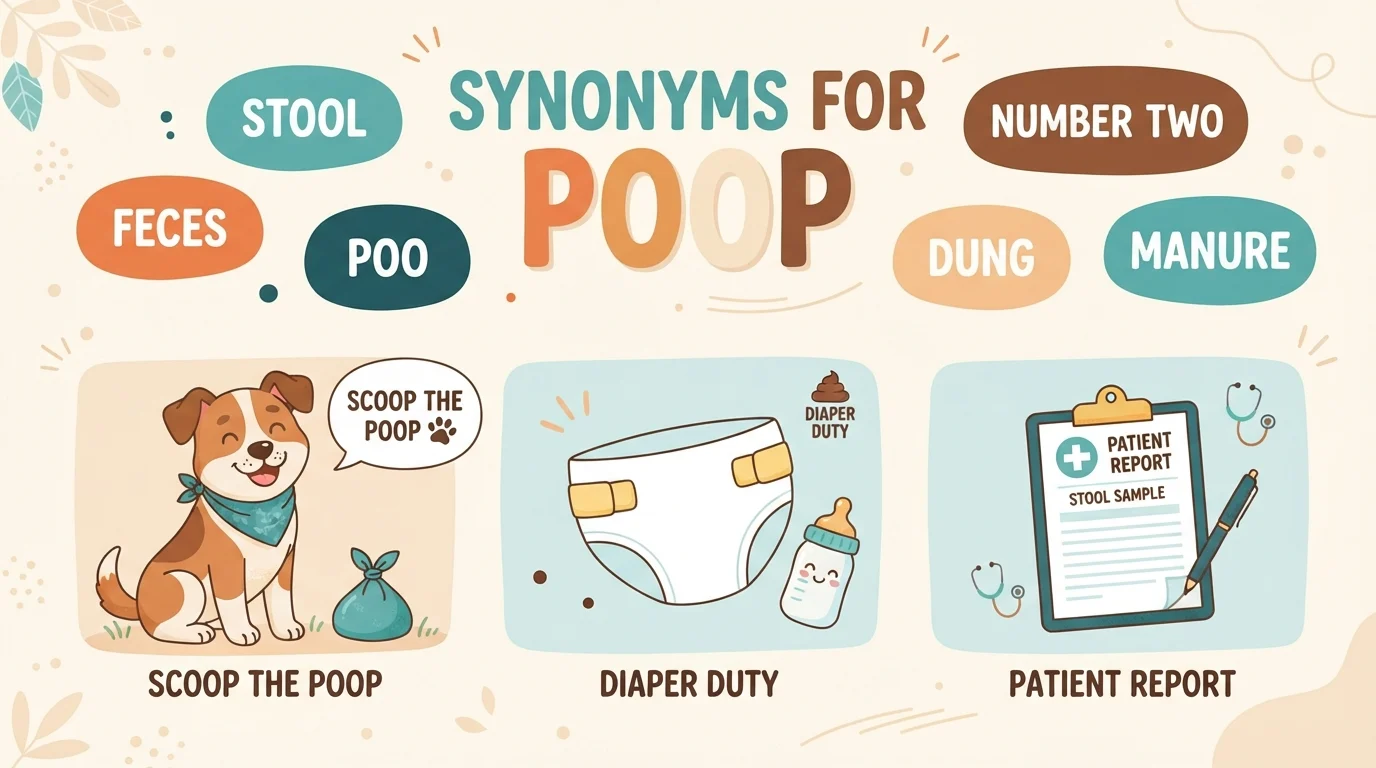
“Poop” refers to solid waste matter discharged from the bowels, also known as feces or stool. It can also mean the act of defecating. Depending on context, alternatives include feces, stool, excrement, waste, bowel movement, number two, poo, crap, dung, and droppings.
Meaning, Tone, and Context
Simple Definition
“Poop” generally refers to:
- Solid waste: the bodily waste discharged from the intestines
- The act: the process of defecating
- Animal waste: droppings from animals (though “poop” is often used for pets too)
Part of Speech
“Poop” functions as a noun and a verb.
Noun Examples:
- “The dog left poop on the lawn.”
- “There’s poop in the diaper.”
Verb Examples:
- “The baby pooped three times today.”
- “The dog pooped in the yard.”
Related Forms:
- Poopy (adjective): covered in or resembling poop (childish)
- Pooped (adjective): exhausted (informal, different meaning)
Positive, Negative, or Neutral Tone
“Poop” is generally neutral but informal and often considered childish or cute depending on context.
- Used with children: neutral, cute
- Used in adult conversation: informal, slightly childish
- Used in medical context: inappropriate
Formality Level
“Poop” is informal. It works in casual conversation, parenting content, and humor. It does not work in medical, academic, or professional writing.
| Formality Level | Example Words |
|---|---|
| Very Formal/Clinical | feces, stool, excrement, defecation |
| Formal/Polite | bowel movement, waste, solid waste |
| Neutral/Everyday | poop, poo, number two |
| Informal/Slang | crap, dump, dookie |
| Vulgar | shit |
| Animal-specific | dung, droppings, manure |
Common Use Cases
“Poop” commonly appears in:
- Parenting content (diapers, potty training)
- Pet care (dog poop, cat poop)
- Casual conversation
- Humor and comedy
- Children’s books and media
Important Word Forms
- Poop (noun): solid waste
- Poop (verb): to defecate
- Poopy (adjective): covered in poop; also used to describe a diaper
- Pooped (adjective): exhausted (unrelated meaning)
- Poo (noun/verb): British variant
- Poopoo (noun): childish variant
When and How to Use “Poop”
Use “poop” when you are in a casual, informal, or child-friendly context.
Parenting
“Did the baby poop today?”
This is natural and appropriate for parenting contexts.
Pet Care
“Remember to pick up your dog’s poop.”
Standard in pet care conversations.
Casual Conversation
“I really need to poop.”
Acceptable among friends but informal.
Humor
“The movie was full of poop jokes.”
Common in comedy contexts.
Children’s Content
“The silly monkey threw poop at the zookeeper.”
Appropriate for children’s books or cartoons.
When Not to Use “Poop”
Do not use “poop” in:
- Medical or clinical writing
- Academic papers
- Professional business documents
- Formal reports
- Scientific research
Incorrect (medical): “The patient reported blood in his poop.”
Correct (medical): “The patient reported blood in his stool.”
Incorrect (formal): “The facility manages animal poop.”
Correct (formal): “The facility manages animal waste.”
Words Commonly Confused With “Poop”
Poop vs. Feces
Feces is the medical/scientific term. Poop is informal and childish.
Poop vs. Stool
Stool is the polite medical term, commonly used by doctors.
Poop vs. Poo
Poo is the British variant of “poop.” They are essentially the same.
Poop vs. Crap
Crap is a vulgar slang term, stronger than poop but weaker than shit.
Poop vs. Dung
Dung specifically refers to animal waste, especially from large animals like cows or elephants.
Best Synonym by Context for “Poop”
| Context | Best Synonym | Why It Works | Example |
|---|---|---|---|
| Medical/Clinical | Stool, feces | Professional and accurate | The doctor asked about the patient’s stool. |
| Scientific | Feces, excrement | Technical and precise | Researchers analyzed the animal’s feces. |
| Polite/Formal | Bowel movement | Polite and inoffensive | He had a bowel movement this morning. |
| Parenting | Poop, poo | Natural and child-friendly | Did the baby poop today? |
| British English | Poo | Standard British term | The dog did a poo in the park. |
| Casual American | Poop, number two | Informal and common | I need to go number two. |
| Vulgar/Slang | Crap, shit | Strong and informal | That movie was full of crap jokes. |
| Animal waste | Dung, droppings, manure | Specific to animals | The elephant’s dung was enormous. |
| Agriculture | Manure | Used as fertilizer | The farmer spread manure on the field. |
| Humorous | Dookie, turd | Funny and casual | He stepped in a big pile of dookie. |
| Childish | Poopoo, caca | Very young children | The toddler said “poopoo” and giggled. |
Which Synonym Should You Choose?
Match your word to your audience:
- Doctors/medical: stool, feces, bowel movement
- Scientists: feces, excrement
- Parents: poop, poo, number two
- Friends (casual): poop, crap
- Comedy: turd, dookie, crap
- Children: poopoo, caca
- Animals: dung, droppings, manure
- British: poo
- Formal writing: waste, solid waste
10 Key Synonyms for “Poop”
| Synonym | Formality | Best Used For | Example Sentence |
|---|---|---|---|
| Stool | Medical | Doctor’s office, health | The doctor examined the stool sample. |
| Feces | Scientific | Research, medical | The lab tested the animal’s feces. |
| Excrement | Formal | Technical, formal | The facility disposed of the excrement safely. |
| Bowel movement | Polite | Medical, polite conversation | He had a bowel movement this morning. |
| Poo | Informal/British | Casual, parenting | The baby did a poo in the diaper. |
| Number two | Casual/Polite | Everyday polite speech | I need to go number two. |
| Crap | Vulgar slang | Casual, frustrated | I stepped in dog crap. |
| Dung | Animal-specific | Farms, animals | The beetles rolled the dung into a ball. |
| Droppings | Animal-specific | Birds, small animals | The bird droppings stained the car. |
| Manure | Agricultural | Farming, gardening | The farmer used manure as fertilizer. |
Synonym Groups and Usage Differences
Medical vs. Casual Synonyms
Medical professionals use stool and feces. Parents and friends use poop and poo.
American vs. British Synonyms
| American | British |
|---|---|
| poop | poo |
| diaper | nappy |
| bathroom | loo |
Childish vs. Adult Synonyms
Childish: poopoo, caca, doo-doo
Adult (informal): poop, crap, dump
Adult (formal): stool, feces, bowel movement
Funny vs. Serious Synonyms
Funny: turd, dookie, crap, log
Serious: stool, feces, excrement
Animal vs. Human Synonyms
Animal: dung, droppings, manure, scat
Human: stool, feces, poop, bowel movement
Antonyms of “Poop”
“Poop” does not have exact antonyms, but related concepts include:
| Antonym | Context | Meaning |
|---|---|---|
| Constipation | Medical | Inability to poop |
| Retention | Medical | Holding in waste |
| Cleanliness | General | State of being clean |
Common Phrases and Expressions with “Poop”
1. Poop out
Meaning:
To become exhausted or stop working.
Example:
“The car pooped out on the highway.”
2. Pooped
Meaning:
Exhausted.
Example:
“I’m totally pooped after that workout.”
3. Party pooper
Meaning:
Someone who spoils the fun.
Example:
“Don’t be a party pooper—come dance!”
4. Poop deck
Meaning:
The highest deck at the back of a ship (nautical term, unrelated to waste).
Example:
“The sailors gathered on the poop deck.”
5. Piece of poop
Meaning:
Something worthless or of poor quality (informal, mildly vulgar).
Example:
“This phone is a piece of poop.”
6. Poop happens
Meaning:
A humorous variation of “stuff happens” (things go wrong).
Example:
“Don’t worry about the mistake—poop happens.”
Common Mistakes to Avoid
1. Using “poop” in medical or professional writing
Wrong: “The patient’s poop was tested.”
Right: “The patient’s stool sample was tested.”
2. Using “poop” in formal business documents
Wrong: “Please clean up the dog poop.”
Right: “Please clean up the animal waste.”
3. Confusing “pooped” (exhausted) with “pooped” (defecated)
Exhausted: “I’m pooped after work.”
Defecated: “The dog pooped on the carpet.”
4. Using “poop” with strangers or in polite company
Use bowel movement or number two if you need a polite alternative.
5. Choosing the wrong formality for your audience
Always match the word to the reader. A children’s book uses poop. A medical journal uses stool.
FAQs
What is the medical term for “poop”?
The medical term is stool or feces. Doctors often ask about “bowel movements.”
What is the British word for “poop”?
The British equivalent is poo.
What is a polite way to say “poop”?
Bowel movement and number two are polite alternatives.
What is animal poop called?
Animal poop is called dung, droppings, manure, or scat, depending on the animal.
Is “poop” a bad word?
No, “poop” is not a swear word. It is informal and often considered childish or cute, but not offensive.
What is the difference between “poop” and “crap”?
“Crap” is a stronger, vulgar slang term. “Poop” is milder and more child-friendly.
What is the scientific term for poop?
The scientific term is feces (or faeces in British English).
Conclusion
“Poop” is a common, informal word with a surprising number of synonyms—each suited to a different audience and tone. The best alternative depends entirely on your context.
Choose stool or feces for medical and scientific writing, bowel movement for polite conversation, poo for British English and parenting, dung or droppings for animals, manure for agriculture, and crap or turd for casual or humorous contexts.
Most importantly, match your word to your audience. The wrong choice—clinical in a joke or vulgar in a medical report—will feel jarring.
For medical, academic, and professional writing, always use the standard clinical terms: stool, feces, or bowel movement.
Before publishing a vocabulary guide, verify definitions and usage with trusted dictionaries such as Cambridge, Oxford, Merriam-Webster, Collins, or Britannica.
The practical takeaway is simple: when “poop” feels too childish, too informal, or too vague, ask yourself who your reader is and what tone you want. Then choose the word that fits perfectly.
