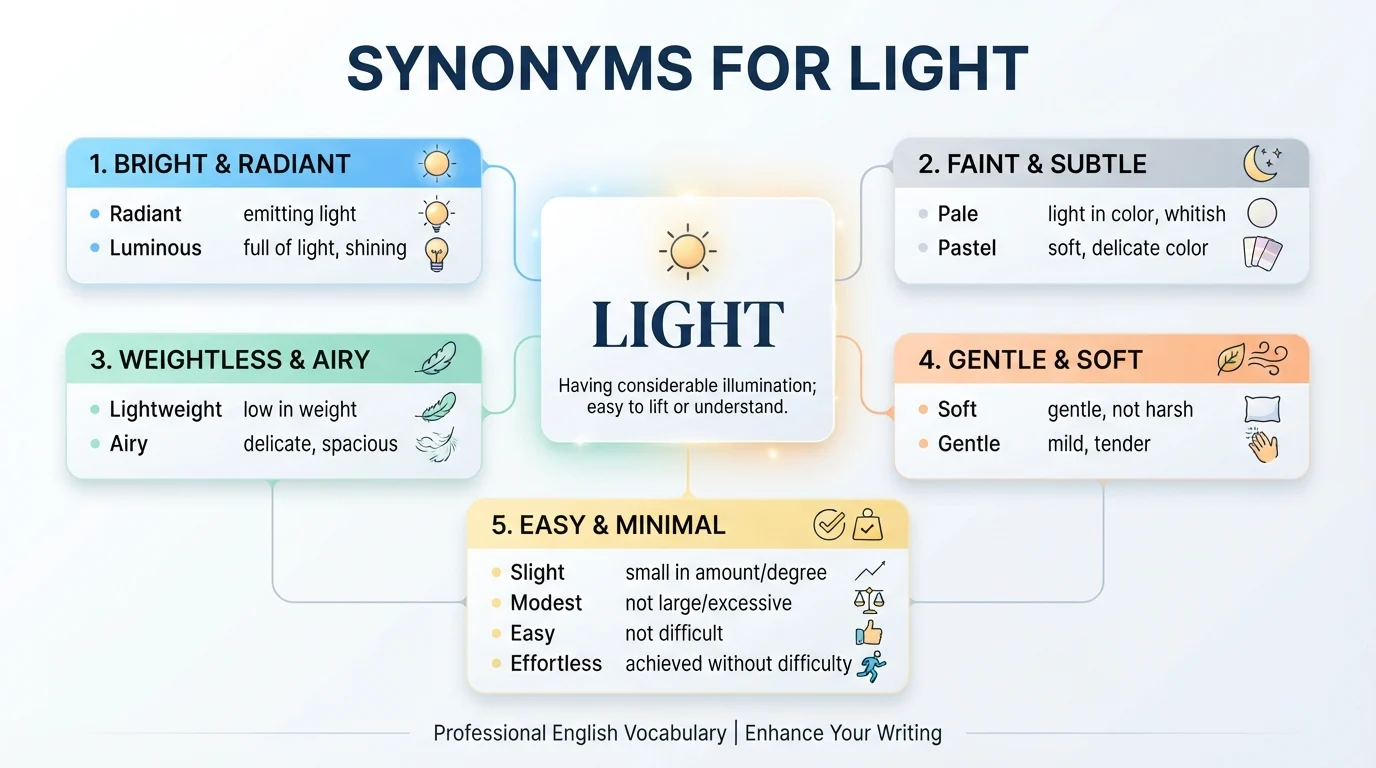
Do you keep using the word “light” in essays, blog posts, creative writing, scientific papers, or everyday conversations? Although it is one of the most versatile and essential words in English, repeating it can make your writing feel monotonous or imprecise.
The good news is that the best alternative depends on what you actually mean. You might be referring to illumination, brightness, a light source, pale colors, lightweight objects, or metaphorical concepts like knowledge or happiness.
This guide explains synonyms for light by meaning, tone, context, and usage. You will learn which alternatives work best in academic writing, creative expression, professional communication, scientific content, casual conversation, and descriptive writing.
Quick Answer: What Does “Light” Mean?
Light refers to electromagnetic radiation visible to the human eye, illumination that makes things visible, a source of brightness, a pale color, something of low weight, or figurative concepts like understanding, happiness, or guidance. Depending on context, alternatives include illumination, brightness, glow, radiance, lamp, pale, lightweight, understanding, and clarity.
Meaning, Tone, and Context
Simple Definition
Light generally refers to:
- The natural agent that stimulates sight and makes things visible
- A source of illumination (lamp, candle, sun)
- Brightness or radiance
- Pale color (not dark)
- Low weight (not heavy)
- Figurative meanings: understanding, knowledge, happiness, guidance, or enlightenment
Part of Speech
Light functions as both a noun, verb, and adjective.
Noun Examples:
- “The light was too bright.”
- “She turned on the light.”
Verb Examples:
- “Please light the candle.”
- “The sun lights the room.”
Adjective Examples:
- “She wore a light blue dress.”
- “The package is light enough to carry.”
Positive, Negative, or Neutral Tone
Light is generally neutral or positive.
Positive associations:
- “Her face lit up with joy.”
- “He saw the light of understanding.”
Negative or neutral contexts:
- “The light was harsh and glaring.”
- “The room had poor light.”
Formality Level
Light is a standard, widely accepted word in both formal and informal English. It works in academic papers, scientific writing, creative literature, news articles, business communication, resumes, and everyday conversation. However, more specific words can improve clarity depending on context.
Common Use Cases
Light commonly refers to:
- Natural sunlight and moonlight
- Artificial illumination (lamps, bulbs, LEDs)
- Brightness and radiance
- Color descriptions (light blue, light green)
- Weight descriptions (lightweight, not heavy)
- Figurative concepts (enlightenment, understanding, hope)
- Scientific contexts (electromagnetic radiation, photons)
- Cooking (light cream, light batter)
Important Word Forms
- Light (noun): illumination or brightness
- Light (verb): to ignite or illuminate
- Light (adjective): pale or not heavy
- Lighter (comparative): more light in color or weight
- Lightest (superlative): most light in color or weight
- Lights (plural): multiple sources of illumination
- Lighting (noun): the arrangement of lights
- Lighted/Lit (verb past tense): illuminated or ignited
- Lightly (adverb): gently or not heavily
- Lightness (noun): quality of being light
- Enlighten (verb): to give knowledge or understanding
When and How to Use “Light”
Use light when discussing illumination, brightness, pale colors, low weight, or figurative concepts like understanding and hope.
Because the word is broad and versatile, it is especially useful when discussing general concepts. However, specific contexts benefit from more precise alternatives.
Professional
“The office requires adequate light for employee productivity.”
This works naturally in workplace communication.
Academic
“Light travels at approximately 299,792 kilometers per second in a vacuum.”
The broad term is appropriate when discussing scientific principles generally.
Personal
“I prefer reading in natural light rather than artificial illumination.”
The word sounds natural in everyday conversation.
Business
“The store installed new light fixtures to improve product visibility.”
Here, light refers to illumination used in commercial settings.
Creative
“The golden light of sunset painted the mountains in shades of amber and rose.”
The broad term works well when discussing aesthetic or atmospheric themes.
Scientific
“White light consists of all the colors of the visible spectrum.”
This concise wording is suitable for scientific or educational content.
Another Word for “Light”
There is no single perfect synonym because light can refer to many different things.
- Illumination context: illumination, brightness, radiance
- Light source context: lamp, lantern, candle, bulb
- Color context: pale, pastel, fair, whitish
- Weight context: lightweight, featherlight, not heavy
- Figurative context: understanding, clarity, enlightenment, hope
- Scientific context: electromagnetic radiation, photons
- Creative writing: glow, gleam, shimmer, sparkle
- Religious context: divine light, holy light
- Atmospheric context: sunshine, moonlight, twilight
If you need one broad alternative, illumination works well when you are specifically discussing the quality or act of lighting something. However, illumination is not a complete replacement for light—it emphasizes the lighting process rather than the source, color, weight, or metaphorical meanings.
When Not to Use “Light”
Light can become too broad when the reader needs to know exactly what you mean.
Consider:
“The room had light.”
This statement does not tell readers whether the room had sunlight, artificial lamps, dim lighting, or bright illumination.
A more precise sentence could be:
“The room was flooded with morning sunlight.”
Similarly, avoid using light when you simply mean a specific light source. If you mean a lamp, say lamp. If you mean a candle, say candle.
In scientific writing, specific terms such as electromagnetic radiation, photons, or visible spectrum are often more accurate.
Words Commonly Confused With “Light”
Light vs. Brightness
Brightness refers to the intensity or quality of light. Light is the phenomenon itself.
Example:
“The light was blinding.” (referring to the source)
“The brightness was overwhelming.” (referring to the intensity)
Light vs. Illumination
Illumination emphasizes the act or process of lighting. Light is the physical phenomenon.
Example:
“The light entered the room.” (physical phenomenon)
“The illumination of the room was carefully designed.” (process or quality)
Light vs. Radiance
Radiance suggests a warm, glowing, or beautiful light. Light is a broader term.
Example:
“The light came from the window.” (neutral)
“The radiance of her smile warmed the room.” (positive, emotional)
Light vs. Lamp
A lamp is a specific light source. Light is the general phenomenon.
Example:
“Please turn on the light.” (could refer to any source)
“Please turn on the lamp.” (specific object)
Light vs. Pale
Pale describes a color with low saturation. Light as an adjective describes a shade.
Example:
“Light blue” and “pale blue” are often interchangeable, but pale suggests lower intensity.
Best Synonym by Context for “Light”
| Context | Best Synonym | Why It Works | Example |
|---|---|---|---|
| Formal writing | Illumination | Sounds precise and professional | The illumination of the gallery was carefully calibrated. |
| Academic writing | Electromagnetic radiation | Scientifically accurate | Electromagnetic radiation spans a broad spectrum. |
| Scientific context | Photons or visible spectrum | Technically precise | Photons are the fundamental particles of light. |
| Creative writing | Glow, gleam, radiance | Adds atmosphere and emotion | The golden glow of candles filled the room. |
| Color description | Pale, pastel, fair | Describes low color intensity | She wore a pale yellow dress. |
| Weight description | Lightweight, featherlight | Clearly indicates low weight | The package was featherlight. |
| Figurative meaning | Enlightenment, clarity, understanding | Captures metaphorical meaning | The teacher brought clarity to the complex topic. |
| Casual conversation | Light (itself) or glow | Natural and concise | The room had great light. |
| Light source | Lamp, lantern, candle, bulb | Specifies the object | She lit a candle. |
| Natural light | Sunlight, moonlight, daylight | Identifies the source | Sunlight streamed through the window. |
| Atmospheric light | Twilight, dawn, dusk | Describes time and mood | The landscape looked beautiful in twilight. |
| Religious context | Divine light, holy light | Captures spiritual meaning | They prayed in the divine light of the sanctuary. |
| Medical/health | Phototherapy, light therapy | Specific treatment context | The patient underwent phototherapy. |
| Artistic context | Chiaroscuro (artistic use) | Technical art term | The painting used chiaroscuro to dramatic effect. |
| Emotional context | Warmth, hope, joy | Captures emotional resonance | Her presence brought warmth to the room. |
Which Synonym Should You Choose?
Start by identifying what kind of light you are discussing.
- Natural illumination: sunshine, sunlight, moonlight, daylight, starlight
- Artificial illumination: lamp, lantern, bulb, LED, flashlight, candle, torch
- Brightness quality: brilliance, radiance, glow, gleam, shimmer, sparkle
- Color shade: pale, pastel, fair, bleached, faded, whitish
- Weight: lightweight, featherlight, not heavy, buoyant
- Figurative meaning: enlightenment, understanding, clarity, insight, hope, guidance
- Scientific context: electromagnetic radiation, photons, visible spectrum, radiant energy
- Atmospheric context: dawn, twilight, sunset, sunrise, dusk, morning light
- Artistic context: chiaroscuro, luminance, luminosity
Real Life Examples of “Light” in Sentences
School
“Students learn about how light travels and interacts with different surfaces.”
A more specific version:
“Students learn about how sunlight interacts with lenses and mirrors.”
Workplace
“Employees prefer working in natural light.”
A more precise version:
“Employees prefer working with adjustable LED task lighting.”
Writing
“The novel uses light as a metaphor for knowledge.”
For a more focused analysis:
“The novel uses enlightenment as a central theme.”
Conversation
“Can you turn on the light?”
In more specific conversation:
“Can you turn on the lamp?”
Social Media
“Finding the light in every situation.”
This metaphorical statement works well for inspirational posts.
Resume
“I designed lighting systems for theater productions.”
A stronger resume version:
“Designed theatrical lighting systems, including LED fixtures and color gels.”
Business
“Our company sells lighting solutions for modern homes.”
A more precise version:
“Our company sells smart LED lighting systems for modern homes.”
Storytelling
“The light from the ancient lighthouse guided ships to safety.”
For atmospheric storytelling:
“The warm golden glow from the ancient lighthouse cut through the fog.”
10 Synonyms for “Light”
The table below includes accurate alternatives and related terms. Since light has a broad meaning, some choices work as contextual alternatives rather than exact replacements.
| Synonym | Simple Meaning | Best Used For | Example Sentence |
|---|---|---|---|
| Illumination | The act or quality of lighting | Formal or professional contexts | The illumination of the room was impressive. |
| Brightness | High intensity of light | Describing strong light | The brightness of the sun was blinding. |
| Radiance | Warm, glowing light | Positive or beautiful light | The radiance of her smile was unforgettable. |
| Glow | Soft, warm, gentle light | Cozy or peaceful settings | The glow of the fireplace was relaxing. |
| Sunlight | Light from the sun | Natural illumination | Sunlight flooded the room. |
| Moonlight | Light from the moon | Nighttime scenes | They walked in the moonlight. |
| Lamp | A device that produces light | Specific light sources | She turned on the desk lamp. |
| Pale | Light in color (adjective) | Color descriptions | She chose a pale blue shade. |
| Lightweight | Not heavy | Physical descriptions | The backpack is lightweight. |
| Enlightenment | Understanding or knowledge | Figurative, intellectual | He achieved enlightenment through study. |
Synonym Groups and Usage Differences
Professional vs. Personal Synonyms
Professional writing benefits from specific terms such as illumination, lighting systems, LED technology, and photometrics.
Personal communication often uses light, glow, or shine.
Compare:
“We need better lighting in the workspace.”
“We need better office illumination.”
The second sentence gives more formal, professional tone.
Formal vs. Conversational Synonyms
Light itself works in both formal and conversational English.
However, illumination is more formal, while glow and shine are more conversational.
Examples:
“Light has both wave and particle properties.” (formal scientific)
“The sun’s glow was beautiful this morning.” (conversational)
Academic Synonyms
Academic writing should distinguish between light, electromagnetic radiation, photons, visible spectrum, and luminance.
For example, light refers to visible electromagnetic radiation, while electromagnetic radiation includes radio waves, microwaves, X-rays, and more.
Professional and Business Synonyms
Business writing often benefits from phrases such as lighting solutions, LED technology, illumination systems, and optical systems.
Instead of:
“Our business sells lights.”
Consider:
“Our business sells energy-efficient LED lighting solutions.”
Creative or Literary Synonyms
Creative writing can use glow, gleam, shimmer, radiance, luster, sheen, and brilliance depending on the setting and mood.
Science fiction writers might describe photonic energy, bioluminescent glow, or neon illumination.
For example:
“The forest glowed with bioluminescent flora, casting an ethereal blue light.”
Slang or Modern Synonyms
Glow and shine are common in casual American English.
Lit is slang for something exciting or excellent, derived from “lighted.”
Bright can be slang for intelligent.
Glow-up is modern slang for transformation or improvement.
Examples:
“The party was lit!” (exciting)
“She had a major glow-up.” (transformation)
“She’s really bright.” (intelligent)
Strongest vs. Weaker Synonyms
Light does not have a simple intensity scale because its alternatives describe different aspects.
A practical specificity scale is:
Broad: light
More focused: illumination, brightness
Specific: sunlight, moonlight, lamp, LED
Highly specific: photon emission, bioluminescence, photonic energy
The more specific the word, the more information the reader receives.
Emotional vs. Neutral Synonyms
Light is generally neutral.
Glow, radiance, and warmth can sound positive and emotional.
Harsh, glare, and blinding suggest negative, uncomfortable light.
Examples:
“The room had adequate light.” (neutral)
“The room was bathed in warm radiance.” (positive)
“The harsh glare of fluorescent lights was exhausting.” (negative)
Antonyms of “Light”
Light does not have exact antonyms because it describes a broad category. However, depending on context, the following words represent opposites:
| Antonym | Context | Meaning | Example Sentence |
|---|---|---|---|
| Darkness | General | Absence of light | The room was filled with darkness. |
| Shadow | Physical | Area without light | He stood in the shadow of the tree. |
| Gloom | Atmospheric | Partial darkness | The cave was full of gloom. |
| Dimness | Quality | Low light level | The dimness made reading difficult. |
| Dullness | Brightness | Lack of brightness | The dullness of the day depressed him. |
| Heavy | Weight | High weight | The package was too heavy to carry. |
| Dark | Color | Deep or strong color | She chose a dark blue shirt. |
| Obscurity | Figurative | Lack of clarity | The topic remained in obscurity. |
| Ignorance | Figurative | Lack of knowledge | They lived in ignorance of the facts. |
| Despair | Emotional | Lack of hope | He was consumed by despair. |
Comparison: “Light” vs. Similar Words
Light vs. Illumination
Main difference: Light refers broadly to the physical phenomenon, source, or quality. Illumination emphasizes the act, process, or quality of lighting something.
Examples:
“The light came through the window.” (physical phenomenon)
“The illumination of the stage was dramatic.” (process/quality)
Light vs. Brightness
Main difference: Light is the phenomenon itself. Brightness is the intensity or quality of light.
Examples:
“Light reflects off surfaces.” (phenomenon)
“The brightness of the sun is intense.” (quality/intensity)
Light vs. Radiance
Main difference: Light is neutral. Radiance suggests warm, beautiful, or positive light.
Examples:
“The room had adequate light.” (neutral)
“The radiance of her presence filled the room.” (positive, emotional)
Light vs. Glow
Main difference: Light is general. Glow suggests soft, steady, warm, or gentle light.
Examples:
“The light illuminated the room.” (neutral)
“The glow of the fireplace was comforting.” (warm, gentle)
Light vs. Lamp
Main difference: Light is the phenomenon. A lamp is a specific source of artificial light.
Examples:
“I need light to read.” (phenomenon)
“I need a lamp to read.” (specific object)
Light vs. Pale
Main difference: Light as an adjective describes color value (light blue vs. dark blue). Pale describes low color saturation or washed-out color.
Examples:
“She wore a light blue dress.” (color value)
“She wore a pale blue dress.” (washed-out, low saturation)
Common Phrases and Expressions with “Light”
1. Shed light on
Meaning:
To clarify or explain something.
Example:
“The study sheds light on the causes of the disease.”
2. See the light
Meaning:
To understand or realize something; to become enlightened.
Example:
“After many years, she finally saw the light.”
3. Light at the end of the tunnel
Meaning:
Hope or relief after a difficult period.
Example:
“After months of work, we finally see the light at the end of the tunnel.”
4. In the light of
Meaning:
Considering something; because of new information.
Example:
“In the light of recent developments, we will change our strategy.”
5. Bring to light
Meaning:
To reveal or make known.
Example:
“The investigation brought new evidence to light.”
6. Light up
Meaning:
To illuminate or brighten; to become happy or animated.
Example:
“Her face lit up when she saw him.”
7. Make light of
Meaning:
To treat something as unimportant or trivial.
Example:
“He made light of the serious situation.”
8. Go lightly
Meaning:
To proceed gently or with little force.
Example:
“Go lightly on the paint.”
9. Lightweight champion
Meaning:
A boxing champion in the lightweight division.
Example:
“He became a lightweight champion at age 22.”
10. Light work
Meaning:
Easy work; not requiring much effort.
Example:
“The job was light work for an experienced professional.”
Common Mistakes to Avoid
1. Using “light” when a precise term is available
If you mean sunlight, moonlight, lamp, candle, LED, brightness, or radiance, name the specific aspect.
Specific vocabulary makes writing more informative.
2. Confusing light with illumination
Light is the phenomenon. Illumination is the process or quality of lighting.
Incorrect: “The light of the room was carefully designed.”
Correct: “The illumination of the room was carefully designed.”
3. Confusing light with brightness
Light is the phenomenon. Brightness is the intensity.
Incorrect: “The light of the sun was overwhelming.”
Correct: “The brightness of the sun was overwhelming.”
4. Using “light” for “lamp” when specificity matters
If you mean a lamp, say lamp.
Vague: “Please turn on the light.”
Specific: “Please turn on the lamp.”
5. Using “light” for “pale” incorrectly
Light as an adjective modifies color (light blue). Pale suggests lower saturation.
Example: “Light blue” (value) vs. “Pale blue” (saturation)
6. Using “light” for “not heavy” without clarity
Vague: “The box is light.”
Specific: “The box is lightweight and easy to carry.”
7. Overusing “light” in figurative contexts
Repetitive: “The teacher brought light to the topic. The students saw the light.”
Improved: “The teacher brought clarity to the topic. The students gained understanding.”
8. Choosing a synonym that changes the meaning
Do not replace light with illumination, brightness, or radiance simply because the words are related. Always check whether the replacement communicates the same idea.
FAQs
What is the best synonym for “light”?
The best synonym depends on context. Illumination works for formal contexts, radiance for positive glowing light, brightness for intensity, sunlight for natural light, and clarity for figurative understanding.
What is a formal synonym for “light”?
Illumination is a common formal synonym. Other formal options include luminance, luminosity, photonic emission, and electromagnetic radiation in scientific contexts.
What is an informal synonym for “light”?
Glow, shine, and bright are common informal alternatives. In casual speech, “light” itself works naturally.
What is another word for “light” in creative writing?
Glow, gleam, shimmer, radiance, sparkle, twinkle, and luster work well in creative writing to add atmosphere and emotion.
What is the difference between “light” and “illumination”?
Light refers to the physical phenomenon or source. Illumination emphasizes the act, process, or quality of lighting something.
What is the opposite of “light”?
Light has no exact antonym. Depending on context, opposites include darkness, shadow, gloom, dimness, obscurity, and ignorance.
What does “light” mean in figurative contexts?
Figuratively, light often represents understanding, knowledge, clarity, hope, guidance, or positive inspiration.
Conclusion
Light is a remarkably versatile word that can describe physical illumination, light sources, pale colors, low weight, and abstract concepts like knowledge, hope, and understanding.
The best synonym depends on what you actually mean. Choose illumination for formal contexts, radiance for warm positive light, brightness for intensity, sunlight for natural light, lamp for a specific source, pale for light colors, lightweight for low weight, and clarity for figurative understanding.
Most importantly, do not replace light simply to avoid repetition. First identify the specific idea behind the word, then choose the alternative that communicates that idea most clearly.
For academic, professional, and technical writing, precision is usually more valuable than vocabulary variety. A specific term such as sunlight, LED, radiance, or electromagnetic radiation can tell readers much more than the broad word light.
Before publishing a vocabulary guide, verify definitions and usage with trusted dictionaries such as Cambridge, Oxford, Merriam-Webster, Collins, or Britannica. This helps ensure that each alternative accurately matches its intended meaning and context.
The practical takeaway is simple: when light feels too general, ask yourself what type of illumination, source, color, weight, or figurative concept you are actually describing. Then use the most precise word available.

6 thoughts on “50+ Synonyms for Light: Meanings, Examples, and Best Alternatives”