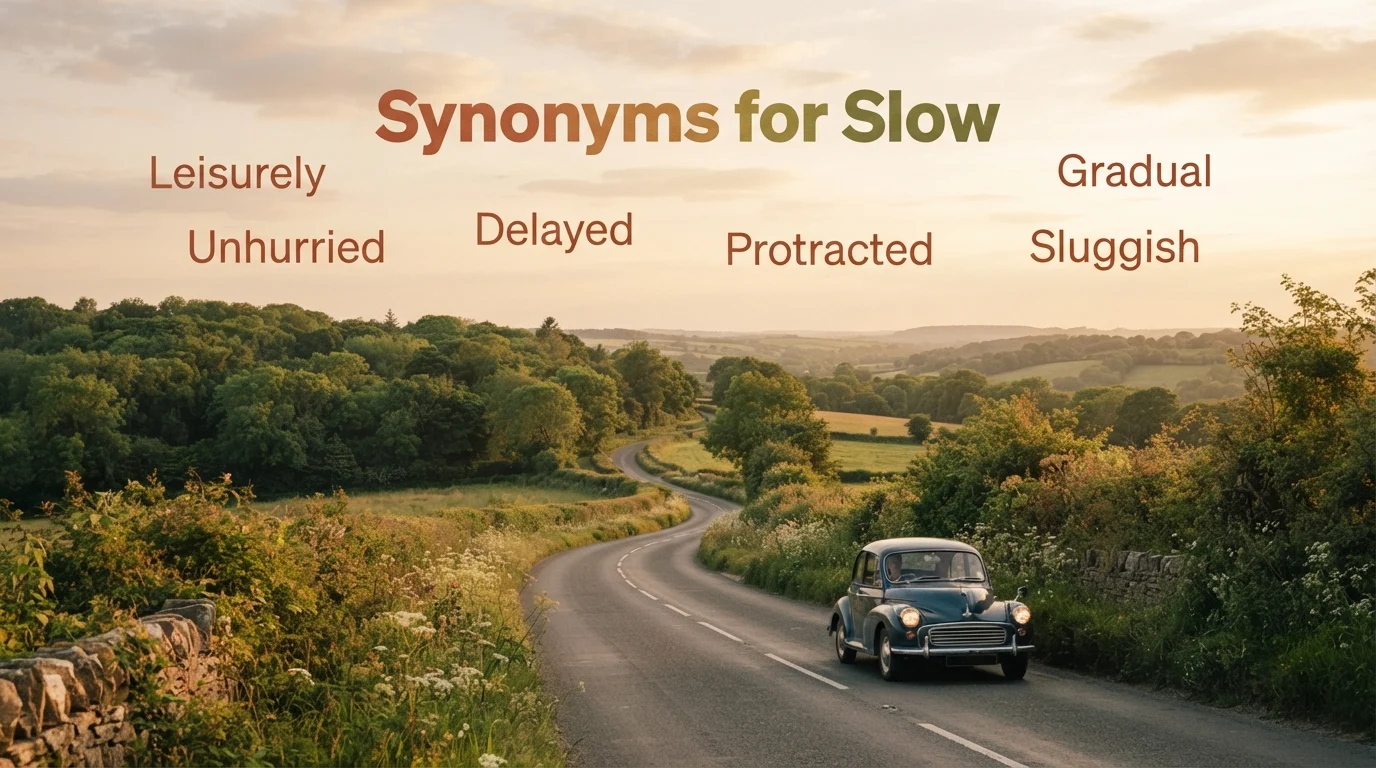
Do you keep using the word “slow” in essays, business reports, creative writing, technical content, or everyday conversation? While it is a simple and useful word, repeating it can make your writing feel flat or lack the precision needed to describe different types of slowness.
The good news is that the best alternative depends on what you actually mean. You might be describing a low speed, a gradual process, a sluggish economy, a dull intellect, a delayed response, or a relaxed pace.
This guide explains synonyms for “slow” by meaning, tone, context, and usage. You will learn which alternatives work best in academic writing, professional communication, creative expression, technical content, and casual conversation.
Quick Answer: What Does “Slow” Mean?
“Slow” refers to moving or operating at a low speed, taking a long time, lacking promptness, or being mentally dull. It can also describe a gradual process, a sluggish economy, or a relaxed pace. Depending on context, alternatives include sluggish, gradual, leisurely, unhurried, delayed, plodding, slack, dull, measured, and lagging.
Meaning, Tone, and Context
Simple Definition
“Slow” generally refers to:
- Low speed: moving or operating at a reduced rate
- Gradual process: happening over a long period
- Lack of promptness: delayed or tardy
- Mental dullness: lacking quickness of mind
- Sluggish activity: reduced economic or physical activity
- Relaxed pace: unhurried, leisurely movement
Part of Speech
“Slow” functions as an adjective, adverb, and verb.
Adjective Examples:
- “The traffic was slow this morning.” (low speed)
- “He is a slow learner.” (mental pace)
- “Business has been slow lately.” (reduced activity)
Adverb Examples:
- “Please drive slow.” (at a low speed)
- “The project progressed slow.” (gradually)
Verb Examples:
- “The car slowed as it approached the turn.” (reduced speed)
- “Economic growth has slowed.” (decreased)
Related Forms:
- Slowly (adverb): in a slow manner
- Slowness (noun): the quality of being slow
- Slowed (verb past tense): reduced speed
- Slowing (verb present participle): reducing speed
Positive, Negative, or Neutral Tone
“Slow” is generally neutral, but it can be negative depending on context.
Positive associations:
- “We enjoyed a slow, relaxing weekend.” (leisurely)
- “The slow burn of the novel built tension beautifully.” (gradual)
Negative associations:
- “The internet connection is painfully slow.” (frustrating)
- “He is slow to understand.” (mental dullness)
Neutral contexts:
- “The train was slow but steady.” (factual)
- “The slow cooker prepares meals over hours.” (method)
Formality Level
“Slow” is a standard word that works in both formal and informal English. However, more specific alternatives like sluggish, gradual, lethargic, and protracted are often preferred in academic and professional writing.
Common Use Cases
“Slow” commonly refers to:
- Speed: vehicles, internet, runners, processes
- Time: gradual changes, long durations, delays
- Economy: sluggish markets, slow growth
- Mental pace: learning, comprehension, reaction time
- Pace of life: leisurely, relaxed, unhurried
- Physical movement: walking, working, recovering
Important Word Forms
- Slow (adjective/adverb/verb): low speed; to reduce speed
- Slowly (adverb): in a slow manner
- Slowness (noun): the quality of being slow
- Slowed (verb): reduced speed
- Slowing (verb): reducing speed
- Slowly but surely (phrase): gradually but steadily
When and How to Use “Slow”
Use “slow” when you want to describe low speed, gradual processes, delays, or reduced activity. Because the word is broad, more specific alternatives can add precision depending on the context.
Professional
“The project has been slow to get off the ground.”
This works naturally in business communication.
Academic
“The study found that slow cognitive processing may be linked to sleep deprivation.”
The term is appropriate in academic research.
Personal
“I prefer a slow morning with coffee and a book.”
The word sounds natural in everyday conversation.
Business
“Sales have been slow this quarter.”
Here, “slow” describes reduced business activity.
Creative
“The slow, deliberate footsteps echoed through the empty hallway.”
The word creates tension and atmosphere.
Technical
“The algorithm is too slow for real-time processing.”
This works in technical contexts.
Another Word for “Slow”
There is no single perfect synonym because “slow” can refer to many different things.
- Low speed: sluggish, plodding, crawling, creeping, dawdling
- Gradual process: gradual, incremental, progressive, measured
- Lack of promptness: delayed, tardy, late, behind schedule
- Mental dullness: dull, dim, obtuse, dense, slow-witted
- Sluggish activity: sluggish, stagnant, slack, lethargic
- Relaxed pace: leisurely, unhurried, easygoing, relaxed
- Extended duration: protracted, prolonged, lengthy, drawn-out
If you need one broad alternative, “sluggish” works for reduced speed or activity, while “gradual” works for processes that happen over time.
When Not to Use “Slow”
“Slow” can become too vague when you need to be specific about what kind of slowness you are describing.
Consider:
“The system is slow.”
This statement does not tell readers whether the system has low processing speed, high latency, delayed response time, or reduced capacity.
A more precise sentence could be:
“The system has a response time of over five seconds.”
Similarly, avoid using “slow” to describe mental ability in professional or formal contexts. Use “deliberate”, “methodical”, or “thorough” instead.
Words Commonly Confused With “Slow”
Slow vs. Sluggish
Sluggish emphasizes reduced energy, activity, or responsiveness. Slow is broader.
Example:
“The economy has been sluggish.” (reduced activity)
“The traffic was slow.” (low speed)
Slow vs. Gradual
Gradual emphasizes happening in stages over time. Slow can refer to speed or duration.
Example:
“There was a gradual improvement.” (incremental)
“The recovery was slow.” (low speed)
Slow vs. Leisurely
Leisurely emphasizes a relaxed, unhurried pace. Slow can be negative or neutral.
Example:
“They enjoyed a leisurely stroll.” (relaxed)
“The walk was slow because of traffic.” (delayed)
Slow vs. Delayed
Delayed emphasizes something happening later than expected. Slow can refer to speed.
Example:
“The flight was delayed by two hours.” (late)
“The flight was slow to board.” (low speed)
Slow vs. Dull
Dull emphasizes lack of interest, brightness, or sharpness. Slow can refer to mental pace but is less offensive.
Example:
“The lecture was dull.” (boring)
“He is a slow learner.” (pace)
Best Synonym by Context for “Slow”
| Context | Best Synonym | Why It Works | Example |
|---|---|---|---|
| Formal writing | Gradual, protracted | Precise and professional | The recovery was gradual but steady. |
| Academic writing | Protracted, incremental | Standard academic usage | The study examined incremental progress. |
| Physical speed | Sluggish, plodding, crawling | Emphasizes low speed | The traffic was crawling along the highway. |
| Economic context | Sluggish, stagnant, lagging | Economically accurate | The economy remained sluggish. |
| Gradual process | Gradual, incremental, measured | Emphasizes stages | The incremental changes were barely noticeable. |
| Leisurely pace | Leisurely, unhurried, relaxed | Positive, calm | They enjoyed a leisurely breakfast. |
| Delayed response | Delayed, tardy, lagging | Emphasizes lateness | The response was delayed by technical issues. |
| Mental pace | Deliberate, methodical | Positive reframing | He is a deliberate thinker. |
| Creative writing | Plodding, lumbering, dawdling | Evocative, descriptive | The plodding footsteps grew louder. |
| Technical context | High-latency, low-throughput | Technically precise | The network has high latency. |
| Casual conversation | Slow (itself) | Natural and concise | The internet is so slow today! |
Which Synonym Should You Choose?
Start by identifying what kind of “slow” you are describing.
- Low physical speed: sluggish, plodding, crawling, creeping, dawdling
- Gradual process: gradual, incremental, progressive, measured, step-by-step
- Delay/lateness: delayed, tardy, late, behind schedule, overdue
- Economic sluggishness: sluggish, stagnant, lagging, weak, slow-moving
- Mental pace: deliberate, methodical, thorough (positive); dull, dense, obtuse (negative)
- Relaxed pace: leisurely, unhurried, easygoing, relaxed, laid-back
- Extended duration: protracted, prolonged, lengthy, drawn-out
- Technical slowness: high-latency, low-throughput, bandwidth-constrained
10 Key Synonyms for “Slow”
The table below includes accurate alternatives with clear meanings and usage contexts.
| Synonym | Simple Meaning | Best Used For | Example Sentence |
|---|---|---|---|
| Sluggish | Moving or reacting with little energy | Economy, traffic, systems | The economy remains sluggish after the recession. |
| Gradual | Happening in stages over time | Processes, change, improvement | There was a gradual improvement in her health. |
| Leisurely | Relaxed and unhurried | Positive, calm contexts | They took a leisurely walk through the park. |
| Unhurried | Not rushed; calm | Relaxed pace | She spoke in an unhurried, measured tone. |
| Delayed | Happening later than expected | Travel, responses, schedules | The flight was delayed due to weather. |
| Plodding | Moving slowly and heavily | Creative, descriptive writing | The plodding oxen pulled the heavy cart. |
| Protracted | Lasting longer than expected | Formal, academic contexts | The protracted negotiations lasted months. |
| Lagging | Falling behind | Performance, economy, technology | The lagging sales worried the investors. |
| Measured | Careful and deliberate | Speech, movement, approach | He walked with measured steps. |
| Slack | Lacking activity or tension | Business, pace | Business has been slack this season. |
Synonym Groups and Usage Differences
Professional vs. Personal Synonyms
Professional writing benefits from specific terms such as gradual, protracted, sluggish, delayed, and incremental.
Personal communication often uses slow itself or casual alternatives like take it easy, laid-back, or dragging.
Compare:
“The project is moving slow.” (personal)
“The project has seen incremental progress.” (professional)
Formal vs. Conversational Synonyms
Slow works in both formal and conversational English.
Formal alternatives: protracted, incremental, sluggish, gradual, measured
Conversational alternatives: slow, dragging, pokey, laid-back
Examples:
“The recovery was protracted and difficult.” (formal)
“The recovery was slow and painful.” (conversational)
Academic Synonyms
Academic writing should distinguish between gradual (incremental change), protracted (extended duration), sluggish (reduced activity), and delayed (later than expected).
For example:
“The study examined the gradual decline in cognitive function.”
“The protracted conflict lasted over a decade.”
Professional and Business Synonyms
Business writing often benefits from phrases such as sluggish growth, gradual improvement, delayed response, and lagging performance.
Instead of:
“Sales are slow this quarter.”
Consider:
“Sales have shown sluggish growth this quarter.”
Creative or Literary Synonyms
Creative writing can use plodding, lumbering, dawdling, creeping, crawling, and drawn-out.
For example:
“The plodding footsteps echoed through the empty hallway.”
“The lumbering giant moved through the forest.”
Slang or Modern Synonyms
Pokey means slow in American slang.
Dragging means moving slowly or taking too long.
Laid-back means relaxed or unhurried.
Slowpoke is a casual term for a slow person.
Examples:
“The service was so pokey.” (slang)
“This meeting is really dragging.” (slang)
“He’s a laid-back kind of guy.” (casual)
Strongest vs. Weaker Synonyms
“Slow” synonyms vary in intensity:
Milder: measured, deliberate, unhurried
Moderate: slow, gradual, sluggish
Strong: plodding, crawling, protracted
Very Strong: stagnant, moribund, comatose
Emotional vs. Neutral Synonyms
“Slow” is generally neutral or negative.
Positive alternatives: leisurely, unhurried, relaxed, measured
Negative alternatives: sluggish, plodding, dragging, stagnant
Neutral alternatives: gradual, incremental, delayed
Examples:
“They enjoyed a leisurely afternoon.” (positive)
“The traffic was sluggish.” (negative)
“The changes were gradual.” (neutral)
Antonyms of “Slow”
“Slow” has several antonyms depending on context:
| Antonym | Context | Meaning | Example Sentence |
|---|---|---|---|
| Fast | Speed | High speed | The car was fast. |
| Quick | Time | Rapid; taking little time | She gave a quick response. |
| Rapid | Speed/change | Very fast | The recovery was rapid. |
| Swift | Movement | Quick and smooth | The bird’s flight was swift. |
| Speedy | General | Characterized by speed | The delivery was speedy. |
| Prompt | Response | Immediate or timely | She gave a prompt reply. |
| Brisk | Pace | Quick and energetic | They went for a brisk walk. |
| Accelerated | Process | Increased speed | The timeline was accelerated. |
| Sudden | Change | Happening quickly and unexpectedly | The change was sudden. |
| Instant | Time | Immediate | The response was instant. |
Comparison: “Slow” vs. Similar Words
Slow vs. Sluggish
Main difference: Sluggish emphasizes reduced energy, activity, or responsiveness. Slow is broader.
Examples:
“The economy has been sluggish.” (reduced activity)
“The traffic was slow.” (low speed)
Slow vs. Gradual
Main difference: Gradual emphasizes happening in stages over time. Slow can refer to speed or duration.
Examples:
“There was a gradual improvement.” (incremental)
“The recovery was slow.” (low speed)
Slow vs. Leisurely
Main difference: Leisurely emphasizes a relaxed, unhurried pace with positive connotations. Slow can be negative or neutral.
Examples:
“They enjoyed a leisurely stroll.” (relaxed, positive)
“The walk was slow because of traffic.” (delayed, neutral)
Slow vs. Delayed
Main difference: Delayed emphasizes something happening later than expected. Slow can refer to speed.
Examples:
“The flight was delayed by two hours.” (late)
“The flight was slow to board.” (low speed)
Slow vs. Protracted
Main difference: Protracted emphasizes lasting longer than expected or necessary. Slow can refer to speed.
Examples:
“The protracted negotiations lasted months.” (extended)
“The negotiations were slow.” (low speed)
Slow vs. Dull
Main difference: Dull emphasizes lack of interest, brightness, or sharpness. Slow can refer to mental pace but is less offensive.
Examples:
“The lecture was dull.” (boring)
“He is a slow learner.” (pace)
Common Phrases and Expressions with “Slow”
1. Slow down
Meaning:
To reduce speed or pace.
Example:
“Please slow down; you’re driving too fast.”
2. Slow but steady
Meaning:
Gradual but consistent progress.
Example:
“Slow but steady wins the race.”
3. Slow on the uptake
Meaning:
Slow to understand or comprehend.
Example:
“He’s a bit slow on the uptake, but he gets there eventually.”
4. Slow burn
Meaning:
Something that develops gradually and gains intensity.
Example:
“The novel is a slow burn that builds to an intense climax.”
5. Slow going
Meaning:
Difficult and slow progress.
Example:
“It’s been slow going with the renovations.”
6. Slow off the mark
Meaning:
Slow to start or react.
Example:
“The team was slow off the mark in the first half.”
7. Slow and steady
Meaning:
Consistent and gradual.
Example:
“Slow and steady progress is better than no progress.”
8. Slow lane
Meaning:
A lane for slower traffic; a less competitive position.
Example:
“He decided to take the slow lane and enjoy life.”
9. Slow down the process
Meaning:
To delay or impede progress.
Example:
“Budget cuts slowed down the process.”
10. Go slow
Meaning:
To proceed slowly, often as a warning or protest.
Example:
“The doctors advised him to go slow after surgery.”
Common Mistakes to Avoid
1. Using “slow” when “gradual” is more precise
If you mean something happens over time, use “gradual.”
Vague: “The change was slow.”
Precise: “The change was gradual.”
2. Using “slow” to describe a person’s intelligence
This can be offensive. Use deliberate, methodical, or thorough instead.
Offensive: “He is slow.”
Better: “He is a deliberate thinker.”
3. Confusing “slow” with “sluggish”
Sluggish implies reduced energy or activity. Slow is broader.
Example:
“The economy is sluggish.” (reduced activity)
“The internet is slow.” (low speed)
4. Overusing “slow” in writing
Repetition can make content feel dull. Use alternatives such as sluggish, gradual, leisurely, delayed, plodding, and protracted.
5. Using “slow” for “delayed” in formal writing
If something is late, use delayed or tardy.
Informal: “The train is slow.”
Formal: “The train is delayed.”
FAQs
What is the best synonym for “slow”?
The best synonym depends on context. Sluggish works for reduced activity, gradual for incremental processes, leisurely for relaxed pace, delayed for lateness, and protracted for extended duration.
What is a formal synonym for “slow”?
Protracted, gradual, incremental, sluggish, and measured are formal synonyms.
What is an informal synonym for “slow”?
Pokey, dragging, laid-back, and slowpoke are informal alternatives.
What is another word for “slow” in creative writing?
Plodding, lumbering, dawdling, creeping, and drawn-out work well in creative writing.
What is the difference between “slow” and “sluggish”?
Slow is broader and can refer to speed or duration. Sluggish specifically means reduced energy, activity, or responsiveness.
What is the opposite of “slow”?
Depending on context, opposites include fast, quick, rapid, swift, prompt, and brisk.
What does “slow” mean in a business context?
In business, slow often refers to sluggish growth, reduced activity, delayed response, or lagging performance.
Conclusion
“Slow” is a versatile word that can describe physical speed, gradual processes, delays, economic sluggishness, mental pace, and relaxed movement. The best synonym depends on what you actually mean.
Choose sluggish for reduced activity, gradual for incremental processes, leisurely for relaxed pace, delayed for lateness, protracted for extended duration, and measured for deliberate movement.
Most importantly, do not replace “slow” simply to avoid repetition. First identify what kind of slowness—physical, temporal, economic, mental, or stylistic—you are actually describing. Then choose the alternative that communicates that idea most clearly.
For academic, professional, and formal writing, precision is usually more valuable than vocabulary variety. A specific term such as gradual, protracted, or sluggish can tell readers much more than the broad word slow.
Before publishing a vocabulary guide, verify definitions and usage with trusted dictionaries such as Cambridge, Oxford, Merriam-Webster, Collins, or Britannica. This helps ensure that each alternative accurately matches its intended meaning and context.
The practical takeaway is simple: when “slow” feels too general, ask yourself what kind of pace, process, or speed you are actually describing. Then use the most precise word available.
Discover More:-
- 50+ Synonyms for Light: Meanings, Examples, and Best Alternatives
- 50+ Synonyms for Technology: Meanings, Examples, and Best Alternatives

1 thought on “50+ Synonyms for Slow: Meanings, Examples, and Best Alternatives”