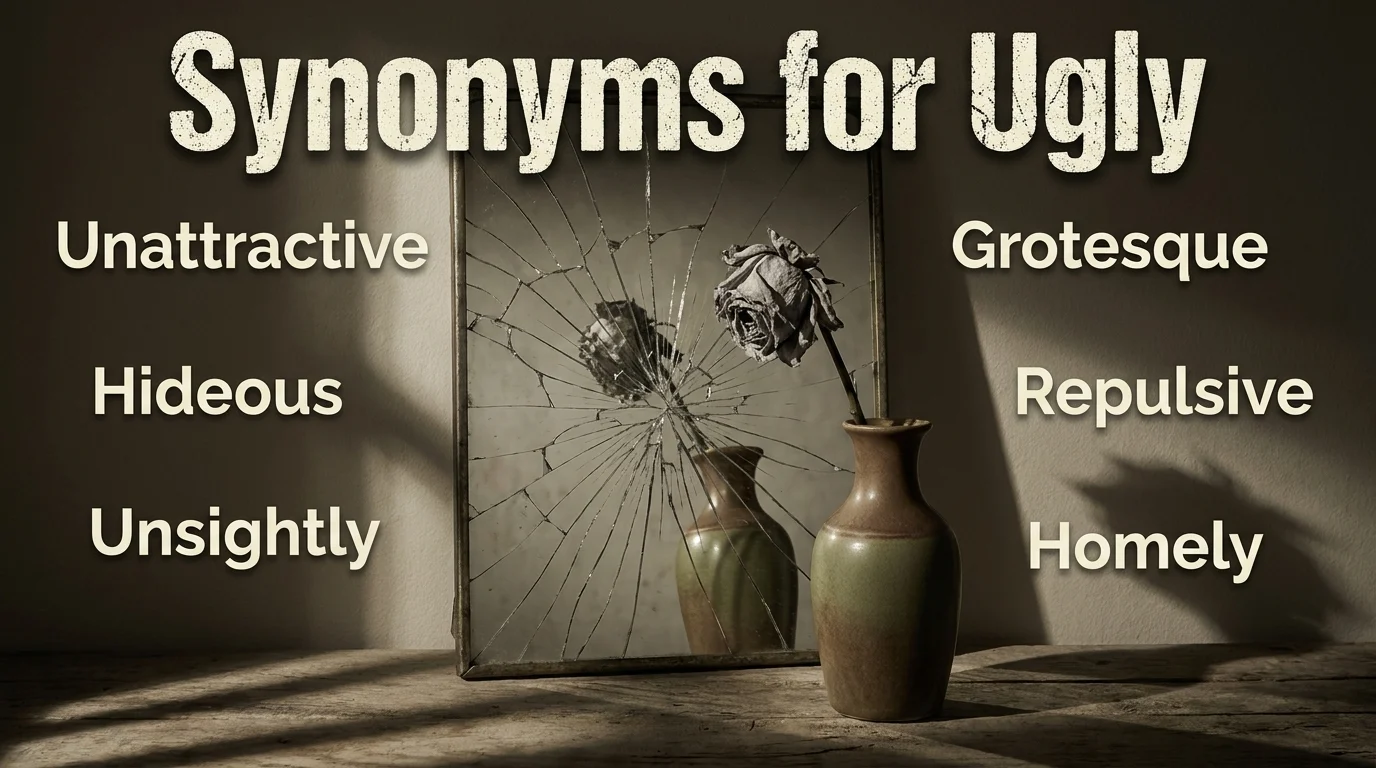
Do you keep using the word “ugly” in essays, creative writing, product reviews, fashion content, or everyday conversation? While it is a direct and powerful word, repeating it can make your writing feel harsh, simplistic, or lacking in nuance.
The good news is that the best alternative depends on what you actually mean. You might be describing an unattractive appearance, an unpleasant situation, offensive behavior, a poorly designed object, or a frightening sight.
This guide explains synonyms for “ugly” by meaning, tone, context, and usage. You will learn which alternatives work best in creative writing, professional communication, casual conversation, fashion and design, and descriptive writing.
Quick Answer: What Does “Ugly” Mean?
“Ugly” refers to something or someone that is unpleasant or unattractive in appearance. It can also describe unpleasant situations, offensive behavior, or frightening sights. Depending on context, alternatives include unattractive, hideous, unsightly, grotesque, repulsive, homely, plain, unappealing, monstrous, and frightful.
Meaning, Tone, and Context
Simple Definition
“Ugly” generally refers to:
- Physical appearance: unpleasant or unattractive to look at
- Aesthetics: lacking beauty or harmony in design
- Situations: unpleasant, hostile, or dangerous circumstances
- Behavior: offensive, rude, or morally reprehensible conduct
- Atmosphere: threatening, ominous, or menacing conditions
Part of Speech
“Ugly” is primarily an adjective.
Examples:
- “The building was considered ugly by most residents.”
- “The situation turned ugly very quickly.”
Related Forms:
- Ugliness (noun): the quality of being ugly
- Uglily (adverb): in an ugly manner (rare)
- Uglify (verb): to make ugly (rare, often humorous)
Positive, Negative, or Neutral Tone
“Ugly” is strongly negative.
It expresses clear disapproval or distaste, and can be harsh or offensive when applied to people. It can also describe dangerous or unpleasant situations.
Examples:
- “The painting was ugly and poorly executed.” (aesthetic criticism)
- “The crowd turned ugly after the announcement.” (situation/threat)
- “He made an ugly comment about her appearance.” (offensive behavior)
Formality Level
“Ugly” is a standard word that works in both formal and informal English. However, it can be blunt or harsh. More formal alternatives like unattractive, unsightly, grotesque, and unappealing may be more appropriate in professional or polite contexts.
Common Use Cases
“Ugly” commonly describes:
- People’s appearance: (use with caution—can be offensive)
- Objects and buildings: design, architecture, products
- Art and design: aesthetics, color combinations, compositions
- Situations: conflicts, confrontations, dangerous scenarios
- Behavior: offensive actions, rude comments, violence
- Weather/atmosphere: threatening skies, stormy conditions
Important Word Forms
- Ugly (adjective): unpleasant or unattractive in appearance
- Ugliness (noun): the quality of being ugly
- Uglier (comparative): more ugly
- Ugliest (superlative): most ugly
- Uglify (verb): to make ugly (rare)
- Uglily (adverb): in an ugly manner (rare)
When and How to Use “Ugly”
Use “ugly” when you want to describe something that is unpleasant or unattractive in appearance, or a situation that is dangerous or hostile. Because the word is blunt and can be offensive, more specific alternatives can add precision and sensitivity.
Creative Writing
“The old house was ugly, with peeling paint and crooked windows.”
This works well in descriptive writing.
Professional (Design)
“The prototype was functional but aesthetically ugly.”
Here, “ugly” describes a design flaw without being personal.
Personal
“I think that color combination is really ugly.”
The word sounds natural in casual conversation.
Situations
“The argument turned ugly when insults were exchanged.”
This describes a hostile or unpleasant situation.
Fashion
“That dress is ugly—the pattern clashes with everything.”
This describes a fashion aesthetic.
News/Journalism
“The scene turned ugly as protests escalated.”
This describes a dangerous or volatile situation.
Another Word for “Ugly”
There is no single perfect synonym because “ugly” can refer to appearance, design, situations, and behavior.
- Physical appearance: unattractive, unsightly, hideous, homely, plain
- Extreme appearance: grotesque, monstrous, repulsive, frightful, ghastly
- Design/aesthetics: unappealing, unsightly, inelegant, clumsy
- Situations: unpleasant, hostile, dangerous, menacing, threatening
- Behavior: offensive, rude, vile, despicable, contemptible
- Atmosphere: ominous, threatening, sinister, foreboding
If you need one broad alternative, “unattractive” is the safest replacement because it is less harsh and works in most contexts. “Hideous” is stronger and more emphatic.
When Not to Use “Ugly”
“Ugly” can become offensive, insensitive, or imprecise when used carelessly.
Consider:
“She is ugly.”
This statement is offensive and subjective. A more sensitive sentence could be:
“She has a unique appearance.” or “She doesn’t fit conventional beauty standards.”
Similarly, avoid using “ugly” in professional or polite contexts when describing people or their work. Use more neutral alternatives like unattractive, unappealing, or not aesthetically pleasing.
In design and fashion, “ugly” is subjective. More precise terms like clashing, unbalanced, inelegant, or poorly designed may be more useful.
Words Commonly Confused With “Ugly”
Ugly vs. Unattractive
Unattractive is a milder, more polite way to describe something that is not pleasing to look at. Ugly is stronger and blunter.
Example:
“The building is unattractive but functional.” (mild)
“The building is ugly and poorly designed.” (strong)
Ugly vs. Hideous
Hideous is much stronger than ugly—it means extremely ugly or repulsive.
Example:
“The wallpaper was ugly.” (strong)
“The wallpaper was hideous—it hurt to look at it.” (very strong)
Ugly vs. Unsightly
Unsightly is a formal, polite word for something unpleasant to look at. Ugly is more direct.
Example:
“The unsightly stain on the carpet was hard to remove.” (formal)
“The carpet was ugly.” (direct)
Ugly vs. Grotesque
Grotesque emphasizes distorted, unnatural, or monstrous appearance. Ugly is broader.
Example:
“The grotesque statue frightened the children.” (distorted, monstrous)
“The statue was ugly.” (general)
Ugly vs. Homely
Homely is a gentle, old-fashioned word for plain or unattractive appearance, often used for people.
Example:
“She had a homely face but a kind heart.” (gentle)
“She was ugly.” (harsh)
Ugly vs. Plain
Plain means simple or ordinary, not necessarily ugly.
Example:
“She preferred plain clothes.” (simple, not ugly)
“She wore ugly clothes.” (unattractive)
Best Synonym by Context for “Ugly”
| Context | Best Synonym | Why It Works | Example |
|---|---|---|---|
| Formal writing | Unattractive, unsightly | Polite and professional | The building was unattractive but functional. |
| Creative writing | Hideous, grotesque, ghastly | Adds drama and description | The hideous creature emerged from the shadows. |
| Fashion/design | Unappealing, inelegant, unflattering | Describes aesthetics | The dress was unflattering on her. |
| Describing people (polite) | Plain, homely, unremarkable | Gentle and inoffensive | He had a plain but pleasant face. |
| Describing people (offensive) | Hideous, monstrous | Use with caution—can be offensive | The mask was hideous and frightening. |
| Situations | Hostile, dangerous, menacing | Describes conflict or threat | The situation turned hostile quickly. |
| Behavior | Offensive, vile, despicable | Describes immoral conduct | His behavior was despicable. |
| Atmosphere | Ominous, sinister, foreboding | Describes threatening mood | An ominous silence filled the room. |
| Casual conversation | Gross, nasty, icky | Informal and natural | That color is so gross. |
| Architecture | Unsightly, clumsy, inelegant | Describes poor design | The unsightly tower blocked the view. |
| Art criticism | Unrefined, crude, clumsy | Describes poor execution | The painting was crude and unrefined. |
Which Synonym Should You Choose?
Start by identifying what kind of “ugly” you are describing:
- Physical appearance (polite): unattractive, plain, homely, unremarkable
- Physical appearance (strong): hideous, grotesque, repulsive, monstrous
- Design/aesthetics: unsightly, unappealing, inelegant, clumsy
- Situations: hostile, dangerous, menacing, threatening
- Behavior: offensive, vile, despicable, contemptible
- Atmosphere: ominous, sinister, foreboding, threatening
- Casual context: gross, nasty, icky, hideous
10 Key Synonyms for “Ugly”
The table below includes accurate alternatives with clear meanings and usage contexts.
| Synonym | Simple Meaning | Best Used For | Example Sentence |
|---|---|---|---|
| Unattractive | Not pleasing to look at | Polite, general contexts | The building was unattractive but functional. |
| Hideous | Extremely ugly | Strong description | The hideous mask frightened the children. |
| Unsightly | Unpleasant to look at | Formal, design contexts | The unsightly stain ruined the carpet. |
| Grotesque | Distorted, unnatural, monstrous | Creative, dramatic | The grotesque statue loomed over the garden. |
| Repulsive | Causing strong aversion | Strong disgust | The repulsive creature was terrifying. |
| Homely | Plain, unattractive (gentle) | Polite, old-fashioned | He had a homely face but a warm smile. |
| Plain | Simple, ordinary | Neutral, gentle | She wore a plain dress. |
| Unappealing | Not attractive or appealing | Food, design, general | The unappealing meal sat untouched. |
| Monstrous | Frightful, shocking, inhuman | Strong, dramatic | The monstrous creature roared. |
| Ghastly | Frightful, horrible, shocking | Creative, dramatic | The ghastly sight made her turn away. |
Synonym Groups and Usage Differences
Professional vs. Personal Synonyms
Professional writing benefits from softer, more polite terms such as unattractive, unsightly, unappealing, and inelegant.
Personal communication often uses ugly, gross, nasty, or hideous.
Compare:
“That building is ugly.” (personal)
“The building is aesthetically unappealing.” (professional)
Formal vs. Conversational Synonyms
Ugly works in both formal and conversational English, but it can be blunt.
Formal alternatives: unsightly, unattractive, unappealing, inelegant
Conversational alternatives: gross, nasty, icky, hideous
Examples:
“The design was unsightly and needed revision.” (formal)
“That design is so gross.” (conversational)
Academic Synonyms
Academic writing should distinguish between aesthetic quality, visual appeal, and design flaws. Avoid “ugly” in academic contexts.
For example:
“The design was aesthetically unappealing and lacked visual harmony.”
Professional and Business Synonyms
Business writing often benefits from phrases such as not aesthetically pleasing, visually unappealing, and requires design improvement.
Instead of:
“The product is ugly.”
Consider:
“The product’s design is visually unappealing and may benefit from revision.”
Creative or Literary Synonyms
Creative writing can use hideous, grotesque, ghastly, monstrous, repulsive, loathsome, and frightful depending on the mood.
For example:
“The grotesque creature had a hideous face that made her stomach turn.”
Slang or Modern Synonyms
Gross is the most common informal alternative in casual English.
Nasty is another casual option.
Butt-ugly is slang for extremely ugly.
Rough can mean unattractive in casual British English.
Examples:
“That color is so gross.” (casual)
“He’s butt-ugly, but he has a great personality.” (slang, crude)
Strongest vs. Weaker Synonyms
“Ugly” synonyms vary in intensity:
Milder: plain, homely, unremarkable, unattractive
Moderate: ugly, unsightly, unappealing
Strong: hideous, repulsive, grotesque, monstrous
Very Strong: abominable, loathsome, ghastly, execrable
Emotional vs. Neutral Synonyms
“Ugly” is generally negative and emotional.
Emotional alternatives: hideous, ghastly, repulsive, loathsome
Neutral alternatives: unattractive, plain, unsightly, unappealing
Examples:
“The building was unattractive.” (neutral)
“The building was hideous.” (emotional)
Antonyms of “Ugly”
“Ugly” has several antonyms:
| Antonym | Context | Meaning | Example Sentence |
|---|---|---|---|
| Beautiful | Appearance | Pleasing to look at | The sunset was beautiful. |
| Attractive | Appearance | Appealing to look at | She wore an attractive dress. |
| Handsome | Appearance | Good-looking (often for men) | He was a handsome man. |
| Pretty | Appearance | Pleasing, often delicate | The flowers were pretty. |
| Gorgeous | Appearance | Very beautiful | The view was gorgeous. |
| Elegant | Design | Graceful and stylish | The design was elegant and simple. |
| Pleasing | General | Giving pleasure | The color was pleasing to the eye. |
| Lovely | General | Delightful, beautiful | What a lovely garden! |
Comparison: “Ugly” vs. Similar Words
Ugly vs. Unattractive
Main difference: Unattractive is milder and more polite. Ugly is stronger and blunter.
Examples:
“The building is unattractive but functional.” (mild)
“The building is ugly and poorly designed.” (strong)
Ugly vs. Hideous
Main difference: Hideous is much stronger than ugly—extremely ugly or repulsive.
Examples:
“The wallpaper was ugly.” (strong)
“The wallpaper was hideous—it hurt to look at it.” (very strong)
Ugly vs. Unsightly
Main difference: Unsightly is a formal, polite word for unpleasant to look at. Ugly is more direct.
Examples:
“The unsightly stain was hard to remove.” (formal)
“The stain was ugly.” (direct)
Ugly vs. Grotesque
Main difference: Grotesque emphasizes distorted, unnatural, or monstrous appearance. Ugly is broader.
Examples:
“The grotesque statue frightened the children.” (distorted, monstrous)
“The statue was ugly.” (general)
Ugly vs. Homely
Main difference: Homely is a gentle, old-fashioned word for plain or unattractive appearance. Ugly is harsher.
Examples:
“She had a homely face but a kind heart.” (gentle)
“She was ugly.” (harsh)
Ugly vs. Repulsive
Main difference: Repulsive emphasizes causing strong aversion or disgust. Ugly is broader.
Examples:
“The repulsive smell made her gag.” (strong disgust)
“The room was ugly but clean.” (appearance)
Common Phrases and Expressions with “Ugly”
1. Ugly duckling
Meaning:
A person or thing that is initially unattractive but becomes beautiful or successful later.
Example:
“She was an ugly duckling in high school but became a model.”
2. Turn ugly
Meaning:
To become unpleasant, hostile, or dangerous.
Example:
“The protest turned ugly when police arrived.”
3. Ugly scene
Meaning:
An unpleasant or violent incident.
Example:
“There was an ugly scene at the meeting.”
4. Ugly truth
Meaning:
An unpleasant but undeniable fact.
Example:
“The ugly truth is that we can’t afford it.”
5. Ugly mood
Meaning:
A bad-tempered or hostile mood.
Example:
“He was in an ugly mood all day.”
6. Ugly as sin
Meaning:
Extremely ugly (informal, emphatic).
Example:
“That car is ugly as sin.”
7. Ugly American
Meaning:
A stereotype of an American abroad who is loud, rude, or insensitive.
Example:
“His behavior abroad was criticized as that of an ugly American.”
Common Mistakes to Avoid
1. Using “ugly” to describe people
Describing people as “ugly” is offensive and subjective. Use milder alternatives like plain, homely, or unconventional if necessary.
Offensive: “She is ugly.”
Polite: “She has unconventional features.”
2. Using “ugly” in professional contexts
In professional writing, use more polite and precise terms.
Unprofessional: “The design is ugly.”
Professional: “The design is not aesthetically pleasing.”
3. Overusing “ugly” in writing
Repetition can make content feel harsh and simplistic. Use alternatives like unattractive, hideous, unsightly, grotesque, and unappealing.
4. Confusing “ugly” with “plain”
Plain means simple or ordinary, not necessarily ugly.
Incorrect: “She wore an ugly dress.” (if the dress is simply simple)
Correct: “She wore a plain dress.”
5. Using “ugly” for situations without context
“Ugly” can describe situations, but clarify what you mean.
Vague: “The situation was ugly.”
Clear: “The situation turned hostile and dangerous.”
6. Choosing a synonym that is too strong
Do not use hideous, monstrous, or repulsive for mildly unattractive things.
Too strong: “The paint color was repulsive.”
Better: “The paint color was unappealing.”
FAQs
What is the best synonym for “ugly”?
The best synonym depends on context. Unattractive works for polite contexts, hideous for strong descriptions, unsightly for formal design contexts, grotesque for creative writing, and homely for gentle descriptions of people.
What is a formal synonym for “ugly”?
Unattractive, unsightly, unappealing, and inelegant are formal synonyms.
What is an informal synonym for “ugly”?
Gross, nasty, hideous, and butt-ugly are informal alternatives.
What is another word for “ugly” in creative writing?
Hideous, grotesque, ghastly, monstrous, repulsive, and loathsome work well in creative writing.
What is the difference between “ugly” and “unattractive”?
Unattractive is milder and more polite. Ugly is stronger and blunter.
What is the opposite of “ugly”?
Depending on context, opposites include beautiful, attractive, handsome, pretty, gorgeous, and elegant.
Can “ugly” describe situations?
Yes. “Ugly” can describe hostile, dangerous, or unpleasant situations, as in “The situation turned ugly.”
Conclusion
“Ugly” is a blunt, powerful word that can describe physical appearance, design, situations, behavior, and atmosphere. The best synonym depends on what you actually mean.
Choose unattractive for polite contexts, hideous for strong descriptions, unsightly for formal design contexts, grotesque for creative writing, homely for gentle descriptions of people, and hostile for situations.
Most importantly, use “ugly” with care. It can be offensive when applied to people. In professional and polite contexts, use softer alternatives like unattractive, unsightly, or unappealing.
For academic, professional, and formal writing, precision and sensitivity are essential. A specific term such as aesthetically unappealing, visually unbalanced, or inelegant can communicate more clearly than the blunt word ugly.
Before publishing a vocabulary guide, verify definitions and usage with trusted dictionaries such as Cambridge, Oxford, Merriam-Webster, and Collins. This helps ensure that each alternative accurately matches its intended meaning and context.
The practical takeaway is simple: when “ugly” feels too harsh, too vague, or too subjective, ask yourself what kind of unattractiveness, unpleasantness, or hostility you are actually describing. Then use the most precise and appropriate word available.
Discover More:-
- 50+ Synonyms for Slow: Meanings, Examples, and Best Alternatives
- 50+ Synonyms for Crucial: Meanings, Examples, and Best Alternatives

1 thought on “50+ Synonyms for Ugly: Meanings, Examples, and Best Alternatives”