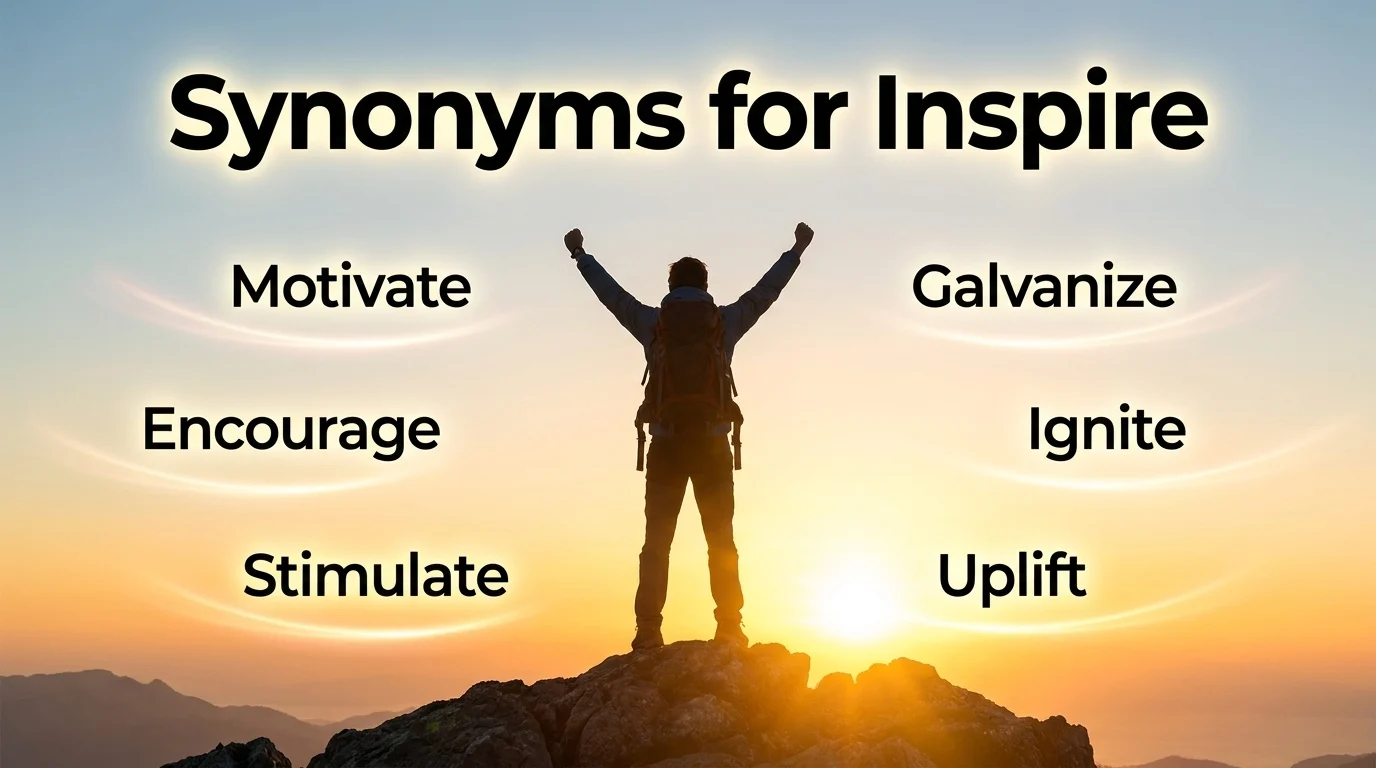
Do you keep using the word “inspire” in essays, motivational content, business writing, speeches, or everyday conversation? While it is a powerful and uplifting word, repeating it can make your writing feel predictable or dilute its emotional impact.
The good news is that the best alternative depends on what you actually mean. You might be encouraging someone, motivating a team, sparking creativity, influencing behavior, or awakening a feeling or idea.
This guide explains synonyms for “inspire” by meaning, tone, context, and usage. You will learn which alternatives work best in academic writing, professional communication, creative expression, motivational content, and casual conversation.
Quick Answer: What Does “Inspire” Mean?
“Inspire” means to fill someone with the urge or ability to do or feel something, especially something creative, positive, or courageous. It can also mean to breathe life into something, to influence, or to stimulate an idea or feeling. Depending on context, alternatives include motivate, encourage, stimulate, galvanize, spur, uplift, influence, prompt, ignite, and embolden.
Meaning, Tone, and Context
Simple Definition
“Inspire” generally refers to:
- Motivating action: giving someone the urge or confidence to do something
- Stimulating creativity: sparking new ideas or artistic expression
- Awakening feelings: evoking emotions like hope, courage, or determination
- Influencing: shaping thoughts, beliefs, or behavior in a positive way
- Breathing life into: energizing or animating something (literal or figurative)
Part of Speech
“Inspire” is a verb.
Examples:
- “Her speech inspired the audience.”
- “The beautiful landscape inspired him to paint.”
Related Forms:
- Inspiration (noun): the process of being inspired; a sudden brilliant idea
- Inspired (adjective): filled with inspiration; excellent
- Inspiring (adjective): having the power to inspire
- Inspiringly (adverb): in an inspiring manner
- Inspiredly (adverb): in an inspired manner
- Uninspiring (adjective): not having the power to inspire
Positive, Negative, or Neutral Tone
“Inspire” is overwhelmingly positive.
Positive associations:
- “Her courage inspired everyone around her.”
- “The teacher inspired a love of learning.”
It can be neutral in some contexts:
- “The results inspired further research.” (neutral, stimulated)
It is rarely negative, but context can shift the tone:
- “His actions inspired fear in his enemies.” (negative outcome, but the word itself remains neutral)
Formality Level
“Inspire” is a standard word that works in both formal and informal English. It is common in motivational writing, professional communication, academic contexts, and casual conversation. However, more specific alternatives can add precision.
Common Use Cases
“Inspire” commonly refers to:
- Motivating people: leaders inspiring teams, teachers inspiring students
- Stimulating creativity: art, music, writing, innovation
- Awakening emotions: hope, courage, determination, compassion
- Influencing behavior: role models, mentors, public figures
- Sparking ideas: research, brainstorming, problem-solving
- Religious/spiritual contexts: divine inspiration, spiritual awakening
Important Word Forms
- Inspire (verb): to fill with the urge or ability to do or feel something
- Inspiration (noun): the process of being inspired; a sudden good idea
- Inspired (adjective): filled with inspiration; outstanding
- Inspiring (adjective): having the power to inspire
- Inspirational (adjective): providing inspiration
- Uninspired (adjective): lacking inspiration or creativity
When and How to Use “Inspire”
Use “inspire” when you want to describe the act of motivating, stimulating, or filling someone with the urge to do or feel something. Because the word is broad and powerful, more specific alternatives can add nuance.
Professional
“Her leadership inspired the team to exceed its goals.”
This works naturally in business and leadership communication.
Academic
“The findings inspired a new line of research.”
The term is appropriate when discussing how discoveries stimulate further inquiry.
Personal
“You inspire me to be a better person.”
The word sounds natural and heartfelt in everyday conversation.
Creative
“The sunset inspired the poet to write his most famous verse.”
Here, “inspire” describes the spark of artistic creation.
Motivational
“Great leaders inspire others to dream more, learn more, and become more.”
This is standard language in motivational content.
Religious/Spiritual
“The scriptures are said to be divinely inspired.”
The term is appropriate in religious contexts.
Another Word for “Inspire”
There is no single perfect synonym because “inspire” can refer to motivating, stimulating, influencing, or awakening.
- Motivating action: motivate, encourage, spur, galvanize, drive, push
- Stimulating creativity: stimulate, spark, ignite, kindle, awaken, stir
- Awakening feelings: uplift, hearten, embolden, encourage, move
- Influencing behavior: influence, shape, guide, prompt, sway
- Breathing life into: animate, energize, invigorate, enliven
- Religious/spiritual: enlighten, awaken, consecrate
If you need one broad alternative, “motivate” works well for driving action, while “stimulate” works for sparking ideas, and “encourage” works for giving confidence.
When Not to Use “Inspire”
“Inspire” can become too vague or lofty when you need to be specific about what is being encouraged, stimulated, or influenced.
Consider:
“The book inspired me.”
This statement does not tell readers whether the book motivated the person to act, sparked a new idea, evoked an emotion, or changed their perspective.
A more precise sentence could be:
“The book inspired me to start my own business.”
Similarly, avoid using “inspire” when you simply mean encourage in a mild, practical sense. Use encourage or support instead.
Words Commonly Confused With “Inspire”
Inspire vs. Motivate
Motivate emphasizes giving someone a reason to act. Inspire can be more about filling someone with a feeling or idea.
Example:
“The bonus motivated the employees to work harder.” (external reason)
“Her story inspired the employees to believe in themselves.” (internal feeling)
Inspire vs. Encourage
Encourage emphasizes giving support or confidence. Inspire can be more profound and emotional.
Example:
“I encourage you to apply for the job.” (support)
“Her journey inspired me to pursue my dreams.” (profound emotional impact)
Inspire vs. Stimulate
Stimulate emphasizes sparking activity or interest. Inspire can be more about awakening a feeling.
Example:
“The discussion stimulated new ideas.” (sparked activity)
“The discussion inspired me to change my career.” (awakened a feeling/decision)
Inspire vs. Influence
Influence is broader and can be positive, negative, or neutral. Inspire is generally positive.
Example:
“Social media influences public opinion.” (neutral)
“Her kindness inspired me to volunteer.” (positive)
Inspire vs. Persuade
Persuade emphasizes convincing someone to believe or do something. Inspire is more about awakening desire or creativity.
Example:
“He persuaded me to change my mind.” (convincing)
“She inspired me to change my life.” (awakening)
Inspire vs. Uplift
Uplift emphasizes raising someone’s spirits or mood. Inspire can include this but is broader.
Example:
“The music uplifted my mood.” (emotional lift)
“The music inspired me to compose my own song.” (creative spark)
Best Synonym by Context for “Inspire”
| Context | Best Synonym | Why It Works | Example |
|---|---|---|---|
| Motivational writing | Motivate, galvanize | Emphasizes action | Great leaders motivate others to act. |
| Professional leadership | Galvanize, spur | Drives collective action | The CEO galvanized the team to innovate. |
| Academic writing | Stimulate, prompt | Sparks inquiry | The results stimulated further research. |
| Creative writing | Spark, ignite, kindle | Evokes artistic creation | The muses kindled her imagination. |
| Personal encouragement | Encourage, hearten | Gives confidence | Her words heartened me during a difficult time. |
| Emotional impact | Move, uplift | Affects feelings deeply | The film moved me to tears. |
| Influencing behavior | Influence, sway, prompt | Shapes action | His mentor prompted him to pursue medicine. |
| Religious/spiritual | Enlighten, awaken | Spiritual awakening | The retreat awakened a new sense of purpose. |
| Giving courage | Embolden, hearten | Instills bravery | Her example emboldened others to speak up. |
| Breathing life into | Animate, energize, invigorate | Energizes or enlivens | The new manager invigorated the department. |
| Formal writing | Prompt, stimulate, inspire | Precise and professional | The findings prompted a policy review. |
| Casual conversation | Encourage, fire up | Natural and informal | You really fired me up to try again. |
Which Synonym Should You Choose?
Start by identifying what kind of “inspire” you are describing.
- Motivating action: motivate, spur, galvanize, drive, push, prompt
- Stimulating creativity: spark, ignite, kindle, awaken, stimulate
- Giving confidence: encourage, hearten, embolden, uplift, support
- Influencing behavior: influence, sway, shape, guide, prompt
- Emotional impact: move, touch, stir, uplift, affect
- Breathing life into: animate, energize, invigorate, enliven, vitalize
- Religious/spiritual: enlighten, awaken, consecrate, sanctify
- Formal contexts: prompt, stimulate, inspire, engender
10 Key Synonyms for “Inspire”
The table below includes accurate alternatives with clear meanings and usage contexts.
| Synonym | Simple Meaning | Best Used For | Example Sentence |
|---|---|---|---|
| Motivate | Give someone a reason to act | Leadership, goals, achievement | The coach motivated the team to win. |
| Encourage | Give support or confidence | Personal, academic, professional | Her parents encouraged her to pursue art. |
| Stimulate | Spark activity or interest | Academic, intellectual, creative | The lecture stimulated a lively debate. |
| Galvanize | Shock or excite into action | Leadership, social change | The protest galvanized the community. |
| Spur | Prompt or urge into action | Motivation, decision-making | The criticism spurred him to improve. |
| Ignite | Set on fire; spark intensely | Creative, emotional, motivational | The speech ignited a passion for change. |
| Uplift | Raise spirits or mood | Emotional, spiritual | The music uplifted everyone in the room. |
| Embolden | Give courage or confidence | Moral courage, activism | Her example emboldened others to speak. |
| Prompt | Cause or bring about | Formal, academic, professional | The findings prompted a review of the policy. |
| Kindle | Light or stir up | Literary, creative, emotional | The book kindled a love of history in him. |
Synonym Groups and Usage Differences
Professional vs. Personal Synonyms
Professional writing benefits from specific terms such as motivate, galvanize, prompt, stimulate, and drive.
Personal communication often uses inspire itself or casual alternatives like fire up, pump up, or encourage.
Compare:
“She inspired me to keep going.” (personal)
“She motivated the team to exceed its targets.” (professional)
Formal vs. Conversational Synonyms
Inspire works in both formal and conversational English.
Formal alternatives: stimulate, prompt, engender, galvanize
Conversational alternatives: fire up, pump up, spark, drive
Examples:
“The findings prompted a new line of inquiry.” (formal)
“The movie really fired me up.” (conversational)
Academic Synonyms
Academic writing should distinguish between stimulate (spark inquiry), prompt (cause), engender (bring about), and inspire (awaken feeling).
For example, research papers might use “prompted” or “stimulated” rather than “inspired” for a more objective tone.
Professional and Business Synonyms
Business writing often benefits from phrases such as motivate, galvanize, drive, empower, and energize.
Instead of:
“The manager inspired the team.”
Consider:
“The manager motivated the team to achieve record results.”
Creative or Literary Synonyms
Creative writing can use kindle, ignite, spark, awaken, stir, and breathe life into depending on the context.
For example:
“The muses kindled her imagination.”
“A single glance ignited a fire in his heart.”
Slang or Modern Synonyms
Fire up means to excite or motivate.
Pump up means to energize or encourage.
Spark is a modern, versatile alternative.
Light a fire under means to motivate someone strongly (sometimes urgently).
Examples:
“That speech really fired me up.” (excited)
“The coach pumped up the team before the game.” (energized)
“The deadline lit a fire under us.” (strong motivation)
Strongest vs. Weaker Synonyms
“Inspire” synonyms vary in intensity:
Milder: encourage, support, nudge, prompt
Moderate: inspire, motivate, stimulate, spur
Strong: galvanize, ignite, embolden, drive
Very Strong: inflame, electrify, set ablaze (figurative)
Emotional vs. Neutral Synonyms
“Inspire” is generally positive and emotional.
Emotional alternatives: move, touch, uplift, hearten, embolden
Neutral alternatives: prompt, stimulate, influence, engender
Examples:
“The film moved me deeply.” (emotional)
“The results prompted a review.” (neutral)
Antonyms of “Inspire”
“Inspire” has several antonyms depending on context:
| Antonym | Context | Meaning | Example Sentence |
|---|---|---|---|
| Discourage | Motivation | Cause loss of confidence | The criticism discouraged him from trying again. |
| Deter | Action | Discourage from acting | The high cost deterred many applicants. |
| Dishearten | Emotional | Cause loss of hope | The defeat disheartened the team. |
| Demotivate | Motivation | Reduce motivation | Constant criticism demotivated the employees. |
| Depress | Emotional | Cause sadness or low spirits | The news depressed everyone. |
| Dissuade | Action | Persuade against | She dissuaded him from quitting. |
| Stifle | Creativity | Suppress or restrain | The strict rules stifled creativity. |
Comparison: “Inspire” vs. Similar Words
Inspire vs. Motivate
Main difference: Motivate emphasizes giving a reason to act. Inspire can be more about filling someone with a feeling or idea.
Examples:
“The bonus motivated the employees.” (external reason)
“Her story inspired the employees.” (internal feeling)
Inspire vs. Encourage
Main difference: Encourage emphasizes giving support or confidence. Inspire can be more profound and emotional.
Examples:
“I encourage you to apply.” (support)
“Her journey inspired me to pursue my dreams.” (profound impact)
Inspire vs. Stimulate
Main difference: Stimulate emphasizes sparking activity or interest. Inspire is more about awakening a feeling.
Examples:
“The discussion stimulated new ideas.” (sparked activity)
“The discussion inspired me to change careers.” (awakened feeling)
Inspire vs. Influence
Main difference: Influence is broader and can be positive, negative, or neutral. Inspire is generally positive.
Examples:
“Social media influences public opinion.” (neutral)
“Her kindness inspired me to volunteer.” (positive)
Inspire vs. Persuade
Main difference: Persuade emphasizes convincing someone. Inspire is more about awakening desire.
Examples:
“He persuaded me to change my mind.” (convincing)
“She inspired me to change my life.” (awakening)
Inspire vs. Uplift
Main difference: Uplift emphasizes raising spirits. Inspire can include this but is broader.
Examples:
“The music uplifted my mood.” (emotional lift)
“The music inspired me to compose.” (creative spark)
Common Phrases and Expressions with “Inspire”
1. Inspire confidence
Meaning:
To make someone feel confident or assured.
Example:
“Her calm demeanor inspired confidence in the team.”
2. Inspire hope
Meaning:
To give someone a feeling of hope.
Example:
“The charity’s work inspired hope in the community.”
3. Inspire awe
Meaning:
To fill someone with wonder or reverence.
Example:
“The majestic mountains inspired awe in every visitor.”
4. Inspire someone to do something
Meaning:
To motivate someone to take action.
Example:
“His story inspired me to volunteer.”
5. Inspire creativity
Meaning:
To spark creative thinking or expression.
Example:
“The workshop inspired creativity in all the participants.”
6. Inspire change
Meaning:
To motivate transformation or reform.
Example:
“The protest inspired change in government policy.”
7. Inspire loyalty
Meaning:
To evoke strong allegiance or support.
Example:
“His fair leadership inspired loyalty among his employees.”
8. Inspire fear
Meaning:
To cause someone to feel afraid.
Example:
“The dictator’s rule inspired fear across the nation.”
Common Mistakes to Avoid
1. Using “inspire” when “motivate” or “encourage” is more precise
If you mean giving a reason to act, use motivate. If you mean giving support, use encourage.
Vague: “The teacher inspired the students to study.”
Precise: “The teacher motivated the students to study by making the lessons engaging.”
2. Using “inspire” in overly formal or academic contexts where it feels subjective
In academic writing, more objective alternatives like prompt, stimulate, or engender may be more appropriate.
Subjective: “The study inspired new research.”
Objective: “The study prompted new research.”
3. Overusing “inspire” in motivational writing
Repetition can make content feel clichéd or shallow. Vary your alternatives: motivate, galvanize, empower, energize, and spur.
4. Confusing “inspire” with “influence”
Influence can be neutral or negative. Inspire is generally positive.
Neutral: “The media influenced public opinion.”
Positive: “The mentor inspired her to pursue science.”
5. Using “inspire” for mild encouragement
If the action is simple or practical, use encourage or support.
Too grand: “I inspired him to fill out the form.”
Better: “I encouraged him to fill out the form.”
6. Choosing a synonym that changes the meaning
Do not replace “inspire” with persuade unless you mean convincing.
Do not replace it with stimulate unless you mean sparking activity or interest.
FAQs
What is the best synonym for “inspire”?
The best synonym depends on context. Motivate works for driving action, encourage for giving confidence, stimulate for sparking ideas, galvanize for collective action, and ignite for intense creative or emotional spark.
What is a formal synonym for “inspire”?
Stimulate, prompt, engender, and galvanize are formal synonyms. These work well in academic papers, business reports, and professional documents.
What is an informal synonym for “inspire”?
Fire up, pump up, spark, and light a fire under are common informal alternatives.
What is another word for “inspire” in creative writing?
Kindle, ignite, spark, awaken, stir, and breathe life into work well in creative writing.
What is the difference between “inspire” and “motivate”?
Motivate emphasizes giving a reason to act. Inspire can be more about filling someone with a feeling or idea.
What is the opposite of “inspire”?
Depending on context, opposites include discourage, deter, dishearten, demotivate, and stifle.
What does “inspire” mean in a religious context?
In religious contexts, “inspire” often means divinely guided or breathed into by a higher power, as in “the inspired word of God.”
Conclusion
“Inspire” is a powerful word that can describe motivating action, stimulating creativity, awakening feelings, and influencing behavior. The best synonym depends on what you actually mean.
Choose motivate for driving action, encourage for giving confidence, stimulate for sparking ideas, galvanize for collective action, ignite for intense passion, uplift for emotional support, and prompt for formal contexts.
Most importantly, do not replace “inspire” simply to avoid repetition. First identify what kind of inspiration—motivational, creative, emotional, or spiritual—you are actually describing. Then choose the alternative that communicates that idea most clearly.
For academic, professional, and formal writing, precision is usually more valuable than vocabulary variety. A specific term such as galvanize, prompt, or stimulate can tell readers much more than the broad word inspire.
Before publishing a vocabulary guide, verify definitions and usage with trusted dictionaries such as Cambridge, Oxford, Merriam-Webster, Collins, or Britannica. This helps ensure that each alternative accurately matches its intended meaning and context.
The practical takeaway is simple: when “inspire” feels too vague or too grand, ask yourself what kind of motivation, spark, or emotional awakening you are actually describing. Then use the most precise word available.
Discover More:-
- 50+ Synonyms for Depressed: Meanings, Examples, and Best Alternatives
- 50+ Synonyms for “In Addition”: Meanings, Examples, and Best Alternatives

4 thoughts on “50+ Synonyms for Inspire: Meanings, Examples, and Best Alternatives”