Do you keep using the word “especially” in essays, emails, reports, presentations, or everyday conversation? While it is a useful and common adverb for emphasizing something, repeating it can make your writing feel predictable, weak, or overly wordy.
The good news is that the best alternative depends on what you actually mean. You might be highlighting something important, singling out an exception, emphasizing a particular example, or indicating that something applies more to one thing than another.
This guide explains synonyms for “especially” by meaning, tone, context, and usage. You will learn which alternatives work best in academic writing, professional communication, creative expression, technical content, and casual conversation.
Quick Answer: What Does “Especially” Mean?
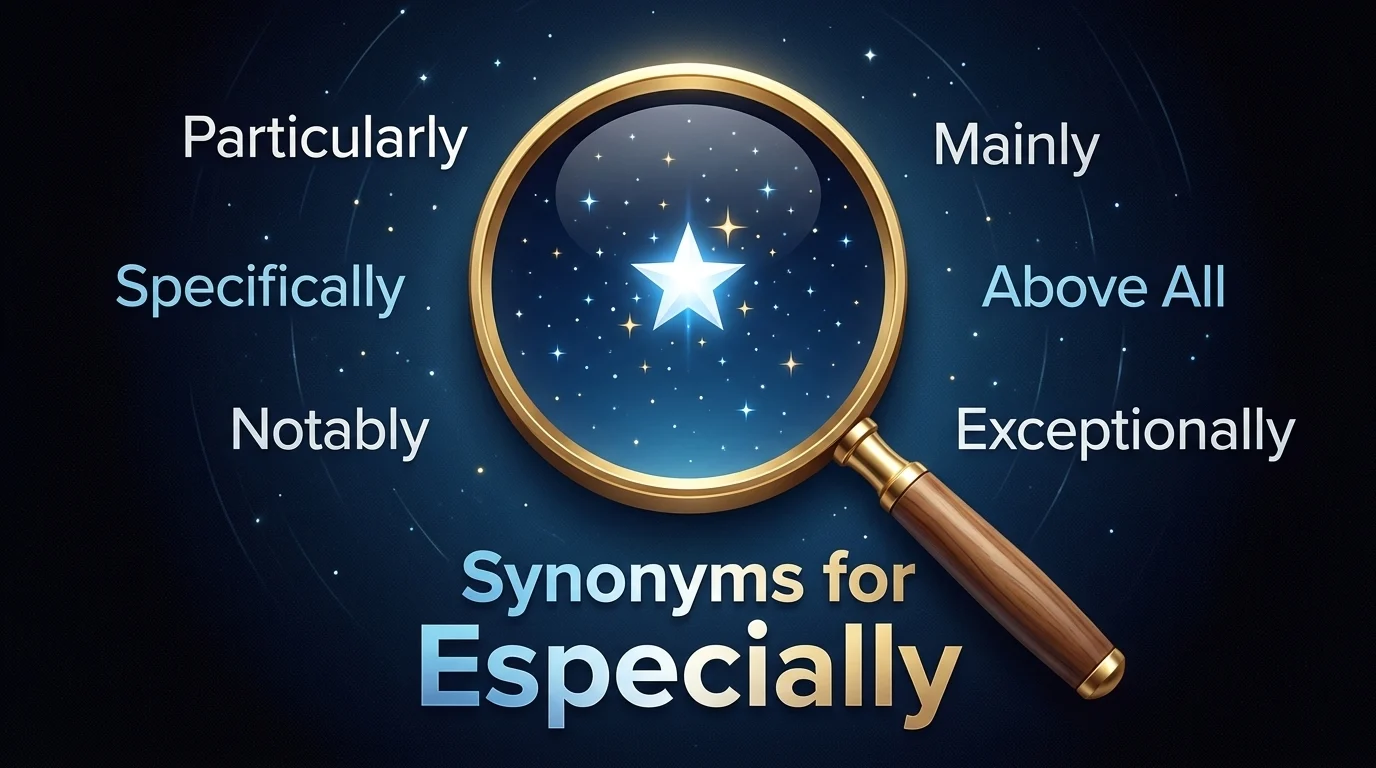
“Especially” is an adverb used to emphasize something that is more significant, relevant, or applicable than others. It means “particularly,” “above all,” or “to a greater degree.” Depending on context, alternatives include particularly, specifically, notably, chiefly, mainly, above all, in particular, prominently, expressly, and singularly.
Meaning, Tone, and Context
Simple Definition
“Especially” generally refers to:
- Emphasis: highlighting something as more important or significant
- Particularization: singling out one item from a group
- Degree: indicating something applies more to one thing than another
- Exception: noting something that stands out from the norm
- Specificity: pointing to a precise case or example
Part of Speech
“Especially” is an adverb.
Examples:
- “I love fruit, especially mangoes.”
- “The weather was bad, especially in the north.”
Related Forms:
- Especial (adjective): special, particular (rare in modern English)
- Special (adjective): better or different from what is usual
- Especially (adverb): particularly, above all
- Specially (adverb): for a special purpose (different meaning)
Positive, Negative, or Neutral Tone
“Especially” is generally neutral. It can be used in positive, negative, or neutral contexts.
Positive:
- “I love all desserts, especially chocolate cake.”
Negative:
- “The traffic was terrible, especially during rush hour.”
Neutral:
- “The report covers several topics, especially budgeting.”
Formality Level
“Especially” is a standard word that works in both formal and informal English. It is appropriate in academic papers, business reports, casual conversation, and creative writing.
However, more formal alternatives like particularly, notably, and specifically may be preferred in academic and professional writing.
Common Use Cases
“Especially” commonly appears in:
- Emphasis: highlighting important points
- Examples: singling out a specific case
- Exceptions: noting something that differs from the norm
- Preferences: expressing strong liking
- Warnings: emphasizing risks or concerns
- Academic writing: emphasizing key findings
Important Word Forms
- Especially (adverb): particularly, above all
- Especial (adjective): special, particular (rare)
- Special (adjective): better or different from usual
- Specially (adverb): for a special purpose
- Specialty (noun): a special skill or area of expertise
When and How to Use “Especially”
Use “especially” when you want to emphasize something that is more significant, relevant, or applicable than others. Because the word is common, more specific alternatives can add precision.
Professional
“The new policy will benefit all employees, especially those in remote positions.”
This works naturally in business communication.
Academic
“The study found significant improvements, especially in reading comprehension.”
The term is appropriate in academic writing.
Personal
“I love Italian food, especially pasta.”
The word sounds natural in everyday conversation.
Creative
“The forest was beautiful in autumn, especially when the leaves turned gold.”
The word adds emphasis in descriptive writing.
Technical
“Ensure all connections are secure, especially the power cable.”
The term is standard in technical documentation.
Customer Service
“We value your feedback, especially during this transition period.”
This sounds professional and appreciative.
Another Word for “Especially”
There is no single perfect synonym because “especially” can emphasize importance, singling out, degree, or exception.
- Emphasis context: particularly, notably, prominently, above all
- Singling out context: specifically, in particular, expressly, singularly
- Degree context: chiefly, mainly, predominantly, largely
- Exception context: unusually, exceptionally, remarkably
- Formal contexts: particularly, notably, specifically, expressly
- Casual contexts: mostly, mainly, really, super (informal)
If you need one broad alternative, “particularly” is the closest and most versatile synonym. “Specifically” works when pointing to an exact case.
When Not to Use “Especially”
“Especially” can become weak or vague when used too often or when a more precise word is available.
Consider:
“The report is important, especially for managers.”
A more precise sentence could be:
“The report is particularly important for managers.” (formal)
“The report is mainly important for managers.” (emphasis on main group)
Similarly, avoid using “especially” when you mean “specifically” (pointing to an exact thing) or “exceptionally” (to a remarkable degree).
Words Commonly Confused With “Especially”
Especially vs. Specially
Especially means “particularly” or “above all.” Specially means “for a special purpose.”
Example:
“I love flowers, especially roses.” (particularly)
“This cake was specially made for your birthday.” (for a purpose)
Especially vs. Specifically
Specifically means “exactly” or “precisely.” Especially means “particularly” or “more than others.”
Example:
“The book is specifically about World War II.” (exactly)
“The book is good, especially the ending.” (particularly)
Especially vs. Particularly
Particularly and especially are often interchangeable. Particularly can sound slightly more formal.
Example:
“She loves fruit, especially mangoes.” (common)
“She loves fruit, particularly mangoes.” (slightly more formal)
Especially vs. Exceptionally
Exceptionally means “to a remarkable degree.” Especially means “particularly” or “more than others.”
Example:
“She is exceptionally talented.” (remarkably)
“She is talented, especially in music.” (particularly)
Especially vs. Notably
Notably means “in a way that is worthy of attention.” Especially means “particularly.”
Example:
“The team performed well, notably in the final quarter.” (worthy of attention)
“The team performed well, especially in the final quarter.” (particularly)
Especially vs. Mainly
Mainly means “chiefly” or “mostly.” Especially means “particularly” or “more than others.”
Example:
“The audience was mainly students.” (mostly)
“The audience was enthusiastic, especially the students.” (particularly)
Best Synonym by Context for “Especially”
| Context | Best Synonym | Why It Works | Example |
|---|---|---|---|
| Formal writing | Particularly, notably | Precise and professional | The findings are particularly relevant to policymakers. |
| Academic writing | Specifically, notably | Standard academic usage | The study is specifically concerned with adolescents. |
| Emphasis | Above all, chiefly | Emphasizes importance | Above all, we must ensure safety. |
| Singling out | In particular, specifically | Points to exact case | The manager, in particular, was pleased. |
| Degree | Mainly, predominantly, largely | Emphasizes degree | The audience was mainly young adults. |
| Exception | Exceptionally, unusually | Highlights difference | The weather was exceptionally hot. |
| Casual conversation | Mostly, really, super | Natural and informal | I love desserts, really chocolate. |
| Professional/business | Notably, particularly, expressly | Professional and precise | The policy applies to all staff, notably managers. |
| Creative writing | Singularly, remarkably, eminently | Adds literary depth | The night was singularly beautiful. |
| Technical writing | Specifically, expressly | Precise and clear | Check all connections, specifically the power cable. |
| Warnings | Particularly, notably | Emphasizes risk | Be careful, particularly on icy roads. |
| Preferences | Especially, particularly | Expresses strong liking | I love fruit, especially mangoes. |
Which Synonym Should You Choose?
Start by identifying what kind of “especially” you are expressing.
- Emphasis: particularly, notably, prominently, above all
- Singling out: specifically, in particular, expressly, singularly
- Degree: chiefly, mainly, predominantly, largely
- Exception: exceptionally, unusually, remarkably
- Formal contexts: particularly, notably, specifically, expressly
- Casual contexts: mostly, mainly, really, super
- Warnings: particularly, notably, especially (itself)
- Preferences: especially, particularly
10 Key Synonyms for “Especially”
The table below includes accurate alternatives with clear meanings and usage contexts.
| Synonym | Simple Meaning | Best Used For | Example Sentence |
|---|---|---|---|
| Particularly | To a higher degree; especially | Formal, general use | She loves fruit, particularly mangoes. |
| Specifically | In a precise and exact way | Pointing to an exact case | The book is specifically about World War II. |
| Notably | In a way worthy of attention | Formal, academic | The team performed well, notably in the final quarter. |
| In particular | Specifically; especially | Formal, emphasis | The manager, in particular, was pleased. |
| Chiefly | Mainly; mostly | Formal, degree | The audience was chiefly students. |
| Mainly | More than anything else | General, degree | The audience was mainly young adults. |
| Above all | More than anything else | Emphasis, importance | Above all, we must ensure safety. |
| Exceptionally | To a remarkable degree | Exception, degree | The weather was exceptionally hot. |
| Expressly | For a specific purpose | Formal, legal | The policy was expressly designed for remote workers. |
| Predominantly | Mainly; for the most part | Formal, degree | The audience was predominantly female. |
Synonym Groups and Usage Differences
Professional vs. Personal Synonyms
Professional writing benefits from specific terms such as particularly, notably, specifically, expressly, and predominantly.
Personal communication often uses especially itself or casual alternatives like mostly, really, or super.
Compare:
“I love fruit, especially mangoes.” (personal)
“The report is particularly relevant to managers.” (professional)
Formal vs. Conversational Synonyms
Especially works in both formal and conversational English.
Formal alternatives: particularly, notably, specifically, chiefly, expressly
Conversational alternatives: mostly, mainly, really, super
Examples:
“The findings are particularly significant.” (formal)
“I love desserts, really chocolate.” (conversational)
Academic Synonyms
Academic writing should distinguish between especially (general emphasis), particularly (specific emphasis), specifically (exact focus), and notably (worthy of attention).
For example:
“The results were significant, particularly for the experimental group.”
“The study specifically examined adolescents.”
Professional and Business Synonyms
Business writing often benefits from phrases such as particularly, notably, specifically, and expressly.
Instead of:
“The policy is important, especially for managers.”
Consider:
“The policy is particularly important for managers.”
Creative or Literary Synonyms
Creative writing can use singularly, remarkably, eminently, peculiarly, and uncommonly depending on the context.
For example:
“The night was singularly beautiful.”
“She was eminently qualified for the role.”
Slang or Modern Synonyms
Super is a casual intensifier.
Really is a common informal emphasis.
Mostly is a casual way to mean “mainly.”
Big time is slang for “especially” or “very much.”
Examples:
“I love pizza, super cheesy pizza.” (casual)
“I’m tired, mostly because I didn’t sleep.” (casual)
Strongest vs. Weaker Synonyms
“Especially” synonyms vary in intensity:
Milder: mostly, mainly, largely
Moderate: especially, particularly, notably
Strong: above all, expressly, chiefly
Very Strong: singularly, exceptionally, eminently
Emotional vs. Neutral Synonyms
“Especially” is generally neutral.
Emotional alternatives: above all, singularly, remarkably
Neutral alternatives: particularly, mainly, notably
Examples:
“Above all, I want you to be safe.” (emotional)
“The report is particularly relevant.” (neutral)
Antonyms of “Especially”
“Especially” has several antonyms depending on context:
| Antonym | Context | Meaning | Example Sentence |
|---|---|---|---|
| Generally | Emphasis | In most cases | The weather is generally mild. |
| Usually | Degree | Most of the time | She usually arrives early. |
| Normally | Exception | Under normal conditions | The train normally runs on time. |
| Commonly | Emphasis | Frequently; typically | This plant is commonly found in gardens. |
| Broadly | Specificity | Widely; generally | The term is broadly defined. |
| Equally | Degree | To the same degree | All team members were equally responsible. |
Comparison: “Especially” vs. Similar Words
Especially vs. Specially
Main difference: Especially means “particularly” or “above all.” Specially means “for a special purpose.”
Examples:
“I love flowers, especially roses.” (particularly)
“This cake was specially made for your birthday.” (for a purpose)
Especially vs. Specifically
Main difference: Specifically means “exactly” or “precisely.” Especially means “particularly” or “more than others.”
Examples:
“The book is specifically about World War II.” (exactly)
“The book is good, especially the ending.” (particularly)
Especially vs. Particularly
Main difference: Particularly and especially are often interchangeable. Particularly can sound slightly more formal.
Examples:
“She loves fruit, especially mangoes.” (common)
“She loves fruit, particularly mangoes.” (slightly more formal)
Especially vs. Exceptionally
Main difference: Exceptionally means “to a remarkable degree.” Especially means “particularly” or “more than others.”
Examples:
“She is exceptionally talented.” (remarkably)
“She is talented, especially in music.” (particularly)
Especially vs. Notably
Main difference: Notably means “in a way that is worthy of attention.” Especially means “particularly.”
Examples:
“The team performed well, notably in the final quarter.” (worthy of attention)
“The team performed well, especially in the final quarter.” (particularly)
Especially vs. Mainly
Main difference: Mainly means “chiefly” or “mostly.” Especially means “particularly” or “more than others.”
Examples:
“The audience was mainly students.” (mostly)
“The audience was enthusiastic, especially the students.” (particularly)
Common Phrases and Expressions with “Especially”
1. Especially for you
Meaning:
Particularly for your benefit or enjoyment.
Example:
“I made this cake especially for you.”
2. Especially important
Meaning:
Particularly significant.
Example:
“Sleep is especially important for growing children.”
3. Especially when
Meaning:
Particularly in the case that.
Example:
“I love the beach, especially when the sun sets.”
4. Especially if
Meaning:
Particularly in the condition that.
Example:
“Bring a jacket, especially if it gets windy.”
5. Especially true
Meaning:
Particularly accurate or relevant.
Example:
“This is especially true for young professionals.”
6. Especially noteworthy
Meaning:
Particularly deserving of attention.
Example:
“Her performance was especially noteworthy.”
7. Especially given
Meaning:
Particularly considering.
Example:
“The decision was surprising, especially given the circumstances.”
Common Mistakes to Avoid
1. Confusing “especially” and “specially”
Especially means “particularly.” Specially means “for a special purpose.”
Incorrect: “I love fruit, specially mangoes.”
Correct: “I love fruit, especially mangoes.”
Correct: “This cake was specially made for you.”
2. Overusing “especially”
Repetition can make content feel weak. Use alternatives such as particularly, notably, specifically, and above all.
3. Using “especially” when “specifically” is more precise
If you mean “exactly” or “precisely,” use specifically.
Vague: “The book is especially about World War II.”
Precise: “The book is specifically about World War II.”
4. Placing “especially” incorrectly
“Especially” usually comes before the word or phrase it emphasizes.
Incorrect: “I love especially fruit.”
Correct: “I especially love fruit.” or “I love fruit, especially mangoes.”
5. Using “especially” in informal contexts when “really” is more natural
In casual conversation, really or super may sound more natural.
Formal: “This is especially important.”
Casual: “This is really important.”
FAQs
What is the best synonym for “especially”?
The best synonym depends on context. Particularly is the closest general synonym. Specifically works for exact cases, notably for formal writing, mainly for degree, and above all for emphasis.
What is a formal synonym for “especially”?
Particularly, notably, specifically, chiefly, and expressly are formal synonyms.
What is an informal synonym for “especially”?
Mostly, mainly, really, and super are common informal alternatives.
What is the difference between “especially” and “specially”?
Especially means “particularly” or “above all.” Specially means “for a special purpose.”
Can “especially” start a sentence?
Yes, “especially” can start a sentence for emphasis. Example: “Especially in winter, the roads can be dangerous.” However, it is more common in the middle of a sentence.
What is the opposite of “especially”?
Depending on context, opposites include generally, usually, normally, commonly, and broadly.
What does “especially” mean in academic writing?
In academic writing, “especially” is used to emphasize key findings, notable exceptions, or specific cases that stand out from the general pattern.
Conclusion
“Especially” is a useful adverb for emphasizing something that is more significant, relevant, or applicable than others. The best synonym depends on what you actually mean.
Choose particularly for general use, specifically for exact cases, notably for formal writing, mainly for degree, above all for emphasis, and exceptionally for remarkable cases.
Most importantly, do not replace “especially” simply to avoid repetition. First identify what kind of emphasis—importance, specificity, degree, or exception—you are actually expressing. Then choose the alternative that communicates that idea most clearly.
For academic, professional, and formal writing, precision is usually more valuable than vocabulary variety. A specific term such as particularly, notably, specifically, or expressly can tell readers much more than the broad word especially.
Before publishing a vocabulary guide, verify definitions and usage with trusted dictionaries such as Cambridge, Oxford, Merriam-Webster, Collins, or Britannica. This helps ensure that each alternative accurately matches its intended meaning and context.
The practical takeaway is simple: when “especially” feels too general or overused, ask yourself what kind of emphasis, exception, or degree you are actually describing. Then use the most precise word available.
Discover More:-
- 50+ Synonyms for Inspire: Meanings, Examples, and Best Alternatives
- 50+ Synonyms for Together: Meanings, Examples, and Best Alternatives

1 thought on “50+ Synonyms for Especially: Meanings, Examples, and Best Alternatives”