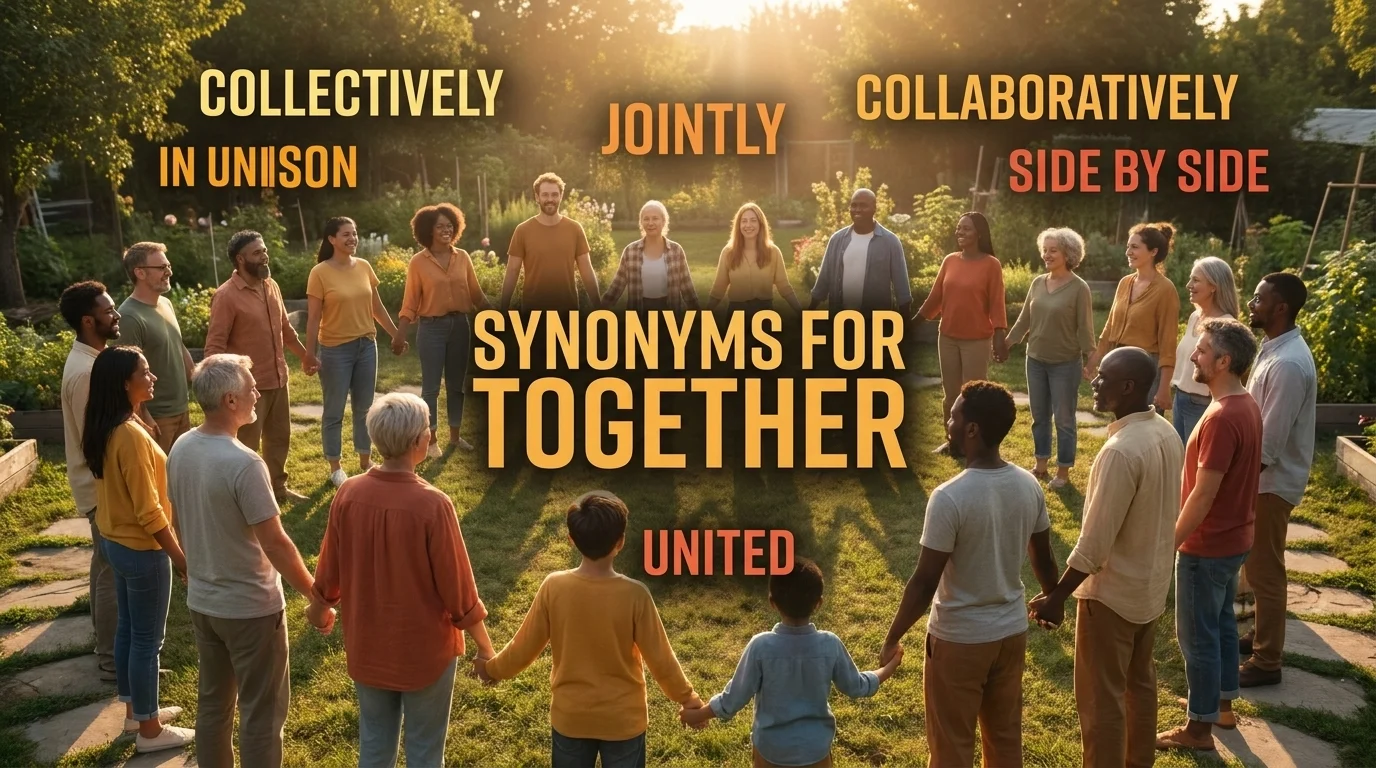
Do you keep using the word “together” in essays, business reports, creative writing, professional communication, or everyday conversation? While it is a common and versatile word, repeating it can make your writing feel monotonous or lack the nuance needed to describe different types of unity, collaboration, or simultaneity.
The good news is that the best alternative depends on what you actually mean. You might be describing people in the same place, working collaboratively, in a relationship, simultaneously, in agreement, or functioning as a unified whole.
This guide explains synonyms for “together” by meaning, tone, context, and usage. You will learn which alternatives work best in academic writing, professional communication, creative expression, personal contexts, and casual conversation.
Quick Answer: What Does “Together” Mean?
“Together” refers to people or things being with each other, in one place, or in a group. It can also mean working jointly, simultaneously, in agreement, or forming a unified whole. Depending on context, alternatives include collectively, jointly, mutually, in unison, as a group, simultaneously, cooperatively, in harmony, united, and concurrently.
Meaning, Tone, and Context
Simple Definition
“Together” generally refers to:
- Physical proximity: people or things in the same place
- Collaboration: working or acting jointly
- Simultaneity: happening at the same time
- Relationship: people in a romantic partnership
- Agreement/harmony: being in accord or unified
- Assembly: parts combined to form a whole
- Continuity: keeping things organized or cohesive
Part of Speech
“Together” is primarily an adverb and can also function as an adjective.
Adverb Examples:
- “They walked together to the store.” (in each other’s company)
- “We worked together on the project.” (jointly)
- “They arrived together.” (at the same time)
Adjective Examples:
- “She is a very together person.” (organized, composed)
- “They are a together couple.” (stable, united)
Related Forms:
- Untogether (adjective): disorganized or dysfunctional
- Togetherness (noun): the state of being together
Positive, Negative, or Neutral Tone
“Together” is generally positive or neutral.
Positive associations:
- “They have a strong, together relationship.”
- “The team worked together effectively.”
Neutral contexts:
- “Put the parts together.”
- “They arrived together.”
Formality Level
“Together” works in both formal and informal English. However, more formal alternatives like collectively, jointly, and concurrently are often preferred in academic and professional writing.
Common Use Cases
“Together” commonly refers to:
- Physical togetherness: people meeting, gatherings, cohabitation
- Collaboration: teamwork, partnerships, group efforts
- Simultaneity: events happening at the same time
- Relationships: couples, partnerships, unity
- Cohesion: things fitting or working as a unit
- Organization: being “put together” or composed
Important Word Forms
- Together (adverb): in one place; jointly; at the same time
- Together (adjective): organized, composed, stable
- Togetherness (noun): the state of being together
- Untogether (adjective): disorganized or dysfunctional
When and How to Use “Together”
Use “together” when you want to describe proximity, collaboration, simultaneity, or unity. Because the word is broad, more specific alternatives can add precision.
Professional
“We need to work together to meet the deadline.”
This works naturally in business communication.
Academic
“The researchers collaborated together on the multi-year study.”
The phrase is appropriate when discussing collaborative research.
Personal
“We’ve been together for five years.”
The word sounds natural in personal conversation about relationships.
Business
“The departments need to function together seamlessly.”
Here, “together” describes organizational unity.
Creative
“The colors come together beautifully in this painting.”
The word can describe aesthetic harmony.
Technical
“Gather all the parts together before assembly.”
This works in instructional or technical contexts.
Another Word for “Together”
There is no single perfect synonym because “together” can refer to many different things.
- Physical proximity: together, side by side, in one place, cheek by jowl
- Collaboration: jointly, collectively, cooperatively, in partnership
- Simultaneity: at the same time, simultaneously, concurrently
- Agreement/harmony: in unison, in harmony, in agreement, united
- Relationships: as a couple, partnered, paired
- Cohesion: as one, as a whole, in concert, in sync
- Organization: composed, put together, organized
If you need one broad alternative, “collectively” works for group contexts, “jointly” for collaboration, and “simultaneously” for timing.
When Not to Use “Together”
“Together” can become too vague when you need to be specific about what kind of togetherness you are describing.
Consider:
“We did it together.”
This statement does not tell readers whether people worked collaboratively, were in the same place, or acted at the same time.
A more precise sentence could be:
“We collaborated on the project.” (collaboration)
“We were in the same room during the presentation.” (proximity)
“We submitted our applications at the same time.” (simultaneity)
Similarly, avoid using “together” when you mean “concurrently” (at the same time) in formal writing.
Words Commonly Confused With “Together”
Together vs. Collectively
Collectively emphasizes people acting as a group or the combined effect of individuals. Together is broader.
Example:
“Collectively, the employees raised $10,000.” (group action)
“We met together in the conference room.” (proximity)
Together vs. Jointly
Jointly emphasizes shared responsibility, ownership, or action. Together is more general.
Example:
“They jointly owned the business.” (shared ownership)
“The team worked together on the presentation.” (general collaboration)
Together vs. Simultaneously
Simultaneously specifically means at the same time. Together can mean that but also other things.
Example:
“The two events happened simultaneously.” (exact same time)
“They arrived together.” (could mean in the same car, not necessarily the same time)
Together vs. In Unison
In unison means doing something at the same time and in harmony. Together is broader.
Example:
“The choir sang in unison.” (harmonized)
“The audience clapped together.” (same time, not necessarily harmonized)
Together vs. Cooperatively
Cooperatively emphasizes working willingly and helpfully. Together can mean simply being in the same place.
Example:
“The children played cooperatively.” (helpful collaboration)
“The children played together.” (in the same place)
Best Synonym by Context for “Together”
| Context | Best Synonym | Why It Works | Example |
|---|---|---|---|
| Formal writing | Collectively, jointly | Precise and professional | The committee collectively approved the proposal. |
| Academic writing | Concurrently, jointly, collectively | Standard academic usage | The events occurred concurrently. |
| Collaboration | Collaboratively, jointly, in partnership | Emphasizes working together | We worked collaboratively on the project. |
| Physical proximity | Side by side, in one place, alongside | Emphasizes location | They worked side by side in the lab. |
| Simultaneity | Simultaneously, concurrently, at the same time | Emphasizes timing | The two talks were scheduled concurrently. |
| Relationships | As a couple, partnered, together | Personal and clear | They’ve been partnered for a decade. |
| Agreement/harmony | In unison, in harmony, in agreement, united | Emphasizes accord | The board was united in its decision. |
| Cohesion | As one, as a whole, in concert | Emphasizes unity | The team acted as one. |
| Organization | Composed, put together, organized | Describes someone stable | She is a very composed leader. |
| Casual conversation | Together (itself) | Natural and concise | They had dinner together. |
| Technical/assembly | Combined, assembled, joined | Describes parts forming a whole | The parts were assembled at the factory. |
Which Synonym Should You Choose?
Start by identifying what kind of “together” you are describing.
- Physical proximity: side by side, alongside, in one place, shoulder to shoulder
- Collaboration: jointly, collaboratively, cooperatively, in partnership
- Simultaneity: simultaneously, concurrently, at the same time, in tandem
- Agreement/harmony: in unison, in harmony, in agreement, united, in accord
- Relationships: as a couple, partnered, paired
- Cohesion: as one, as a whole, in concert, in sync
- Organization: composed, put together, organized, stable
10 Key Synonyms for “Together”
The table below includes accurate alternatives with clear meanings and usage contexts.
| Synonym | Simple Meaning | Best Used For | Example Sentence |
|---|---|---|---|
| Collectively | As a group | Formal, group actions | Collectively, they raised over $50,000 for charity. |
| Jointly | Together with shared effort | Shared ownership/responsibility | They jointly managed the project. |
| Simultaneously | At exactly the same time | Events, actions occurring together | The two events happened simultaneously. |
| Concurrently | At the same time | Formal, academic contexts | The courses will be offered concurrently. |
| Collaboratively | Working together cooperatively | Teamwork, joint projects | They collaboratively designed the new software. |
| In unison | In harmony or at the same time | Singing, speaking, coordinated action | The audience applauded in unison. |
| United | Joined together, in agreement | Groups, nations, organizations | The committee was united in its decision. |
| Side by side | Physically next to each other | Physical proximity, comparison | They worked side by side in the lab. |
| In concert | In agreement or working together | Formal, collaborative contexts | The departments acted in concert. |
| Together (as adjective) | Organized, stable | Describing a composed person | She is a very together person. |
Synonym Groups and Usage Differences
Professional vs. Personal Synonyms
Professional writing benefits from specific terms such as collectively, jointly, collaboratively, and concurrently.
Personal communication often uses together itself or casual alternatives like side by side, as a couple, or in sync.
Compare:
“We worked together on the deal.” (personal)
“We collaboratively structured the deal.” (professional)
Formal vs. Conversational Synonyms
Together works in both formal and conversational English.
Formal alternatives: collectively, jointly, concurrently, in concert, in unison
Conversational alternatives: together, side by side, in sync
Examples:
“The departments collectively approved the budget.” (formal)
“The departments worked together on the budget.” (conversational)
Academic Synonyms
Academic writing should distinguish between together (general), collectively (group action), concurrently (simultaneous time), and in tandem (working in parallel).
For example:
“The two variables were examined concurrently.”
“The researchers collaboratively designed the methodology.”
Professional and Business Synonyms
Business writing often benefits from phrases such as collaboratively, jointly, in partnership, and in concert.
Instead of:
“We worked together to develop the strategy.”
Consider:
“We collaboratively developed the strategy.”
Creative or Literary Synonyms
Creative writing can use in unison, side by side, shoulder to shoulder, as one, hand in hand, and in harmony.
For example:
“The lovers walked hand in hand through the garden.”
“The soldiers stood shoulder to shoulder in defense.”
Slang or Modern Synonyms
In sync means in harmony or agreement.
Lockstep means acting in close agreement or unison (often used for conformity).
BFF (Best Friends Forever) implies being together in friendship.
Tight can mean close-knit or in agreement.
Examples:
“We’re totally in sync.” (in agreement)
“They’re a tight-knit group.” (close)
“We rode together in the car.” (casual, standard)
Strongest vs. Weaker Synonyms
“Together” synonyms vary in specificity:
Broad: together, in one place
More focused: jointly, collectively, simultaneously
Very specific: concurrently, collaboratively, in unison
Emotional vs. Neutral Synonyms
“Together” is generally neutral or positive.
Emotional alternatives: united, in harmony, hand in hand, inseparable
Neutral alternatives: collectively, jointly, simultaneously
Examples:
“The team was united in their goal.” (emotional, positive)
“The team worked collectively.” (neutral)
Antonyms of “Together”
“Together” has several antonyms depending on context:
| Antonym | Context | Meaning | Example Sentence |
|---|---|---|---|
| Separately | General | Apart from each other | They traveled separately. |
| Apart | Physical | Not together | They live apart. |
| Individually | Action | Each person doing their own | They worked individually. |
| Separated | Relationship | Not in a relationship | They are separated. |
| Disjointed | Cohesion | Lacking unity | The disjointed effort failed. |
| In disagreement | Agreement | Not in accord | They were in disagreement. |
| Sequentially | Time | One after another, not at once | The tasks were completed sequentially. |
| Disorganized | Organization | Not “put together” | He has a very disorganized desk. |
Comparison: “Together” vs. Similar Words
Together vs. Collectively
Main difference: Collectively emphasizes the combined effect or action of a group. Together is broader.
Examples:
“Collectively, they raised $100,000.” (combined effort)
“They went to the store together.” (physical proximity)
Together vs. Jointly
Main difference: Jointly emphasizes shared responsibility or ownership. Together is more general.
Examples:
“They jointly own the business.” (shared ownership)
“Let’s do this task together.” (general collaboration)
Together vs. Simultaneously
Main difference: Simultaneously specifically means at the same time. Together can mean that but also other things.
Examples:
“The events occurred simultaneously.” (exact same time)
“They arrived together.” (could be same car, not necessarily same time)
Together vs. In Unison
Main difference: In unison emphasizes harmony and synchronized action. Together is broader.
Examples:
“The choir sang in unison.” (harmonized)
“The children played together.” (in the same place)
Together vs. Cooperatively
Main difference: Cooperatively emphasizes willing, helpful collaboration. Together can mean simply being in the same place.
Examples:
“The children played cooperatively.” (helpful)
“The children played together.” (in the same place, possibly conflict)
Common Phrases and Expressions with “Together”
1. Get together
Meaning:
To meet or gather socially.
Example:
“Let’s get together for dinner this weekend.”
2. Bring together
Meaning:
To unite or gather people or things.
Example:
“The event brought together people from all walks of life.”
3. Come together
Meaning:
To unite or form a group.
Example:
“The community came together to help the family.”
4. Put together
Meaning:
To assemble or combine; also, to organize.
Example:
“He put together an impressive presentation.”
5. Hold together
Meaning:
To remain united or cohesive.
Example:
“The team held together despite the challenges.”
6. Go together
Meaning:
To complement each other; also, to be in a relationship.
Example:
“These colors go together beautifully.”
“They’ve been going together for two years.”
7. Together with
Meaning:
In addition to; along with.
Example:
“Together with his team, he achieved great success.”
8. All together
Meaning:
All in one place or at the same time.
Example:
“Let’s sing all together.”
9. Get it together
Meaning:
To organize oneself or become composed.
Example:
“He needs to get it together before the meeting.”
10. Togetherness
Meaning:
The state of being together or close.
Example:
“The holidays are a time for togetherness.”
Common Mistakes to Avoid
1. Using “together” when “collectively” or “jointly” is more precise
If you mean a group effort or shared responsibility, use more formal alternatives.
Vague: “We worked together.”
Precise: “We worked collaboratively.”
Formal: “We jointly developed the strategy.”
2. Using “together” when “simultaneously” is more precise
If you mean at the same time, use “simultaneously” or “concurrently.”
Vague: “We arrived together.” (could mean in one car)
Precise: “We arrived simultaneously.” (same time)
3. Confusing “together” with “collectively” in formal writing
Collectively emphasizes the combined effect of individuals. Together can be more general.
Example:
“Collectively, the team contributed $5,000.” (combined)
“The team worked together.” (general)
4. Overusing “together” in writing
Repetition can make content feel dull. Use alternatives such as collectively, jointly, collaboratively, simultaneously, in unison, and side by side.
5. Using “together” when “each” or “individually” is meant
If you mean the opposite of together, use individually or separately.
Example:
“Instead of working together, each member worked individually.”
FAQs
What is the best synonym for “together”?
The best synonym depends on context. Collectively works for group actions, jointly for shared effort, simultaneously for timing, side by side for physical proximity, in unison for harmony, and collaboratively for teamwork.
What is a formal synonym for “together”?
Collectively, jointly, concurrently, collaboratively, and in concert are formal synonyms.
What is an informal synonym for “together”?
Together itself is the most common. Side by side, in sync, and as a couple are also informal.
What is another word for “together” in the sense of a relationship?
As a couple, partnered, paired, and together itself are common. Married is used for a formal union.
What is the difference between “together” and “collectively”?
Together is broader and can refer to physical proximity, collaboration, or simultaneity. Collectively emphasizes group action or combined effect.
What is the opposite of “together”?
Depending on context, opposites include separately, apart, individually, separated, and disjointed.
What does “together” mean in the sense of an organized person?
When describing a person as “together,” it means they are organized, stable, and composed.
Conclusion
“Together” is a versatile word that can describe physical proximity, collaboration, simultaneity, agreement, relationships, and cohesion. The best synonym depends on what you actually mean.
Choose collectively for group actions, jointly for shared effort, simultaneously for timing, side by side for physical proximity, in unison for harmony, collaboratively for teamwork, and organized for describing someone as “put together.”
Most importantly, do not replace “together” simply to avoid repetition. First identify what kind of togetherness—physical, collaborative, simultaneous, or harmonious—you are actually describing. Then choose the alternative that communicates that idea most clearly.
For academic, professional, and formal writing, precision is usually more valuable than vocabulary variety. A specific term such as collectively, jointly, or concurrently can tell readers much more than the broad word together.
Before publishing a vocabulary guide, verify definitions and usage with trusted dictionaries such as Cambridge, Oxford, Merriam-Webster, Collins, or Britannica. This helps ensure that each alternative accurately matches its intended meaning and context.
The practical takeaway is simple: when “together” feels too general, ask yourself what kind of unity, collaboration, or simultaneity you are actually describing. Then use the most precise word available.
Discover More:-
- 50+ Synonyms for Quality: Meanings, Examples, and Best Alternatives
- 50+ Synonyms for Thing: Meanings, Examples, and Best Alternatives

1 thought on “50+ Synonyms for Together: Meanings, Examples, and Best Alternatives”