Do you keep using the word “thing” in essays, business reports, creative writing, presentations, or everyday conversation? While it is one of the most common and versatile words in English, overusing it can make your writing feel vague, informal, or imprecise.
The good news is that the best alternative depends on what you actually mean. You might be referring to a physical object, an idea, a situation, a task, a concept, a detail, a device, or something abstract.
This guide explains synonyms for “thing” by meaning, tone, context, and usage. You will learn which alternatives work best in academic writing, professional communication, creative expression, technical content, and casual conversation.
Quick Answer: What Does “Thing” Mean?
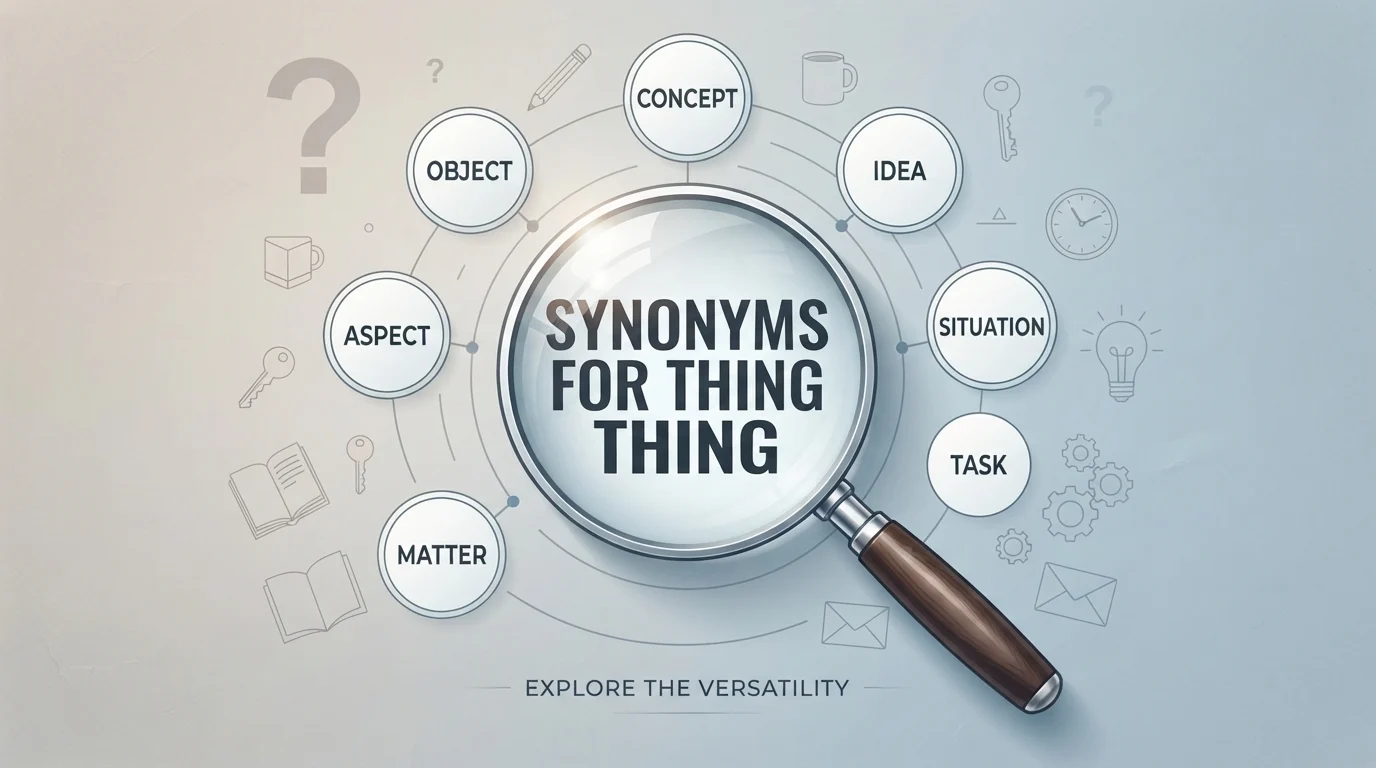
“Thing” is an extremely general noun that can refer to any object, idea, action, situation, or concept. Because it is so broad, it’s often better to use a more specific word. Depending on context, alternatives include object, item, idea, concept, situation, task, device, detail, element, and matter.
Meaning, Tone, and Context
Simple Definition
“Thing” generally refers to:
- Physical objects: any material item that can be seen or touched
- Abstract concepts: ideas, thoughts, beliefs, or notions
- Actions or events: activities, occurrences, or situations
- Details or matters: specific points, issues, or concerns
- Tasks or duties: jobs, responsibilities, or assignments
- Individuals or creatures (informal): people or animals
Part of Speech
“Thing” is primarily a noun.
Examples:
- “Can you pass me that thing?”
- “The thing that matters most is honesty.”
Related Forms:
- Things (plural): multiple items or matters
- Thingy (informal): a placeholder for something whose name is forgotten
- Nothing (pronoun/noun): no thing
Positive, Negative, or Neutral Tone
“Thing” is neutral, but its tone depends on context and modifiers.
Neutral: “There are several things we need to discuss.”
Positive: “The best thing about this job is the team.”
Negative: “The worst thing happened today.”
Formality Level
“Thing” is considered informal to neutral in English. It is acceptable in everyday conversation and casual writing. However, in formal writing—academic papers, business reports, legal documents—it is often better to use more precise alternatives.
Common Use Cases
“Thing” commonly refers to:
- Physical objects: “I can’t find my keys—you know, the little metal thing?”
- Abstract ideas: “Love is a beautiful thing.”
- Situations or events: “The whole thing was a disaster.”
- Tasks or matters: “I have a few things to do today.”
- Details or points: “There’s one thing I want to mention.”
- General reference: “Things are going well.”
Important Word Forms
- Thing (noun): an object, idea, or matter
- Things (plural): multiple objects, ideas, or matters
- Nothing (pronoun): no thing; not anything
- Something (pronoun): an unspecified thing
- Anything (pronoun): any thing
- Everything (pronoun): all things
- Thingy (informal): a placeholder word
When and How to Use “Thing”
Use “thing” when:
- The specific word isn’t necessary or known
- You want to be intentionally vague
- You are referring to something in a very general way
- You are speaking casually or informally
However, in most cases, more specific words will make your writing stronger.
Professional (Avoid or Use Sparingly)
“The main thing we need to focus on is customer satisfaction.”
A more professional version:
“The primary focus should be customer satisfaction.”
Academic (Avoid)
Instead of:
“The study examined things related to behavior.”
Use:
“The study examined behavioral factors.”
Personal (Natural)
“The best thing about today was the weather.”
This sounds natural in everyday conversation.
Business (Avoid or Specify)
Instead of:
“We need to discuss several things.”
Use:
“We need to discuss several action items.”
Creative (Use for Effect)
“The thing about the old house was its silence—a heavy, watchful silence.”
In creative writing, “thing” can be used deliberately for effect.
Another Word for “Thing”
There is no single perfect synonym because “thing” can refer to almost anything. The best alternative depends on what you are actually describing.
- Physical objects: object, item, article, artifact, device, gadget, tool
- Abstract ideas: idea, concept, notion, thought, belief, principle
- Situations or events: situation, event, occurrence, affair, matter
- Tasks or duties: task, job, duty, responsibility, assignment
- Details or points: detail, point, matter, issue, concern
- General matters: matters, affairs, concerns, issues, elements
- Informal/casual: stuff, thingy, whatsit
If you need one broad alternative, “object” works for physical things, while “matter” works for abstract or situational things.
When Not to Use “Thing”
“Thing” is too vague for:
- Formal writing (academic papers, legal documents, business reports)
- Professional communication (emails to clients, performance reviews)
- Technical writing (instructions, specifications)
- Precise descriptions (where specificity is important)
Consider:
“The thing on the table is important.”
This is extremely vague. A precise version could be:
“The contract on the table is important.”
Similarly, instead of “We need to discuss things,” use “We need to discuss budget allocations.”
Words Commonly Confused With “Thing”
Thing vs. Object
Object is more specific and formal, referring to a material item that can be seen and touched.
Example:
“Please move the object from the shelf.” (specific, formal)
“Can you hand me that thing?” (vague, informal)
Thing vs. Idea
Idea specifically refers to a thought, concept, or belief.
Example:
“The idea of freedom is powerful.” (abstract)
“Freedom is a powerful thing.” (vague)
Thing vs. Matter
Matter refers to a situation, issue, or concern, often in formal contexts.
Example:
“We need to address this matter immediately.” (formal)
“We need to address this thing immediately.” (vague)
Thing vs. Item
Item refers to a distinct individual unit, often in lists or inventory.
Example:
“Please check each item on the list.” (specific)
“Please check each thing on the list.” (vague)
Thing vs. Stuff
Stuff is the informal equivalent of “things,” often referring to a collection of items.
Example:
“Where should I put all this stuff?” (informal)
“Where should I put all these things?” (slightly more formal)
Best Synonym by Context for “Thing”
| Context | Best Synonym | Why It Works | Example |
|---|---|---|---|
| Physical objects | Object, item, artifact | Precise and formal | The artifact was dated to 500 BCE. |
| Abstract ideas | Idea, concept, notion | Captures intangible concepts | The concept of justice is universal. |
| Situations/events | Situation, event, affair | Describes occurrences | The event was a complete success. |
| Tasks/duties | Task, job, responsibility | Professional and clear | Completing this task is your responsibility. |
| Details/points | Detail, point, issue | Focuses on specific aspects | There is one issue we need to resolve. |
| General matters | Matters, affairs, concerns | Formal and professional | We need to discuss financial matters. |
| Professional context | Element, component, factor | Business/technical precision | Several factors contributed to the delay. |
| Creative writing | Entity, essence, presence | Adds literary depth | The essence of the story is love. |
| Devices/tools | Device, gadget, tool, apparatus | Specific to technology/tools | The gadget was surprisingly useful. |
| Casual conversation | Stuff, thingy, whatsit | Natural and informal | Where did I put that thingy? |
| Formal writing | Element, aspect, phenomenon | Academic/literary precision | The phenomenon was studied extensively. |
| Resume context | Skill, achievement, responsibility | Professional and specific | My key achievement was increasing sales. |
Which Synonym Should You Choose?
Start by identifying what kind of “thing” you are describing.
- Physical item: object, item, article, artifact, device, gadget, tool
- Abstract concept: idea, concept, notion, thought, belief, principle, philosophy
- Situation/event: situation, event, occurrence, affair, circumstance
- Task/job: task, job, duty, responsibility, assignment, chore
- Detail/point: detail, point, matter, issue, concern, aspect, element
- General collection: matters, affairs, concerns, elements, factors
- Device/technology: device, gadget, appliance, instrument, apparatus, tool
- Informal: stuff, thingy, whatsit, thingamajig
10 Key Synonyms for “Thing”
The table below includes accurate alternatives with clear meanings and usage contexts.
| Synonym | Simple Meaning | Best Used For | Example Sentence |
|---|---|---|---|
| Object | A material item | Formal, physical items | The mysterious object was found in the attic. |
| Idea | A thought or concept | Abstract concepts | The idea of democracy spread quickly. |
| Situation | A set of circumstances | Events and conditions | The situation required immediate action. |
| Matter | A subject or issue | Formal, professional | We need to discuss this matter privately. |
| Item | A distinct unit | Lists, inventory | Please check each item on the list. |
| Task | A piece of work | Duties, assignments | Completing this task is a priority. |
| Aspect | A particular part or feature | Analysis, description | One important aspect is cost. |
| Factor | An element that contributes | Causes, analysis | Several factors influenced the decision. |
| Device | A tool or piece of equipment | Technology, gadgets | The new device has many features. |
| Concept | An abstract idea | Academic, philosophical | The concept of time is fascinating. |
Synonym Groups and Usage Differences
Professional vs. Personal Synonyms
Professional writing benefits from specific terms such as item, object, aspect, factor, element, component, and matter.
Personal communication often uses thing itself or casual alternatives like stuff and thingy.
Compare:
“There are several things we need to address.” (personal)
“There are several matters we need to address.” (professional)
Formal vs. Conversational Synonyms
Thing is informal to neutral.
Formal alternatives: object, item, phenomenon, matter, aspect, element, factor
Conversational alternatives: stuff, thingy, whatsit, thingamajig
Examples:
“The phenomenon was observed.” (formal)
“The thing was weird.” (conversational)
Academic Synonyms
Academic writing should avoid “thing” almost entirely. Use precise terms such as phenomenon, variable, factor, concept, construct, element, component, or aspect.
For example, instead of “Things that affect behavior,” use “Factors that influence behavior.”
Professional and Business Synonyms
Business writing often benefits from phrases such as action items, key factors, critical elements, matters at hand, and areas of concern.
Instead of:
“We need to talk about a few things.”
Consider:
“We need to discuss several action items.”
Creative or Literary Synonyms
Creative writing can use entity, essence, presence, phenomenon, notion, or idea for abstract things.
For physical things, use artifact, object, gadget, instrument, or apparatus.
For example:
“The entity seemed to watch from the shadows.”
“The essence of the poem was longing.”
Slang or Modern Synonyms
Stuff is the most common informal alternative for things.
Thingy or thingamajig are used when you can’t remember the exact word.
Wotsit or whatsit are British informal alternatives.
Dealio is modern slang for a situation or thing.
Examples:
“Where did I put my keys? You know, the little metal thingy?”
“What’s the dealio with this situation?”
Strongest vs. Weaker Synonyms
“Thing” synonyms vary in specificity:
Broad/Vague: thing, stuff, something
More specific: object, item, idea, situation
Highly specific: artifact, concept, phenomenon, responsibility
Emotional vs. Neutral Synonyms
“Thing” is neutral.
Emotional alternatives: burden (negative), treasure (positive), miracle (positive), disaster (negative)
Neutral alternatives: object, item, matter, aspect
Examples:
“The thing was beautiful.” (neutral, vague)
“The treasure was beautiful.” (positive, specific)
Antonyms and Related Concepts
“Thing” does not have exact antonyms, but depending on context, the following concepts represent opposites:
| Antonym | Context | Meaning | Example Sentence |
|---|---|---|---|
| Nothing | Existence | No thing | There is nothing in the box. |
| Idea | Abstract | Not a physical thing | That’s just an idea, not a real thing. |
| Concept | Abstract | An abstraction, not a thing | Freedom is a concept, not a thing. |
Comparison: “Thing” vs. Similar Words
Thing vs. Object
Main difference: Object refers specifically to a material item. Thing can refer to abstract ideas as well.
Examples:
“The object on the table is a sculpture.” (material)
“Love is a beautiful thing.” (abstract)
Thing vs. Idea
Main difference: Idea is specifically abstract. Thing can be physical or abstract.
Examples:
“The idea of justice is important.” (abstract)
“The thing in the room is a chair.” (physical)
Thing vs. Matter
Main difference: Matter often refers to a situation, issue, or concern. Thing is broader.
Examples:
“We need to discuss this matter.” (issue)
“We need to discuss this thing.” (vague)
Thing vs. Item
Main difference: Item refers to a distinct individual unit. Thing is less specific.
Examples:
“Each item on the menu is delicious.” (specific)
“Each thing on the menu is delicious.” (vague)
Thing vs. Stuff
Main difference: Stuff is the informal equivalent of things, often referring to a collection.
Examples:
“Where should I put all this stuff?” (informal)
“Where should I put all these things?” (less informal)
Common Phrases and Expressions with “Thing”
1. The real thing
Meaning:
The genuine article; not an imitation.
Example:
“This painting is the real thing—it’s an original.”
2. A good thing
Meaning:
Something positive or beneficial.
Example:
“Exercise is a good thing for your health.”
3. Do your own thing
Meaning:
Follow your own interests and inclinations.
Example:
“She’s always done her own thing.”
4. The next big thing
Meaning:
The next major trend or success.
Example:
“AI is the next big thing in technology.”
5. Sure thing
Meaning:
Certainly; definitely.
Example:
“Sure thing, I’ll help you.”
6. For one thing
Meaning:
Used to introduce one of several reasons.
Example:
“For one thing, I don’t have the time.”
7. A thing of the past
Meaning:
Something that no longer exists or is obsolete.
Example:
“Typewriters are a thing of the past.”
8. The thing is
Meaning:
Used to emphasize the most important point.
Example:
“The thing is, I don’t trust him.”
9. It’s a good thing
Meaning:
It’s fortunate or beneficial.
Example:
“It’s a good thing you brought an umbrella.”
10. Make a thing (out) of
Meaning:
To treat something as more important than it is.
Example:
“Don’t make a thing out of it—it was just a mistake.”
Common Mistakes to Avoid
1. Using “thing” in formal writing
In formal writing, “thing” is almost always too vague.
Vague: “The study examined things like behavior and attitudes.”
Precise: “The study examined behavioral and attitudinal factors.”
2. Using “thing” when “idea,” “concept,” or “factor” is more precise
If you are referring to an abstract concept, use the specific word.
Vague: “The thing about democracy is…”
Precise: “The concept of democracy is…”
3. Using “thing” in resumes
Resumes should never use “thing.” Use skill, achievement, responsibility, expertise, or accomplishment.
Weak: “Managed a number of things for the team.”
Strong: “Managed project budgets and resource allocation.”
4. Overusing “thing” in writing
Repetition can make content feel lazy. Instead, use specific alternatives such as object, idea, situation, task, detail, matter, aspect, or factor.
5. Choosing a synonym that changes the meaning
Do not replace “thing” with object if you are referring to an abstract idea.
Do not replace “thing” with idea if you are referring to a physical object.
Incorrect: “The object of love is beautiful.” (if referring to the abstract concept)
Correct: “The idea of love is beautiful.”
FAQs
What is the best synonym for “thing”?
The best synonym depends entirely on context. For physical objects, use object or item.
What is a formal synonym for “thing”?
Object, item, matter, aspect, element, factor, phenomenon, and concept are formal alternatives depending on context.
What is an informal synonym for “thing”?
Stuff, thingy, whatsit, and thingamajig are common informal alternatives.
What is another word for “thing” in a business context?
Action item, key factor, critical element, area of concern, matter, and priority are common in business.
What is the difference between “thing” and “object”?
Object refers specifically to a material item. Thing can refer to physical items, abstract ideas, situations, and more.
What is the opposite of “thing”?
“Thing” does not have an exact antonym. The closest is nothing (no thing) or idea (if contrasting physical vs. abstract).
Why should I avoid using “thing”?
“Thing” is vague. Using more specific words makes your writing clearer, more professional, and more engaging.
Conclusion
“Thing” is one of the most common words in English, but it is also one of the vaguest. To improve your writing, replace “thing” with more specific words that accurately describe what you mean.
Choose object for physical items, idea or concept for abstract thoughts, situation for events or circumstances, task for duties, matter for formal issues, aspect or factor for analysis, and device for technology.
Most importantly, do not use “thing” simply because it’s easy. Ask yourself what you are actually describing, then choose the most precise word available.
For academic, professional, and formal writing, precision is essential. A specific term such as phenomenon, variable, component, or factor can tell readers much more than the vague word thing.
Before publishing a vocabulary guide, verify definitions and usage with trusted dictionaries such as Cambridge, Oxford, Merriam-Webster, Collins, or Britannica. This helps ensure that each alternative accurately matches its intended meaning and context.
The practical takeaway is simple: when “thing” feels too vague, ask yourself what kind of object, idea, situation, or task you are actually describing. Then use the most precise word available.
Discover More:-
- 50+ Synonyms for Helped: Meanings, Examples, and Best Alternatives
- 50+ Synonyms for “Cause”: Meanings, Examples, and Best Alternatives

2 thoughts on “50+ Synonyms for Thing: Meanings, Examples, and Best Alternatives”