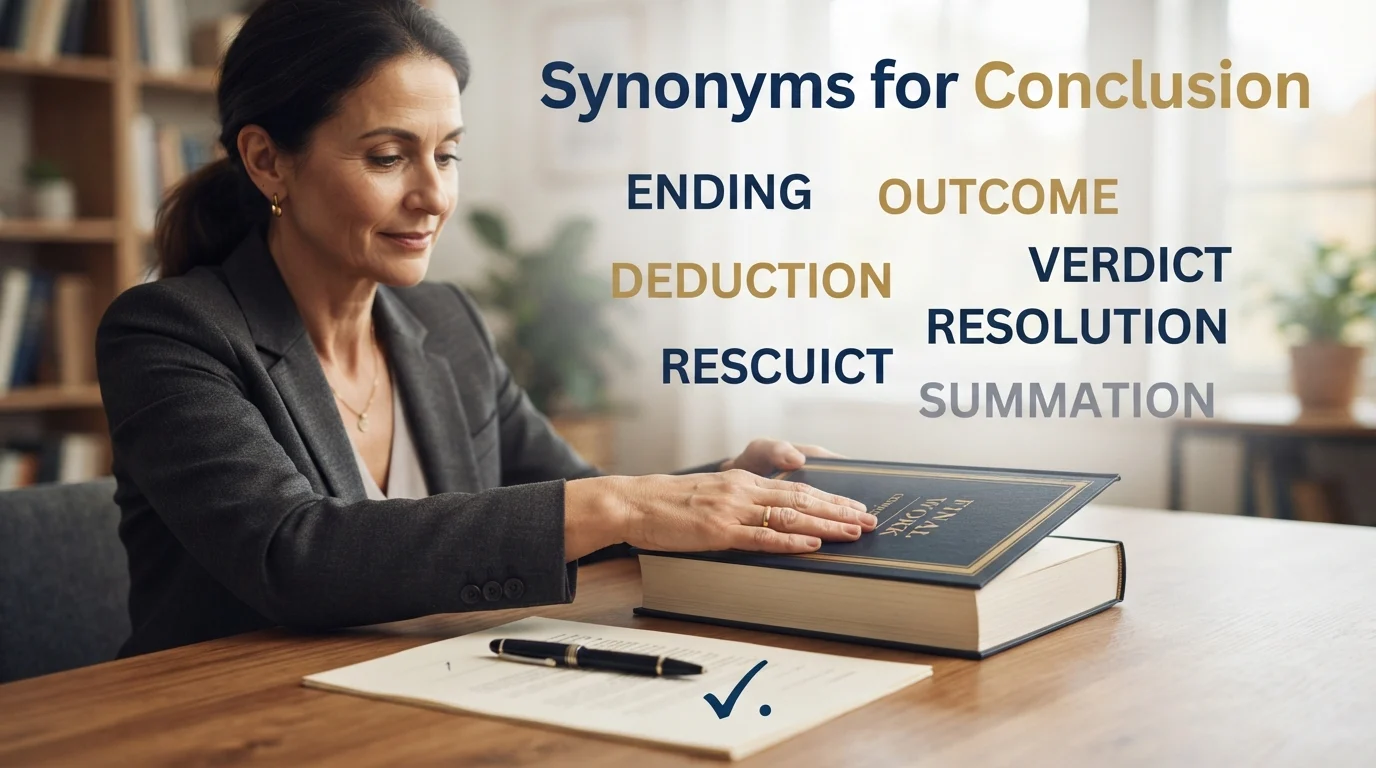
Do you keep using the word “conclusion” in essays, research papers, business reports, presentations, or everyday conversation? While it is one of the most important words in academic and professional writing, repeating it can make your work feel predictable, repetitive, or overly formulaic.
The good news is that the best alternative depends on what you actually mean. You might be referring to the final section of a document, a decision reached after reasoning, the end of an event, or a deduction based on evidence.
This guide explains synonyms for “conclusion” by meaning, tone, context, and usage. You will learn which alternatives work best in academic writing, professional communication, legal contexts, creative expression, and casual conversation.
Quick Answer: What Does “Conclusion” Mean?
“Conclusion” refers to the end or final part of something, a judgment or decision reached after consideration, or a deduction based on evidence. Depending on context, alternatives include ending, finale, outcome, result, deduction, inference, judgment, resolution, summation, and verdict.
Meaning, Tone, and Context
Simple Definition
“Conclusion” generally refers to:
- Ending: the final part of something (a book, speech, event)
- Decision: a judgment reached after reasoning
- Deduction: an inference based on evidence
- Outcome: the result or consequence of an action
- Resolution: the act of settling a matter
- Summation: a summary of main points
Part of Speech
“Conclusion” is primarily a noun.
Examples:
- “The conclusion of the study was surprising.”
- “In conclusion, we recommend further research.”
Related Forms:
- Conclude (verb): to bring to an end; to deduce
- Conclusive (adjective): decisive; convincing
- Conclusively (adverb): in a conclusive manner
- Inconclusive (adjective): not leading to a clear conclusion
Positive, Negative, or Neutral Tone
“Conclusion” is generally neutral. It can be positive, negative, or factual depending on the context.
Positive associations:
- “The conclusion of the negotiations was successful.”
- “The study reached a positive conclusion.”
Negative or neutral contexts:
- “The conclusion of the trial was disappointing.”
- “The conclusion was based on limited evidence.”
Formality Level
“Conclusion” is a standard word that works in both formal and informal English. It is especially common in academic writing, business reports, legal documents, and formal presentations.
However, more specific alternatives can add precision and variety depending on the context.
Common Use Cases
“Conclusion” commonly refers to:
- Academic writing: the final section of an essay, paper, or thesis
- Research: the findings or deductions of a study
- Business: the outcome of a meeting, project, or negotiation
- Legal: the verdict or judgment of a court
- Logic: a deduction based on premises
- General: the end of an event, story, or process
Important Word Forms
- Conclusion (noun): the end, decision, or deduction
- Conclude (verb): to bring to an end; to deduce
- Conclusive (adjective): decisive; convincing
- Conclusively (adverb): in a conclusive manner
- Inconclusive (adjective): not leading to a clear conclusion
- Concluding (adjective): final; ending
When and How to Use “Conclusion”
Use “conclusion” when you want to describe the end of something, a decision reached after reasoning, or a deduction based on evidence. Because the word is broad, more specific alternatives can add precision depending on the context.
Academic
“In conclusion, the study demonstrates a clear link between diet and health.”
This is standard in academic writing.
Professional
“The conclusion of the meeting was that we need more data.”
This works naturally in business communication.
Legal
“The court reached a conclusion after reviewing all the evidence.”
This is appropriate in legal contexts.
Personal
“I’ve come to the conclusion that I need a change.”
The word sounds natural in everyday conversation.
Creative
“The conclusion of the novel left readers in tears.”
The word describes the ending of a story.
Research
“The study’s conclusion was based on a small sample size.”
This is appropriate in research contexts.
Another Word for “Conclusion”
There is no single perfect synonym because “conclusion” can refer to an ending, a decision, a deduction, an outcome, or a resolution.
- Ending context: ending, finale, close, finish, termination
- Decision context: decision, judgment, determination, ruling, verdict
- Deduction context: deduction, inference, reasoning, illation
- Outcome context: outcome, result, consequence, upshot
- Resolution context: resolution, settlement, agreement, closure
- Summary context: summation, summary, recap, recapitulation
If you need one broad alternative, “ending” works for the final part of something, while “deduction” works for a logical inference. “Outcome” works for results.
When Not to Use “Conclusion”
“Conclusion” can become too vague when you need to specify exactly what kind of conclusion you are describing.
Consider:
“The conclusion was clear.”
This statement does not tell readers whether it was a decision, a deduction, an outcome, or a summary.
A more precise sentence could be:
“The court’s verdict was clear and decisive.”
Similarly, avoid using “conclusion” when you mean “opinion” in a subjective context. Use “opinion”, “belief”, or “view” instead.
Words Commonly Confused With “Conclusion”
Conclusion vs. Summary
Summary is a brief statement of main points. Conclusion is the final part or a decision.
Example:
“The summary covered the key findings.” (recap)
“The conclusion offered recommendations.” (final part)
Conclusion vs. Decision
Decision is a choice made after consideration. Conclusion can be a deduction or ending.
Example:
“The committee made a decision.” (choice)
“The conclusion was based on evidence.” (deduction)
Conclusion vs. Inference
Inference is a logical deduction from evidence. Conclusion can be broader.
Example:
“His inference was based on the data.” (deduction)
“The conclusion of the report was clear.” (ending)
Conclusion vs. Outcome
Outcome is the result or consequence of an action. Conclusion can be an ending or decision.
Example:
“The outcome of the election was surprising.” (result)
“The conclusion of the meeting was productive.” (ending)
Conclusion vs. Resolution
Resolution is the act of settling a matter. Conclusion can be an ending or deduction.
Example:
“The resolution of the conflict took months.” (settlement)
“The conclusion of the story was satisfying.” (ending)
Conclusion vs. Verdict
Verdict is a formal decision, especially in law. Conclusion is broader.
Example:
“The jury reached a verdict.” (legal decision)
“The conclusion of the trial was reported.” (ending)
Best Synonym by Context for “Conclusion”
| Context | Best Synonym | Why It Works | Example |
|---|---|---|---|
| Formal writing | Summation, inference | Precise and professional | The summation of the report was clear. |
| Academic writing | Findings, deduction | Standard academic usage | The findings suggest a correlation. |
| Business communication | Outcome, result | Professional and clear | The outcome of the meeting was positive. |
| Legal writing | Verdict, ruling, judgment | Legally precise | The verdict was delivered by the jury. |
| Research | Findings, deduction | Scientifically accurate | The findings support the hypothesis. |
| Logic | Inference, deduction | Logically precise | The inference was based on premises. |
| Creative writing | Finale, ending, denouement | Adds literary depth | The denouement tied up all loose ends. |
| Summary context | Summation, recap | Emphasizes summary | The summation covered all key points. |
| Decision context | Decision, determination | Emphasizes choice | The determination was made after review. |
| Casual conversation | End, finish, wrap-up | Natural and informal | Let’s wrap up the meeting. |
| Event ending | Close, finale, termination | Emphasizes ending | The finale of the concert was spectacular. |
| Settlement | Resolution, settlement | Emphasizes agreement | The resolution was reached peacefully. |
Which Synonym Should You Choose?
Start by identifying what kind of “conclusion” you are describing.
- Ending: ending, finale, close, finish, termination, denouement
- Decision: decision, judgment, determination, ruling, verdict
- Deduction: deduction, inference, reasoning, illation
- Outcome: outcome, result, consequence, upshot
- Resolution: resolution, settlement, agreement, closure
- Summary: summation, summary, recap, recapitulation
10 Key Synonyms for “Conclusion”
The table below includes accurate alternatives with clear meanings and usage contexts.
| Synonym | Simple Meaning | Best Used For | Example Sentence |
|---|---|---|---|
| Ending | The final part | General, creative | The ending of the movie was unexpected. |
| Finale | The last part of a performance | Creative, events | The finale of the concert was spectacular. |
| Outcome | The result or consequence | Business, general | The outcome of the election was surprising. |
| Deduction | A logical inference | Logic, research | The deduction was based on solid evidence. |
| Inference | A conclusion from evidence | Academic, logic | The inference was supported by the data. |
| Judgment | A decision or opinion | Legal, formal | The judgment was delivered by the court. |
| Verdict | A formal decision | Legal | The jury reached a verdict of not guilty. |
| Resolution | A settlement or ending | Conflict, formal | The resolution of the dispute was peaceful. |
| Summation | A summary of main points | Formal, academic | The summation highlighted the key arguments. |
| Outcome | The final result | Business, general | The outcome of the project exceeded expectations. |
Synonym Groups and Usage Differences
Professional vs. Personal Synonyms
Professional writing benefits from specific terms such as outcome, findings, summation, resolution, and determination.
Personal communication often uses conclusion itself or casual alternatives like end, wrap-up, or takeaway.
Compare:
“Let’s wrap up the meeting.” (personal)
“The outcome of the meeting was positive.” (professional)
Formal vs. Conversational Synonyms
Conclusion works in both formal and conversational English.
Formal alternatives: summation, inference, deduction, determination
Conversational alternatives: end, finish, wrap-up, takeaway
Examples:
“The summation of the report was clear.” (formal)
“Let’s wrap up the discussion.” (conversational)
Academic Synonyms
Academic writing should distinguish between conclusion (final section), findings (research results), deduction (logical inference), and implication (suggested consequence).
For example:
“The findings suggest a strong correlation.”
“The conclusion offers recommendations for future research.”
Professional and Business Synonyms
Business writing often benefits from phrases such as outcome, result, determination, resolution, and takeaway.
Instead of:
“The conclusion of the meeting was positive.”
Consider:
“The outcome of the meeting was a clear action plan.”
Creative or Literary Synonyms
Creative writing can use finale, denouement, ending, close, and epilogue depending on the context.
For example:
“The denouement tied up all loose ends.”
“The finale left the audience breathless.”
Slang or Modern Synonyms
Wrap-up is a common casual term.
Takeaway is modern for the main conclusion or lesson.
Bottom line means the main conclusion or most important point.
Examples:
“Let’s do a quick wrap-up.” (casual)
“The bottom line is we need more funding.” (modern)
Strongest vs. Weaker Synonyms
“Conclusion” synonyms vary in intensity:
Milder: end, finish, close
Moderate: conclusion, ending, outcome
Strong: determination, resolution, verdict
Very Strong: definitive conclusion, incontrovertible deduction
Emotional vs. Neutral Synonyms
“Conclusion” is generally neutral.
Emotional alternatives: finale, denouement (creative)
Neutral alternatives: outcome, result, determination
Examples:
“The finale was deeply moving.” (emotional)
“The outcome was recorded.” (neutral)
Antonyms of “Conclusion”
“Conclusion” has several antonyms depending on context:
| Antonym | Context | Meaning | Example Sentence |
|---|---|---|---|
| Beginning | General | The start of something | The beginning of the story was slow. |
| Introduction | Academic | The opening section | The introduction outlined the thesis. |
| Prologue | Creative | The introductory part | The prologue set the scene. |
| Overture | Creative | An introductory performance | The overture began the opera. |
| Premise | Logic | A proposition supporting a conclusion | The premise was stated clearly. |
| Start | General | The beginning | The start of the race was chaotic. |
Comparison: “Conclusion” vs. Similar Words
Conclusion vs. Summary
Main difference: Summary is a brief statement of main points. Conclusion is the final part or a decision.
Examples:
“The summary covered the key findings.” (recap)
“The conclusion offered recommendations.” (final part)
Conclusion vs. Decision
Main difference: Decision is a choice made after consideration. Conclusion can be a deduction or ending.
Examples:
“The committee made a decision.” (choice)
“The conclusion was based on evidence.” (deduction)
Conclusion vs. Inference
Main difference: Inference is a logical deduction from evidence. Conclusion can be broader.
Examples:
“His inference was based on the data.” (deduction)
“The conclusion of the report was clear.” (ending)
Conclusion vs. Outcome
Main difference: Outcome is the result or consequence of an action. Conclusion can be an ending or decision.
Examples:
“The outcome of the election was surprising.” (result)
“The conclusion of the meeting was productive.” (ending)
Conclusion vs. Resolution
Main difference: Resolution is the act of settling a matter. Conclusion can be an ending or deduction.
Examples:
“The resolution of the conflict took months.” (settlement)
“The conclusion of the story was satisfying.” (ending)
Conclusion vs. Verdict
Main difference: Verdict is a formal decision, especially in law. Conclusion is broader.
Examples:
“The jury reached a verdict.” (legal decision)
“The conclusion of the trial was reported.” (ending)
Common Phrases and Expressions with “Conclusion”
1. In conclusion
Meaning:
A phrase used to introduce the final part of a speech or essay.
Example:
“In conclusion, we recommend further research.”
2. Come to a conclusion
Meaning:
To reach a decision or judgment.
Example:
“After much discussion, we came to a conclusion.”
3. Jump to conclusions
Meaning:
To make a decision without all the facts.
Example:
“Don’t jump to conclusions before hearing the full story.”
4. Draw a conclusion
Meaning:
To deduce or infer something.
Example:
“From the evidence, we can draw a conclusion.”
5. Foregone conclusion
Meaning:
A result that is certain to happen.
Example:
“The victory was a foregone conclusion.”
6. Bring to a conclusion
Meaning:
To end something.
Example:
“The negotiations were brought to a successful conclusion.”
7. Reach a conclusion
Meaning:
To arrive at a decision or deduction.
Example:
“The study reached a surprising conclusion.”
8. At the conclusion of
Meaning:
At the end of something.
Example:
“At the conclusion of the ceremony, everyone applauded.”
9. Conclusion of law
Meaning:
A legal determination made by a judge.
Example:
“The conclusion of law was based on the statute.”
10. Logical conclusion
Meaning:
A deduction that follows logically from premises.
Example:
“The logical conclusion is that demand will increase.”
Common Mistakes to Avoid
1. Using “conclusion” when a more precise term is available
If you mean outcome, deduction, verdict, or resolution, use the more specific word.
Vague: “The conclusion was clear.”
Precise: “The verdict was clear and decisive.”
2. Confusing “conclusion” with “summary”
A summary is a recap of main points. A conclusion is the final part or a decision.
Incorrect: “The conclusion of the article summarized the key points.” (if only a summary)
Correct: “The summary of the article covered the key points.”
3. Using “conclusion” in legal writing when “verdict” is needed
Legal documents require precise language. Use verdict, ruling, or judgment.
Vague: “The conclusion of the trial was announced.”
Precise: “The verdict of the trial was announced.”
4. Overusing “conclusion” in writing
Repetition can make content feel dull. Use alternatives such as outcome, finding, deduction, resolution, and summation.
5. Choosing a synonym that changes the meaning
Do not replace conclusion with opinion unless you mean a subjective view.
Do not replace conclusion with summary unless you mean a recap.
FAQs
What is the best synonym for “conclusion”?
The best synonym depends on context. Ending works for final parts, outcome for results, deduction for logical inferences, verdict for legal decisions, and resolution for settlements.
What is a formal synonym for “conclusion”?
Summation, inference, deduction, determination, and resolution are formal synonyms.
What is an informal synonym for “conclusion”?
End, finish, wrap-up, takeaway, and bottom line are common informal alternatives.
What is another word for “conclusion” in creative writing?
Finale, denouement, ending, close, and epilogue work well in creative writing.
What is the difference between “conclusion” and “summary”?
A summary is a brief statement of main points. A conclusion is the final part or a decision.
What is the opposite of “conclusion”?
Depending on context, opposites include beginning, introduction, prologue, premise, and start.
What does “conclusion” mean in a legal context?
In law, a conclusion often refers to a verdict, ruling, or judgment—a formal decision made by a court or judge.
Conclusion
“Conclusion” is a versatile and important word that can describe an ending, a decision, a deduction, an outcome, or a resolution. The best synonym depends on what you actually mean.
Choose ending for final parts, outcome for results, deduction for logical inferences, verdict for legal decisions, resolution for settlements, and summation for summaries.
Most importantly, do not replace “conclusion” simply to avoid repetition. First identify what kind of conclusion—ending, decision, deduction, or outcome—you are actually describing. Then choose the alternative that communicates that idea most clearly.
For academic, professional, and legal writing, precision is usually more valuable than vocabulary variety. A specific term such as findings, verdict, determination, or outcome can tell readers much more than the broad word conclusion.
Before publishing a vocabulary guide, verify definitions and usage with trusted dictionaries such as Cambridge, Oxford, Merriam-Webster, Collins, or Britannica. This helps ensure that each alternative accurately matches its intended meaning and context.
The practical takeaway is simple: when “conclusion” feels too general, ask yourself what kind of ending, decision, or deduction you are actually describing. Then use the most precise word available.
Discover More:-
- 50+ Synonyms for Thing: Meanings, Examples, and Best Alternatives
- 50+ Synonyms for Thought: Meanings, Examples, and Best Alternatives
