Do you keep using the word “stated” in essays, business reports, legal documents, news articles, or everyday conversation? While it is a useful and professional word, repeating it can make your writing feel flat, repetitive, or overly formal.
The good news is that the best alternative depends on what you actually mean. You might be referring to something said formally, declared officially, mentioned briefly, claimed without proof, or expressed in writing.
This guide explains synonyms for “stated” by meaning, tone, context, and usage. You will learn which alternatives work best in academic writing, professional communication, legal contexts, journalism, and casual conversation.
Quick Answer: What Does “Stated” Mean?
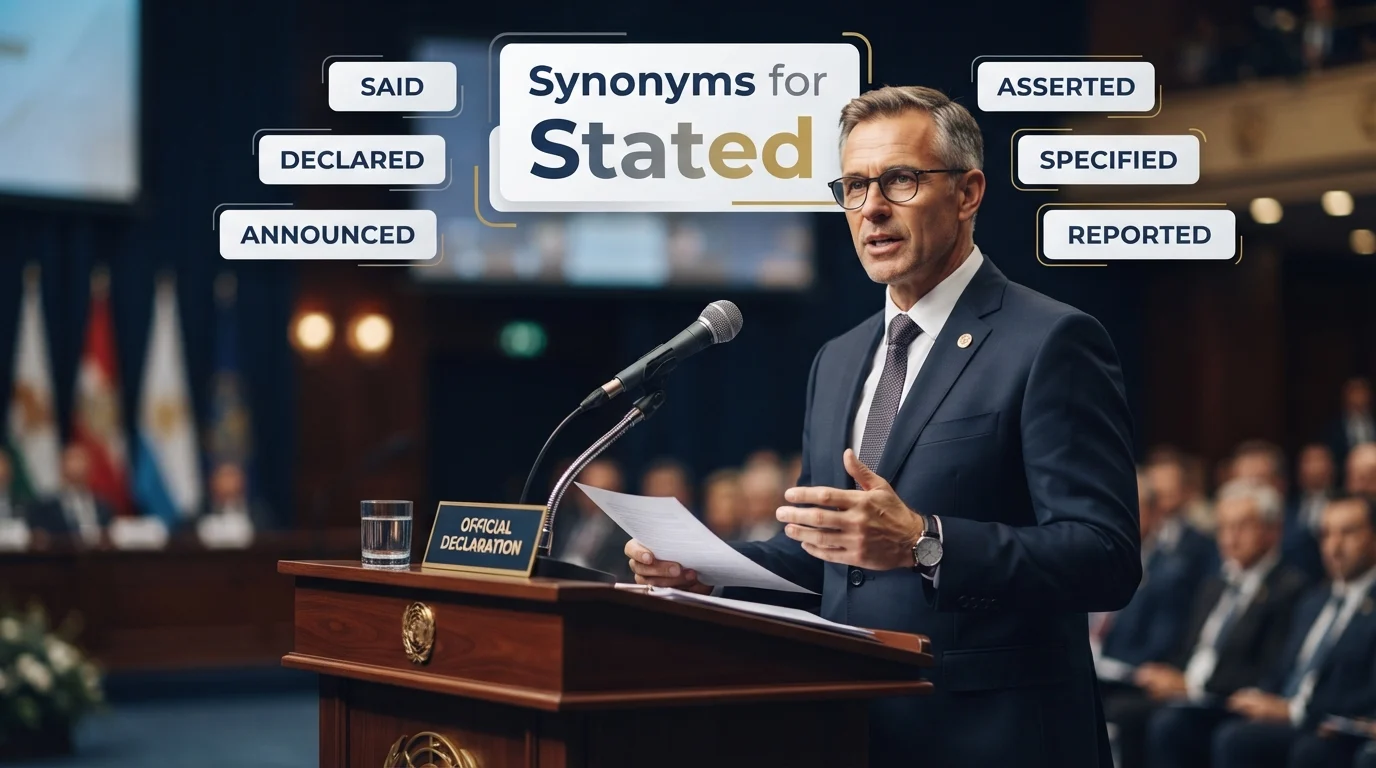
“Stated” is the past tense and past participle of the verb “state,” which means to express something clearly and formally in speech or writing. It often implies precision, authority, or official declaration. Depending on context, alternatives include said, declared, announced, mentioned, asserted, affirmed, claimed, noted, specified, and expressed.
Meaning, Tone, and Context
Simple Definition
“Stated” generally refers to:
- Saying something clearly: expressing information in speech or writing
- Declaring formally: making an official or authoritative statement
- Specifying: mentioning something in a precise or exact way
- Asserting: claiming something confidently
- Reporting: conveying information that has been communicated
Part of Speech
“Stated” functions as a verb (past tense and past participle) and as an adjective.
Verb Examples:
- “She stated her opinion clearly.”
- “The report stated the facts.”
Adjective Examples:
- “The stated goal was to improve efficiency.”
- “The stated price is $50.”
Related Forms:
- State (verb): to express something clearly
- State (noun): a condition or a political entity
- Statement (noun): something that is stated
- Statedly (adverb): in a stated manner (rare)
Positive, Negative, or Neutral Tone
“Stated” is generally neutral and formal. It does not carry strong emotional connotations, but it implies clarity and authority.
Neutral/formal contexts:
- “The document stated the terms clearly.”
- “He stated his position on the issue.”
Slightly negative contexts (if used to imply mere assertion):
- “He stated his opinion as if it were fact.”
Formality Level
“Stated” is a formal word that works best in academic papers, business reports, legal documents, news articles, and official communication. In casual conversation, “said” is more natural.
Common Use Cases
“Stated” commonly appears in:
- Legal documents: contracts, laws, court rulings
- Business reports: policies, procedures, findings
- Academic writing: research findings, citations, arguments
- News journalism: reporting what officials or sources said
- Official statements: press releases, government communications
- Resumes and cover letters: describing qualifications or objectives
Important Word Forms
- State (verb): to express clearly in speech or writing
- Stated (verb/adjective): expressed clearly; declared
- Statement (noun): a definite or clear expression
- Stately (adjective): dignified or majestic (different meaning)
- Understated (adjective): expressed in a restrained way
- Overstated (adjective): expressed in an exaggerated way
When and How to Use “Stated”
Use “stated” when you want to describe something that has been expressed clearly, formally, or officially. Because the word is formal, more specific alternatives can add nuance depending on the context.
Professional
“The CEO stated that the company would expand into new markets.”
This works naturally in business communication.
Academic
“The author stated that further research is needed.”
The term is appropriate in academic writing.
Legal
“The contract stated that payment must be made within 30 days.”
This is standard in legal documents.
Personal
“She stated her opinion firmly.”
The word is acceptable but may sound formal in casual conversation.
News/Journalism
“The spokesperson stated that the investigation is ongoing.”
This is common in news reporting.
Resume
“Stated objective: to contribute to a dynamic team.”
This is common in resumes and cover letters.
Another Word for “Stated”
There is no single perfect synonym because “stated” can refer to saying, declaring, specifying, asserting, or reporting.
- Saying context: said, mentioned, noted, remarked, observed
- Declaring context: declared, announced, proclaimed, pronounced
- Asserting context: asserted, affirmed, claimed, maintained, contended
- Specifying context: specified, detailed, outlined, defined, stipulated
- Reporting context: reported, indicated, disclosed, revealed, communicated
- Expressing context: expressed, articulated, voiced, conveyed, put forward
If you need one broad alternative, “said” is the most natural in casual contexts, while “declared” works for formal or authoritative contexts.
When Not to Use “Stated”
“Stated” can sound overly formal or stiff when a simpler word would work better.
Consider:
“He stated that he was tired.”
This sounds overly formal for casual conversation. A more natural sentence would be:
“He said he was tired.”
Similarly, avoid using “stated” when you mean “claimed” in a context where the truth is uncertain. Use “claimed”, “alleged”, or “asserted” instead.
Words Commonly Confused With “Stated”
Stated vs. Said
Said is the general, neutral word for expressing something. Stated is more formal and implies clarity.
Example:
“She said she was busy.” (casual)
“She stated that she was unavailable.” (formal)
Stated vs. Declared
Declared implies a formal, official, or emphatic statement. Stated is more neutral.
Example:
“The government declared a state of emergency.” (official)
“The report stated the findings.” (neutral)
Stated vs. Claimed
Claimed implies assertion without proof. Stated is more neutral and factual.
Example:
“He claimed he was innocent.” (assertion)
“He stated he was innocent.” (neutral)
Stated vs. Mentioned
Mentioned implies a brief or casual reference. Stated implies a clear, deliberate expression.
Example:
“She mentioned the meeting in passing.” (brief)
“She stated the meeting’s purpose clearly.” (deliberate)
Stated vs. Asserted
Asserted implies confidence or forcefulness. Stated is more neutral.
Example:
“He asserted his authority.” (forceful)
“He stated his position.” (neutral)
Stated vs. Specified
Specified means clearly identified or named. Stated is broader.
Example:
“The contract specified the delivery date.” (exact)
“The contract stated the terms.” (general)
Best Synonym by Context for “Stated”
| Context | Best Synonym | Why It Works | Example |
|---|---|---|---|
| Formal writing | Declared, affirmed | Precise and professional | The committee declared the results official. |
| Academic writing | Noted, observed, asserted | Standard academic usage | The author noted that further research is needed. |
| Legal writing | Stipulated, specified, provided | Legally precise | The contract stipulated a 30-day notice period. |
| Business communication | Announced, reported, indicated | Professional and clear | The company announced a new policy. |
| Journalism | Reported, said, disclosed | Standard news usage | The official reported that the investigation is ongoing. |
| Casual conversation | Said | Natural and informal | He said he was tired. |
| Asserting a claim | Claimed, alleged, maintained | Emphasizes assertion | He claimed he was innocent. |
| Specifying details | Specified, detailed, outlined | Emphasizes precision | The plan outlined the next steps. |
| Expressing opinion | Expressed, voiced, articulated | Emphasizes communication | She expressed her concerns clearly. |
| Reporting information | Reported, indicated, disclosed | Emphasizes conveyance | The data indicated a downward trend. |
| Official statement | Proclaimed, pronounced, decreed | Emphasizes authority | The king proclaimed a new law. |
| Resume context | Stated, described, outlined | Professional and clear | The resume stated her key achievements. |
Which Synonym Should You Choose?
Start by identifying what kind of “stated” you are describing.
- Saying: said, mentioned, noted, remarked, observed
- Declaring: declared, announced, proclaimed, pronounced, decreed
- Asserting: asserted, affirmed, claimed, maintained, contended
- Specifying: specified, detailed, outlined, defined, stipulated
- Reporting: reported, indicated, disclosed, revealed, communicated
- Expressing: expressed, articulated, voiced, conveyed, put forward
10 Key Synonyms for “Stated”
The table below includes accurate alternatives with clear meanings and usage contexts.
| Synonym | Simple Meaning | Best Used For | Example Sentence |
|---|---|---|---|
| Said | Expressed in words | General, casual | He said he would come. |
| Declared | Announced formally | Official, legal | The government declared a holiday. |
| Announced | Made known publicly | Business, news | The company announced a new product. |
| Mentioned | Referred to briefly | Casual, academic | She mentioned the meeting in passing. |
| Asserted | Claimed confidently | Debate, argument | He asserted his innocence. |
| Affirmed | Stated positively | Formal, legal | The court affirmed the decision. |
| Claimed | Asserted without proof | News, legal | He claimed he was elsewhere. |
| Noted | Mentioned or observed | Academic, formal | The report noted a rise in costs. |
| Specified | Clearly identified | Legal, technical | The contract specified the terms. |
| Expressed | Conveyed a thought or feeling | General, formal | She expressed her concerns. |
Synonym Groups and Usage Differences
Professional vs. Personal Synonyms
Professional writing benefits from specific terms such as declared, announced, reported, affirmed, and specified.
Personal communication often uses said or mentioned.
Compare:
“He said he was busy.” (personal)
“The CEO announced the new strategy.” (professional)
Formal vs. Conversational Synonyms
Stated is formal. In conversational English, said is more natural.
Formal alternatives: declared, affirmed, asserted, proclaimed
Conversational alternatives: said, mentioned, told
Examples:
“The witness affirmed the statement.” (formal)
“She said she’d be there.” (conversational)
Academic Synonyms
Academic writing should distinguish between stated (general), noted (observed), asserted (claimed), and argued (reasoned).
For example:
“The author noted that further research is needed.”
“The researcher asserted a correlation between the variables.”
Professional and Business Synonyms
Business writing often benefits from phrases such as announced, reported, indicated, and outlined.
Instead of:
“The report stated a decline in sales.”
Consider:
“The report indicated a decline in sales.”
Creative or Literary Synonyms
Creative writing can use declared, proclaimed, whispered, murmured, uttered, and voiced depending on the context.
For example:
“She whispered her secret.”
“He proclaimed his love to the world.”
Slang or Modern Synonyms
Said is the most common casual alternative.
Told is also common.
Went is slang for said (e.g., “He went, ‘No way!'”).
Was like is slang for said.
Examples:
“He said he was leaving.” (casual)
“She was like, ‘I can’t believe it!'” (slang)
Strongest vs. Weaker Synonyms
“Stated” synonyms vary in intensity:
Milder: mentioned, noted, observed
Moderate: stated, said, reported
Strong: declared, asserted, affirmed
Very Strong: proclaimed, decreed, pronounced
Emotional vs. Neutral Synonyms
“Stated” is generally neutral.
Emotional alternatives: proclaimed (emphatic), whispered (intimate), declared (formal)
Neutral alternatives: said, mentioned, noted, reported
Examples:
“He proclaimed his innocence.” (emphatic)
“He said he was tired.” (neutral)
Antonyms of “Stated”
“Stated” has several antonyms depending on context:
| Antonym | Context | Meaning | Example Sentence |
|---|---|---|---|
| Unstated | General | Not expressed | The unstated assumption was clear. |
| Implied | General | Suggested but not stated | The implication was clear. |
| Withheld | Information | Kept back | The information was withheld. |
| Concealed | Information | Hidden | The truth was concealed. |
| Suppressed | Information | Kept from being known | The report was suppressed. |
| Silent | Communication | Not speaking | He remained silent on the issue. |
Comparison: “Stated” vs. Similar Words
Stated vs. Said
Main difference: Said is general and casual. Stated is formal and implies clarity.
Examples:
“She said she was busy.” (casual)
“She stated that she was unavailable.” (formal)
Stated vs. Declared
Main difference: Declared implies a formal, official, or emphatic statement. Stated is more neutral.
Examples:
“The government declared a state of emergency.” (official)
“The report stated the findings.” (neutral)
Stated vs. Claimed
Main difference: Claimed implies assertion without proof. Stated is more neutral and factual.
Examples:
“He claimed he was innocent.” (assertion)
“He stated he was innocent.” (neutral)
Stated vs. Mentioned
Main difference: Mentioned implies a brief or casual reference. Stated implies a clear, deliberate expression.
Examples:
“She mentioned the meeting in passing.” (brief)
“She stated the meeting’s purpose clearly.” (deliberate)
Stated vs. Asserted
Main difference: Asserted implies confidence or forcefulness. Stated is more neutral.
Examples:
“He asserted his authority.” (forceful)
“He stated his position.” (neutral)
Stated vs. Specified
Main difference: Specified means clearly identified or named. Stated is broader.
Examples:
“The contract specified the delivery date.” (exact)
“The contract stated the terms.” (general)
Common Phrases and Expressions with “Stated”
1. Stated goal
Meaning:
An explicitly expressed aim or objective.
Example:
“The stated goal of the project is to reduce costs.”
2. Stated purpose
Meaning:
The declared reason for something.
Example:
“The stated purpose of the meeting was to discuss the budget.”
3. As stated
Meaning:
As previously mentioned or expressed.
Example:
“As stated earlier, the deadline is Friday.”
4. Stated clearly
Meaning:
Expressed in a clear manner.
Example:
“The rules were stated clearly.”
5. Stated in writing
Meaning:
Expressed in written form.
Example:
“The agreement was stated in writing.”
6. Stated otherwise
Meaning:
Unless expressed differently.
Example:
“Unless stated otherwise, all prices include tax.”
7. Stated above
Meaning:
Mentioned earlier in a document.
Example:
“The items stated above are subject to change.”
8. Stated value
Meaning:
The value declared or specified.
Example:
“The stated value of the property is $500,000.”
9. Stated terms
Meaning:
The conditions explicitly expressed.
Example:
“The stated terms of the contract are binding.”
10. Stated objective
Meaning:
A formally expressed aim.
Example:
“The stated objective is to improve customer satisfaction.”
Common Mistakes to Avoid
1. Using “stated” when “said” is more natural
In casual conversation, “said” is more natural.
Stiff: “He stated that he was tired.”
Natural: “He said he was tired.”
2. Using “stated” when “claimed” is more accurate
If the truth is uncertain, use claimed or alleged.
Incorrect: “He stated he was innocent.” (if uncertain)
Correct: “He claimed he was innocent.”
3. Confusing “stated” with “declared”
Declared implies formality or officialness. Stated is more neutral.
Incorrect: “He stated war on the enemy.”
Correct: “He declared war on the enemy.”
4. Overusing “stated” in writing
Repetition can make content feel dull. Use alternatives such as said, declared, announced, noted, and specified.
5. Choosing a synonym that changes the meaning
Do not replace stated with implied unless you mean suggested but not expressed.
Do not replace stated with claimed unless you mean asserted without proof.
FAQs
What is the best synonym for “stated”?
The best synonym depends on context. Said works for casual contexts, declared for formal contexts, claimed for uncertain assertions, specified for precise details, and noted for observations.
What is a formal synonym for “stated”?
Declared, affirmed, asserted, proclaimed, and pronounced are formal synonyms.
What is an informal synonym for “stated”?
Said, told, and mentioned are common informal alternatives.
What is another word for “stated” in creative writing?
Declared, proclaimed, whispered, murmured, uttered, and voiced work well in creative writing.
What is the difference between “stated” and “said”?
Said is general and casual. Stated is formal and implies clarity.
What is the opposite of “stated”?
Depending on context, opposites include unstated, implied, withheld, concealed, and silent.
What does “stated” mean in a legal context?
In legal contexts, stated often means specified, stipulated, or provided—explicitly expressed in a document.
Conclusion
“Stated” is a formal, precise word that can describe saying, declaring, asserting, specifying, and reporting. The best synonym depends on what you actually mean.
Choose said for casual contexts, declared for formal contexts, claimed for uncertain assertions, specified for precise details, noted for observations, and reported for journalism.
Most importantly, do not replace “stated” simply to avoid repetition. First identify what kind of statement—formal, casual, precise, or assertive—you are actually describing. Then choose the alternative that communicates that idea most clearly.
For academic, professional, and legal writing, precision is usually more valuable than vocabulary variety. A specific term such as declared, stipulated, affirmed, or specified can tell readers much more than the broad word stated.
Before publishing a vocabulary guide, verify definitions and usage with trusted dictionaries such as Cambridge, Oxford, Merriam-Webster, Collins, or Britannica. This helps ensure that each alternative accurately matches its intended meaning and context.
The practical takeaway is simple: when “stated” feels too general or formal, ask yourself what kind of statement—spoken, written, official, or asserted—you are actually describing. Then use the most precise word available.
Discover More:-
- 50+ Synonyms for Various: Meanings, Examples, and Best Alternatives
- 50+ Synonyms for Especially: Meanings, Examples, and Best Alternatives

2 thoughts on “50+ Synonyms for Stated: Meanings, Examples, and Best Alternatives”