Do you keep using the word “thought” in essays, business reports, creative writing, academic papers, or everyday conversations? While it is one of the most fundamental and useful words in English, repeating it can make your writing feel monotonous, vague, or lacking in nuance.
The good news is that the best alternative depends on what you actually mean. You might be referring to a single idea, a mental process, careful consideration, a belief, an intention, a memory, or a philosophical concept.
This guide explains synonyms for “thought” by meaning, tone, context, and usage. You will learn which alternatives work best in academic writing, professional communication, creative expression, casual conversation, and technical content.
Quick Answer: What Does “Thought” Mean?
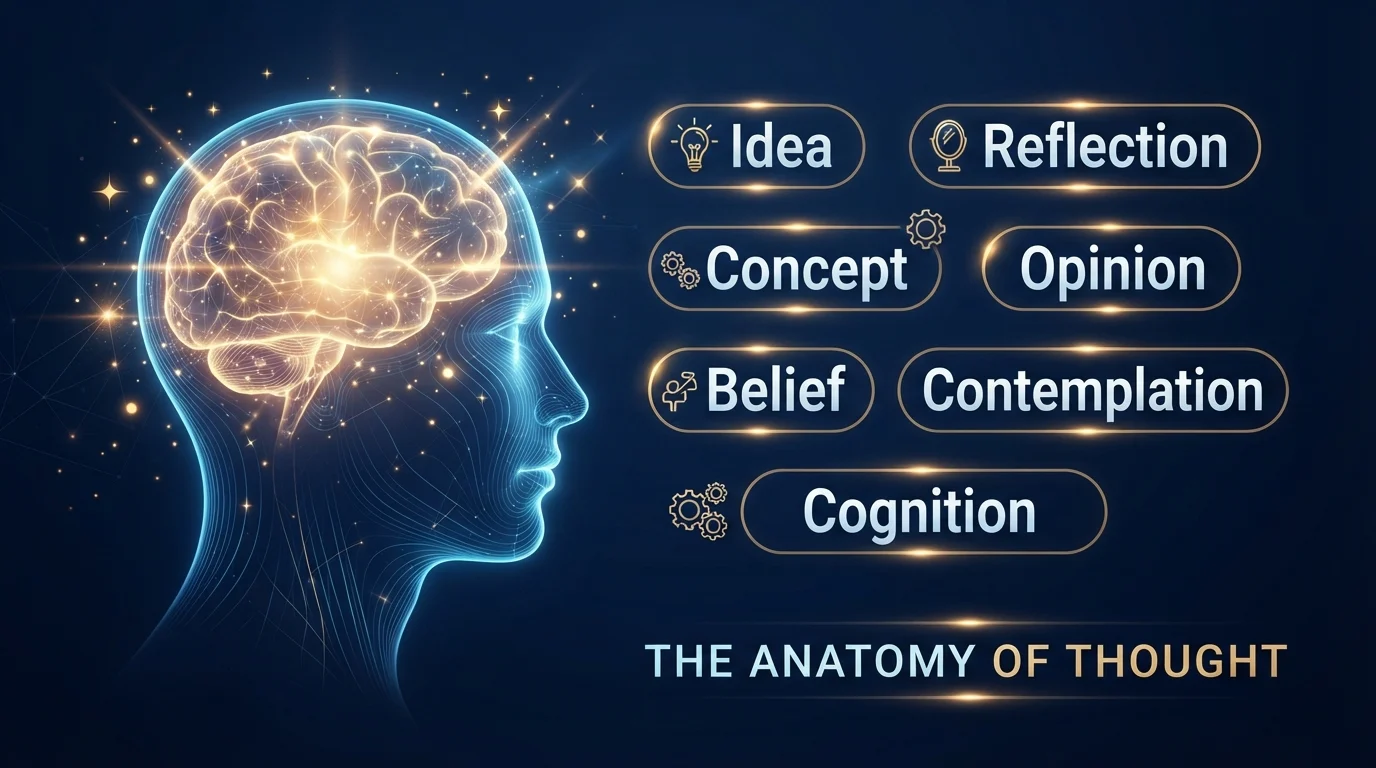
“Thought” refers to the process of thinking, a single idea or notion, careful consideration, a belief or opinion, an intention, or a recollection. Depending on context, alternatives include idea, notion, concept, belief, consideration, reflection, contemplation, meditation, cognition, judgment, opinion, impression, intention, memory, and recollection.
Meaning, Tone, and Context
Simple Definition
“Thought” generally refers to:
- The process or act of thinking: mental activity, cognition, reasoning
- A single idea or notion: something that comes to mind
- Careful consideration: deliberation, reflection, contemplation
- A belief or opinion: what someone thinks about something
- An intention or purpose: what someone intends to do
- A memory or recollection: something remembered
Part of Speech
“Thought” functions as a noun and as a verb (past tense of “think”).
Noun Examples:
- “Her thought on the matter is clear.”
- “He was lost in thought.”
Verb Examples:
- “I thought about it yesterday.”
- “She thought he was coming.”
Positive, Negative, or Neutral Tone
“Thought” is generally neutral. However, the tone can vary depending on the context and synonym you choose:
- Idea – neutral, common
- Concept – neutral, intellectual
- Reflection – positive, implies depth and wisdom
- Contemplation – positive, implies careful consideration
- Notion – can be neutral or imply something vague or unproven
- Judgment – neutral or negative depending on context
Formality Level
“Thought” is a standard word that works in both formal and informal English. However, more formal alternatives like cognition, rumination, deliberation, and contemplation are often preferred in academic and professional contexts.
Common Use Cases
“Thought” commonly refers to:
- Mental processes: thinking, reasoning, cognition, reflection
- Individual ideas: ideas, notions, concepts, impressions
- Beliefs and opinions: beliefs, judgments, convictions, views
- Careful consideration: deliberation, contemplation, meditation
- Intentions: plans, purposes, designs, aims
- Memories: recollections, remembrances, reminiscences
Important Word Forms
- Think (verb): to use the mind actively
- Thought (noun): an idea or the process of thinking
- Thoughtful (adjective): showing careful consideration
- Thoughtless (adjective): lacking consideration
- Thinker (noun): a person who thinks, especially deeply
- Thinking (noun/verb): the process of thought
When and How to Use “Thought”
Use “thought” when you want to describe a mental process, an idea, careful consideration, or an opinion. Because the word is broad, more specific alternatives can add precision.
Professional
“Her thought on the proposal was carefully considered.”
This works naturally in business communication.
Academic
“The philosopher’s thoughts on ethics have influenced modern thinking.”
The term is appropriate when discussing intellectual contributions.
Personal
“I had a thought about your birthday gift.”
The word sounds natural in everyday conversation.
Creative
“His thoughts drifted to distant memories.”
Here, “thoughts” describes reflective mental activity.
Scientific
“The study examines thought processes in decision-making.”
The term works well in psychological or cognitive contexts.
Philosophical
“What is the nature of thought itself?”
This is a fundamental question in philosophy.
Another Word for “Thought”
There is no single perfect synonym because “thought” can refer to many different mental activities and concepts.
- Individual idea: idea, notion, concept, impression, perception
- Mental process: thinking, reasoning, cognition, reflection
- Careful consideration: contemplation, deliberation, meditation, rumination
- Belief or opinion: belief, opinion, judgment, conviction, view
- Intention: intention, purpose, plan, design
- Memory: memory, recollection, remembrance, reminiscence
- Philosophical concept: thought (itself), ideation, mentation
If you need one broad alternative, “idea” works well for individual mental content, while “reflection” works better for the process of thinking carefully.
When Not to Use “Thought”
“Thought” can become too vague when you need to specify what kind of mental activity or content you are describing.
Consider:
“I have a thought about this.”
This statement does not tell readers whether you have an idea, an opinion, a concern, or a plan.
A more precise sentence could be:
“I have a concern about this approach.”
Similarly, avoid using “thought” when you need to emphasize careful reasoning or philosophical depth. Use “reflection”, “contemplation”, or “deliberation” instead.
Words Commonly Confused With “Thought”
Thought vs. Idea
Idea refers to a specific mental concept or plan. Thought is broader and can include the entire mental process.
Example:
“I had an idea for a new business.” (specific concept)
“I was lost in thought.” (mental process)
Thought vs. Concept
Concept refers to an abstract idea or general notion. Thought is broader.
Example:
“The concept of freedom is central to the philosophy.” (abstract idea)
“His thoughts on the topic were insightful.” (more general)
Thought vs. Reflection
Reflection implies serious or careful thought. Thought can be more casual.
Example:
“After much reflection, she made her decision.” (careful consideration)
“He was lost in thought.” (general mental activity)
Thought vs. Opinion
Opinion refers to a personal view or judgment. Thought can include this but is broader.
Example:
“In my opinion, this is the best option.” (personal view)
“I need to give this some thought.” (mental process)
Thought vs. Belief
Belief refers to something accepted as true. Thought can include this but is broader.
Example:
“Her belief in hard work is strong.” (accepted truth)
“His thoughts on the matter are complex.” (more general)
Thought vs. Contemplation
Contemplation implies deep, sustained thought. Thought can be more casual or brief.
Example:
“She spent hours in contemplation.” (deep thought)
“He had a sudden thought.” (brief mental event)
Best Synonym by Context for “Thought”
| Context | Best Synonym | Why It Works | Example |
|---|---|---|---|
| Formal writing | Deliberation, contemplation | Precise and professional | After careful deliberation, we reached a decision. |
| Academic writing | Cognition, reflection | Standard academic usage | The study examines cognitive processes. |
| Individual idea | Idea, notion, concept | Specifies mental content | The concept of sustainability is important. |
| Belief/opinion | Belief, opinion, conviction | Emphasizes personal views | His conviction on the matter is unwavering. |
| Careful consideration | Reflection, contemplation, meditation | Emphasizes depth of thought | Through quiet reflection, she found clarity. |
| Philosophical context | Ideation, mentation, cognition | Intellectual and precise | The nature of cognition is debated. |
| Creative writing | Reflection, meditation, reverie | Adds atmosphere and depth | He was lost in a pleasant reverie. |
| Casual conversation | Thought, idea | Natural and concise | I have an idea for dinner. |
| Memory context | Memory, recollection, remembrance | Specifies remembered content | His recollections of childhood are vivid. |
| Intention context | Intention, purpose, plan | Emphasizes future action | My intention is to help. |
| Business context | Judgment, analysis, consideration | Professional and clear | We need your analysis of the market. |
| Psychological context | Cognition, perception | Scientifically accurate | Cognitive development occurs in stages. |
Which Synonym Should You Choose?
Start by identifying what kind of “thought” you are describing.
- Individual mental content: idea, notion, concept, impression
- Mental process: thinking, cognition, reasoning, reflection
- Deep consideration: contemplation, deliberation, meditation, rumination
- Personal view: opinion, belief, judgment, conviction, view
- Intention: intention, purpose, plan, design, aim
- Memory: memory, recollection, remembrance
- Philosophical or intellectual: ideation, mentation, cognition
10 Key Synonyms for “Thought”
The table below includes accurate alternatives with clear meanings and usage contexts.
| Synonym | Simple Meaning | Best Used For | Example Sentence |
|---|---|---|---|
| Idea | A specific mental concept | Everyday, professional | She had a brilliant idea for the project. |
| Notion | A general or vague idea | Informal, descriptive | I have a notion that he’ll be late. |
| Concept | An abstract or theoretical idea | Academic, intellectual | The concept of democracy is central to the course. |
| Reflection | Serious, careful thought | Formal, personal growth | After much reflection, he changed his mind. |
| Contemplation | Deep, sustained thought | Philosophical, spiritual | The monk spent hours in quiet contemplation. |
| Opinion | A personal view or judgment | Professional, personal | In my opinion, this is the best approach. |
| Belief | Something accepted as true | Religious, personal | His belief in justice is unwavering. |
| Cognition | The mental process of knowing | Academic, scientific | The study focuses on human cognition. |
| Memory | Something remembered | Personal, descriptive | My childhood memories are precious to me. |
| Intention | A plan or purpose | Business, personal | His intention is to start a new business. |
Synonym Groups and Usage Differences
Professional vs. Personal Synonyms
Professional writing benefits from specific terms such as analysis, judgment, consideration, deliberation, and assessment.
Personal communication often uses thought, idea, notion, or opinion.
Compare:
“After much thought, I decided to accept the offer.” (personal)
“After careful deliberation, the board approved the proposal.” (professional)
Formal vs. Conversational Synonyms
Thought works in both formal and conversational English.
Formal alternatives: deliberation, contemplation, cognition, reflection
Conversational alternatives: thought, idea, notion
Examples:
“The philosopher’s reflections on existence are profound.” (formal)
“Here’s an idea for dinner.” (conversational)
Academic Synonyms
Academic writing should distinguish between cognition (the mental process), concept (abstract idea), reflection (careful thought), and analysis (systematic examination).
For example, psychology papers use cognition for mental processes, while philosophy papers use reflection or contemplation for deep thinking.
Professional and Business Synonyms
Business writing often benefits from phrases such as analysis, assessment, evaluation, judgment, and consideration.
Instead of:
“Give me your thought on this.”
Consider:
“Please provide your analysis of this proposal.”
Creative or Literary Synonyms
Creative writing can use reflection, meditation, reverie, rumination, contemplation, and musing to add depth and atmosphere.
For example:
“Her musings drifted to distant lands.”
“He was consumed by deep rumination.”
Slang or Modern Synonyms
Thought itself is standard.
Brainwave is slang for a sudden idea.
Notion is somewhat informal.
Take is modern slang for an opinion or perspective.
Examples:
“I just had a brainwave!” (sudden idea)
“What’s your take on this?” (opinion/perspective)
Strongest vs. Weaker Synonyms
“Thought” synonyms vary in depth and intensity:
Milder: notion, impression, idea
Moderate: thought, belief, opinion, concept
Stronger: reflection, contemplation, deliberation
Deepest: meditation, rumination, introspection
Emotional vs. Neutral Synonyms
“Thought” is generally neutral.
Positive/emotional alternatives: reflection (wisdom), contemplation (peace), meditation (mindfulness)
Negative/emotional alternatives: rumination (overthinking), worry (anxiety)
Neutral alternatives: thought, idea, concept, cognition
Examples:
“Her reflection on the matter was wise.” (positive)
“His constant rumination made him anxious.” (negative)
Antonyms of “Thought”
“Thought” does not have exact antonyms, but depending on context, the following words represent opposites:
| Antonym | Context | Meaning | Example Sentence |
|---|---|---|---|
| Action | Mental vs. physical | Doing rather than thinking | He prefers action over thought. |
| Ignorance | Knowledge | Lack of knowledge | The thought was lost in ignorance. |
| Instinct | Mental process | Unthinking reaction | He acted on instinct, not thought. |
| Emotion | Mental vs. emotional | Feeling rather than thinking | Emotion clouded her judgment. |
| Unconsciousness | Mental state | Lack of awareness | The thought was buried in the unconscious. |
| Impulse | Action | Immediate reaction | He followed impulse, not thought. |
| Thoughtlessness | Care | Lack of consideration | His thoughtlessness caused problems. |
Comparison: “Thought” vs. Similar Words
Thought vs. Idea
Main difference: Thought refers to the mental process or a broad range of mental content. Idea refers to a specific mental concept or plan.
Examples:
“I had a thought about the project.” (general)
“I had an idea for the project.” (specific solution)
Thought vs. Notion
Main difference: Notion often implies a vague or general idea, while thought can be more defined.
Examples:
“I have a notion that he might be right.” (vague feeling)
“I’ve given the matter careful thought.” (serious consideration)
Thought vs. Reflection
Main difference: Reflection implies serious, careful, or deep thought. Thought can be more casual.
Examples:
“Upon reflection, I realize I was wrong.” (careful reconsideration)
“I gave it some thought and decided to go.” (casual consideration)
Thought vs. Contemplation
Main difference: Contemplation implies deep, sustained thought, often of a philosophical or spiritual nature.
Examples:
“He spent hours in quiet contemplation.” (deep, spiritual)
“I had a thought about the problem.” (brief, casual)
Thought vs. Opinion
Main difference: Opinion is a personal view or judgment. Thought can be a mental process or any mental content.
Examples:
“In my opinion, this is the right decision.” (personal view)
“Let me have some thought on this.” (mental process)
Thought vs. Belief
Main difference: Belief is something accepted as true. Thought can include beliefs but is much broader.
Examples:
“His belief in equality is strong.” (accepted truth)
“His thoughts on the matter are complex.” (broader mental content)
Common Phrases and Expressions with “Thought”
1. Lost in thought
Meaning:
Deeply absorbed in thinking.
Example:
“She was so lost in thought that she didn’t hear him call.”
2. Food for thought
Meaning:
Something worth thinking about carefully.
Example:
“His presentation gave us plenty of food for thought.”
3. Second thought
Meaning:
A later reconsideration; a change of mind.
Example:
“On second thought, I’ll have the salad instead.”
4. A thought-provoking
Meaning:
Stimulating careful thinking.
Example:
“The thought-provoking film sparked a lively discussion.”
5. Give it some thought
Meaning:
Consider something carefully.
Example:
“I’ll give it some thought and get back to you.”
6. The thought of
Meaning:
The consideration or idea of something.
Example:
“The thought of going back to school excites me.”
7. Train of thought
Meaning:
The sequence of thoughts or reasoning.
Example:
“Sorry, I lost my train of thought.”
8. School of thought
Meaning:
A particular way of thinking or a belief system.
Example:
“There are several schools of thought on this issue.”
9. Spare a thought for
Meaning:
Consider someone else’s situation.
Example:
“Spare a thought for those less fortunate.”
10. Penny for your thoughts
Meaning:
A way of asking what someone is thinking.
Example:
“You look thoughtful—a penny for your thoughts?”
Common Mistakes to Avoid
1. Using “thought” when “reflection” or “contemplation” is more precise
If you mean deep, careful consideration, use a stronger word.
Vague: “After thought, she made her decision.”
Precise: “After careful reflection, she made her decision.”
2. Using “thought” when “opinion” or “belief” is more specific
If you mean a personal view, use the specific word.
Vague: “My thought is that we should wait.”
Precise: “My opinion is that we should wait.”
3. Using “thought” when “concept” or “notion” is more specific for abstract ideas
If you mean an abstract idea, use the specific word.
Vague: “She had a thought about change.”
Precise: “She had a concept of how change should happen.”
4. Overusing “thought” in writing
Repetition can make content feel dull. Use alternatives such as reflection, contemplation, idea, notion, opinion, and consideration.
5. Choosing a synonym that changes the meaning
Do not replace thought with idea if you mean the mental process.
Do not replace thought with belief if you mean a casual notion.
Mental process: “I was lost in thought.” (cannot be “lost in idea”)
Specific concept: “I have an idea.” (cannot be “I have a belief” if you just mean a casual notion)
FAQs
What is the best synonym for “thought”?
The best synonym depends on context. Idea works for specific mental content, reflection for careful consideration, opinion for personal views, belief for accepted truths, and concept for abstract ideas.
What is a formal synonym for “thought”?
Deliberation, contemplation, reflection, cognition, and rumination are formal synonyms. These work well in academic papers, philosophical writing, and professional documents.
What is an informal synonym for “thought”?
Thought itself is standard. Notion, idea, and brainwave (for sudden ideas) are somewhat informal. Take is modern slang for opinion.
What is another word for “thought” in creative writing?
Reflection, meditation, reverie, rumination, contemplation, and musing work well in creative writing to add depth and atmosphere.
What is the difference between “thought” and “idea”?
Thought can refer to the mental process or a range of mental content. Idea refers to a specific mental concept or plan.
What is the opposite of “thought”?
Depending on context, opposites include action, instinct, impulse, ignorance, and thoughtlessness.
What does “thought” mean in a philosophical context?
Philosophically, thought refers to the mental process of thinking, often contrasted with emotion, instinct, or action, and explored in terms of consciousness, cognition, and reason.
Conclusion
“Thought” is a versatile word that can describe mental processes, individual ideas, careful consideration, beliefs, intentions, and memories. The best synonym depends on what you actually mean.
Choose idea for specific mental content, reflection for careful consideration, contemplation for deep philosophical thought, opinion for personal views, belief for accepted truths, concept for abstract ideas, and cognition for academic or scientific contexts.
Most importantly, do not replace “thought” simply to avoid repetition. First identify what kind of thought—mental process, individual idea, careful consideration, or personal view—you are actually describing. Then choose the alternative that communicates that idea most clearly.
For academic, professional, and formal writing, precision is usually more valuable than vocabulary variety. A specific term such as reflection, contemplation, analysis, or cognition can tell readers much more than the broad word thought.
Before publishing a vocabulary guide, verify definitions and usage with trusted dictionaries such as Cambridge, Oxford, Merriam-Webster, Collins, or Britannica. This helps ensure that each alternative accurately matches its intended meaning and context.
The practical takeaway is simple: when “thought” feels too general, ask yourself what kind of mental activity, content, or process you are actually describing. Then use the most precise word available.
Discover More:-
- 50+ Synonyms for Pride: Meanings, Examples, and Best Alternatives
- 50+ Synonyms for Talk: Meanings, Examples, and Best Alternatives
