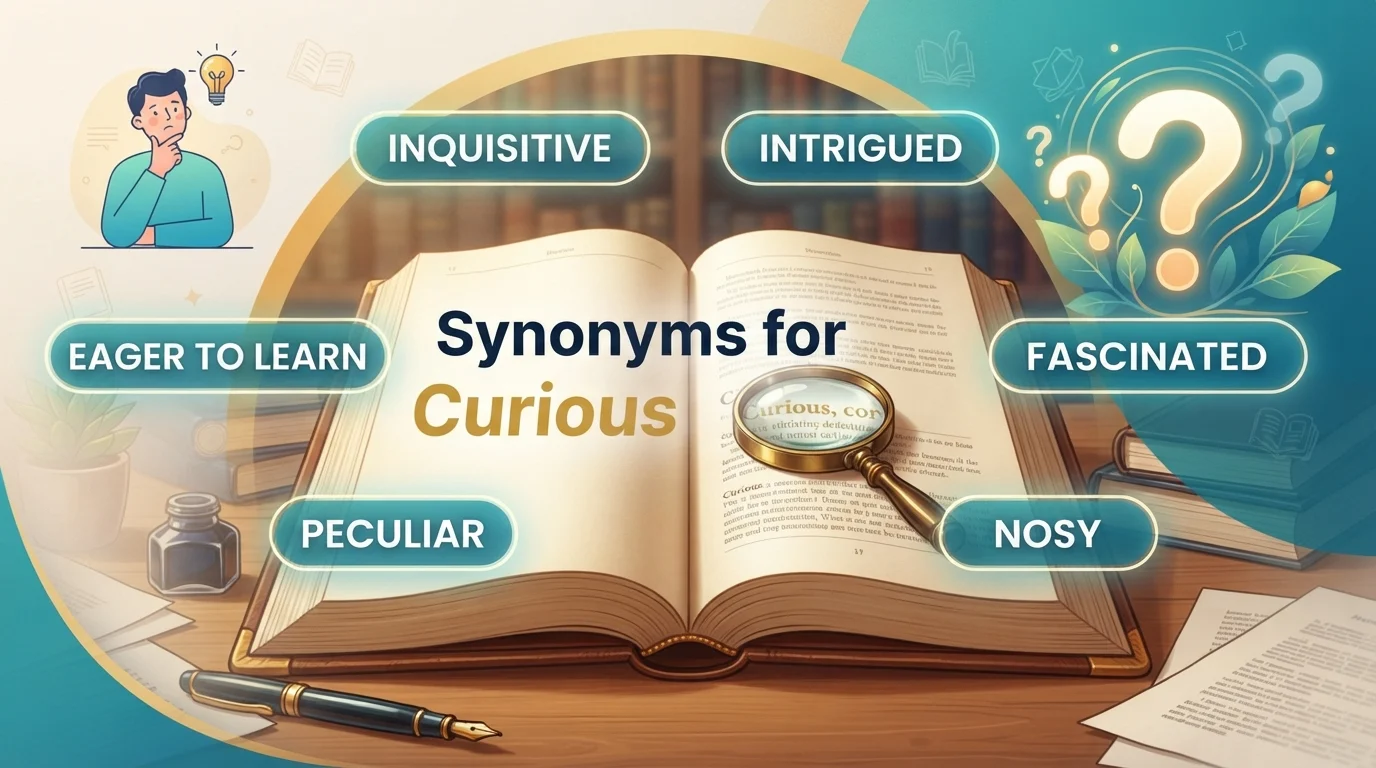
Do you keep using the word “curious” in essays, business reports, creative writing, job applications, or everyday conversations? While it is a positive and versatile word, repeating it can make your writing feel monotonous or lack nuance.
The good news is that the best alternative depends on what you actually mean. You might be describing a healthy desire to learn, a nosy interest in others’ affairs, an unusual or strange quality, an inquisitive personality trait, or a deep intellectual thirst for knowledge.
This guide explains synonyms for “curious” by meaning, tone, context, and usage. You will learn which alternatives work best in academic writing, professional communication, creative expression, personal descriptions, and casual conversation.
Quick Answer: What Does “Curious” Mean?
“Curious” refers to a strong desire to learn, know, or investigate something. It can describe an inquisitive nature, an unusual or interesting quality, or a meddlesome interest in others’ affairs. Depending on context, alternatives include inquisitive, interested, intrigued, nosy, prying, inquisitorial, unusual, peculiar, fascinated, and eager to learn.
Meaning, Tone, and Context
Simple Definition
“Curious” generally refers to:
- A desire to learn or know: wanting to understand more about something
- An inquisitive nature: naturally interested in exploring and discovering
- Strangeness or unusualness: something odd, peculiar, or noteworthy
- A meddlesome interest: prying into others’ affairs (negative connotation)
Part of Speech
“Curious” is primarily an adjective.
Example:
“The curious child asked endless questions.”
Related Forms:
- Curiosity (noun): the desire to learn or know
- Curiously (adverb): in a curious manner
- Curiousness (noun): the quality of being curious
Positive, Negative, or Neutral Tone
“Curious” can be positive, neutral, or negative depending on context:
- Positive: eager to learn, intellectually engaged, interested
- Neutral: interested in finding out, inquisitive
- Negative: nosy, prying, meddlesome, interfering
Formality Level
“Curious” is a standard word that works in both formal and informal English. It is widely used in academic writing, professional communication, creative writing, and everyday conversation.
Common Use Cases
“Curious” commonly describes:
- Intellectual curiosity: a desire to learn, explore, and understand
- Personal interest: wanting to know more about a specific topic
- Unusual qualities: strange, odd, or interesting characteristics
- Nosy behavior: prying into others’ personal matters
- Children’s nature: a natural tendency to ask questions and explore
Important Word Forms
- Curious (adjective): eager to learn or know
- Curiosity (noun): the desire to learn or know
- Curiously (adverb): in a curious manner
- Incurious (adjective): lacking curiosity, uninterested
- Curios (noun): unusual or interesting objects
When and How to Use “Curious”
Use “curious” when you want to describe a desire to learn, an inquisitive nature, or something unusual and interesting. Because the word has multiple meanings, more specific alternatives can add precision.
Professional
“I’m curious about the company’s approach to sustainability.”
This works naturally in business communication.
Academic
“The study was driven by a curious interest in human behavior.”
The term is appropriate in academic contexts when discussing intellectual motivation.
Personal
“I’m curious to hear what you think about this.”
The word sounds natural in everyday conversation.
Creative
“A curious light glowed from the abandoned house.”
Here, “curious” means unusual, strange, or intriguing.
Job Application
“I have a curious mind that drives me to learn new skills.”
This is a positive way to describe intellectual engagement.
Social Media
“I’m curious about your thoughts on this topic.”
This works well for engaging audiences and encouraging discussion.
Another Word for “Curious”
There is no single perfect synonym because “curious” can refer to different aspects of inquisitiveness, strangeness, or nosiness.
- Intellectual desire to learn: inquisitive, interested, eager to learn, inquiring
- Fascination or engagement: intrigued, fascinated, captivated, spellbound
- Unusual or strange: peculiar, odd, unusual, queer, extraordinary
- Nosy or meddling: nosy, prying, meddlesome, intrusive
- Formal contexts: inquisitorial, investigative, inquisitive
- Playful curiosity: wondering, questioning
If you need one broad alternative, “inquisitive” works well for intellectual curiosity, while “intrigued” works better for being fascinated by something specific.
When Not to Use “Curious”
“Curious” can become too vague or carry the wrong connotation in certain contexts.
Consider:
“She is curious about her colleagues.”
This statement could mean she is intellectually interested in their work OR she is nosily prying into their personal lives. The context determines the meaning.
A more precise sentence could be:
“She is interested in learning more about her colleagues’ professional expertise.”
Similarly, avoid using “curious” when you mean simply “interested” in a casual way. Interested is more neutral and less likely to imply nosiness.
Words Commonly Confused With “Curious”
Curious vs. Inquisitive
Inquisitive specifically describes a desire to learn or ask questions. Curious is broader and can include unusualness or nosiness.
Example:
“The inquisitive student asked many questions.” (intellectual curiosity)
“The curious object caught her attention.” (unusual)
Curious vs. Nosy
Nosy has a negative connotation and refers to prying into others’ personal affairs. Curious can be neutral or positive.
Example:
“The nosy neighbor peered through the curtains.” (negative)
“The curious child explored the forest.” (positive)
Curious vs. Interested
Interested describes having attention or concern about something. Curious implies a stronger desire to learn more.
Example:
“She is interested in art.” (enjoys it)
“She is curious about how art is created.” (wants to learn)
Curious vs. Intrigued
Intrigued emphasizes being fascinated or captivated by something mysterious. Curious is broader.
Example:
“I’m intrigued by the mystery novel.” (captivated)
“I’m curious about the novel’s author.” (desire to know)
Curious vs. Peculiar
Peculiar specifically means strange or unusual. Curious can mean this but also means inquisitive.
Example:
“He has a peculiar habit.” (strange)
“He is curious about everything.” (inquisitive)
Best Synonym by Context for “Curious”
| Context | Best Synonym | Why It Works | Example |
|---|---|---|---|
| Intellectual curiosity | Inquisitive, inquiring | Emphasizes desire to learn | The inquisitive scholar explored the archives. |
| Job applications/resumes | Eager to learn, intellectually curious | Positive professional tone | I am intellectually curious and always seeking new challenges. |
| Fascination | Intrigued, fascinated, captivated | Emphasizes engagement | She was captivated by the mystery. |
| Unusual/strange | Peculiar, odd, unusual, remarkable | Describes strangeness | I noticed a peculiar smell. |
| Nosy (negative) | Nosy, prying, meddlesome, intrusive | Emphasizes unwanted interest | Stop being so nosy about my personal life. |
| Creative writing | Wondering, questioning, inquisitive | Adds depth | The wondering child gazed at the stars. |
| Formal writing | Inquisitorial, investigative | Professional and precise | The commission adopted an investigative approach. |
| Conversational | Curious (itself), wondering | Natural and concise | I was just wondering about that. |
| Research context | Investigative, inquiring, exploratory | Emphasizes systematic exploration | The exploratory study revealed new insights. |
| Describing a personality trait | Inquisitive, questioning, observant | Positive character description | He has an observant and thoughtful nature. |
Which Synonym Should You Choose?
Start by identifying what kind of “curious” you are expressing.
- Positive intellectual curiosity: inquisitive, inquiring, intellectually curious, eager to learn
- Fascination with something specific: intrigued, fascinated, captivated
- Strangeness/unusualness: peculiar, odd, unusual, queer, remarkable
- Nosy or meddlesome (negative): nosy, prying, meddlesome, intrusive
- Formal/academic: inquisitorial, investigative, exploratory
- Creative/descriptive: wondering, questioning, searching
10 Key Synonyms for “Curious”
The table below includes accurate alternatives with clear meanings and usage contexts.
| Synonym | Simple Meaning | Best Used For | Example Sentence |
|---|---|---|---|
| Inquisitive | Eager to learn and ask questions | Positive intellectual curiosity | The inquisitive student always asks insightful questions. |
| Intrigued | Fascinated or captivated | Responding to something compelling | I’m intrigued by the author’s writing style. |
| Fascinated | Extremely interested and captivated | Responding to something captivating | The children were fascinated by the magician. |
| Inquiring | Seeking information or knowledge | Formal or academic contexts | He had an inquiring mind from a young age. |
| Peculiar | Unusual, strange, or odd | Describing unusual things | I noticed a peculiar odor in the room. |
| Unusual | Not common or ordinary | Describing unique qualities | She has an unusual talent for languages. |
| Nosy | Unduly curious about others’ affairs (negative) | Describing meddlesome behavior | The nosy neighbor was always gossiping. |
| Eager to learn | Showing enthusiasm for knowledge | Professional and personal descriptions | I am eager to learn new technologies. |
| Captivated | Holding attention completely | Strong fascination | The audience was captivated by the performance. |
| Exploratory | Undertaken to discover or learn | Research, scientific contexts | The study was exploratory in nature. |
Synonym Groups and Usage Differences
Positive vs. Negative Synonyms
Curious can be positive or negative depending on context and synonym choice:
Positive synonyms: inquisitive, inquiring, interested, eager to learn, intellectually curious, fascinated, intrigued
Negative synonyms: nosy, prying, meddlesome, intrusive, snooping
Examples:
“She has an inquisitive mind.” (positive)
“She has a nosy nature.” (negative)
Professional vs. Personal Synonyms
Professional writing benefits from specific terms such as inquisitive, inquiry-driven, analytically curious, and investigative.
Personal communication often uses curious, wondering, or interested.
Compare:
“I’m curious about your process.” (personal)
“I’m interested in understanding your methodological approach.” (professional)
Formal vs. Conversational Synonyms
Curious works in both formal and conversational English.
Formal alternatives: inquisitorial, investigative, exploratory, inquiring
Conversational alternatives: curious, wondering, intrigued, interested
Examples:
“The committee undertook an exploratory investigation.” (formal)
“I’m just wondering about that.” (conversational)
Academic Synonyms
Academic writing should distinguish between inquisitive (personal trait), exploratory (type of research), investigative (systematic inquiry), and inquiring (seeking knowledge).
For example, research papers often use exploratory study to describe preliminary research.
Professional and Business Synonyms
Business writing often benefits from phrases such as eager to learn, inquisitive, analytically curious, intellectually engaged, and inquiry-driven.
Instead of:
“I am a curious person.”
Consider:
“I am intellectually curious and consistently seek opportunities to learn and grow.”
Creative or Literary Synonyms
Creative writing can use wondering, questioning, searching, pondering, musing, and reflective to describe thoughtful characters.
For example:
“The wondering child gazed at the stars, questioning the mysteries of the universe.”
Slang or Modern Synonyms
Nosey (variant spelling of nosy) is common in casual English.
Snoopy (similar to Snoopy the cartoon dog) can mean inquisitive in a playful way.
Gumshoe is old-fashioned slang for an investigator.
In the know means well-informed rather than curious.
Examples:
“Don’t be so nosey!” (casual, negative)
“She’s always snooping around.” (casual, negative)
Strongest vs. Weaker Synonyms
“Curious” synonyms vary in intensity:
Milder: interested, wondering, questioning, interested
Moderate: curious, intrigued, inquisitive, fascinated
Stronger: captivated, spellbound, riveted, consumed with curiosity
Very Strong: obsessive, voracious (as in voracious curiosity)
Emotional vs. Neutral Synonyms
Curious is generally neutral but can become emotional with stronger synonyms.
Emotional: fascinated, captivated, spellbound, intrigued, obsessed
Neutral: interested, inquisitive, inquiring, exploratory
Examples:
“I’m curious about the results.” (neutral)
“I’m captivated by the story.” (emotional, engaged)
Antonyms of “Curious”
Curious does not have exact antonyms, but depending on context, the following words represent opposites:
| Antonym | Context | Meaning | Example Sentence |
|---|---|---|---|
| Indifferent | Interest | Lack of interest or concern | She was indifferent to the news. |
| Incurious | Intellectual | Lacking curiosity | He was incurious and never asked questions. |
| Uninterested | Engagement | Not interested | The students were uninterested in the lecture. |
| Disinterested | Engagement | Not caring | She seemed disinterested in the conversation. |
| Apathetic | Emotion | Showing no interest | He was apathetic about the election. |
| Common | Unusualness | Not unusual or remarkable | It was a common sight. |
| Ordinary | Unusualness | Not unusual | The object was completely ordinary. |
| Unremarkable | Unusualness | Not worthy of notice | The building was unremarkable. |
Comparison: “Curious” vs. Similar Words
Curious vs. Inquisitive
Main difference: Inquisitive emphasizes a desire to ask questions and learn. Curious is broader and can also mean unusual or nosy.
Examples:
“The inquisitive child asked many questions.” (positive, intellectual)
“The curious object had mysterious markings.” (unusual)
Curious vs. Nosy
Main difference: Nosy has a negative connotation and implies prying into others’ affairs. Curious can be positive, neutral, or negative.
Examples:
“The nosy neighbor peeked through the window.” (negative)
“The curious scientist conducted experiments.” (positive)
Curious vs. Intrigued
Main difference: Intrigued emphasizes being fascinated or captivated by something. Curious implies a desire to learn more.
Examples:
“I’m intrigued by the mystery.” (captivated)
“I’m curious about how it works.” (desire to understand)
Curious vs. Interested
Main difference: Interested describes having attention or concern. Curious implies a stronger desire to learn or know more.
Examples:
“She is interested in history.” (enjoys it)
“She is curious about ancient civilizations.” (wants to learn more)
Curious vs. Peculiar
Main difference: Peculiar specifically means strange or unusual. Curious can mean this or inquisitive.
Examples:
“He has a peculiar accent.” (strange)
“He is curious about her accent.” (inquisitive)
Common Phrases and Expressions with “Curious”
1. Curiosity killed the cat
Meaning:
A warning against being too curious or nosy, as it can lead to trouble.
Example:
“I know you want to look inside, but curiosity killed the cat.”
2. Satisfy my curiosity
Meaning:
To learn something that one has been wanting to know.
Example:
“Please tell me what happened—satisfy my curiosity.”
3. I’m curious to know
Meaning:
A polite way to ask for information.
Example:
“I’m curious to know what you think about the proposal.”
4. Out of curiosity
Meaning:
Done because of interest rather than necessity.
Example:
“Out of curiosity, I looked up the author online.”
5. Pique someone’s curiosity
Meaning:
To stimulate or arouse interest.
Example:
“The trailer for the movie piqued my curiosity.”
6. Burning curiosity
Meaning:
An intense, urgent desire to know something.
Example:
“Her burning curiosity drove her to research the topic for hours.”
7. Curious case
Meaning:
An unusual or strange situation.
Example:
“The curious case of the missing documents baffled the police.”
8. Curious nature
Meaning:
An innate tendency to be inquisitive.
Example:
“His curious nature made him an excellent scientist.”
9. Curious about
Meaning:
Wanting to know more about something.
Example:
“I’m curious about how the new system works.”
10. A curious thing
Meaning:
Something unusual or surprising.
Example:
“It’s a curious thing that she never mentioned it.”
Common Mistakes to Avoid
1. Using “curious” when you mean “nosy” without making the negative connotation clear
If you mean nosy or prying, use those words to avoid ambiguity.
Ambiguous: “She is curious about her colleagues.”
Clear: “She is nosy about her colleagues’ personal lives.”
2. Using “curious” when “interested” is more appropriate
Curious implies a desire to learn more. If you simply have attention or concern, use interested.
Example:
“I’m interested in art.” (enjoyment)
“I’m curious about how art is created.” (desire to learn)
3. Confusing “curious” with “peculiar” in context
Curious as an adjective for things means unusual. Peculiar is more precise.
Ambiguous: “He has a curious habit.”
Clear: “He has a peculiar habit.” (if you mean strange)
4. Overusing “curious” in writing
Repetition can make content feel dull. Instead, use alternatives such as inquisitive, intrigued, interested, fascinated, and exploratory.
5. Choosing a synonym that changes the meaning
Do not replace curious with nosy unless you mean negative, meddlesome interest.
Do not replace curious with peculiar unless you mean unusual rather than inquisitive.
Neutral: “He is curious about science.”
Negative: “He is nosy about his neighbors.”
Unusual: “He has a peculiar accent.”
6. Using “curious” with a negative connotation without context
Without context, “curious” is generally neutral to positive. If you want negative, use nosy, prying, or meddlesome.
7. Using “curious” to describe objects without clarifying meaning
When describing objects, “curious” means unusual or strange. However, this usage can sound outdated. Peculiar or unusual is often clearer.
Dated: “A curious object.”
Clearer: “An unusual object.”
FAQs
What is the best synonym for “curious”?
The best synonym depends on context. Inquisitive works for intellectual curiosity, intrigued for fascination, interested for general attention, peculiar for strangeness, and nosy for meddlesome interest.
What is a positive synonym for “curious”?
Inquisitive, inquiring, eager to learn, intellectually curious, and interested are positive synonyms.
What is a negative synonym for “curious”?
Nosy, prying, meddlesome, intrusive, and snooping are negative synonyms.
What is a formal synonym for “curious”?
Inquisitorial, investigative, exploratory, inquiring, and analytically curious are formal synonyms.
What is another word for “curious” in creative writing?
Wondering, questioning, searching, pondering, musing, thoughtful, and reflective work well in creative writing.
What is the difference between “curious” and “inquisitive”?
Inquisitive emphasizes a desire to ask questions and learn. Curious is broader and can also mean unusual or nosy.
What is the opposite of “curious”?
Depending on context, opposites include incurious, indifferent, uninterested, apathetic, disinterested, common, and ordinary.
What does “curious” mean when describing a person?
When describing a person, curious means having a strong desire to learn or know things. It can also mean being overly interested in others’ affairs (negative connotation).
Conclusion
“Curious” is a versatile word that can describe intellectual interest, fascination, strangeness, or nosiness. The best synonym depends on what you actually mean.
Choose inquisitive for positive intellectual curiosity, intrigued for fascination, interested for general attention, peculiar for strangeness, nosy for negative meddlesome interest, eager to learn for professional contexts, and fascinated for strong engagement.
Most importantly, do not replace “curious” simply to avoid repetition. First identify whether you are describing intellectual curiosity, fascination, strangeness, or nosiness. Then choose the alternative that communicates that idea most clearly.
For academic, professional, and formal writing, precision is usually more valuable than vocabulary variety. A specific term such as inquisitive, investigative, or exploratory can tell readers much more than the broad word curious.
Before publishing a vocabulary guide, verify definitions and usage with trusted dictionaries such as Cambridge, Oxford, Merriam-Webster, Collins, or Britannica. This helps ensure that each alternative accurately matches its intended meaning and context.
The practical takeaway is simple: when “curious” feels too broad, ask yourself what kind of interest—intellectual, fascinated, unusual, or nosy—you are actually describing. Then use the most precise word available.
Discover More:-
- 50+ Synonyms for Motivation: Meanings, Examples, and Best Alternatives
- 50+ Synonyms for Light: Meanings, Examples, and Best Alternatives

2 thoughts on “50+ Synonyms for Curious: Meanings, Examples, and Best Alternatives”