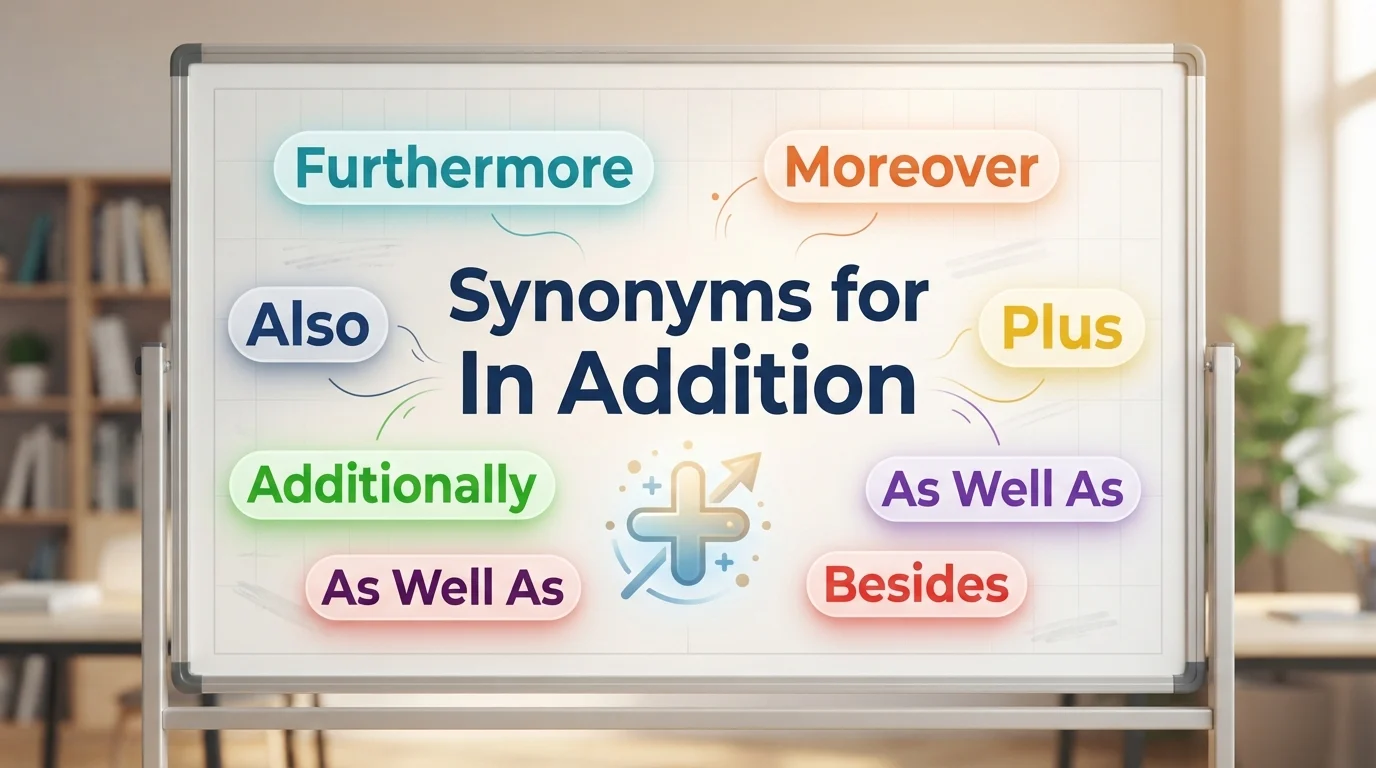
Do you keep using the phrase “in addition” in essays, business reports, academic papers, presentations, or everyday writing? While it is a common and useful transitional phrase for adding information, repeating it can make your writing feel predictable or overly formal.
The good news is that the best alternative depends on your context, tone, and what you want to emphasize. You might be adding a point, providing supplementary information, introducing another reason, or emphasizing an extra item in a list.
This guide explains synonyms for “in addition” by meaning, tone, context, and usage. You will learn which alternatives work best in academic writing, professional communication, creative expression, and casual conversation.
Quick Answer: What Does “In Addition” Mean?
“In addition” is a transitional phrase used to introduce extra information, add a point to an argument, or list supplementary items. It indicates that what follows is connected to and builds upon what was previously stated. Depending on context, alternatives include furthermore, moreover, also, besides, additionally, plus, as well as, not to mention, and on top of that.
Meaning, Tone, and Context
Simple Definition
“In addition” generally means:
- Introducing extra information or a supplementary point
- Adding another item to a list
- Providing another reason or example
- Building upon a previous statement
- Indicating that something is included along with what was already mentioned
Part of Speech
“In addition” functions as a transitional phrase or conjunctive adverb in sentences.
Examples:
- “In addition, we need to consider the budget.”
- “The company offers health insurance in addition to paid leave.”
Positive, Negative, or Neutral Tone
“In addition” is generally neutral. However, the tone can vary depending on the synonym you choose:
- Furthermore – formal and academic
- Moreover – formal, emphatic
- Also – neutral and universal
- Plus – informal and conversational
- Besides – can be informal or formal depending on context
Formality Level
“In addition” is a standard transitional phrase that works in both formal and informal English. However, it is more common in formal and academic writing. For informal contexts, alternatives like plus, also, or besides may be more natural.
Common Use Cases
“In addition” commonly appears in:
- Academic writing (adding supporting evidence)
- Business reports (listing additional factors)
- Essays (building arguments)
- Presentations (transitioning to new points)
- Professional communication (adding information)
- Everyday speech (giving extra reasons)
Important Related Forms
- Additionally (adverb): formal synonym
- In addition to (preposition): used before a noun
- Added to that (phrase): emphasizing addition
- Along with (preposition): indicating inclusion
When and How to Use “In Addition”
Use “in addition” when you want to add information that supports, supplements, or extends what you have already said. It works well between paragraphs, at the start of a new sentence, or before a list of items.
Professional
“In addition, we will review the new safety protocols at tomorrow’s meeting.”
This works naturally in professional communication.
Academic
“The study found significant results. In addition, it identified several areas for future research.”
The phrase is standard in academic writing.
Business
“The product is affordable. In addition, it is backed by a comprehensive warranty.”
Here, “in addition” introduces a supplementary benefit.
Creative
“The cottage was quaint. In addition, it had a stunning view of the lake.”
The phrase works well in descriptive writing.
Formal Writing
“The policy covers full-time employees. In addition, part-time staff are eligible for pro-rated benefits.”
This maintains a professional tone.
Another Word for “In Addition”
There is no single perfect synonym because “in addition” can be used in different ways. The best alternative depends on tone, context, and whether you want to emphasize a list, a new point, or a supplementary idea.
- Formal writing: furthermore, moreover, additionally, in addition to this
- Academic writing: furthermore, moreover, additionally, further
- Business communication: additionally, in addition, plus
- Adding points to an argument: furthermore, moreover, what’s more
- Adding to a list: also, as well as, along with, plus
- Informal contexts: plus, besides, also, on top of that
- Emphasizing inclusion: not to mention, let alone
If you need one broad alternative, “furthermore” is a safe formal replacement, while “also” works in almost all contexts and maintains a neutral tone.
When Not to Use “In Addition”
“In addition” can become too formal or repetitive if overused. Consider varying your transitions to maintain reader engagement.
Consider:
“The proposal is well-written. In addition, it is cost-effective. In addition, it is easy to implement.”
This repetition makes the writing feel awkward and monotonous.
A better version:
“The proposal is well-written. Furthermore, it is cost-effective. Finally, it is easy to implement.”
Similarly, avoid using “in addition” when you need a stronger contrast like “however” or “nevertheless”.
Words Commonly Confused With “In Addition”
In Addition vs. Furthermore
Furthermore is more formal and emphatic. It indicates not just addition but also building upon the previous point with significant new information.
Example:
“The company has strong brand recognition. Furthermore, it has a loyal customer base.”
In Addition vs. Moreover
Moreover is similar to furthermore but often indicates that the added point is even more important or significant.
Example:
“The project is on schedule. Moreover, it is under budget.”
In Addition vs. Also
Also is a shorter, less formal alternative. It is best for adding points in a list or providing supplementary details.
Example:
“She is a talented musician. Also, she writes her own songs.”
In Addition vs. Plus
Plus is informal and conversational. It is best for lists, everyday speech, and informal writing.
Example:
“The car is affordable. Plus, it has great fuel economy.”
In Addition vs. Besides
Besides can mean “in addition to” but can also introduce an alternative or contrasting point. In informal contexts, it often means “anyway.”
Example:
“Besides the obvious benefits, the plan also offers tax advantages.”
In Addition vs. Furthermore vs. Moreover
| Term | Formality Level | Best Used For |
|---|---|---|
| Furthermore | Very formal | Adding significant, serious points |
| Moreover | Very formal | Adding a point that strengthens a claim |
| In addition | Formal/Neutral | General addition, works almost everywhere |
| Also | Neutral/Informal | Short, easy addition |
| Plus | Informal | Casual speech, friendly writing |
Best Synonym by Context for “In Addition”
| Context | Best Synonym | Why It Works | Example |
|---|---|---|---|
| Formal writing | Furthermore, moreover | Precise and professional | The proposal is strong. Furthermore, it is feasible. |
| Academic writing | Additionally, moreover | Standard academic usage | The study had limitations. Additionally, it had several strengths. |
| Business communication | Additionally, in addition | Professional and clear | The product is high-quality. Additionally, it is cost-effective. |
| Adding to a list | Also, as well as | Natural and concise | The package includes a charger as well as earphones. |
| Casual conversation | Plus, also, besides | Natural and informal | We went to the beach. Plus, we had lunch there. |
| Emphasizing inclusion | Not to mention | Highlights extra items | He has a great voice, not to mention his acting skills. |
| Emphasizing importance | Moreover, what’s more | Highlights significance | The idea is creative. Moreover, it is practical. |
| Preposition context | In addition to, along with | Before a noun | In addition to his salary, he receives bonuses. |
| Adding a final point | Last but not least | Before the final item | Last but not least, we need to consider the timeline. |
| Informal writing | On top of that | Casual, conversational | He missed the deadline. On top of that, his work was incomplete. |
Which Synonym Should You Choose?
Start by identifying what you want to communicate with your addition.
- Formal, serious addition: furthermore, moreover, additionally
- Neutral addition: also, in addition, as well as
- Adding to a list: also, plus, as well as, along with
- Emphasizing importance: moreover, what’s more, furthermore
- Casual addition: plus, besides, on top of that
- Including extras: not to mention, to say nothing of, let alone
10 Key Synonyms for “In Addition”
The table below includes accurate alternatives with clear meanings and usage contexts.
| Synonym | Simple Meaning | Best Used For | Example Sentence |
|---|---|---|---|
| Furthermore | In addition; used to add a point | Formal writing, academic papers | The theory is plausible. Furthermore, it is testable. |
| Moreover | In addition; adds important info | Formal, emphasizing significance | Her research is thorough. Moreover, it is groundbreaking. |
| Additionally | In addition; formal | Business, academic, professional | The budget is approved. Additionally, we have secured funding. |
| Also | In addition; neutral | Universal, all contexts | The house is spacious. Also, it has a large garden. |
| As well as | In addition to | Before nouns | He speaks Spanish as well as French. |
| Plus | In addition; informal | Casual speech, informal writing | The job pays well. Plus, it offers great benefits. |
| Besides | In addition; can also mean “except” | Informal and formal contexts | Besides the salary, the perks are excellent. |
| What’s more | In addition; emphasizes | Conversational but can be formal | The product is reliable. What’s more, it’s affordable. |
| Not to mention | Emphasizes an extra point | Highlighting additional items | She can sing, not to mention dance beautifully. |
| Along with | Together with; in addition to | Preposition before nouns | Along with the report, we submitted supporting documents. |
Synonym Groups and Usage Differences
Professional vs. Personal Synonyms
Professional writing benefits from specific terms such as furthermore, moreover, additionally, and as well as.
Personal communication often uses plus, also, besides, or on top of that.
Compare:
“The proposal is excellent. In addition, it is cost-effective.” (formal)
“The proposal is great. Plus, it’s cheap.” (personal)
Formal vs. Conversational Synonyms
In addition works in both formal and conversational English.
Formal alternatives: furthermore, moreover, additionally, in addition to this
Conversational alternatives: plus, also, besides, on top of that
Examples:
“The research is comprehensive. Furthermore, it is well-documented.” (formal)
“The research is thorough. Plus, it’s well-documented.” (conversational)
Academic Synonyms
Academic writing should distinguish between furthermore (adding a significant point), moreover (adding an even more important point), additionally (neutral addition), and further (often used for elaboration).
For example, research papers use “furthermore” to add supporting evidence and “moreover” to introduce a point that strengthens the argument.
Professional and Business Synonyms
Business writing often benefits from phrases such as additionally, in addition, as well as, and along with.
Instead of:
“The product is reliable. Plus, it’s affordable.” (too informal)
Consider:
“The product is reliable. Additionally, it is cost-effective.” (professional)
Creative or Literary Synonyms
Creative writing can use furthermore, moreover, also, besides, and in addition to vary transitions and maintain a polished style.
For example:
“The forest was dark. Moreover, it was eerily quiet.”
Slang or Modern Synonyms
Plus is the most common informal alternative in casual English.
On top of that is conversational and emphatic.
Not to mention is commonly used to add surprising or obvious extras.
Examples:
“She’s smart. Plus, she’s kind.” (casual)
“He failed the test. On top of that, he lost his homework.” (conversational)
Strongest vs. Weaker Synonyms
“In addition” synonyms vary in emphasis:
Neutral: also, in addition, additionally, as well as
Stronger emphasis: moreover, furthermore, what’s more
Strongest emphasis: not to mention, to say nothing of
Transition Placement
Some synonyms work at the beginning of sentences, while others work before nouns.
Beginning of sentence: furthermore, moreover, additionally, also, plus
Before a noun: in addition to, as well as, along with, besides
Examples:
“Furthermore, we need to consider the timeline.” (sentence start)
“In addition to the timeline, we need to consider the budget.” (before noun)
Antonyms and Opposites
“In addition” indicates addition. The opposite concepts would be:
| Opposite Word | Context | Meaning | Example Sentence |
|---|---|---|---|
| However | Contrast | Introducing a contrast | The plan is creative. However, it is too costly. |
| Nevertheless | Contrast | Despite what was said | The task is difficult. Nevertheless, we will succeed. |
| On the other hand | Contrast | Presenting an alternative | The apartment is spacious. On the other hand, it is expensive. |
| Conversely | Contrast | Reversing the point | Some studies support this. Conversely, others refute it. |
| Excluding | Exclusion | Leaving out | The package includes everything, excluding taxes. |
Comparison: “In Addition” vs. Similar Words
In Addition vs. Furthermore
Main difference: Furthermore is more formal and emphatic. It indicates building upon the previous point with significant new information.
Examples:
“The evidence is compelling. Furthermore, the conclusions are clear.” (formal)
“The product is good. In addition, the customer support is excellent.” (neutral)
In Addition vs. Moreover
Main difference: Moreover often indicates that the added point is even more important or significant than what came before.
Examples:
“The restaurant has great food. Moreover, the service is impeccable.” (emphasis)
“The restaurant has great food. In addition, the ambiance is nice.” (neutral)
In Addition vs. Also
Main difference: Also is shorter, less formal, and often used for simple additions.
Examples:
“She speaks French. Also, she speaks Spanish.” (simple addition)
“She speaks French. Moreover, she is fluent in several dialects.” (formal)
In Addition vs. Plus
Main difference: Plus is informal and conversational.
Examples:
“We went to the museum. Plus, we had lunch downtown.” (informal)
“We visited the museum. In addition, we had lunch at a nearby café.” (formal)
In Addition vs. As Well As
Main difference: “As well as” is a preposition used before nouns, while “in addition” can start a sentence.
Examples:
“In addition, we need to review the budget.” (sentence start)
“We need to review the budget as well as the timeline.” (before noun)
Common Phrases and Expressions with “In Addition”
1. In addition to
Meaning:
Used before a noun or phrase to introduce something extra.
Usage:
Formal and neutral contexts.
Example:
“In addition to his regular salary, he receives bonuses.”
2. In addition to this
Meaning:
Variation of “in addition to,” often used to start a new sentence.
Usage:
Formal writing.
Example:
“The project is on schedule. In addition to this, it is under budget.”
3. Added to that
Meaning:
Emphasizes the addition of a new point.
Usage:
Semi-formal to formal.
Example:
“He has experience in marketing. Added to that, he has strong leadership skills.”
4. Last but not least
Meaning:
Used to introduce the final item in a list, emphasizing its importance.
Usage:
All contexts.
Example:
“Last but not least, we need to thank our sponsors.”
5. Not to mention
Meaning:
Adds an extra point that is often considered obvious or surprising.
Usage:
Informal to semi-formal.
Example:
“She has a great voice, not to mention her excellent stage presence.”
6. On top of that
Meaning:
Adds something extra, often something negative or additional.
Usage:
Conversational, informal.
Example:
“He missed the deadline. On top of that, he forgot to attach the document.”
7. To say nothing of
Meaning:
Indicates that what follows is even more significant.
Usage:
Semi-formal to formal.
Example:
“This is a difficult journey, to say nothing of the dangers involved.”
8. Along with
Meaning:
In addition to; together with.
Usage:
Preposition before nouns.
Example:
“Along with the report, we submitted supporting evidence.”
Common Mistakes to Avoid
1. Using “in addition” too often
Repetition can make writing feel dull. Instead, use a variety of alternatives such as furthermore, moreover, also, plus, and additionally.
Monotonous: “In addition, the plan is affordable. In addition, it is easy to implement. In addition, it is popular.”
Improved: “Furthermore, the plan is affordable. Additionally, it is easy to implement. Finally, it is popular.”
2. Starting a sentence with “in addition to”
“In addition to” is a preposition and must be followed by a noun phrase. It should not start a sentence without a noun after it.
Incorrect: “In addition to, we need to consider the budget.”
Correct: “In addition to the salary, we offer generous benefits.”
Correct: “In addition, we need to consider the budget.” (this uses the adverbial “in addition”)
3. Using “in addition” when “as well as” is more appropriate
“As well as” is used before nouns or phrases. “In addition” can start a sentence.
Correct: “We offer health insurance as well as dental coverage.”
Correct: “We offer health insurance. In addition, we offer dental coverage.”
4. Confusing “in addition” with “however” or “therefore”
“In addition” adds information. “However” introduces contrast. “Therefore” introduces a conclusion.
Incorrect: “The plan is creative. In addition, it is too expensive.” (should be “However”)
Correct: “The plan is creative. However, it is too expensive.”
5. Overusing formal alternatives in casual contexts
In casual conversation or informal writing, using furthermore or moreover can sound pompous. Use plus, also, or besides instead.
Formal: “Furthermore, we need to leave soon.” (too formal for casual)
Casual: “Also, we need to leave soon.” (more natural)
6. Using “in addition” when “besides” is more appropriate
“Besides” can mean “in addition to” but can also mean “except for” or “anyway.” Make sure the context is correct.
Example:
“Besides the cost, the location is excellent.” (in addition to)
“Besides, we don’t have time.” (anyway)
FAQs
What is the best synonym for “in addition”?
The best synonym depends on context. Furthermore and moreover are best for formal writing, additionally for professional contexts, also for neutral additions, plus for casual contexts, and as well as before nouns.
What is a formal synonym for “in addition”?
Furthermore, moreover, additionally, and further are formal synonyms. These work well in academic papers, business reports, and professional documents.
What is an informal synonym for “in addition”?
Plus, also, besides, and on top of that are common informal alternatives.
What is the difference between “in addition” and “furthermore”?
“In addition” is a neutral transitional phrase. “Furthermore” is more formal and emphatic, often used to add significant points in academic or professional writing.
What is the difference between “in addition” and “as well as”?
“In addition” can start a sentence and works as an adverb. “As well as” is a preposition used before nouns or phrases.
Can “in addition” start a sentence?
Yes, “in addition” can start a sentence when used as an adverbial transitional phrase.
What is the difference between “in addition to” and “in addition”?
“In addition to” is a preposition that must be followed by a noun. “In addition” is an adverbial phrase that can start a sentence.
Example:
“In addition to the report, we submitted data.” (preposition)
“In addition, we submitted data.” (adverb)
Conclusion
“In addition” is a versatile transitional phrase for adding information, points, and items. The best synonym depends on your context, tone, and what you want to emphasize.
Choose furthermore for formal writing, moreover for emphasizing importance, additionally for professional contexts, also for neutral additions, plus for casual conversation, as well as before nouns, and not to mention for highlighting extras.
Most importantly, do not replace “in addition” simply to avoid repetition. First identify whether you are adding a point, supplementing information, or listing items. Then choose the alternative that communicates that idea most clearly.
For academic, professional, and formal writing, using a variety of transitional phrases enhances readability and demonstrates strong writing skills. A specific term such as furthermore, moreover, or additionally can add nuance that the more general “in addition” lacks.
Before publishing a vocabulary guide, verify definitions and usage with trusted dictionaries and grammar guides. This helps ensure that each alternative accurately matches its intended meaning and context.
The practical takeaway is simple: when “in addition” feels too repetitive, ask yourself what kind of addition you are making and what tone you want to achieve. Then choose the most appropriate alternative.
Discover More:-
- 50+ Synonyms for Curious: Meanings, Examples, and Best Alternatives
- 50+ Synonyms for Showing: Meanings, Examples, and Best Alternatives
