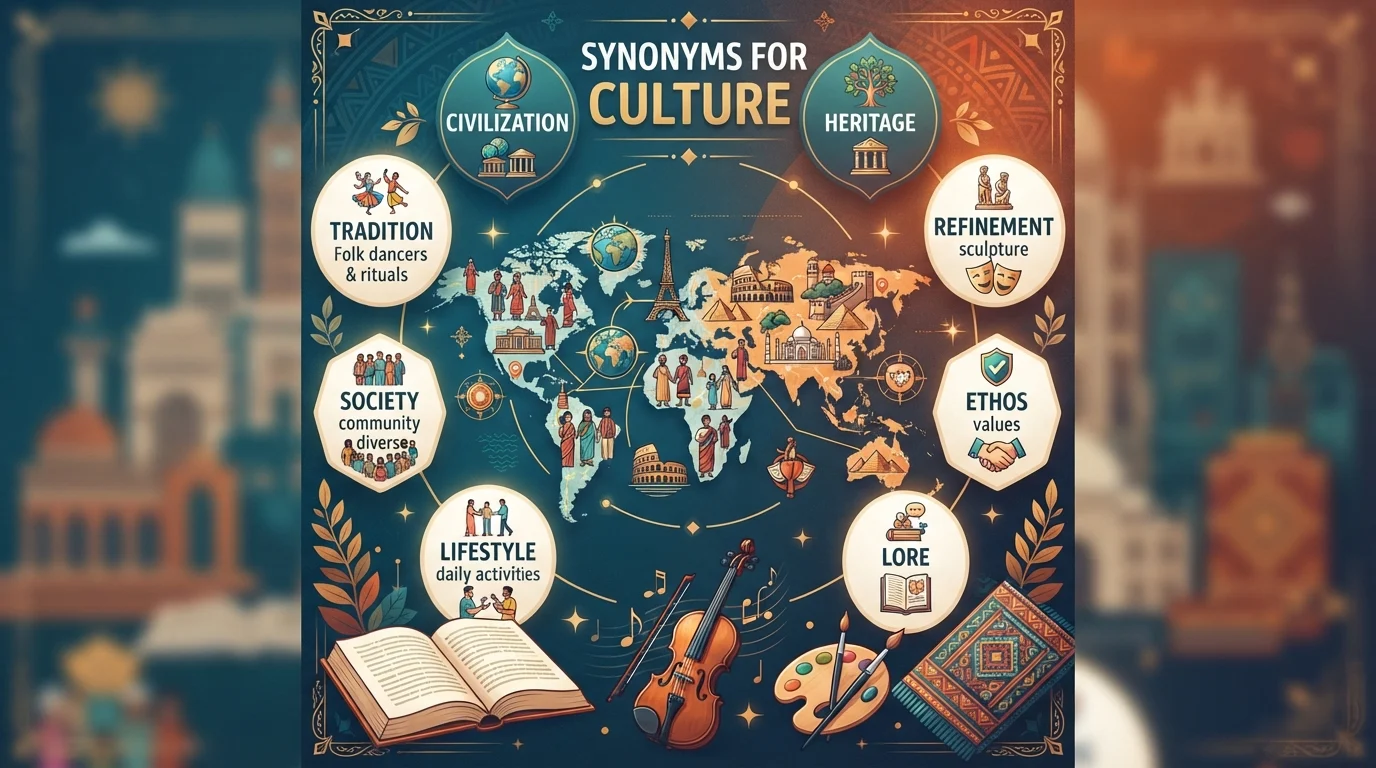
Do you keep using the word “culture” in essays, business reports, anthropology papers, marketing content, or everyday conversation? While it is a rich and essential word, repeating it can make your writing feel vague or imprecise.
The good news is that the best alternative depends on what you actually mean. You might be referring to a society’s shared customs and way of life, personal refinement and education, a workplace environment, or the cultivation of plants and living organisms.
This guide explains synonyms for “culture” by meaning, tone, context, and usage. You will learn which alternatives work best in academic writing, professional communication, creative expression, business contexts, and casual conversation.
Quick Answer: What Does “Culture” Mean?
“Culture” refers to the ideas, customs, and social behavior of a particular people or society . It can also mean a developed understanding of the arts, the act of cultivating plants, or the values and environment of an organization . Depending on context, alternatives include civilization, society, way of life, refinement, cultivation, ethos, traditions, and heritage .
Meaning, Tone, and Context
Simple Definition
“Culture” generally refers to:
- Social/Shared: The customs, beliefs, and social behavior of a particular group or society
- Personal/Intellectual: A developed understanding of the arts, refinement, and good taste
- Organizational: The values, habits, and environment within a company or institution
- Biological/Agricultural: The cultivation of plants, animals, or microorganisms
Part of Speech
“Culture” is primarily a noun.
Examples:
- “The culture of ancient Egypt is fascinating.” (social)
- “She is a woman of culture and refinement.” (personal)
Related Forms:
- Cultural (adjective): relating to culture
- Culturally (adverb): in a cultural way
- Cultured (adjective): showing good taste and refinement
- Cultivate (verb): to develop or grow
- Acculturation (noun): the process of adopting another culture’s customs
Positive, Negative, or Neutral Tone
“Culture” is generally positive or neutral.
- Neutral: “The culture of the region is diverse.”
- Positive: “She is a woman of great culture.” (implies refinement)
- Negative (contextual): “A culture of dependency” or “a culture of fear” .
Formality Level
“Culture” is a standard word that works in both formal and informal English. It is appropriate in academic papers, business reports, casual conversation, and creative writing. However, more specific alternatives can add precision.
Common Use Cases
“Culture” commonly refers to:
- Societal: Shared values, traditions, and heritage of a community .
- Workplace: Company values, environment, and employee behavior.
- Personal Development: Sophistication, education, and good taste in the arts .
- Biology/Agriculture: Cultivation of plants, farming, and microbiology.
Important Word Forms
- Culture (noun): The main term.
- Cultural (adjective): Pertaining to culture (e.g., “cultural heritage”).
- Cultured (adjective): Refined or educated (e.g., “a cultured individual”).
- Cultivate (verb): To grow or develop (e.g., “to cultivate a love for art”).
- Subculture (noun): A cultural group within a larger culture.
When and How to Use “Culture”
Use “culture” when you want to describe the shared values, practices, or refinement of a group or individual.
Professional
“We are building a culture of innovation and accountability.”
This works naturally in business and management.
Academic
“Anthropologists study the material culture of early civilizations.”
The term is standard in academic research .
Personal
“Traveling broadens your horizons and exposes you to new cultures.”
The word sounds natural in everyday conversation.
Business
“Our company culture values collaboration and creativity.”
Here, “culture” describes the internal environment.
Creative
“The culture of the city was a vibrant mix of old traditions and new ideas.”
Biological/Agricultural
“The culture of crops requires careful attention to soil conditions.”
Another Word for “Culture”
There is no single perfect synonym because “culture” can refer to many different things.
- Shared Social Customs: civilization, society, way of life, traditions, heritage, customs, mores, folklore .
- Personal Refinement: refinement, cultivation, polish, sophistication, education, enlightenment, breeding .
- Group Environment: ethos, atmosphere, vibe, spirit, mindset, philosophy .
- Biological/Agricultural: cultivation, farming, agriculture, husbandry, agronomy .
When Not to Use “Culture”
“Culture” can become too vague when you need to specify exactly what aspect you mean.
Vague: “The culture here is good.”
This does not tell readers if the company has high ethical standards, a relaxed dress code, or competitive employees.
Precise: “The workplace has an atmosphere of mutual respect and collaboration.”
Similarly, if you simply mean traditions or customs, use those specific words.
Words Commonly Confused With “Culture”
Culture vs. Civilization
Civilization emphasizes a highly developed stage of social and political organization. Culture is broader, encompassing everyday customs and arts.
Example:
“Ancient Rome was a powerful civilization.” (political/organized)
“Roman culture included elaborate feasts and entertainment.” (daily life)
Culture vs. Society
Society refers to the people and institutions interacting in a community. Culture is the content of what those people believe and do.
Example:
“British society is diverse.” (the people)
“British culture includes afternoon tea.” (the customs)
Culture vs. Refinement
Refinement specifically refers to elegant and cultured personal behavior. Culture can be a broader concept.
Example:
“She is a woman of culture.” (general knowledge and taste)
“She is a woman of refinement.” (specific polished manner)
Culture vs. Heritage
Heritage refers to traditions passed down through generations. Culture is more fluid and includes contemporary aspects.
Example:
“Protecting our cultural heritage.” (traditions, inheritance)
“Understanding our workplace culture.” (contemporary environment)
Culture vs. Ethos
Ethos is the guiding beliefs or ideals of a group. Culture includes behavior, systems, and environment.
Example:
“The company’s ethos is customer-centric.” (beliefs)
“The company’s culture is fast-paced.” (overall experience)
Best Synonym by Context for “Culture”
Which Synonym Should You Choose?
Start by identifying what kind of “culture” you are describing.
- Shared way of life: civilization, society, lifestyle, way of life, customs .
- Personal development: refinement, cultivation, polish, sophistication, education .
- Work environment: ethos, atmosphere, environment, vibe, philosophy .
- Traditions: heritage, traditions, folklore, lore, values .
- Farming/Growing: cultivation, agriculture, agronomy, husbandry .
10 Key Synonyms for “Culture”
The table below includes accurate alternatives with clear meanings and usage contexts.
Synonym Groups and Usage Differences
Professional vs. Personal Synonyms
Professional writing benefits from specific terms such as ethos, environment, atmosphere, and values.
Personal communication often uses culture itself or casual alternatives like vibe or scene.
Compare:
“The culture here is great.” (personal)
“The organizational ethos promotes inclusivity.” (professional)
Formal vs. Conversational Synonyms
Formal alternatives: civilization, refinement, cultivation, sophistication, heritage .
Conversational alternatives: vibe, scene, ways.
Academic Synonyms
Academic writing distinguishes between culture (shared meaning), civilization (organized society), and ethnology (comparison of cultures).
In anthropology, terms like material culture (physical objects), customs (behaviors), and folkways (habits) are used .
Professional and Business Synonyms
Business writing often benefits from phrases such as company culture, work environment, and corporate ethos.
Instead of: “We need to improve the culture.”
Consider: “We need to foster a more collaborative work environment.”
Creative or Literary Synonyms
Creative writing can use heritage, lore, traditions, civilization, and ethos to build rich worlds. For describing a specific person, refinement, cultivation, sophistication, and polish work well .
Slang or Modern Synonyms
Vibe is the most common informal alternative to describe the feeling or atmosphere of a place. Scene is used to describe the cultural or social activity in a place.
Strongest vs. Weaker Synonyms
“Culture” synonyms vary in intensity:
Milder: background, upbringing, habits
Moderate: customs, traditions, values, lifestyle
Strong: civilization, civilization, refinement, sophistication
Very Strong: heritages, mores, ethos
Antonyms of “Culture”
“Culture” has several antonyms depending on context:
Common Phrases and Expressions with “Culture”
1. Culture of… (e.g., Culture of dependency, fear, excellence)
Meaning: Describes a pervasive environment or habit within a group.
Example: “They have created a culture of dependency.”
2. Company Culture
Meaning: The personality of a company, including its values and environment.
Example: “Our company culture values transparency.”
3. High Culture / Low Culture
Meaning: Refinement in arts vs. mass/popular culture.
Example: “He is a man of high culture.”
4. Material Culture
Meaning: The physical objects made and used by a society.
Example: “The museum exhibits artifacts of Native American material culture.”
5. Culture Shock
Meaning: Confusion when experiencing a different culture .
Example: “I experienced culture shock when I moved to a new country.”
Common Mistakes to Avoid
1. Using “culture” when “atmosphere” or “environment” is more precise
If you are referring to the feeling of a place, use vibe, atmosphere, or environment.
2. Confusing “culture” with “cultivation” or “agriculture”
Culture can mean “farming,” but in modern use, it almost always refers to society. If you mean farming, use farming, agriculture, cultivation, or husbandry .
3. Overusing “culture” in writing
Repetition can make content feel dull. Instead, use alternatives such as traditions, customs, values, ethos, or heritage .
4. Using “culture” for personal attributes without context
When describing an individual, refinement, sophistication, polish, and cultivation are better choices .
FAQs
What is the best synonym for “culture”?
The best synonym depends on context. Civilization works for society, traditions for customs, refinement for personal taste, ethos for workplace environment, and cultivation for farming.
What is a formal synonym for “culture”?
Civilization, refinement, sophistication, heritage, and cultivation are formal synonyms .
What is an informal synonym for “culture”?
Vibe and scene are common informal alternatives.
What is another word for “culture” in a business context?
Ethos, atmosphere, environment, values, and workplace culture are used.
What is the difference between “culture” and “civilization”?
Culture is the way of life (customs, arts), while Civilization is the social/political organization that supports it .
What is the opposite of “culture”?
Depending on context, opposites include ignorance, crudeness, barbarism, or chaos .
Conclusion
“Culture” is a versatile word that can describe shared customs, personal refinement, and cultivation. The best synonym depends on what you actually mean.
Choose civilization for society, traditions and customs for shared practices, refinement and cultivation for personal development, ethos for business environments, and farming for agriculture.
Most importantly, do not replace “culture” simply to avoid repetition. First identify what kind of culture—social, personal, organizational, or agricultural—you are describing.
For academic, professional, and formal writing, precision is essential. A specific term such as heritage, ethos, or refinement can provide greater clarity
Discover More:-
- 50+ Synonyms for Stop: Meanings, Examples, and Best Alternatives
- 50+ Synonyms for Future: Meanings, Examples, and Best Alternatives
