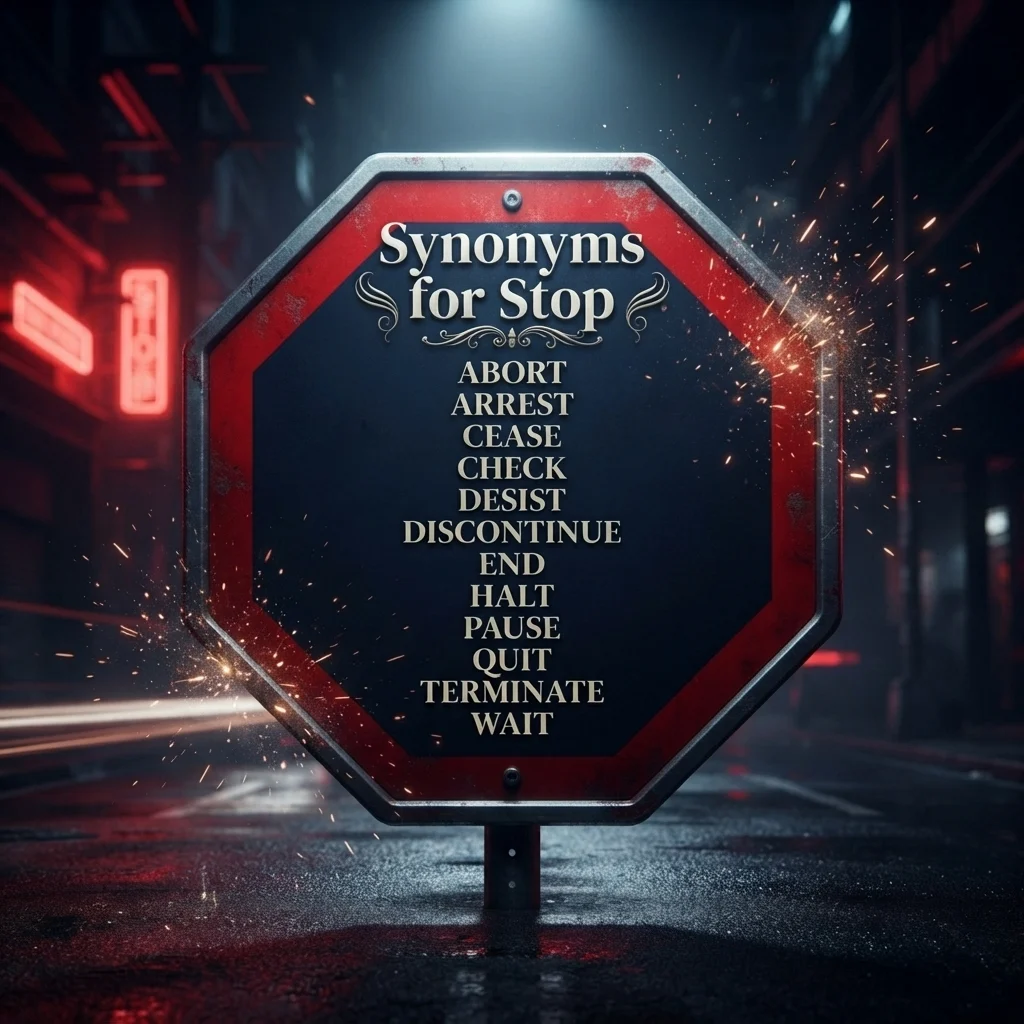
Do you keep using the word “stop” in essays, blog posts, business communication, creative writing, or everyday conversations? Although it is one of the most common and useful verbs in English, repeating it can make your writing feel monotonous or imprecise.
The good news is that the best alternative depends on what you actually mean. You might be referring to ceasing an action, bringing something to an end, preventing something from happening, pausing temporarily, blocking movement, or discontinuing a habit.
This guide explains synonyms for stop by meaning, tone, context, and usage. You will learn which alternatives work best in academic writing, professional communication, creative expression, casual conversation, and technical content.
Quick Answer: What Does “Stop” Mean?
Stop refers to bringing something to an end, ceasing movement or action, preventing something from continuing, or discontinuing a process. Depending on context, alternatives include cease, halt, quit, discontinue, terminate, pause, suspend, block, prevent, and interrupt.
Meaning, Tone, and Context
Simple Definition
Stop generally refers to:
- Ceasing movement or activity
- Bringing something to an end
- Preventing something from happening
- Pausing temporarily
- Discontinuing a habit or practice
- Blocking or obstructing progress
Part of Speech
Stop functions as both a verb and a noun.
Verb Examples:
- “Please stop talking.”
- “The bus stopped at the corner.”
Noun Examples:
- “The train came to a stop.”
- “We made a brief stop along the way.”
Verb Forms:
- Stop (base form)
- Stopped (past tense)
- Stopping (present participle)
- Stops (third person singular)
Noun Forms:
- Stop (singular)
- Stops (plural)
Positive, Negative, or Neutral Tone
Stop is generally neutral in tone. Its connotation depends entirely on context.
Negative contexts:
- “Stop making that noise!” (command, frustration)
- “The project came to a stop.” (failure, interruption)
Positive contexts:
- “Stop smoking for better health.” (beneficial)
- “She stopped to admire the view.” (appreciation)
Formality Level
Stop is a standard word that works in both formal and informal English. However, more formal alternatives like cease, terminate, discontinue, and suspend are often preferred in official, academic, or professional writing.
Common Use Cases
Stop commonly refers to:
- Ceasing an action (stop working, stop talking)
- Halting movement (stop the car, stop running)
- Discontinuing habits (stop smoking, stop overeating)
- Preventing events (stop the spread of disease, stop crime)
- Pausing temporarily (stop for a break, rest stop)
- Blocking progress (stop the enemy, stop the flow)
- Interrupting processes (stop the machine, stop the flow of information)
Important Word Forms
- Stop (verb/noun): to cease or bring to an end
- Stopped (verb past tense): ceased or halted
- Stopping (verb present participle): ceasing or halting
- Stoppage (noun): an instance of stopping or being stopped
- Stopper (noun): something that stops or blocks
- Stopgap (noun): a temporary solution
- Cease (verb formal): to bring to an end
- Halt (verb): to stop movement or progress
When and How to Use “Stop”
Use stop when you want to express that an action, movement, or process is ending, preventing something, or pausing.
Because the word is broad and versatile, it is especially useful when discussing general concepts. However, specific contexts benefit from more precise alternatives.
Professional
“Please stop working on that project until we receive clarification.”
This works naturally in professional communication.
Academic
“The researchers stopped the experiment when they observed unexpected side effects.”
The term is appropriate in academic contexts.
Personal
“I need to stop eating so much sugar.”
The word sounds natural in everyday conversation.
Business
“The company stopped production due to supply chain issues.”
Here, stop refers to business operations.
Creative
“The rain stopped as suddenly as it had begun, leaving the world fresh and clean.”
The word creates a clear, vivid image in creative writing.
Technical
“The system automatically stops the process if an error is detected.”
This works well for technical documentation.
Social Media
“Stop scrolling for a moment and appreciate this view.”
This engaging command works well on social platforms.
Another Word for “Stop”
There is no single perfect synonym because stop can refer to many different types of ending, pausing, or preventing.
- Ceasing completely: cease, discontinue, desist, terminate, end, conclude
- Halting movement: halt, freeze, immobilize, bring to a standstill
- Pausing temporarily: pause, interrupt, suspend, adjourn, recess
- Preventing: prevent, block, prohibit, ban, forbid, inhibit
- Quitting habits: quit, give up, abandon, renounce, forswear
- Interrupting: interrupt, cut off, break off, discontinue
- Blocking physical movement: block, obstruct, barricade, impede, hinder
- Ending gradually: taper off, wind down, phase out, let up
If you need one broad alternative, cease works well in formal contexts, while quit works better in informal contexts.
When Not to Use “Stop”
Stop can become too vague when the reader needs to know exactly what kind of ending or preventing is happening.
Consider:
“The machine stopped.”
This statement does not tell readers whether the machine broke down, was turned off, ran out of power, or was deliberately halted.
A more precise sentence could be:
“The machine was shut down for maintenance.”
Similarly, avoid using stop in formal or technical writing where more specific terms like terminate, suspend, discontinue, or withdraw might be more appropriate.
Words Commonly Confused With “Stop”
Stop vs. Cease
Cease is a formal synonym for stop, often used in official, legal, or academic contexts. Stop is more general.
Example:
“The company ceased operations.” (formal)
“The company stopped operations.” (neutral)
Stop vs. Halt
Halt often refers to stopping movement or progress, sometimes temporarily. Stop is broader.
Example:
“The car halted.” (movement stopped)
“The car stopped.” (could mean parked, broken down, etc.)
Stop vs. Quit
Quit often refers to voluntarily stopping a habit, job, or activity. Stop is broader.
Example:
“He quit his job.” (voluntary)
“He stopped working.” (could be voluntary or forced)
Stop vs. Pause
Pause means to stop temporarily with the intention of resuming. Stop can mean permanent or temporary.
Example:
“She paused the movie.” (temporary)
“She stopped the movie.” (could be temporary or permanent)
Stop vs. Block
Block means to obstruct or prevent movement, often physically. Stop is broader.
Example:
“The road was blocked.” (physical obstruction)
“The car stopped.” (general)
Best Synonym by Context for “Stop”
| Context | Best Synonym | Why It Works | Example |
|---|---|---|---|
| Formal writing | Cease, discontinue | Sounds precise and professional | The company will cease operations. |
| Academic writing | Terminate, discontinue | Scientifically accurate | The researchers terminated the experiment. |
| Movement | Halt, freeze | Describes stopping motion | The troops halted their advance. |
| Temporary pause | Suspend, pause, interrupt | Indicates resumption possible | The project was suspended indefinitely. |
| Prevention | Prevent, block, prohibit | Describes stopping from happening | The vaccine prevents the disease. |
| Habit quitting | Quit, abandon, give up | Specifically about habits | He quit smoking. |
| Casual conversation | Stop itself or quit | Natural and concise | Just stop it! |
| Creative writing | Desist, refrain, forbear | Adds literary depth | She refrained from speaking. |
| Business/professional | Suspend, discontinue, terminate | Maintains professionalism | The service will be discontinued. |
| Legal/official | Cease and desist, prohibit | Formal legal usage | The court issued a cease and desist order. |
| Physical obstruction | Block, obstruct, barricade | Describes physical stopping | The fallen tree blocked the road. |
| Gradual ending | Taper off, phase out, wind down | Describes gradual cessation | The program will be phased out. |
Which Synonym Should You Choose?
Start by identifying what kind of stopping you are describing.
- Permanent ending: cease, terminate, discontinue, end, conclude
- Temporary pause: pause, suspend, adjourn, recess, interrupt
- Stopping movement: halt, freeze, immobilize, bring to a standstill
- Preventing action: prevent, block, prohibit, ban, forbid, inhibit, impede
- Quitting habits: quit, abandon, renounce, give up, kick, forswear
- Interrupting speech/action: interrupt, cut off, break off, butt in
- Physical obstruction: block, obstruct, barricade, bar, dam, plug
- Gradual reduction: taper off, wind down, phase out, let up, ease off
- Formal/official: cease, desist, terminate, discontinue, adjourn
Real Life Examples of “Stop” in Sentences
School
“The teacher told the students to stop talking during the exam.”
A more specific version:
“The teacher instructed the students to cease talking during the exam.”
Workplace
“We need to stop wasting time on unproductive meetings.”
A more precise version:
“We need to discontinue unnecessary meetings.”
Writing
“The rain stopped, and the sun emerged from behind the clouds.”
For a more literary version:
“The rain ceased abruptly, and the sun broke through the clouds.”
Conversation
“Could you please stop making that noise?”
In more specific conversation:
“Could you please refrain from making that noise?”
Social Media
“Stop what you’re doing and read this post!”
For a more engaging post:
“Pause for a moment and reflect on this.”
Resume
Avoid using stop in resumes. Focus on positive action verbs like managed, led, implemented, or improved.
Business
“The company stopped production of the outdated model.”
A more professional version:
“The company discontinued production of the outdated model.”
Storytelling
“He stopped at the edge of the forest, unsure of what lay ahead.”
For more descriptive storytelling:
“He halted at the edge of the forest, his heart pounding with uncertainty.”
10 Key Synonyms for “Stop”
The table below includes accurate alternatives and related terms. Since stop has a broad meaning, some choices work as contextual alternatives rather than exact replacements.
| Synonym | Simple Meaning | Best Used For | Example Sentence |
|---|---|---|---|
| Cease | Bring to an end | Formal writing | The fighting will cease. |
| Halt | Stop movement/progress | Movement context | The train came to a halt. |
| Quit | Voluntarily stop | Habits, jobs | She quit her job. |
| Discontinue | Stop production/service | Business context | The service is discontinued. |
| Terminate | Bring to an end | Formal/official | The contract was terminated. |
| Suspend | Temporarily stop | Temporary pause | The bus service was suspended. |
| Pause | Short temporary stop | Media, conversations | Pause the movie, please. |
| Prevent | Stop from happening | Causal/prevention | Seatbelts prevent injuries. |
| Block | Physically stop | Obstruction | The box blocks the doorway. |
| Abandon | Give up completely | Projects, attempts | They abandoned the project. |
Synonym Groups and Usage Differences
Professional vs. Personal Synonyms
Professional writing benefits from specific terms such as discontinue, terminate, suspend, cease, and withdraw.
Personal communication often uses stop, quit, give up, and call it quits.
Compare:
“I need to stop being late.” (personal)
“The policy will be discontinued effective immediately.” (professional)
Formal vs. Conversational Synonyms
Stop works in both formal and conversational English.
Formal alternatives: cease, desist, terminate, discontinue, suspend, adjourn
Conversational alternatives: quit, knock it off, cut it out, call it a day
Examples:
“The court ordered him to cease and desist.” (formal)
“Just cut it out already!” (conversational)
Academic Synonyms
Academic writing should distinguish between stop, cease, terminate, discontinue, and withdraw depending on the context.
For example, research might terminate an experiment, while a participant might withdraw from a study.
Professional and Business Synonyms
Business writing often benefits from phrases such as cease operations, discontinue service, suspend trading, terminate employment, and phase out production.
Instead of:
“The factory stopped making the product.”
Consider:
“The factory discontinued production of the product.”
Creative or Literary Synonyms
Creative writing can use desist, refrain, forbear, halt, cease, interrupt, and suspend depending on the setting and mood.
For example:
“He desisted from his attempt, knowing it was futile.”
Slang or Modern Synonyms
Knock it off is a common informal alternative.
Cut it out is another casual phrase.
Cool it means to calm down or stop.
Chill can mean to stop being upset or to relax.
Call it a day means to stop working for the day.
Examples:
“Knock it off, you two!” (casual)
“Let’s call it a day and go home.” (informal work context)
Strongest vs. Weaker Synonyms
Stop words vary in intensity and finality:
Milder: pause, interrupt, suspend, delay, adjourn
Moderate: stop, halt, quit, discontinue, block
Strong: cease, terminate, end, conclude, abolish
Very Strong: annihilate, eradicate, eliminate, obliterate
Emotional vs. Neutral Synonyms
Stop is generally neutral.
Emotional alternatives: cease, quit, abandon, renounce, forsake
Neutral alternatives: discontinue, halt, pause, suspend, interrupt
Examples:
“He quit his job in frustration.” (emotional)
“The project was suspended.” (neutral)
Antonyms of “Stop”
Stop does not have exact antonyms, but depending on context, the following words represent opposites:
| Antonym | Context | Meaning | Example Sentence |
|---|---|---|---|
| Start | General | Begin or commence | Let’s start the meeting. |
| Begin | General | Commence | The concert begins at 8 PM. |
| Continue | General | Keep going | Please continue your work. |
| Proceed | General | Move forward | We shall proceed with the plan. |
| Resume | After pause | Start again | The negotiations will resume. |
| Commence | Formal | Begin formally | The ceremony will commence. |
| Initiate | Formal | Start formally | They initiated the project. |
| Go | Movement | Move | The car wouldn’t go. |
| Move | Movement | Change position | The crowd began to move. |
| Advance | Progress | Move forward | The troops advanced. |
Comparison: “Stop” vs. Similar Words
Stop vs. Cease
Main difference: Cease is more formal and often suggests a permanent or complete ending, while stop is broader and more conversational.
Examples:
“The rain ceased.” (formal)
“The rain stopped.” (neutral)
Stop vs. Halt
Main difference: Halt often refers to stopping movement or progress, sometimes dramatically or abruptly. Stop is more general.
Examples:
“The car came to a halt.” (abrupt, movement)
“He stopped talking.” (general)
Stop vs. Quit
Main difference: Quit usually implies voluntary abandonment, often of a habit, job, or activity. Stop is broader.
Examples:
“He quit smoking.” (voluntary habit)
“He stopped running.” (could be voluntary or involuntary)
Stop vs. Pause
Main difference: Pause implies a temporary stop with the expectation of resuming. Stop can be permanent or temporary.
Examples:
“She paused the video.” (temporary)
“She stopped the video.” (could be permanent or temporary)
Stop vs. Block
Main difference: Block specifically means to obstruct or prevent movement, often physically. Stop is broader.
Examples:
“The road was blocked.” (physical obstruction)
“The project was stopped.” (general)
Stop vs. Prevent
Main difference: Prevent means to stop something from happening at all. Stop can mean ending something already in progress.
Examples:
“Vaccines prevent disease.” (stops from happening)
“She stopped the process.” (ends something in progress)
Common Phrases and Expressions with “Stop”
1. Come to a stop
Meaning:
To gradually stop moving or progressing.
Example:
“The car came to a stop at the traffic lights.”
2. Bring to a stop
Meaning:
To cause something to stop.
Example:
“The accident brought traffic to a stop.”
3. Full stop (UK) / Period (US)
Meaning:
Used to emphasize that something is definite and cannot be argued with.
Example:
“I will not do it. Full stop.”
4. Stop and smell the roses
Meaning:
To pause and enjoy life’s simple pleasures.
Example:
“You work too hard—you need to stop and smell the roses.”
5. Stop at nothing
Meaning:
To do whatever is necessary to achieve a goal.
Example:
“She will stop at nothing to succeed.”
6. Put a stop to
Meaning:
To end or prevent something.
Example:
“We must put a stop to this unfair practice.”
7. Stop by / Stop in
Meaning:
To visit briefly and informally.
Example:
“Stop by my office later today.”
8. Stop off
Meaning:
To pause during a journey.
Example:
“We stopped off for coffee on the way.”
9. Stop over
Meaning:
To stay somewhere temporarily during a journey.
Example:
“We stopped over in Paris for two days.”
10. Stop dead / Stop in one’s tracks
Meaning:
To stop suddenly and completely.
Example:
“The announcement stopped him dead in his tracks.”
Common Mistakes to Avoid
1. Using “stop” when a precise term is available
If you mean cease, halt, quit, pause, suspend, block, or prevent, use the more specific word.
Specific vocabulary makes writing more precise and informative.
2. Confusing stop with pause in official contexts
If a process is temporarily suspended with intent to resume, use suspend or pause. If it is permanently ended, use terminate or discontinue.
Incorrect: “The program was stopped permanently.”
Better: “The program was terminated permanently.”
3. Using stop in formal writing where alternatives are better
In formal writing, cease, terminate, or discontinue may be more appropriate.
Informal: “The company stopped operations.”
Formal: “The company ceased operations.”
4. Overusing stop
Repetition can make content feel lazy. Instead, identify whether you mean ending, pausing, preventing, or blocking.
5. Choosing a synonym that changes the meaning
Do not replace stop with interrupt if you mean a complete ending, or with pause if you mean permanent cessation.
Incorrect: “The project was paused.” (if it was permanently ended)
Correct: “The project was discontinued.” (permanent ending)
6. Using stop for prevention incorrectly
If you want to describe stopping something from happening at all, use prevent.
Incorrect: “Safety measures stop the accident.”
Correct: “Safety measures prevent accidents.”
7. Using stop in resumes without positive framing
Resumes should focus on positive, proactive language.
Weak: “Stopped customer complaints.”
Strong: “Resolved customer complaints effectively.”
FAQs
What is the best synonym for “stop”?
The best synonym depends on context. Cease works for formal permanent ending, halt for movement, suspend for temporary pause, quit for habits, and prevent for stopping from happening.
What is a formal synonym for “stop”?
Cease, terminate, discontinue, suspend, and adjourn are formal synonyms. These words work well in official, academic, and professional writing.
What is an informal synonym for “stop”?
Quit, give up, knock it off, cut it out, and call it a day are common informal alternatives.
What is another word for “stop” in creative writing?
Cease, desist, refrain, forbear, halt, and interrupt work well in creative writing to add literary variety and depth.
What is the difference between “stop” and “cease”?
Cease is more formal than stop and often implies a complete and permanent ending. Stop is broader and can be used in both formal and informal contexts.
What is the difference between “stop” and “pause”?
Pause implies a temporary stop with the intention of resuming. Stop can mean permanent or temporary.
What is the opposite of “stop”?
Depending on context, opposites include start, begin, continue, proceed, resume, and advance.
What does “stop” mean in figurative contexts?
Figuratively, stop can refer to ending negative patterns (“stop worrying”), preventing outcomes (“stop the spread”), or taking time to appreciate (“stop and think”).
Conclusion
Stop is a remarkably versatile word that can describe ending actions, halting movement, pausing temporarily, preventing events, discontinuing habits, and blocking progress.
The best synonym depends on what you actually mean. Choose cease for formal permanent endings, halt for stopping movement, suspend for temporary pauses, quit for habits, prevent for stopping from happening, and discontinue for business contexts.
Most importantly, do not replace stop simply to avoid repetition. First identify the specific idea behind the word, then choose the alternative that communicates that idea most clearly.
For academic, professional, and technical writing, precision is usually more valuable than vocabulary variety. A specific term such as terminate, suspend, discontinue, or prohibit can tell readers much more than the broad word stop.
Before publishing a vocabulary guide, verify definitions and usage with trusted dictionaries such as Cambridge, Oxford, Merriam-Webster, Collins, or Britannica. This helps ensure that each alternative accurately matches its intended meaning and context.
The practical takeaway is simple: when stop feels too general, ask yourself what type of ending—permanent, temporary, physical, preventive, or habitual—you are actually describing. Then use the most precise word available.

3 thoughts on “50+ Synonyms for Stop: Meanings, Examples, and Best Alternatives”