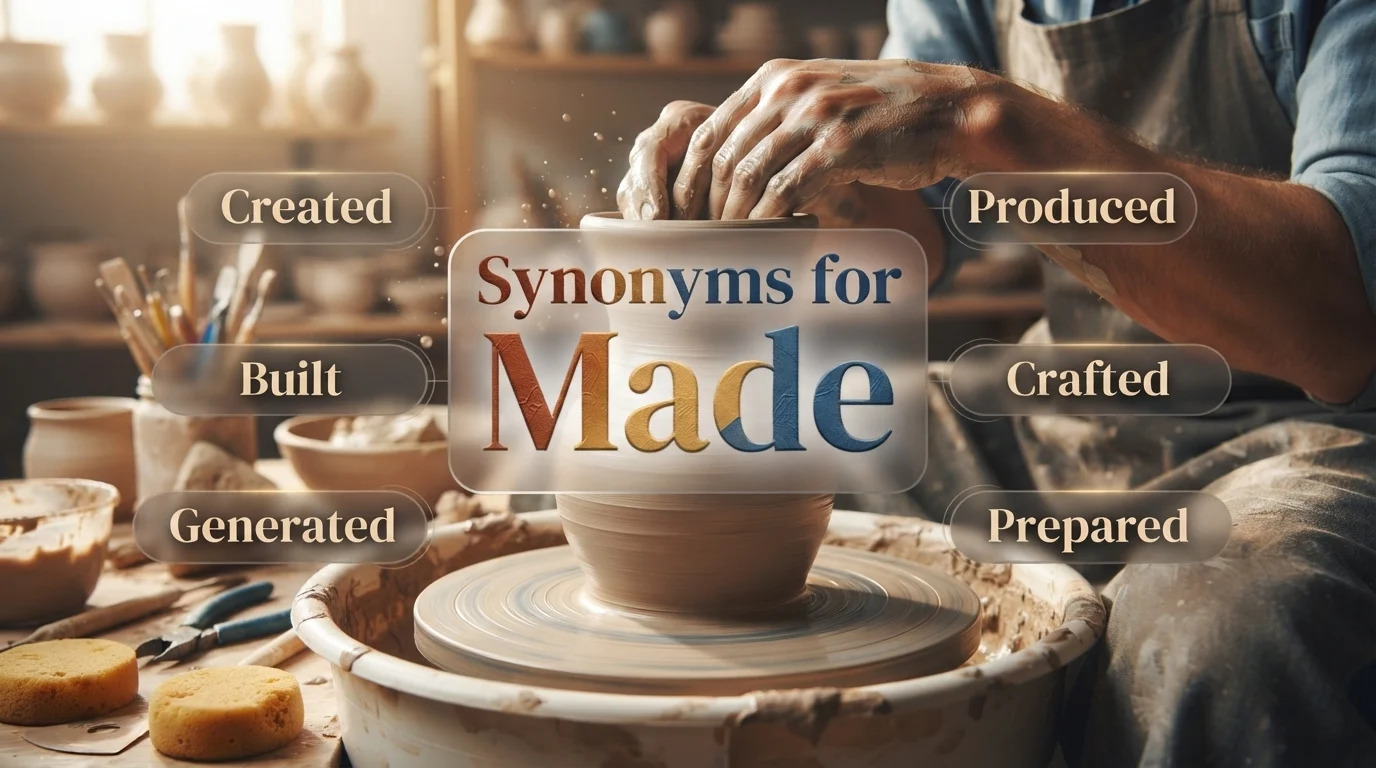
Do you keep using the word “made” in essays, business reports, creative writing, resumes, or everyday conversation? While it is one of the most common and versatile verbs in English, repeating it can make your writing feel flat, repetitive, or overly simplistic.
The good news is that the best alternative depends on what you actually mean. You might be describing creating something, manufacturing a product, causing an outcome, building a structure, or preparing a meal.
This guide explains synonyms for “made” by meaning, tone, context, and usage. You will learn which alternatives work best in academic writing, professional communication, creative expression, technical content, and casual conversation.
Quick Answer: What Does “Made” Mean?
“Made” is the past tense and past participle of the verb “make.” It means to create, produce, construct, cause, or prepare something. Depending on context, alternatives include created, produced, manufactured, built, constructed, formed, crafted, generated, caused, and prepared.
Meaning, Tone, and Context
Simple Definition
“Made” generally refers to:
- Creating: bringing something into existence
- Producing: manufacturing or generating something
- Building: constructing or assembling something
- Causing: bringing about a result or effect
- Preparing: getting something ready
- Forming: shaping or developing something
Part of Speech
“Made” functions as a verb (past tense and past participle of “make”).
Examples:
- “She made a cake for the party.”
- “The company made a profit last year.”
- “He was made manager last month.”
Related Forms:
- Make (verb): to create or produce (present tense)
- Making (verb/noun): the act of creating
- Maker (noun): a person who makes something
- Remake (verb/noun): to make again
- Unmade (adjective): not made; undone
Positive, Negative, or Neutral Tone
“Made” is generally neutral. It can be used in positive, negative, or factual contexts.
Positive associations:
- “She made a beautiful painting.”
- “He made a significant contribution.”
Negative or neutral contexts:
- “The company made a mistake.”
- “The decision was made without consultation.”
Formality Level
“Made” is a standard word that works in both formal and informal English. It is appropriate in academic papers, business reports, creative writing, and casual conversation.
However, more specific alternatives can add precision and variety depending on the context.
Common Use Cases
“Made” commonly refers to:
- Creating: made art, made music, made a film
- Manufacturing: made in China, made by hand, made to order
- Building: made a house, made a bridge, made a table
- Causing: made a difference, made a mistake, made an impact
- Preparing: made dinner, made coffee, made a plan
- Forming: made a decision, made a choice, made a promise
- Achieving: made a profit, made progress, made history
Important Word Forms
- Make (verb): to create, produce, or cause
- Made (verb): past tense of make
- Making (verb/noun): the act of creating
- Maker (noun): a person who makes something
- Remake (verb/noun): to make again
- Unmade (adjective): not made; undone
- Self-made (adjective): successful through one’s own efforts
When and How to Use “Made”
Use “made” when you want to describe the act of creating, producing, building, causing, or preparing something. Because the word is broad, more specific alternatives can add precision depending on the context.
Professional
“She made a significant contribution to the project.”
This works naturally in business communication.
Academic
“The study was made possible by a grant from the National Science Foundation.”
The term is appropriate in academic writing.
Personal
“I made dinner for my family last night.”
The word sounds natural in everyday conversation.
Creative
“The artist made a sculpture from recycled materials.”
The word describes the creative process.
Business
“The company made a profit of $2 million last quarter.”
This is appropriate in business contexts.
Technical
“The product is made from high-quality materials.”
This is standard in technical documentation.
Another Word for “Made”
There is no single perfect synonym because “made” can refer to creating, producing, building, causing, preparing, or forming.
- Creating context: created, produced, generated, designed, crafted
- Manufacturing context: manufactured, produced, fabricated, assembled
- Building context: built, constructed, assembled, erected
- Causing context: caused, created, generated, brought about
- Preparing context: prepared, cooked, assembled, arranged
- Forming context: formed, shaped, developed, established
- Achieving context: achieved, earned, gained, attained
If you need one broad alternative, “created” works for bringing something into existence, while “produced” works for manufacturing. “Caused” works for results.
When Not to Use “Made”
“Made” can become too vague when you need to specify exactly what kind of creation, production, or causation you are describing.
Consider:
“He made a difference.”
This statement does not tell readers whether he created change, influenced outcomes, contributed to a cause, or something else.
A more precise sentence could be:
“He made a lasting impact on the community through his volunteer work.”
Similarly, avoid using “made” when you mean “built” or “constructed” in technical contexts where precision matters.
Words Commonly Confused With “Made”
Made vs. Created
Created emphasizes bringing something new into existence. Made is broader.
Example:
“She created a new recipe.” (new invention)
“She made dinner.” (prepared)
Made vs. Produced
Produced emphasizes manufacturing or generating. Made is broader.
Example:
“The factory produced 1,000 units.” (manufactured)
“She made a cake.” (prepared)
Made vs. Built
Built emphasizes constructing or assembling. Made is broader.
Example:
“He built a house.” (constructed)
“He made a table.” (created)
Made vs. Caused
Caused emphasizes bringing about a result. Made can mean this but is broader.
Example:
“The storm caused widespread damage.” (result)
“She made a mistake.” (action)
Made vs. Prepared
Prepared emphasizes getting something ready. Made can mean this but is broader.
Example:
“She prepared the meal.” (ready)
“She made the meal.” (created)
Made vs. Manufactured
Manufactured emphasizes industrial production. Made is broader.
Example:
“The car was manufactured in Japan.” (industrial)
“The toy was made by hand.” (general)
Best Synonym by Context for “Made”
| Context | Best Synonym | Why It Works | Example |
|---|---|---|---|
| Formal writing | Created, produced | Precise and professional | The committee created a new policy. |
| Academic writing | Generated, produced | Standard academic usage | The study generated significant data. |
| Business/Resume | Generated, achieved, delivered | Emphasizes results | Generated $2 million in revenue. |
| Manufacturing | Manufactured, produced, fabricated | Industrial context | The parts were manufactured in Germany. |
| Building/Construction | Built, constructed, assembled | Construction context | The bridge was built in 1995. |
| Causing results | Caused, generated, brought about | Emphasizes causation | The policy brought about significant change. |
| Preparing food | Prepared, cooked, assembled | Culinary context | She prepared a delicious meal. |
| Creative writing | Crafted, fashioned, forged | Adds literary depth | He crafted a beautiful poem. |
| Achieving | Achieved, earned, gained | Success context | She achieved record sales. |
| Forming/Shaping | Formed, shaped, developed | Development context | He formed a new company. |
| Decision-making | Reached, took, arrived at | Decisions | The committee reached a decision. |
| Casual conversation | Made (itself) | Natural and informal | I made dinner. |
Which Synonym Should You Choose?
Start by identifying what kind of “made” you are describing.
- Creating: created, produced, generated, designed, crafted
- Manufacturing: manufactured, produced, fabricated, assembled
- Building: built, constructed, assembled, erected
- Causing: caused, created, generated, brought about
- Preparing: prepared, cooked, assembled, arranged
- Forming: formed, shaped, developed, established
- Achieving: achieved, earned, gained, attained
10 Key Synonyms for “Made”
The table below includes accurate alternatives with clear meanings and usage contexts.
| Synonym | Simple Meaning | Best Used For | Example Sentence |
|---|---|---|---|
| Created | Brought into existence | Art, ideas, new things | She created a beautiful painting. |
| Produced | Made or manufactured | Manufacturing, results | The factory produced 1,000 units. |
| Built | Constructed or assembled | Buildings, structures | They built a new house. |
| Constructed | Built or assembled | Infrastructure, arguments | The bridge was constructed in 1995. |
| Formed | Shaped or developed | Organizations, relationships | He formed a new company. |
| Crafted | Made with skill | Art, writing, objects | She crafted a beautiful poem. |
| Generated | Produced or created | Energy, revenue, data | The campaign generated significant interest. |
| Caused | Brought about | Results, effects | The storm caused widespread damage. |
| Prepared | Made ready | Food, plans, documents | She prepared a delicious meal. |
| Manufactured | Made in a factory | Industrial production | The car was manufactured in Japan. |
Synonym Groups and Usage Differences
Professional vs. Personal Synonyms
Professional writing, especially in resumes and business communication, benefits from specific terms such as generated, achieved, delivered, produced, and created.
Personal communication often uses made itself or casual alternatives like fixed, cooked, or put together.
Compare:
“I made dinner.” (personal)
“I prepared a comprehensive report.” (professional)
Formal vs. Conversational Synonyms
Made works in both formal and conversational English.
Formal alternatives: created, produced, generated, manufactured, constructed
Conversational alternatives: made, fixed, put together, whipped up
Examples:
“The company manufactured the components.” (formal)
“She whipped up a quick meal.” (conversational)
Academic Synonyms
Academic writing should distinguish between made (general), created (new), produced (manufactured), generated (data/results), and constructed (built).
For example:
“The study generated significant findings.”
“The instrument was constructed by the research team.”
Professional and Business Synonyms
Business writing often benefits from phrases such as generated, achieved, delivered, produced, and created.
Instead of:
“I made a profit.”
Consider:
“I generated a profit of $2 million through strategic initiatives.”
Creative or Literary Synonyms
Creative writing can use crafted, fashioned, forged, wrought, and concocted depending on the context.
For example:
“He crafted a beautiful poem.”
“She concocted a clever plan.”
Slang or Modern Synonyms
Put together is a common casual phrase.
Whipped up means made quickly (often food).
Threw together means made hastily.
Cooked up means invented or made (often a plan or excuse).
Examples:
“She put together a great presentation.” (casual)
“He whipped up a delicious meal.” (casual)
Strongest vs. Weaker Synonyms
“Made” synonyms vary in intensity:
Milder: put together, fixed, prepared
Moderate: made, created, produced
Strong: manufactured, constructed, generated
Very Strong: forged, crafted, engineered
Emotional vs. Neutral Synonyms
“Made” is generally neutral.
Emotional alternatives: crafted, fashioned (positive); concocted, fabricated (negative)
Neutral alternatives: made, produced, created
Examples:
“She crafted a beautiful tribute.” (emotional, positive)
“She concocted a false story.” (negative)
Antonyms of “Made”
“Made” has several antonyms depending on context:
| Antonym | Context | Meaning | Example Sentence |
|---|---|---|---|
| Destroyed | Creation | Ruined or demolished | The building was destroyed in the fire. |
| Dismantled | Construction | Taken apart | The machine was dismantled for parts. |
| Unmade | General | Not made; undone | The bed was unmade. |
| Ruined | General | Spoiled or damaged | The rain ruined the picnic. |
| Demolished | Construction | Torn down | The old stadium was demolished. |
| Undone | General | Reversed or ruined | His hard work was undone. |
| Destroyed | General | Wrecked | The evidence was destroyed. |
Comparison: “Made” vs. Similar Words
Made vs. Created
Main difference: Created emphasizes bringing something new into existence. Made is broader.
Examples:
“She created a new recipe.” (new invention)
“She made dinner.” (prepared)
Made vs. Produced
Main difference: Produced emphasizes manufacturing or generating. Made is broader.
Examples:
“The factory produced 1,000 units.” (manufactured)
“She made a cake.” (prepared)
Made vs. Built
Main difference: Built emphasizes constructing or assembling. Made is broader.
Examples:
“He built a house.” (constructed)
“He made a table.” (created)
Made vs. Caused
Main difference: Caused emphasizes bringing about a result. Made can mean this but is broader.
Examples:
“The storm caused widespread damage.” (result)
“She made a mistake.” (action)
Made vs. Prepared
Main difference: Prepared emphasizes getting something ready. Made can mean this but is broader.
Examples:
“She prepared the meal.” (ready)
“She made the meal.” (created)
Made vs. Manufactured
Main difference: Manufactured emphasizes industrial production. Made is broader.
Examples:
“The car was manufactured in Japan.” (industrial)
“The toy was made by hand.” (general)
Common Phrases and Expressions with “Made”
1. Made in
Meaning:
Manufactured or produced in a specific place.
Example:
“Made in Italy.”
2. Made by hand
Meaning:
Created manually rather than by machine.
Example:
“The pottery is made by hand.”
3. Made to order
Meaning:
Created according to specific requirements.
Example:
“The furniture is made to order.”
4. Made a difference
Meaning:
Had a positive impact.
Example:
“Her volunteer work made a difference.”
5. Made a mistake
Meaning:
Committed an error.
Example:
“Everyone makes mistakes.”
6. Made a decision
Meaning:
Reached a conclusion or choice.
Example:
“The committee made a decision.”
7. Made a profit
Meaning:
Earned money.
Example:
“The company made a profit last year.”
8. Made history
Meaning:
Achieved something significant.
Example:
“She made history as the first woman to hold the office.”
9. Made a name for oneself
Meaning:
Became well-known.
Example:
“He made a name for himself in the industry.”
10. Made up
Meaning:
Invented; reconciled; applied cosmetics.
Example:
“He made up an excuse.”
“They made up after the argument.”
Common Mistakes to Avoid
1. Using “made” when a more precise term is available
If you mean created, produced, built, caused, or prepared, use the more specific word.
Vague: “He made a difference.”
Precise: “He created lasting change in the community.”
2. Confusing “made” with “did”
Made is used with nouns (made a mistake, made a decision). Did is used with actions (did homework, did the dishes).
Incorrect: “He made his homework.”
Correct: “He did his homework.”
Correct: “He made a mistake.”
3. Using “made” in technical writing when “manufactured” is needed
Technical documents require precise language. Use manufactured, fabricated, or assembled.
Vague: “The product is made in China.”
Precise: “The product is manufactured in China.”
4. Overusing “made” in writing
Repetition can make content feel dull. Use alternatives such as created, produced, built, generated, crafted, and prepared.
5. Choosing a synonym that changes the meaning
Do not replace made with built unless you mean constructed.
Do not replace made with caused unless you mean brought about a result.
FAQs
What is the best synonym for “made”?
The best synonym depends on context. Created works for bringing into existence, produced for manufacturing, built for construction, caused for results, and prepared for food or plans.
What is a formal synonym for “made”?
Created, produced, manufactured, constructed, generated, and fabricated are formal synonyms.
What is an informal synonym for “made”?
Put together, whipped up, threw together, and fixed are common informal alternatives.
What is another word for “made” in creative writing?
Crafted, fashioned, forged, wrought, and concocted work well in creative writing.
What is the difference between “made” and “did”?
Made is used with nouns (made a mistake). Did is used with actions (did homework).
What is the opposite of “made”?
Depending on context, opposites include destroyed, dismantled, unmade, ruined, and demolished.
What does “made” mean in a business context?
In business, made often means generated, achieved, earned, or produced—as in “made a profit” or “made progress.”
Conclusion
“Made” is a versatile and essential word that can describe creating, producing, building, causing, preparing, and forming. The best synonym depends on what you actually mean.
Choose created for bringing into existence, produced for manufacturing, built for construction, caused for results, prepared for food or plans, and generated for data or revenue.
Most importantly, do not replace “made” simply to avoid repetition. First identify what kind of creation, production, or causation you are actually describing. Then choose the alternative that communicates that idea most clearly.
For academic, professional, and formal writing, precision is usually more valuable than vocabulary variety. A specific term such as generated, manufactured, constructed, or crafted can tell readers much more than the broad word made.
Before publishing a vocabulary guide, verify definitions and usage with trusted dictionaries such as Cambridge, Oxford, Merriam-Webster, Collins, or Britannica. This helps ensure that each alternative accurately matches its intended meaning and context.
The practical takeaway is simple: when “made” feels too general, ask yourself what kind of creation, production, or causation you are actually describing. Then use the most precise word available.
Discover More:-
- 50+ Synonyms for Stop: Meanings, Examples, and Best Alternatives
- 50+ Synonyms for Future: Meanings, Examples, and Best Alternatives
