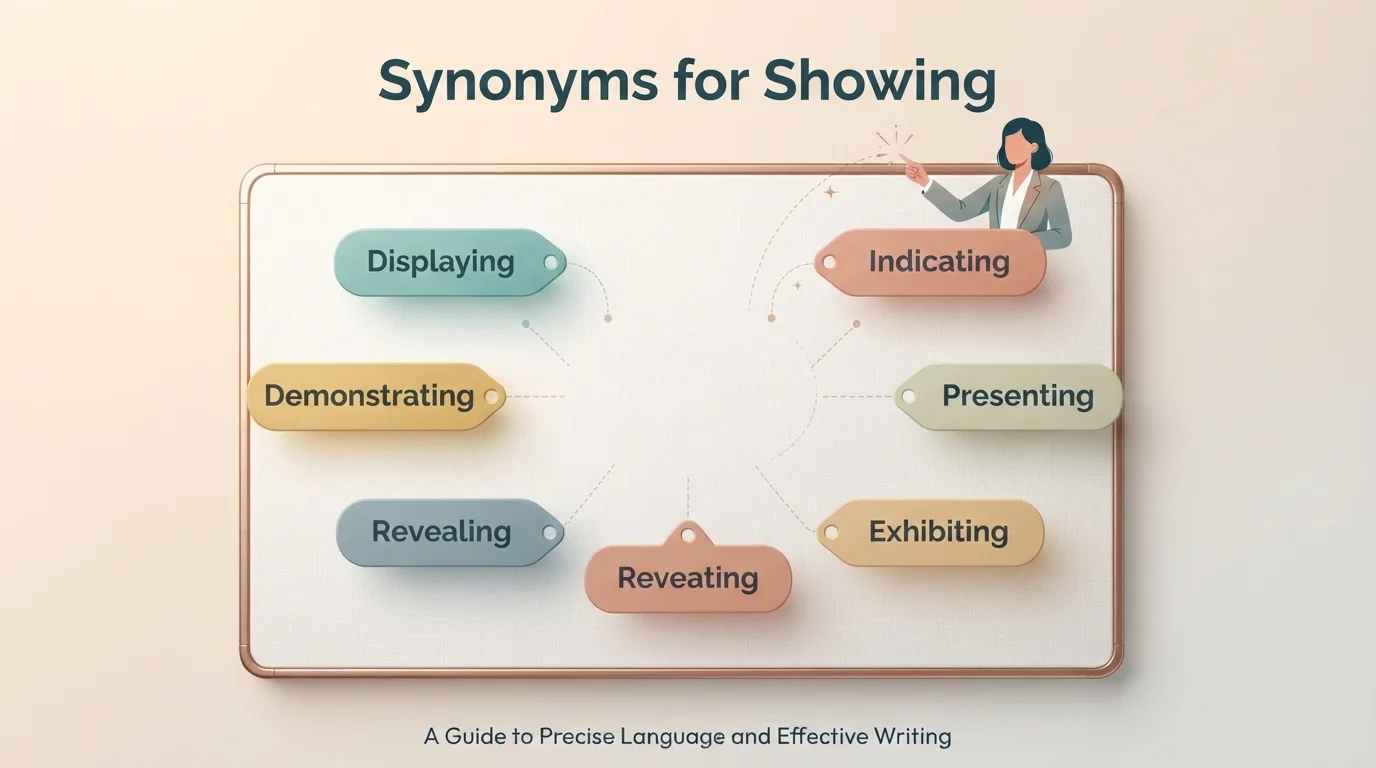
Do you keep using the word “showing” in essays, business reports, presentations, creative writing, or everyday conversation? While it is a useful and common word, repeating it can make your writing feel monotonous or lack precision.
The good news is that the best alternative depends on what you actually mean. You might be referring to displaying something visually, demonstrating a concept, revealing information, indicating evidence, performing an act, or presenting something to an audience.
This guide explains synonyms for “showing” by meaning, tone, context, and usage. You will learn which alternatives work best in academic writing, professional communication, creative expression, technical content, and casual conversation.
Quick Answer: What Does “Showing” Mean?
“Showing” refers to the act of making something visible, apparent, or known. It can involve displaying, demonstrating, revealing, indicating, presenting, or performing. Depending on context, alternatives include displaying, demonstrating, revealing, indicating, presenting, exhibiting, portraying, illustrating, disclosing, and evidencing.
Meaning, Tone, and Context
Simple Definition
“Showing” generally refers to:
- Making something visible: allowing something to be seen
- Demonstrating or proving: providing evidence or proof
- Revealing or disclosing: making something known that was hidden
- Indicating or pointing out: directing attention to something
- Presenting or performing: putting on a display or exhibition
Part of Speech
“Showing” functions as a verb (present participle) and as a noun.
Verb Examples:
- “She is showing her artwork at the gallery.”
- “The data is showing a clear trend.”
Noun Examples:
- “The showing of the film was sold out.”
- “Her performance was an impressive showing.”
Positive, Negative, or Neutral Tone
“Showing” is generally neutral. However, the tone can vary depending on the synonym you choose:
- Displaying – neutral, factual
- Demonstrating – positive, implies skill or proof
- Revealing – can be neutral or dramatic
- Exposing – often negative, implies vulnerability or scandal
- Exhibiting – positive, implies pride or professionalism
Formality Level
“Showing” is a standard word that works in both formal and informal English. However, more formal alternatives like demonstrating, exhibiting, evidencing, and manifesting are often preferred in academic and professional contexts.
Common Use Cases
“Showing” commonly refers to:
- Visual displays: art exhibitions, product demonstrations, data visualizations
- Proving or evidencing: research findings, test results, evidence in court
- Revealing information: revealing secrets, exposing truths, disclosing facts
- Indicating direction or signs: showing the way, showing symptoms
- Performing or presenting: showing a film, showing a performance
Important Word Forms
- Show (verb/noun): the base form
- Showing (verb/noun): present participle or gerund
- Shown (verb past participle): the past participle
- Showed (verb past tense): the simple past
- Showy (adjective): ostentatious or flashy
- Showcase (verb/noun): to display prominently
When and How to Use “Showing”
Use “showing” when you want to describe the act of making something visible, apparent, or known. Because the word is broad, more specific alternatives can add precision.
Professional
“The report is showing a significant increase in sales.”
This works naturally in business communication.
Academic
“The study is showing a correlation between sleep and cognitive function.”
The term is appropriate when discussing preliminary or ongoing research findings.
Personal
“She is showing me how to cook this dish.”
The word sounds natural in everyday conversation.
Creative
“The artist is showing her latest collection at the gallery.”
Here, “showing” describes a public display of creative work.
Scientific
“The experiment is showing promising results.”
The term works well when discussing preliminary data.
Medical
“The patient is showing signs of improvement.”
This is standard medical language.
Another Word for “Showing”
There is no single perfect synonym because “showing” can refer to many different actions and contexts.
- Visual display context: displaying, exhibiting, presenting, showcasing
- Demonstrating context: demonstrating, proving, evidencing
- Revealing context: revealing, disclosing, unveiling, exposing
- Indicating context: indicating, signaling, pointing to, suggesting
- Performance context: performing, presenting, staging
- Artistic context: portraying, depicting, representing
- Scientific context: evidencing, manifesting, indicating
- Map/direction context: indicating, marking, showing the way
If you need one broad alternative, “displaying” works well for visual contexts, while “demonstrating” works better for contexts involving proof or evidence.
When Not to Use “Showing”
“Showing” can become too vague or informal when you need to be specific about what is being displayed, proven, or revealed.
Consider:
“The data is showing something important.”
This statement does not tell readers what the data shows or how it shows it.
A more precise sentence could be:
“The data demonstrates a clear link between exercise and heart health.”
Similarly, avoid using “showing” when you need to emphasize that something is being proven with evidence. Use “demonstrating”, “evidencing”, or “proving” instead.
Words Commonly Confused With “Showing”
Showing vs. Displaying
Displaying emphasizes putting something in a position where it can be seen. Showing is broader and can include revealing, demonstrating, or performing.
Example:
“The museum is displaying ancient artifacts.” (visual presentation)
“She is showing her colleagues how to use the software.” (demonstration)
Showing vs. Demonstrating
Demonstrating emphasizes proving or explaining how something works. Showing can be more general.
Example:
“The scientist is demonstrating the experiment to her students.” (explaining/proving)
“The data is showing a change.” (indicating)
Showing vs. Revealing
Revealing emphasizes making something known that was previously hidden or secret. Showing can include this but is broader.
Example:
“The investigation is revealing new information.” (making hidden info known)
“She is showing her passport at the airport.” (presenting for inspection)
Showing vs. Indicating
Indicating emphasizes pointing to or suggesting something. Showing can be more direct.
Example:
“The sign is indicating the direction to the exit.” (pointing out)
“Her smile is showing her happiness.” (demonstrating)
Showing vs. Presenting
Presenting emphasizes offering or introducing something to an audience. Showing can be less formal.
Example:
“He is presenting his research at the conference.” (formal presentation)
“She is showing her friends her new phone.” (casual display)
Best Synonym by Context for “Showing”
| Context | Best Synonym | Why It Works | Example |
|---|---|---|---|
| Formal writing | Demonstrating, evidencing | Precise and professional | The study demonstrates a clear causal relationship. |
| Academic writing | Indicating, evidencing | Standard academic usage | The data indicates a significant correlation. |
| Visual display | Displaying, exhibiting, showcasing | Emphasizes visual presentation | The gallery is exhibiting her latest work. |
| Proving/evidence | Demonstrating, proving, evidencing | Emphasizes proof | The results demonstrate the effectiveness of the treatment. |
| Revealing secrets | Revealing, disclosing, unveiling | Emphasizes making hidden things known | The report reveals shocking statistics. |
| Artistic context | Portraying, depicting, representing | Describes artistic representation | The painting depicts a rural landscape. |
| Performance | Performing, presenting, staging | Describes live presentations | The theater is staging a new production. |
| Casual conversation | Showing (itself) | Natural and concise | She is showing me the photos. |
| Scientific context | Evidencing, manifesting, indicating | Scientifically precise | The symptoms manifest in early childhood. |
| Pointing out | Indicating, signaling, pointing to | Emphasizes guidance | The report points to a need for reform. |
| Business context | Presenting, showcasing | Professional and impactful | The CEO is presenting the annual report. |
| Map/direction | Indicating, marking | Emphasizes location | The map indicates the shortest route. |
Which Synonym Should You Choose?
Start by identifying what kind of “showing” you are describing.
- Visual display: display, exhibit, showcase, present
- Proving or evidence: demonstrate, prove, evidence, show (itself)
- Revealing hidden information: reveal, disclose, unveil, expose
- Indicating or pointing out: indicate, signal, point to, suggest
- Artistic representation: portray, depict, represent, render
- Performance: perform, present, stage
- Scientific manifestation: manifest, evidence, indicate
- Casual context: show (itself), let someone see
10 Key Synonyms for “Showing”
The table below includes accurate alternatives with clear meanings and usage contexts.
| Synonym | Simple Meaning | Best Used For | Example Sentence |
|---|---|---|---|
| Displaying | Putting something in view | Visual contexts, presentations | The store is displaying its new collection. |
| Demonstrating | Proving or explaining | Academic, scientific, teaching | The experiment demonstrates the theory in practice. |
| Revealing | Making something known | Confessions, discoveries, secrets | The investigation is revealing new details. |
| Indicating | Pointing to or suggesting | Data, signs, evidence | The results indicate a need for further study. |
| Presenting | Formally introducing | Business, conferences, reports | She is presenting her findings to the board. |
| Exhibiting | Displaying in a formal setting | Museums, galleries, competitions | The artist is exhibiting her work in New York. |
| Portraying | Describing or depicting | Art, literature, films | The film portrays the struggles of a young artist. |
| Illustrating | Clarifying with examples | Explanations, teaching | The diagram illustrates the process clearly. |
| Disclosing | Revealing confidential info | Legal, formal contexts | The lawyer is disclosing the settlement terms. |
| Evidencing | Providing proof | Scientific, legal, academic | The fossils evidence the existence of ancient species. |
Synonym Groups and Usage Differences
Professional vs. Personal Synonyms
Professional writing benefits from specific terms such as demonstrating, evidencing, presenting, and exhibiting.
Personal communication often uses showing itself or casual alternatives like letting someone see.
Compare:
“He is showing the team the new design.” (personal)
“He is presenting the new design to the board.” (professional)
Formal vs. Conversational Synonyms
Showing works in both formal and conversational English.
Formal alternatives: demonstrating, evidencing, manifesting, indicating
Conversational alternatives: showing, letting someone see
Examples:
“The research demonstrates a clear link.” (formal)
“The research shows a clear link.” (conversational)
Academic Synonyms
Academic writing should distinguish between demonstrating (proving), indicating (suggesting), evidencing (providing proof), and manifesting (revealing).
For example, research papers often use “demonstrates” for proof, “indicates” for suggestions, and “shows” for general findings.
Professional and Business Synonyms
Business writing often benefits from phrases such as presenting, showcasing, demonstrating, and displaying.
Instead of:
“The report is showing a decline.”
Consider:
“The report demonstrates a clear downward trend.”
Creative or Literary Synonyms
Creative writing can use portraying, depicting, representing, rendering, and unveiling depending on the context.
For example:
“The novel portrays the complexities of human relationships.”
“The author unveils the truth about the character’s past.”
Slang or Modern Synonyms
Show itself is standard casual English.
Flashing is slang for showing quickly or excessively.
Flexing is slang for showing off.
Clocking can mean showing or registering (as in a display).
Examples:
“He’s just showing off.” (casual)
“He’s flexing his new car.” (slang, showing off)
Strongest vs. Weaker Synonyms
“Showing” synonyms vary in intensity:
Milder: indicating, suggesting, pointing to
Moderate: showing, displaying, presenting
Strong: demonstrating, proving, evidencing
Very Strong: exposing, unveiling, revealing
Emotional vs. Neutral Synonyms
“Showing” is generally neutral.
Emotional alternatives: exposing (negative), revealing (dramatic), unveiling (dramatic), flaunting (negative, showing off)
Neutral alternatives: displaying, demonstrating, indicating
Examples:
“She is showing her artwork.” (neutral)
“She is flaunting her wealth.” (negative, showing off)
Antonyms of “Showing”
“Showing” does not have exact antonyms, but depending on context, the following words represent opposites:
| Antonym | Context | Meaning | Example Sentence |
|---|---|---|---|
| Hiding | Visibility | Preventing something from being seen | He is hiding the truth. |
| Concealing | Information | Keeping something secret | She is concealing her feelings. |
| Covering | Physical | Obstructing view | The mask is covering his face. |
| Suppressing | Information | Withholding information | The company is suppressing the report. |
| Masking | Hidden | Disguising or covering | The smile is masking his pain. |
| Withholding | Information | Keeping back | The witness is withholding evidence. |
| Camouflaging | Visibility | Hiding from view | The animal is camouflaging itself. |
Comparison: “Showing” vs. Similar Words
Showing vs. Displaying
Main difference: Displaying emphasizes putting something in a position where it can be seen. Showing is broader and can include demonstrating or revealing.
Examples:
“The museum is displaying ancient artifacts.” (visual presentation)
“She is showing her colleagues how to use the software.” (demonstration)
Showing vs. Demonstrating
Main difference: Demonstrating emphasizes proving or explaining how something works. Showing can be more general.
Examples:
“The scientist is demonstrating the experiment.” (explaining/proving)
“The data is showing a change.” (indicating)
Showing vs. Revealing
Main difference: Revealing emphasizes making something known that was previously hidden. Showing can include this but is broader.
Examples:
“The investigation is revealing new information.” (making hidden info known)
“She is showing her passport.” (presenting for inspection)
Showing vs. Indicating
Main difference: Indicating emphasizes pointing to or suggesting something. Showing can be more direct.
Examples:
“The sign is indicating the direction.” (pointing out)
“Her smile is showing her happiness.” (demonstrating)
Showing vs. Presenting
Main difference: Presenting emphasizes formally offering something to an audience. Showing can be less formal.
Examples:
“He is presenting his research at the conference.” (formal)
“She is showing her friends her new phone.” (casual)
Showing vs. Exhibiting
Main difference: Exhibiting emphasizes a formal, often professional display. Showing is more general.
Examples:
“The gallery is exhibiting her work.” (formal display)
“She is showing her friends her photos.” (casual)
Common Phrases and Expressions with “Showing”
1. Showing signs of
Meaning:
Demonstrating symptoms or evidence of something.
Example:
“The patient is showing signs of improvement.”
2. Showing off
Meaning:
Boasting or displaying something to impress others (often negative).
Example:
“He is always showing off his new car.”
3. Showing up
Meaning:
Arriving or appearing; also, outperforming someone.
Example:
“She showed up late to the meeting.”
“He really showed up his competitors.”
4. Show your work
Meaning:
Provide evidence or demonstrate your process.
Example:
“Please show your work when solving the math problem.”
5. Good showing
Meaning:
A strong or impressive performance.
Example:
“The team made a good showing in the championship.”
6. Showing the way
Meaning:
Leading or guiding someone.
Example:
“His research is showing the way forward for the industry.”
7. Showing promise
Meaning:
Demonstrating future potential.
Example:
“The young artist is showing great promise.”
Common Mistakes to Avoid
1. Using “showing” when “demonstrating” or “evidencing” is more precise
If you mean to prove something, use a stronger word like demonstrate or evidence.
Vague: “The data is showing a link.”
Precise: “The data demonstrates a clear link.”
2. Using “showing” in formal writing when “indicating” or “evidencing” is better
Academic and professional writing often benefit from more formal alternatives.
Informal: “The study is showing positive results.”
Formal: “The study indicates positive results.”
3. Confusing “showing” with “presenting”
Presenting implies a formal introduction to an audience, while showing is broader.
Example:
“She is presenting at the conference.” (formal)
“She is showing her work to her colleagues.” (informal)
4. Overusing “showing” in writing
Repetition can make content feel dull. Instead, use alternatives such as demonstrating, displaying, revealing, indicating, and presenting.
5. Choosing a synonym that changes the meaning
Do not replace showing with exposing unless you mean to reveal something negative or hidden.
Do not replace showing with flaunting unless you mean to show off.
Neutral: “She is showing her artwork.”
Negative: “She is flaunting her wealth.”
FAQs
What is the best synonym for “showing”?
The best synonym depends on context. Displaying works for visual contexts, demonstrating for proving or explaining, revealing for making hidden things known, indicating for pointing to evidence, and presenting for formal introductions.
What is a formal synonym for “showing”?
Demonstrating, evidencing, manifesting, indicating, and exhibiting are formal synonyms. These work well in academic papers, business reports, and professional documents.
What is an informal synonym for “showing”?
Showing itself is standard. In casual contexts, letting someone see or showing off (with negative connotation) are used.
What is another word for “showing” in creative writing?
Portraying, depicting, representing, rendering, and unveiling work well in creative writing.
What is the difference between “showing” and “demonstrating”?
Showing is broader and can include displaying, revealing, or indicating. Demonstrating emphasizes proving or explaining how something works.
What is the opposite of “showing”?
Depending on context, opposites include hiding, concealing, covering, masking, and withholding.
What does “showing” mean in a performance context?
In performance, “showing” can mean performing, staging, or presenting a work to an audience.
Conclusion
“Showing” is a versatile word that can describe displaying, demonstrating, revealing, indicating, and presenting. The best synonym depends on what you actually mean.
Choose displaying for visual contexts, demonstrating for proving or explaining, revealing for making hidden things known, indicating for pointing to evidence, presenting for formal contexts, and portraying for creative representation.
Most importantly, do not replace “showing” simply to avoid repetition. First identify what kind of showing—visual, evidential, indicative, or revealing—you are actually describing. Then choose the alternative that communicates that idea most clearly.
For academic, professional, and formal writing, precision is usually more valuable than vocabulary variety. A specific term such as demonstrates, evidences, or indicates can tell readers much more than the broad word showing.
Before publishing a vocabulary guide, verify definitions and usage with trusted dictionaries such as Cambridge, Oxford, Merriam-Webster, Collins, or Britannica. This helps ensure that each alternative accurately matches its intended meaning and context.
Discover More:-
- 50+ Synonyms for You: Meanings, Examples, and Best Alternatives
- 50+ Synonyms for Annoying: Meanings, Examples, and Best Alternatives

1 thought on “50+ Synonyms for Showing: Meanings, Examples, and Best Alternatives”