Do you keep using the word “annoying” in essays, conversations, emails, captions, reviews, or everyday writing? It is natural and familiar, but repeating the same word can make your vocabulary feel limited.
Fortunately, English has many alternatives that express different levels and types of irritation. Something can be irritating, frustrating, bothersome, distracting, inconvenient, aggravating, or downright exasperating.
This guide explains synonyms for annoying by meaning, tone, intensity, and context. You will learn which words work best for academic writing, professional communication, casual conversation, creative writing, social media, and everyday speech.
Quick Answer: What Does “Annoying” Mean?
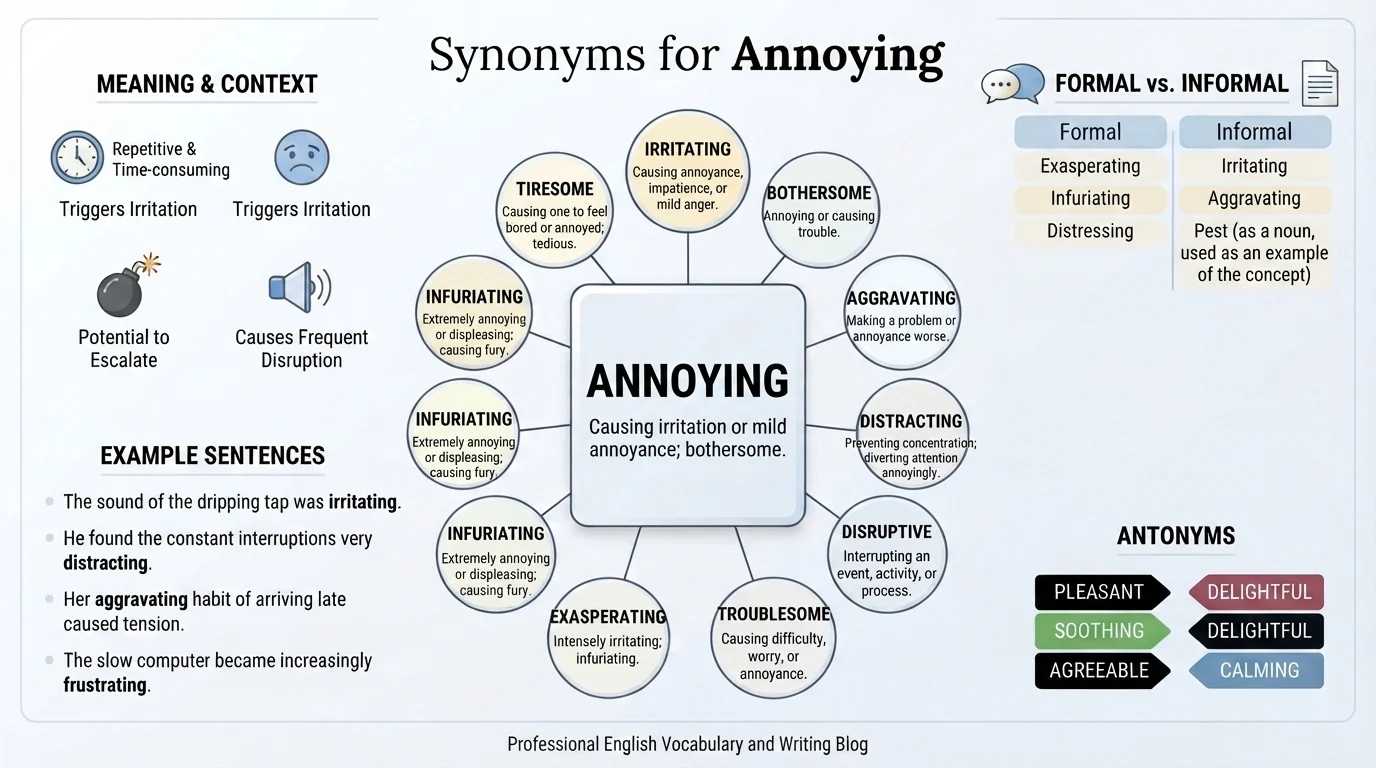
“Annoying” describes something that causes irritation, frustration, inconvenience, or mild anger. Depending on context, useful synonyms include irritating, bothersome, frustrating, aggravating, distracting, troublesome, exasperating, and tiresome.
Meaning, Tone and Context
Simple definition
Annoying means causing someone to feel irritated, bothered, impatient, or mildly angry.
For example, “The noise was annoying” means the noise disturbed or irritated the person.
Part of speech
“Annoying” is an adjective.
Example: “That buzzing sound is annoying.”
It comes from the verb “annoy,” which means to irritate or bother someone.
Positive, negative, or neutral tone
Annoying has a negative tone because it describes something that causes irritation or discomfort.
However, the strength of the negativity depends on the situation. A slightly inconvenient delay can be annoying, while repeated interruptions may be extremely aggravating.
Formality level
Annoying is a common and neutral word. It works well in everyday American English, informal writing, conversations, reviews, and many general situations.
For formal or professional communication, however, more specific words such as inconvenient, disruptive, or problematic can sound more measured.
Common use cases
Annoying commonly describes:
- People
- Sounds
- Habits
- Behaviors
- Problems
- Delays
- Situations
- Technology
- Interruptions
- Repetitive actions
Important word forms
Annoy: a verb meaning to irritate or bother someone.
Annoyed: an adjective describing how someone feels.
Annoying: an adjective describing something that causes irritation.
Annoyance: a noun describing the feeling or source of irritation.
Annoyingly: an adverb describing an irritating manner or situation.
When and How to Use “Annoying”
Use annoying when something causes irritation, inconvenience, impatience, or mild frustration.
The word is especially useful when you want a simple and direct description without making the situation sound extremely serious.
Personal
“My little brother can be annoying sometimes.”
This sounds natural in casual conversation and suggests irritation without necessarily expressing serious anger.
Everyday situation
“The constant notifications are annoying.”
Here, annoying clearly communicates repeated irritation.
Academic
“The repeated interruptions were annoying for the participants.”
Although understandable, distracting or disruptive may sound more precise in academic writing.
Professional
“The frequent software errors are becoming annoying.”
In a workplace context, problematic or disruptive may sound more professional.
Emotional
“It was annoying to wait for two hours.”
The sentence communicates frustration caused by an inconvenient situation.
Social media
“Those pop up ads are so annoying.”
This casual wording fits social media posts and everyday online conversations.
“It was annoying to receive the same notification several times.”
For a formal email, “It was frustrating to receive the same notification several times” may sound more polished.
Another Word for “Annoying”
The best replacement depends on what kind of irritation you mean.
- Professional writing: disruptive
- Academic writing: distracting
- Casual conversation: irritating
- Emotional writing: aggravating
- Creative writing: exasperating
- Resume or workplace use: inconvenient or disruptive
- Social media captions: irritating or frustrating
- Stronger meaning: infuriating
- Softer meaning: bothersome
If you need one versatile alternative, irritating is an excellent choice. For workplace communication, disruptive is often more precise because it explains how the problem affects productivity or communication.
When Not to Use “Annoying”
Annoying can sound too casual when discussing serious professional or academic problems.
For example:
“The technical issue was annoying.”
This sounds conversational and does not explain the actual impact.
A stronger professional version is:
“The technical issue was disruptive and delayed the project.”
Similarly, annoying may be too weak when something causes intense anger. In that case, words such as infuriating or exasperating may be more accurate.
Avoid using annoying when you actually mean inconvenient, distracting, disrespectful, offensive, harmful, or disruptive. Each word communicates a different problem.
Words Commonly Confused With “Annoying”
Irritating
Irritating means causing annoyance or discomfort. It is one of the closest general synonyms for annoying.
“The constant buzzing was irritating.”
Frustrating
Frustrating describes something that prevents progress or makes a desired result difficult.
“The slow internet connection was frustrating.”
Inconvenient
Inconvenient describes something that causes difficulty because it is poorly timed, unsuitable, or troublesome.
“The new meeting time is inconvenient.”
Distracting
Distracting means taking someone’s attention away from what they should be focusing on.
“The loud conversation was distracting.”
Aggravating
Aggravating means highly irritating or frustrating.
“The repeated delays were aggravating.”
Infuriating
Infuriating means causing intense anger.
“The unfair decision was infuriating.”
Best Synonym by Context for “Annoying”
| Context | Best Synonym | Why It Works | Example |
|---|---|---|---|
| Formal writing | Irritating | Clear and reasonably neutral | The repeated interruptions were irritating. |
| Academic writing | Distracting | Describes interference with concentration | Background noise was distracting for students. |
| Professional or business use | Disruptive | Emphasizes negative effects on work | The system outage was disruptive to operations. |
| Resume | Challenging | Can describe difficult circumstances professionally | I resolved challenging customer issues. |
| Casual conversation | Irritating | Sounds natural and direct | That noise is really irritating. |
| Creative writing | Exasperating | Adds emotional intensity | His constant excuses were exasperating. |
| Emotional tone | Aggravating | Communicates strong irritation | The repeated mistakes were aggravating. |
| Strong intensity | Infuriating | Expresses intense anger | The unfair treatment was infuriating. |
| Soft or moderate tone | Bothersome | Communicates mild irritation | The small delay was bothersome. |
| Social media captions | Frustrating | Common and conversational | These loading problems are frustrating. |
| US usage | Annoying | Extremely common in American English | That habit is annoying. |
| UK usage | Irritating | Natural and widely understood | The constant noise was irritating. |
Which Synonym Should You Choose?
First, identify what exactly is causing the negative reaction.
If something simply bothers you, bothersome or irritating may be enough.
When something prevents concentration, choose distracting. If it interferes with work or progress, disruptive may be more accurate.
For situations that create difficulty or prevent progress, frustrating works well. Meanwhile, aggravating communicates stronger irritation.
If the situation creates intense anger, choose infuriating rather than the much milder annoying.
Finally, consider your audience. Casual conversations can handle direct words such as annoying or irritating, while professional communication often benefits from precise and measured vocabulary.
Real Life Examples of “Annoying” in Sentences
School
“The constant talking during the lecture was annoying.”
A more precise academic version is:
“The constant talking was distracting other students.”
Workplace
“The repeated software errors are annoying.”
A professional alternative is:
“The repeated software errors are disrupting our workflow.”
Writing
“The character found his neighbor’s constant complaints annoying.”
A stronger literary alternative is:
“The character found his neighbor’s constant complaints exasperating.”
Conversation
“That buzzing sound is really annoying.”
This is a completely natural use in everyday speech.
Social media
“Getting the same notification ten times is so annoying.”
The informal tone fits a social media post.
Resume
Instead of writing:
“Handled annoying customer complaints.”
A professional resume should say:
“Resolved challenging customer concerns efficiently.”
“The repeated billing messages are annoying.”
A more professional version is:
“The repeated billing messages are becoming disruptive.”
Storytelling
“The endless questions were annoying at first.”
A more descriptive version is:
“After an hour of endless questions, his patience began to disappear.”
25 Synonyms for “Annoying”
The following table highlights ten especially useful alternatives. Each word has a slightly different meaning, so the best choice depends on the situation.
| Synonym | Simple Meaning | Best Used For | Example Sentence |
|---|---|---|---|
| Irritating | Causing annoyance | Everyday irritation | The constant buzzing was irritating. |
| Bothersome | Mildly troublesome or irritating | Small problems | The minor delay was bothersome. |
| Frustrating | Making progress difficult | Problems and obstacles | The slow connection was frustrating. |
| Aggravating | Very irritating | Repeated problems | The recurring errors were aggravating. |
| Distracting | Taking attention away | Noise, interruptions, surroundings | The conversation nearby was distracting. |
| Disruptive | Interrupting normal activity | Work, school, systems | The outage was disruptive to the entire team. |
| Troublesome | Causing difficulty or problems | Situations and tasks | The faulty equipment proved troublesome. |
| Exasperating | Extremely frustrating | Repeated behavior or problems | Her constant interruptions were exasperating. |
| Infuriating | Causing intense anger | Serious unfairness or repeated offenses | The unfair accusation was infuriating. |
| Tiresome | Boring or irritating because of repetition | Repetitive behavior | His tiresome complaints continued all afternoon. |
Synonym Groups and Usage Differences
Professional vs. Personal Synonyms
Personal conversations often use annoying, irritating, frustrating, and bothersome because these words sound natural and direct.
Professional communication usually benefits from more objective terms such as disruptive, inconvenient, problematic, or challenging.
Compare:
“That customer was annoying.”
“The interaction was challenging, but the issue was resolved professionally.”
The second version sounds more appropriate for workplace communication.
Formal vs. Conversational Synonyms
Formal writing tends to favor words that describe the specific effect of a problem.
For example, distracting, disruptive, inconvenient, and problematic can communicate more information than annoying.
Conversational English commonly uses annoying, irritating, frustrating, and aggravating.
Therefore, choose vocabulary according to both meaning and audience.
Academic Synonyms
Academic writing should avoid overly emotional language when a neutral description is possible.
Words such as distracting, disruptive, inconvenient, and problematic often work well because they explain the effect of an issue.
For example:
“The background noise was distracting for participants.”
This is more precise than:
“The background noise was annoying for participants.”
Professional and Business Synonyms
Workplace writing should focus on consequences rather than personal irritation.
Instead of saying:
“The software is annoying.”
Consider:
“The software is causing repeated workflow disruptions.”
Likewise, “inconvenient” can be useful when discussing scheduling, while “problematic” works for situations that create broader concerns.
Creative or Literary Synonyms
Creative writing allows stronger emotional vocabulary.
Words such as exasperating, aggravating, maddening, infuriating, and tiresome can help reveal a character’s emotional state.
For example:
“The endless tapping was maddening.”
This creates a stronger emotional image than simply saying the tapping was annoying.
Slang or Modern Synonyms
Informal expressions such as irritating, frustrating, a pain, or getting on my nerves are common in casual American English.
These expressions can work in conversations, texts, and informal social media.
However, they should generally be avoided in academic essays, formal reports, resumes, and professional complaints.
Strongest vs. Weaker Synonyms
A general intensity scale can help:
Mild: bothersome
Moderate: annoying
Moderately strong: irritating
Strong: aggravating
Very strong: exasperating
Extremely strong: infuriating
This is a practical guide rather than a strict ranking. Context always affects how strong a word sounds.
Emotional vs. Neutral Synonyms
Annoying and irritating can be relatively neutral descriptions of irritation.
Frustrating emphasizes difficulty or blocked progress. Distracting emphasizes loss of focus, while disruptive emphasizes interference with normal activity.
Infuriating and maddening are much more emotional.
Antonyms of “Annoying”
| Antonym | Meaning | Example Sentence |
|---|---|---|
| Pleasant | Enjoyable or agreeable | The conversation was pleasant. |
| Enjoyable | Giving pleasure | We had an enjoyable afternoon. |
| Soothing | Calming or comforting | The music was soothing. |
| Relaxing | Helping someone feel calm | The vacation was relaxing. |
| Convenient | Easy and suitable | The new schedule is convenient. |
| Helpful | Providing useful assistance | Her advice was helpful. |
| Agreeable | Pleasant or acceptable | Everyone found the arrangement agreeable. |
| Entertaining | Providing amusement | The show was entertaining. |
| Engaging | Holding attention positively | The speaker was engaging. |
| Interesting | Attracting attention or curiosity | The documentary was interesting. |
| Fascinating | Extremely interesting | The discovery was fascinating. |
| Calming | Reducing stress or agitation | Her voice was calming. |
| Comfortable | Providing physical or emotional ease | The new chair is comfortable. |
| Cooperative | Willing to work with others | The team was cooperative. |
| Delightful | Highly pleasant or enjoyable | The garden was delightful. |
Comparison: “Annoying” vs. Similar Words
Annoying vs. Irritating
Main difference: Both describe irritation, but irritating can sound slightly stronger or more direct.
Which one is stronger: Irritating can be somewhat stronger, although they often overlap.
Which one is more formal: Both are neutral.
Examples:
“The noise was annoying.”
“The constant buzzing was irritating.”
Annoying vs. Frustrating
Main difference: Frustrating focuses on obstacles, delays, or blocked progress.
Which one is stronger: Neither is automatically stronger.
Which one is more formal: Frustrating often fits professional and academic contexts well.
Examples:
“The noise was annoying.”
“The slow software was frustrating.”
Annoying vs. Inconvenient
Main difference: Inconvenient describes difficulty caused by poor timing or unsuitable circumstances.
Which one is stronger: Annoying is more emotional.
Which one is more formal: Inconvenient is more suitable for professional communication.
Examples:
“The repeated calls were annoying.”
“The meeting time was inconvenient.”
Annoying vs. Distracting
Main difference: Distracting means something takes attention away from a task.
Which one is stronger: Annoying expresses irritation, while distracting describes a specific effect.
Which one is more formal: Distracting works especially well in academic and professional contexts.
Examples:
“The noise was annoying.”
“The noise was distracting during the exam.”
Annoying vs. Aggravating
Main difference: Aggravating generally expresses stronger irritation or frustration.
Which one is stronger: Aggravating is stronger.
Which one is more formal: Both are common, although aggravating can sound more emotionally charged.
Examples:
“The delay was annoying.”
“The repeated delays were aggravating.”
Annoying vs. Infuriating
Main difference: Infuriating describes something that causes intense anger.
Which one is stronger: Infuriating is considerably stronger.
Which one is more formal: Neither is particularly formal because both express emotion.
Examples:
“The delay was annoying.”
“The unfair decision was infuriating.”
Common Phrases and Expressions with “Annoying”
1. Annoying habit
Meaning:
A repeated behavior that causes irritation.
Example sentence:
“Checking his phone during every conversation is an annoying habit.”
2. Annoying noise
Meaning:
A sound that repeatedly bothers or irritates someone.
Example sentence:
“The construction created an annoying noise outside my window.”
3. Annoying person
Meaning:
Someone whose behavior repeatedly causes irritation.
Example sentence:
“I try to stay patient when dealing with an annoying person.”
4. Annoying problem
Meaning:
A relatively minor issue that creates frustration or inconvenience.
Example sentence:
“Finding a parking spot became an annoying problem.”
5. Annoying interruption
Meaning:
An interruption that disturbs concentration or an activity.
Example sentence:
“The constant notifications were an annoying interruption.”
6. Annoying situation
Meaning:
A circumstance that causes irritation or inconvenience.
Example sentence:
“Waiting for hours without an explanation was an annoying situation.”
7. Annoying behavior
Meaning:
Actions that cause irritation or frustration.
Example sentence:
“His repeated interruptions were annoying behavior.”
Common Mistakes to Avoid
1. Using “annoying” when a precise word is better
If the real problem is distraction, disruption, inconvenience, or frustration, use the word that communicates that exact meaning.
2. Confusing “annoying” with “annoyed”
Use annoying for the thing causing irritation.
Use annoyed for the person experiencing irritation.
Correct:
“The delay was annoying.”
“I was annoyed by the delay.”
3. Using a casual synonym in formal writing
Expressions such as “a pain” or “getting on my nerves” may sound too informal in academic and professional contexts.
4. Using an overly dramatic synonym
Calling a minor inconvenience infuriating can make your writing sound exaggerated.
Choose vocabulary that matches the actual level of irritation.
5. Repeating “annoying” too often
Repeated use can make your writing sound basic.
Instead, consider whether irritating, frustrating, distracting, or inconvenient provides a more accurate meaning.
6. Choosing the wrong emotional tone
Frustrating does not simply mean annoying. It often involves an obstacle or inability to achieve a desired result.
Similarly, distracting focuses on attention, while disruptive focuses on interference.
7. Using slang in academic or professional writing
Casual expressions can make personal communication sound natural. However, formal contexts usually require more measured and objective vocabulary.
FAQs
What is the best synonym for “annoying”?
Irritating is one of the closest general synonyms, while frustrating, distracting, disruptive, and aggravating work better for specific situations.
What is a formal synonym for “annoying”?
Disruptive, inconvenient, distracting, problematic, and troublesome can serve as formal alternatives when they accurately describe the issue.
What is an informal synonym for “annoying”?
Irritating, frustrating, bothersome, aggravating, and expressions such as “a pain” work naturally in casual American English.
What is another word for “annoying” in professional writing?
Disruptive is often effective for workplace problems because it explains how an issue interferes with normal operations, communication, or productivity.
What is the difference between “annoying” and “frustrating”?
Annoying describes irritation, while frustrating usually describes a situation that makes progress difficult or prevents someone from achieving a desired result.
What is the opposite of “annoying”?
Common antonyms include pleasant, enjoyable, soothing, relaxing, convenient, helpful, agreeable, entertaining, engaging, and delightful.
Conclusion
“Annoying” is a common and useful adjective for describing irritation, but a more precise synonym can make your writing clearer and more effective.
Choose irritating for general annoyance, frustrating for obstacles, distracting for concentration problems, disruptive for workplace interference, and aggravating for stronger irritation.
When the emotion becomes intense, words such as exasperating or infuriating may be more appropriate. Meanwhile, professional and academic writing usually benefits from objective alternatives that describe the specific effect of the problem.
The best vocabulary choice is not always the strongest word. Instead, choose the synonym that accurately matches your meaning, audience, tone, and situation.
Before publishing a vocabulary guide, verify definitions and usage with trusted dictionaries such as Cambridge, Oxford, Merriam Webster, Collins, or Britannica. This helps ensure that every synonym fits its intended context accurately.
A simple vocabulary tip can make a big difference: when you write “annoying,” ask yourself what exactly is causing the irritation. Is it distracting, inconvenient, disruptive, frustrating, or simply bothersome? Once you identify that detail, choosing the right word becomes much easier.
Discover More:-
- 50+ Synonyms for Problems: Meanings, Examples, and Best Alternatives
- 50+ Synonyms for Exciting: Meanings, Examples, and Best Alternatives

1 thought on “50+ Synonyms for Annoying: Meanings, Examples, and Best Alternatives”