Do you find yourself using the word “exciting” again and again in essays, emails, captions, conversations, or workplace writing? Although it is a useful word, repeating it too often can make your vocabulary sound predictable.
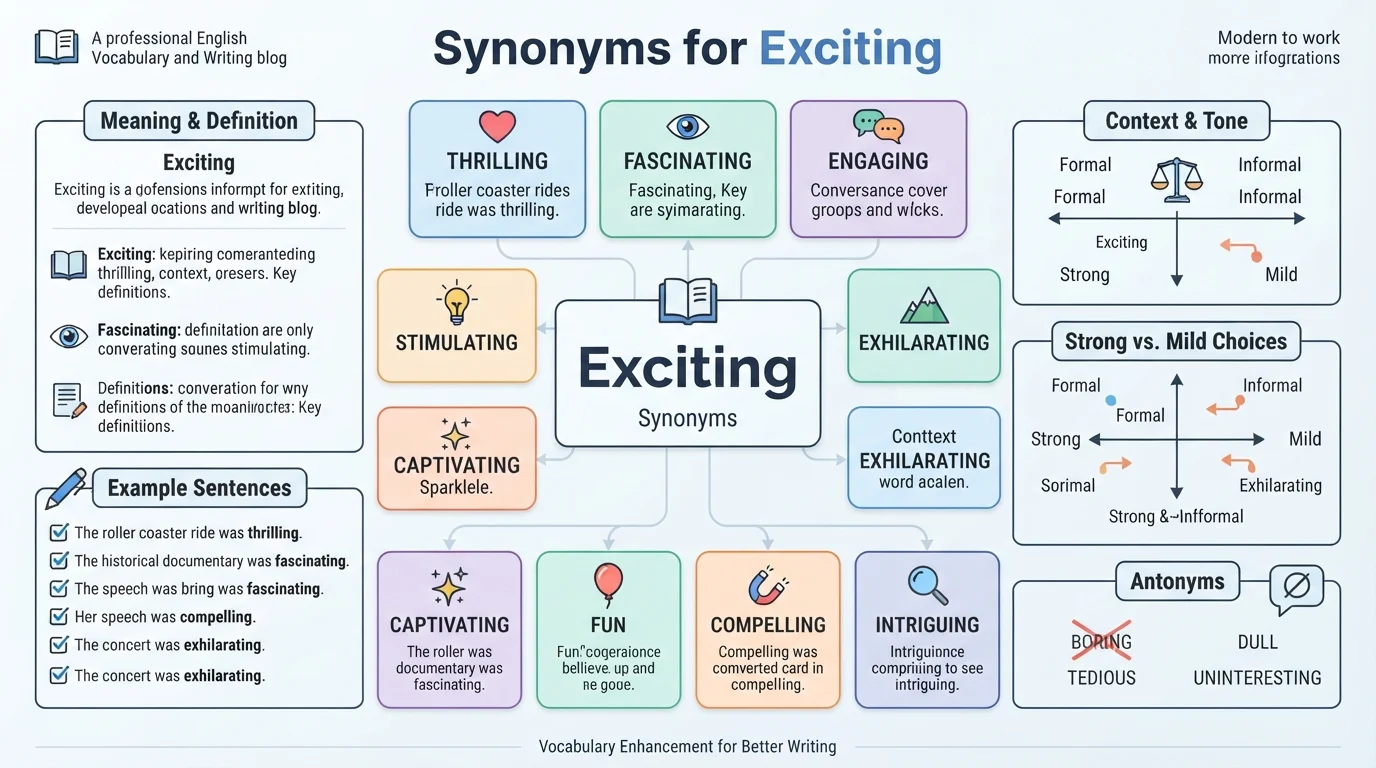
Fortunately, English offers many precise alternatives. For example, a thrilling race creates suspense, while a fascinating discovery sparks curiosity. Likewise, an engaging presentation holds attention, whereas an exhilarating adventure creates intense energy.
This guide explains synonyms for exciting by meaning, tone, intensity, and context. As a result, you can choose better words for academic writing, professional communication, creative work, social media, and everyday conversation.
Quick Answer: What Does “Exciting” Mean?
“Exciting” describes something that creates enthusiasm, interest, anticipation, or strong emotion. Depending on context, useful synonyms include thrilling, engaging, fascinating, exhilarating, captivating, stimulating, inspiring, lively, and entertaining.
Meaning, Tone and Context
Simple definition
Exciting means causing someone to feel enthusiastic, interested, eager, happy, or emotionally stimulated.
For instance, “The concert was exciting” tells readers that the experience created strong positive energy or anticipation.
Part of speech
“Exciting” is an adjective.
Example: “We watched an exciting game.”
The word comes from the verb “excite,” which means to cause someone to feel enthusiasm, interest, or emotional stimulation.
Positive, negative, or neutral tone
Exciting usually has a positive tone. However, the surrounding context can change the feeling.
For example, an exciting opportunity sounds positive. On the other hand, an exciting situation might involve uncertainty, danger, or tension.
Formality level
Exciting is a common, neutral English word. Therefore, it works naturally in everyday speech, school assignments, emails, captions, marketing content, and many professional situations.
Still, a more precise synonym can make formal writing clearer and more sophisticated.
Common use cases
Exciting commonly describes:
- Events
- Experiences
- Opportunities
- News
- Ideas
- Activities
- Stories
- Travel
- Entertainment
- Achievements
Important word forms
Excite: a verb meaning to create enthusiasm or interest.
Excited: an adjective describing how someone feels.
Exciting: an adjective describing something that causes excitement.
Excitement: a noun describing the feeling or state of being excited.
Unexciting: an adjective describing something that does not create much interest or enthusiasm.
When and How to Use “Exciting”
Use exciting when something creates enthusiasm, anticipation, interest, or emotional energy. Because the word is broad, it is especially useful when you do not need to explain the exact type of excitement.
Professional
“We are excited to announce the launch of our new service.”
This sentence sounds positive, friendly, and appropriate for many business announcements.
Personal
“I am excited about our weekend trip.”
Here, excited describes the speaker’s personal anticipation.
Academic
“The experiment produced exciting results.”
Although this sentence is understandable, promising, significant, or noteworthy may provide greater precision in academic writing.
Emotional
“Getting the acceptance letter was an exciting moment.”
In this context, exciting communicates happiness, anticipation, and emotional significance.
Creative
“The novel takes readers on an exciting journey through an unfamiliar world.”
A stronger alternative, such as thrilling or captivating, could create a more vivid literary effect.
Social media
“Exciting news is coming soon!”
The short sentence creates anticipation and works naturally as a social media caption.
“We are excited to welcome you to the team.”
This expression is common in friendly workplace communication and onboarding messages.
Another Word for “Exciting”
There is no single best replacement for exciting because each synonym adds a slightly different meaning.
- Professional writing: engaging
- Academic writing: stimulating
- Casual conversation: fun
- Emotional writing: exhilarating
- Creative writing: captivating
- Resume or workplace use: engaging
- Social media captions: amazing
- Stronger meaning: thrilling
- Softer meaning: interesting
If you need one versatile alternative, engaging works well when something successfully holds attention. However, thrilling is better when you mean intense excitement or suspense.
When Not to Use “Exciting”
Exciting can become too vague when you need to explain why something matters.
Consider this sentence:
“The presentation was exciting.”
The reader still does not know whether the presentation was informative, entertaining, interactive, persuasive, or emotionally powerful.
A more precise version would be:
“The presentation was engaging because it used clear examples and interactive demonstrations.”
Similarly, academic and professional writing often benefits from specific language. Instead of calling research exciting, you might describe the findings as promising, significant, compelling, or noteworthy.
Avoid using exciting when your actual meaning is impressive, important, interesting, inspiring, or successful.
Words Commonly Confused With “Exciting”
Excited
Excited describes the person who experiences the emotion.
“I am excited about the trip.”
Exciting
Exciting describes something that causes the emotion.
“The trip will be exciting.”
Interesting
Interesting means attracting attention or curiosity. It does not necessarily suggest strong emotion.
“The lecture was interesting.”
Thrilling
Thrilling suggests intense excitement, usually involving suspense, adventure, competition, or risk.
“The final minutes of the game were thrilling.”
Fascinating
Fascinating describes something extremely interesting or absorbing. It focuses more on curiosity than adrenaline.
“The documentary was fascinating.”
Exhilarating
Exhilarating describes an intensely exciting experience that produces energy and enthusiasm.
“Skydiving was exhilarating.”
Best Synonym by Context for “Exciting”
| Context | Best Synonym | Why It Works | Example |
|---|---|---|---|
| Formal writing | Compelling | It suggests strong interest or persuasive appeal. | The report presents a compelling argument. |
| Academic writing | Stimulating | It emphasizes intellectual interest. | The seminar provided a stimulating discussion. |
| Professional or business use | Engaging | It sounds polished, positive, and approachable. | The workshop was engaging and practical. |
| Resume | Impactful | It emphasizes meaningful results or influence. | I developed impactful training materials. |
| Casual conversation | Fun | It sounds natural and relaxed. | We had a fun weekend. |
| Creative writing | Captivating | It suggests that something strongly holds attention. | The story opened with a captivating scene. |
| Emotional tone | Exhilarating | It communicates intense positive emotion. | Crossing the finish line was exhilarating. |
| Strong intensity | Thrilling | It conveys suspense and powerful excitement. | The final match was thrilling. |
| Soft or moderate tone | Interesting | It communicates curiosity without exaggeration. | She shared an interesting idea. |
| Social media captions | Amazing | It is short, familiar, and energetic. | Amazing news is coming soon. |
| US usage | Exciting | It is natural and widely used in American English. | We have exciting plans for Saturday. |
| UK usage | Exciting | It is also standard and widely understood in British English. | It was an exciting opportunity. |
Which Synonym Should You Choose?
First, identify the exact feeling or reaction you want to describe.
If something creates suspense or adrenaline, choose thrilling or exhilarating. For strong curiosity, fascinating may be more accurate.
If something holds attention, consider engaging or captivating. Meanwhile, intellectual subjects often work better with stimulating or compelling.
For professional writing, measured vocabulary usually sounds more credible. Therefore, engaging, promising, compelling, and noteworthy can be better choices than highly dramatic words.
In casual speech, simpler alternatives such as fun, amazing, awesome, or thrilling may sound more natural.
Real Life Examples of “Exciting” in Sentences
School
“The students were excited about the science competition.”
A more precise alternative would be:
“The students were enthusiastic about the science competition.”
Workplace
“We have an exciting opportunity to expand the project.”
A more measured business version is:
“We have a promising opportunity to expand the project.”
Writing
“The author creates an exciting atmosphere from the first chapter.”
For literary analysis, engaging, compelling, or suspenseful may provide more useful information.
Conversation
“That sounds exciting!”
This is a natural response when someone shares positive news or describes an upcoming experience.
Social media
“Exciting things are happening this month!”
For a more energetic caption, you could write:
“Amazing things are happening this month!”
Resume
“I helped create exciting customer experiences.”
A more professional alternative is:
“I helped create engaging customer experiences.”
“We are excited to share the updated schedule.”
The wording sounds positive, professional, and approachable.
Storytelling
“The race became more exciting with every lap.”
A stronger alternative would be:
“The race became more thrilling with every lap.”
25 Synonyms for “Exciting”
The table below focuses on accurate alternatives with different shades of meaning. The first ten are especially useful across everyday, academic, professional, and creative situations.
| Synonym | Simple Meaning | Best Used For | Example Sentence |
|---|---|---|---|
| Thrilling | Extremely exciting | Sports, adventures, suspense | The final race was thrilling from beginning to end. |
| Exhilarating | Intensely exciting and energizing | Adventures, achievements, physical experiences | The mountain climb was exhilarating. |
| Engaging | Holding attention and interest | Work, education, presentations | Her presentation was engaging and easy to follow. |
| Fascinating | Extremely interesting | Ideas, discoveries, subjects | The museum offered a fascinating look at local history. |
| Captivating | Holding attention strongly | Stories, performances, creative work | The singer gave a captivating performance. |
| Stimulating | Encouraging thought or mental interest | Academic and intellectual settings | The discussion was intellectually stimulating. |
| Compelling | Very convincing or difficult to ignore | Arguments, stories, evidence | The article presents a compelling explanation. |
| Inspiring | Creating motivation or positive emotion | People, achievements, ideas | Her achievement was inspiring. |
| Lively | Full of energy and activity | Conversations, events, environments | The restaurant had a lively atmosphere. |
| Entertaining | Providing enjoyment or amusement | Shows, books, conversations | The speaker gave an entertaining presentation. |
Synonym Groups and Usage Differences
Professional vs. Personal Synonyms
Professional writing often benefits from measured alternatives such as engaging, compelling, promising, and stimulating.
Personal communication can use more emotional words, including thrilling, exhilarating, amazing, and fantastic.
Compare these examples:
“The training session was exciting.”
“The training session was engaging and practical.”
The second sentence communicates a clearer professional quality.
Formal vs. Conversational Synonyms
Formal writing often favors compelling, stimulating, engaging, and noteworthy.
Conversational English commonly uses exciting, fun, amazing, thrilling, and awesome.
For example, a research paper might describe evidence as compelling. In contrast, a friend might say, “That sounds awesome!”
Academic Synonyms
Academic writing should favor precision instead of emotional exaggeration.
Useful choices include stimulating, compelling, fascinating, engaging, and noteworthy.
Rather than writing:
“The experiment was really exciting.”
You could write:
“The experiment produced promising results.”
The second version communicates a specific academic value.
Professional and Business Synonyms
For emails, presentations, workplace communication, and business content, engaging and promising are often reliable choices.
For example:
“We are excited about the new project.”
A more specific version could be:
“We are optimistic about the new project’s potential.”
This wording communicates enthusiasm while maintaining a professional tone.
Creative or Literary Synonyms
Creative writing can use captivating, thrilling, exhilarating, enthralling, spellbinding, and electrifying when the context supports strong emotion.
These alternatives can add atmosphere and intensity. However, dramatic vocabulary should match the scene.
Calling a quiet afternoon “electrifying” may sound exaggerated unless the writer intentionally wants a dramatic effect.
Slang or Modern Synonyms
Words such as awesome, epic, wild, and wild can express excitement in informal American English.
They work well in casual conversation, texts, and some social media posts. Nevertheless, they may sound inappropriate in academic papers, resumes, formal reports, or serious business communication.
Strongest vs. Weaker Synonyms
A general intensity scale looks like this:
Mild: interesting
Moderate: engaging
Strong: fascinating
Very strong: thrilling
Intense: exhilarating
This scale is only a practical guide. Context can change the perceived strength of any word.
Emotional vs. Neutral Synonyms
Words such as exciting, interesting, and engaging can remain relatively neutral.
By comparison, exhilarating, thrilling, inspiring, and captivating add stronger emotional meaning.
Choose neutral vocabulary when accuracy matters more than dramatic effect.
Antonyms of “Exciting”
| Antonym | Meaning | Example Sentence |
|---|---|---|
| Boring | Not interesting | The lecture was boring. |
| Dull | Lacking interest or energy | The presentation felt dull. |
| Tedious | Repetitive and tiring | The task became tedious after several hours. |
| Uninteresting | Not attracting attention | The topic seemed uninteresting to the audience. |
| Monotonous | Lacking variety | The routine was monotonous. |
| Ordinary | Not unusual or remarkable | It was an ordinary afternoon. |
| Routine | Regular and predictable | The meeting was routine. |
| Mundane | Ordinary and lacking excitement | He wanted a break from his mundane schedule. |
| Lifeless | Lacking energy | The discussion felt lifeless. |
| Predictable | Easy to anticipate | The ending was predictable. |
| Calm | Peaceful and without strong activity | The evening was calm and quiet. |
| Relaxing | Providing rest rather than stimulation | The vacation was relaxing. |
| Unstimulating | Failing to create mental interest | The material was unstimulating. |
| Uneventful | Without notable events or excitement | The flight was completely uneventful. |
| Sleepy | Quiet, inactive, or lacking energy | The town felt sleepy after sunset. |
Comparison: “Exciting” vs. Similar Words
Exciting vs. Interesting
Main difference: Exciting suggests emotional energy or anticipation, while interesting mainly means something attracts attention.
Which one is stronger: Exciting is usually stronger emotionally.
Which one is more formal: Both are neutral everyday words.
Examples:
“The concert was exciting.”
“The lecture was interesting.”
Exciting vs. Thrilling
Main difference: Thrilling suggests more intense emotion, often involving suspense, competition, adventure, or risk.
Which one is stronger: Thrilling is generally stronger.
Which one is more formal: Both are neutral and widely used.
Examples:
“The trip was exciting.”
“The roller coaster was thrilling.”
Exciting vs. Fascinating
Main difference: Fascinating emphasizes curiosity and deep interest rather than adrenaline.
Which one is stronger: Fascinating can be stronger intellectually, while exciting often carries more emotional energy.
Which one is more formal: Fascinating can fit polished and academic prose well.
Examples:
“The discovery was exciting.”
“The discovery was fascinating.”
Exciting vs. Engaging
Main difference: Engaging means successfully holding someone’s attention.
Which one is stronger: Exciting usually carries greater emotional energy.
Which one is more formal: Engaging is often more suitable for professional writing.
Examples:
“The event was exciting.”
“The presentation was engaging.”
Exciting vs. Exhilarating
Main difference: Exhilarating describes intense excitement combined with energy or exhilaration.
Which one is stronger: Exhilarating is stronger.
Which one is more formal: Exhilarating can sound more sophisticated and descriptive.
Examples:
“The competition was exciting.”
“The final climb was exhilarating.”
Exciting vs. Inspiring
Main difference: Inspiring means creating motivation, admiration, hope, or a desire to act.
Which one is stronger: Neither is automatically stronger because they describe different emotional effects.
Which one is more formal: Inspiring works well in both professional and personal writing.
Examples:
“The announcement was exciting.”
“Her achievement was inspiring.”
Common Phrases and Expressions with “Exciting”
1. Exciting news
Meaning:
News that creates happiness, anticipation, or enthusiasm.
Example sentence:
“We have some exciting news to share with the team.”
2. Exciting opportunity
Meaning:
An opportunity that appears attractive, promising, or rewarding.
Example sentence:
“This position offers an exciting opportunity to develop new skills.”
3. Exciting experience
Meaning:
An experience that creates strong interest or positive emotion.
Example sentence:
“Traveling through the national park was an exciting experience.”
4. Exciting adventure
Meaning:
An adventurous experience involving novelty, energy, or uncertainty.
Example sentence:
“They planned an exciting adventure along the coast.”
5. Exciting journey
Meaning:
A journey that is emotionally engaging or full of memorable experiences.
Example sentence:
“Her journey from student to entrepreneur was exciting to follow.”
6. Exciting new development
Meaning:
A new change or event that appears promising or important.
Example sentence:
“The company announced an exciting new development.”
7. Exciting possibilities
Meaning:
Potential future outcomes that create enthusiasm.
Example sentence:
“The new technology creates exciting possibilities.”
Common Mistakes to Avoid
1. Using “exciting” when a precise word is better
Instead of calling every interesting idea exciting, choose fascinating, compelling, stimulating, or engaging when those words better express the intended meaning.
2. Confusing “exciting” with “excited”
Use exciting for something that creates the emotion.
Use excited for the person experiencing it.
Correct:
“I am excited.”
“The event is exciting.”
3. Using a casual synonym in formal writing
Words such as awesome, epic, and wild can sound too informal in academic and professional contexts.
Choose measured alternatives when the audience expects formal language.
4. Using an overly dramatic synonym
Calling a routine team meeting exhilarating can sound unnatural.
Instead, select a word that matches the actual level of excitement.
5. Repeating “exciting” too often
Frequent repetition can make writing feel limited.
Rather than replacing every occurrence, identify the exact meaning and select a more precise alternative where appropriate.
6. Choosing the wrong emotional tone
Fascinating, thrilling, inspiring, and exhilarating express different reactions.
Therefore, consider whether you want to communicate curiosity, suspense, motivation, or intense energy.
7. Using slang in academic or professional writing
Informal expressions can work in conversations and social media. However, they may weaken an essay, report, resume, presentation, or formal email.
FAQs
What is the best synonym for “exciting”?
Thrilling is a strong choice for intense experiences, while engaging is better for professional settings and fascinating works well for ideas or discoveries.
What is a formal synonym for “exciting”?
Compelling, stimulating, engaging, and exhilarating can work in formal writing, depending on the intended meaning and emotional intensity.
What is an informal synonym for “exciting”?
Fun, awesome, amazing, thrilling, and wild can express excitement naturally in casual American English, texts, conversations, and social posts.
What is another word for “exciting” in professional writing?
Engaging is a strong professional alternative. Promising, compelling, and stimulating can also work when they accurately describe the situation.
What is the difference between “exciting” and “interesting”?
Exciting emphasizes enthusiasm or emotional energy, while interesting mainly means something attracts attention, curiosity, or mental interest.
What is the opposite of “exciting”?
Common opposites include boring, dull, tedious, monotonous, mundane, uneventful, predictable, and uninteresting, depending on the intended meaning.
Conclusion
“Exciting” is a useful everyday adjective, but the best synonym depends on the exact meaning, tone, and situation.
Choose thrilling or exhilarating for intense experiences, fascinating for curiosity, engaging for professional communication, stimulating for academic contexts, and captivating for creative writing.
Most importantly, do not replace a word simply to sound sophisticated. Select the synonym that communicates the exact feeling, intensity, and context you want your reader to understand.
Before publishing vocabulary content, verify definitions and usage with trusted dictionaries such as Cambridge, Oxford, Merriam Webster, Collins, or Britannica. This extra step helps confirm that each synonym accurately fits its intended meaning.
The practical takeaway is simple: when “exciting” feels too general, ask what makes the experience exciting. Then choose the word that describes that specific quality.

1 thought on “50+ Synonyms for Exciting: Meanings, Examples, and Best Alternatives”