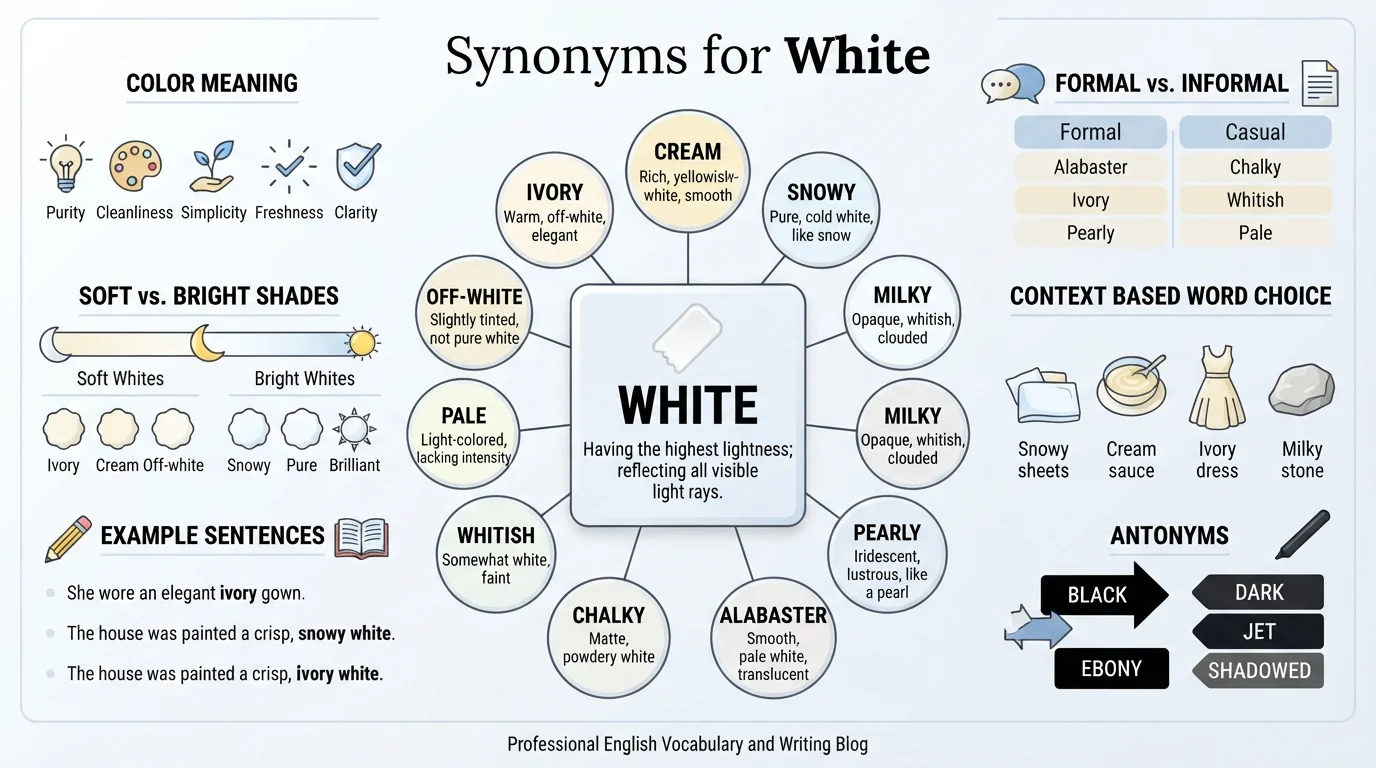
The word “white” looks simple, but choosing the right alternative can make your writing much more precise. A white dress, a snowy landscape, white paint, and white hair can all have very different shades and meanings.
For example, ivory may suggest a warm, creamy shade, while snowy can create a bright and clean visual image. Similarly, pale can describe a light color without necessarily meaning pure white.
This guide explains synonyms for white by shade, tone, context, and usage. Whether you are writing an essay, product description, story, caption, email, or professional document, you will learn how to choose the most accurate word.
Quick Answer: What Does “White” Mean?
“White” describes a color with very little or no visible hue and high brightness. Depending on context, useful alternatives include ivory, cream, snowy, pale, milky, pearly, chalky, bleached, colorless, and alabaster.
Meaning, Tone and Context
Simple definition
White is a color associated with brightness and the absence of a strong visible hue. It can describe objects, surfaces, clothing, hair, animals, weather, and visual effects.
For example, “She wore a white dress” simply identifies the color of the dress.
Part of speech
White is commonly used as an adjective and noun.
As an adjective:
“The walls are white.”
As a noun:
“White is a popular color for interior design.”
White can also function as part of certain expressions and compound terms.
Positive, negative, or neutral tone
White is generally neutral when it describes color.
However, its emotional or symbolic meaning changes according to context. It can suggest cleanliness, simplicity, purity, freshness, elegance, brightness, or emptiness.
Formality level
White is a standard, neutral English word. It works in everyday conversation, academic writing, professional communication, product descriptions, creative writing, and social media.
More descriptive alternatives can create a specific visual effect when simple color identification is not enough.
Common use cases
White commonly describes:
- Clothing
- Paint
- Walls
- Flowers
- Animals
- Hair
- Snow
- Food
- Clouds
- Design
- Furniture
- Photography
Important word forms
White: the basic color term.
Whiten: a verb meaning to make something white or whiter.
Whiteness: a noun describing the quality or appearance of being white.
Whitish: an adjective meaning somewhat or approximately white.
Whitening: a form describing the process of making something whiter.
When and How to Use “White”
Use white when you want to identify a color clearly and without unnecessary description.
The word is especially useful when the exact shade is not important.
Personal
“She bought a white jacket for the winter.”
The sentence simply identifies the jacket’s color.
Professional
“The office uses white walls to create a clean appearance.”
Here, white describes a design choice.
Academic
“The researchers placed the samples in white containers.”
The straightforward color term is appropriate because precision matters.
Creative
“White clouds drifted across the pale blue sky.”
In creative writing, white can create a clear visual image.
Social media
“Keeping it classic in white.”
This short phrase works naturally for a fashion caption.
Product description
“The chair features a white finish with a smooth surface.”
The wording is clear and useful for shoppers.
“Please use the white version of the logo for the presentation.”
White works naturally in workplace communication when identifying a design element.
Another Word for “White”
The best single replacement depends on the shade and the effect you want.
- Professional writing: neutral or clean
- Academic writing: white or pale
- Casual conversation: light
- Emotional writing: pure
- Creative writing: snowy or pearly
- Product descriptions: ivory or cream
- Social media captions: crisp or bright
- Stronger visual effect: dazzling
- Softer shade: off white or whitish
If you need one descriptive alternative for a warm white shade, ivory is an excellent choice. For a bright, snowy appearance, snowy creates a stronger visual impression.
When Not to Use “White”
White can sound too general when the exact shade matters.
For example:
“She chose a white dress.”
This sentence gives the reader only basic color information.
A more descriptive version might be:
“She chose an ivory dress with warm undertones.”
Similarly, “white walls” may be less informative than “cream walls” or “pearl white walls” when describing interior design.
However, do not force a synonym when plain white is the most accurate choice. Precision is more important than variety.
Words Commonly Confused With “White”
Ivory
Ivory describes a warm, creamy white that is usually softer and less stark than pure white.
“The bride wore an ivory gown.”
Cream
Cream refers to a pale yellowish or warm white shade.
“The kitchen has cream cabinets.”
Off white
Off white describes a color that is close to white but not completely pure white.
“The room has off white walls.”
Pale
Pale means light or lacking strong color. It does not necessarily mean white.
“She chose a pale pink dress.”
Silver
Silver is a light gray color associated with a metallic appearance. It is not simply another word for white.
“He wore a silver tie.”
Transparent
Transparent means allowing light to pass through. It describes visibility or material properties rather than a white color.
“The glass is transparent.”
Best Synonym by Context for “White”
| Context | Best Synonym | Why It Works | Example |
|---|---|---|---|
| Formal writing | Ivory | Gives a precise warm white description | The room featured ivory furnishings. |
| Academic writing | Pale | Works when describing a light visual quality | The sample developed a pale appearance. |
| Professional or business use | Neutral | Communicates a restrained design quality | The website uses a neutral background. |
| Resume | Clean | Can describe a simple visual presentation | I created a clean visual layout. |
| Casual conversation | Light | Sounds natural when describing a light shade | I prefer light colors in summer. |
| Creative writing | Snowy | Creates a vivid bright image | Snowy peaks filled the horizon. |
| Emotional tone | Pure | Can suggest innocence or symbolic cleanliness | The poem describes a pure white flower. |
| Strong intensity | Dazzling | Suggests extremely bright white | The sunlight made the snow look dazzling. |
| Soft or moderate tone | Cream | Suggests a warm and gentle shade | She chose cream curtains. |
| Social media captions | Crisp | Suggests freshness and brightness | A crisp white shirt never goes out of style. |
| US usage | White | Standard and widely understood | He painted the door white. |
| UK usage | White | Equally standard in British English | The walls were painted white. |
Which Synonym Should You Choose?
First, determine whether you are describing an exact color or creating an impression.
If you mean a warm white, consider ivory, cream, or off white. If you mean a bright, cold white, snowy or brilliant may be more suitable.
For a soft appearance, milky, pearly, or pale can work well. Meanwhile, dazzling emphasizes brightness rather than simply identifying the color.
In professional and academic writing, use the simplest accurate word. Creative writing allows more descriptive choices, especially when the color contributes to mood or imagery.
Real Life Examples of “White” in Sentences
School
“The student used a white sheet of paper for the project.”
A more descriptive version could mention the paper’s bright or clean appearance if that detail matters.
Workplace
“The new office has white walls and wooden desks.”
For a design report, “neutral walls” might communicate the intended visual effect more effectively.
Writing
“The character entered the room wearing a white coat.”
If the author wants stronger imagery, “ivory coat” or “snowy white coat” may create a different impression.
Conversation
“Do you have this shirt in white?”
This is the most natural choice when discussing clothing colors.
Social media
“White outfits are perfect for a clean summer look.”
A caption might use “crisp white” to create a fresher visual tone.
Resume
“I designed a clean, white interface for the company’s website.”
In this context, clean describes the overall design rather than merely the color.
“Please send the final document with a white background.”
The direct color term is clear and professional.
Storytelling
“Snow covered the trees until the entire forest looked white.”
A literary version could use “snowy” to make the visual description more vivid.
25 Synonyms for “White”
The following words can relate to white in specific contexts, but they do not all mean exactly the same thing. Always choose the word that matches the intended shade or visual quality.
| Synonym | Simple Meaning | Best Used For | Example Sentence |
|---|---|---|---|
| Ivory | Warm creamy white | Clothing, interiors, design | The curtains were a soft ivory shade. |
| Cream | Warm pale white | Paint, clothing, food, interiors | She selected cream fabric for the sofa. |
| Snowy | Bright like fresh snow | Nature, creative descriptions | The snowy peaks glowed at sunrise. |
| Milky | Soft and opaque white | Liquids, glass, visual descriptions | The lake had a milky appearance in the mist. |
| Pearly | White with a subtle luminous quality | Jewelry, surfaces, creative writing | The shell had a pearly sheen. |
| Alabaster | Very light, often warm white | Art, skin, architecture, literary descriptions | The statue had an alabaster appearance. |
| Chalky | Dull or powdery white | Paint, surfaces, textures | The old wall had a chalky finish. |
| Bleached | Made pale or white through treatment or exposure | Hair, fabric, natural materials | The fabric looked bleached by the sun. |
| Whitish | Somewhat white | Scientific and descriptive writing | A whitish layer covered the surface. |
| Colorless | Without noticeable color | Scientific or visual contexts | The liquid appeared almost colorless. |
Synonym Groups and Usage Differences
Professional vs. Personal Synonyms
Professional writing usually benefits from precise and restrained color descriptions.
Words such as white, neutral, ivory, cream, and clean can work well in business, design, and workplace contexts.
Personal writing allows more expressive descriptions. For example, snowy, pearly, dazzling, and pure can create a stronger visual or emotional impression.
Formal vs. Conversational Synonyms
White itself is suitable for both formal and conversational English.
In everyday speech, people often use simple phrases such as light, cream, or off white.
Formal descriptions may use more precise terms such as ivory, alabaster, or colorless when those words accurately identify the appearance.
Academic Synonyms
Academic writing should prioritize accuracy.
Words such as pale, whitish, colorless, and opaque white can be useful when describing observations.
For example:
“The solution became whitish after mixing.”
This is more precise than simply saying:
“The solution became white.”
Professional and Business Synonyms
Product descriptions, branding, interior design, fashion, and presentations often require more specific color vocabulary.
Ivory, cream, pearl, off white, and neutral can help communicate design characteristics.
For example:
“The collection uses warm ivory tones.”
This gives a designer or customer more information than simply saying “white.”
Creative or Literary Synonyms
Creative writing can use snowy, pearly, milky, alabaster, dazzling, and pure to create imagery.
These words should support the scene rather than overwhelm it.
For example:
“Pearly light spread across the horizon.”
This creates a softer image than:
“White light spread across the horizon.”
Slang or Modern Synonyms
There are relatively few true slang synonyms for white because the basic color term is already simple and widely understood.
In casual fashion and design conversations, expressions such as bright white, crisp white, and stark white are common.
These expressions describe visual qualities rather than functioning as exact synonyms.
Strongest vs. Weaker Synonyms
A practical visual intensity scale can look like this:
Soft: milky
Moderate: ivory
Clear: white
Bright: snowy
Very bright: brilliant
Extremely bright: dazzling
These terms describe different qualities, so intensity should be interpreted according to context.
Emotional vs. Neutral Synonyms
White is usually neutral when it simply identifies color.
Pure can add symbolic or emotional associations. Snowy can add freshness or natural imagery, while pearly can suggest elegance and delicacy.
Choose neutral vocabulary when factual accuracy is the priority.
Antonyms of “White”
Color does not have one universal opposite, so the best antonyms depend on whether you mean color, brightness, or symbolic meaning.
| Antonym | Meaning | Example Sentence |
|---|---|---|
| Black | The darkest common color | She wore a black dress. |
| Dark | Having little light or low brightness | The room had dark walls. |
| Gray | A color between black and white | The clouds looked gray. |
| Colored | Having a noticeable hue | The poster uses colored lettering. |
| Brightly colored | Having vivid color | The children chose brightly colored paints. |
| Multicolored | Having several colors | The blanket was multicolored. |
| Red | A distinct warm color | He selected a red notebook. |
| Blue | A distinct cool color | The door was painted blue. |
| Green | A color commonly associated with vegetation | The walls were green. |
| Yellow | A bright warm color | She wore a yellow scarf. |
| Brown | A darker earthy color | The table has a brown finish. |
| Purple | A color combining red and blue | The flowers were purple. |
| Orange | A vivid warm color | The sign was orange. |
| Darkened | Made less bright | The room was darkened for the presentation. |
| Stained | Marked by a visible color or discoloration | The once white fabric became stained. |
Comparison: “White” vs. Similar Words
White vs. Ivory
Main difference: White is a broad color term, while ivory describes a warmer creamy shade.
Which one is stronger: Neither is stronger. Ivory is more specific.
Which one is more formal: Both can work in formal writing.
Examples:
“She wore a white dress.”
“She wore an ivory dress.”
White vs. Cream
Main difference: Cream usually has warm yellow or beige undertones.
Which one is stronger: Neither is stronger. They describe different shades.
Which one is more formal: Both are standard color terms.
Examples:
“The walls are white.”
“The walls are cream.”
White vs. Off White
Main difference: Off white refers to a color close to white but not completely pure.
Which one is stronger: White usually appears cleaner and brighter.
Which one is more formal: Both work in professional and design contexts.
Examples:
“The shirt is white.”
“The shirt is off white.”
White vs. Pale
Main difference: Pale means light or lacking strong color, while white identifies a specific color.
Which one is stronger: White is more specific.
Which one is more formal: Both are neutral.
Examples:
“She chose a white dress.”
“She chose a pale pink dress.”
White vs. Snowy
Main difference: Snowy describes an appearance similar to snow and often adds a bright visual quality.
Which one is stronger: Snowy creates a more vivid image.
Which one is more formal: White is more neutral, while snowy is more descriptive.
Examples:
“The mountains were white.”
“The mountains were snowy.”
White vs. Pearly
Main difference: Pearly describes a white or light surface with a soft, luminous quality.
Which one is stronger: Pearly is more descriptive.
Which one is more formal: Both can appear in polished writing, but pearly is more literary.
Examples:
“She chose white earrings.”
“She chose pearly earrings.”
Common Phrases and Expressions with “White”
1. White as snow
Meaning:
Extremely white or visually similar to fresh snow.
Example sentence:
“The mountain peaks were white as snow.”
2. White space
Meaning:
An empty area in a design or layout that improves readability and visual balance.
Example sentence:
“The designer added more white space around the headings.”
3. White collar
Meaning:
Relating to professional, administrative, or office based work.
Example sentence:
“The city has a large white collar workforce.”
4. White lie
Meaning:
A small or minor lie that someone tells to avoid hurting another person’s feelings or causing a problem.
Example sentence:
“She told a white lie to keep the surprise secret.”
5. White paper
Meaning:
A detailed document that explains a topic, problem, technology, or proposed solution.
Example sentence:
“The company published a white paper about renewable energy.”
6. White label
Meaning:
A product or service made by one company and sold by another under its own branding.
Example sentence:
“The agency offers a white label service to smaller businesses.”
7. White noise
Meaning:
A consistent sound containing a broad range of frequencies, often used to mask other sounds.
Example sentence:
“She uses white noise while studying.”
Common Mistakes to Avoid
1. Treating every light color as white
Pale pink, cream, beige, ivory, and light gray are not identical to white.
Choose the actual color when precision matters.
2. Assuming ivory means pure white
Ivory normally suggests a warmer shade with creamy or yellowish undertones.
Use white when you mean a straightforward white color.
3. Using “pale” as an exact synonym
Pale describes lightness rather than one specific color.
For example, pale blue is not white.
4. Confusing white with colorless
Colorless means lacking visible color. A white object still has a visible color.
Therefore, glass can be colorless while milk can be white.
5. Using dramatic descriptions in factual writing
Words such as dazzling and snowy may be inappropriate when a simple factual description is needed.
Academic and technical writing should prioritize accuracy.
6. Repeating “white” when a shade matters
Repeated use can make a description feel flat.
If the subject has a warm, creamy, or luminous appearance, choose a precise term such as ivory, cream, or pearly.
7. Using a synonym that changes the meaning
Not every descriptive word is a true replacement.
For example, silver is not simply another word for white because silver usually implies a gray or metallic quality.
FAQs
What is the best synonym for “white”?
The best synonym depends on the shade. Ivory works for warm white, snowy for bright white, cream for soft warm white, and pearly for luminous white.
What is a formal synonym for “white”?
Ivory, alabaster, pale, and colorless can work in formal contexts when they accurately describe the intended appearance.
What is an informal synonym for “white”?
Light is a common casual alternative when discussing a light color, although it is broader than white and does not always mean the same thing.
What is another word for “white” in professional writing?
Ivory, cream, neutral, off white, and clean can work in professional contexts, especially for design, branding, fashion, and product descriptions.
What is the difference between “white” and “ivory”?
White is a general color term, while ivory usually describes a warmer white with subtle creamy or yellowish undertones.
What is the opposite of “white”?
Black is the most common color contrast for white. However, the appropriate opposite can vary when discussing brightness, color, or symbolic meaning.
Conclusion
White is a simple and versatile color word, but choosing a more precise alternative can make descriptions clearer and more vivid.
Use ivory or cream for warm white shades, snowy for bright natural imagery, pearly for a soft luminous effect, and pale when describing a light color rather than pure white.
Most importantly, do not replace white simply for the sake of variety. The strongest vocabulary choice is the one that accurately communicates the color, shade, texture, or visual impression you intend.
Before publishing vocabulary content, verify definitions and usage with trusted dictionaries such as Cambridge, Oxford, Merriam Webster, Collins, or Britannica. This helps ensure that each alternative fits its intended meaning and context.
The practical takeaway is simple: when white feels too general, identify what makes the color distinctive. Then choose the word that communicates that specific quality.

2 thoughts on “50+ Synonyms for White: Meanings, Examples, and Best Alternatives”