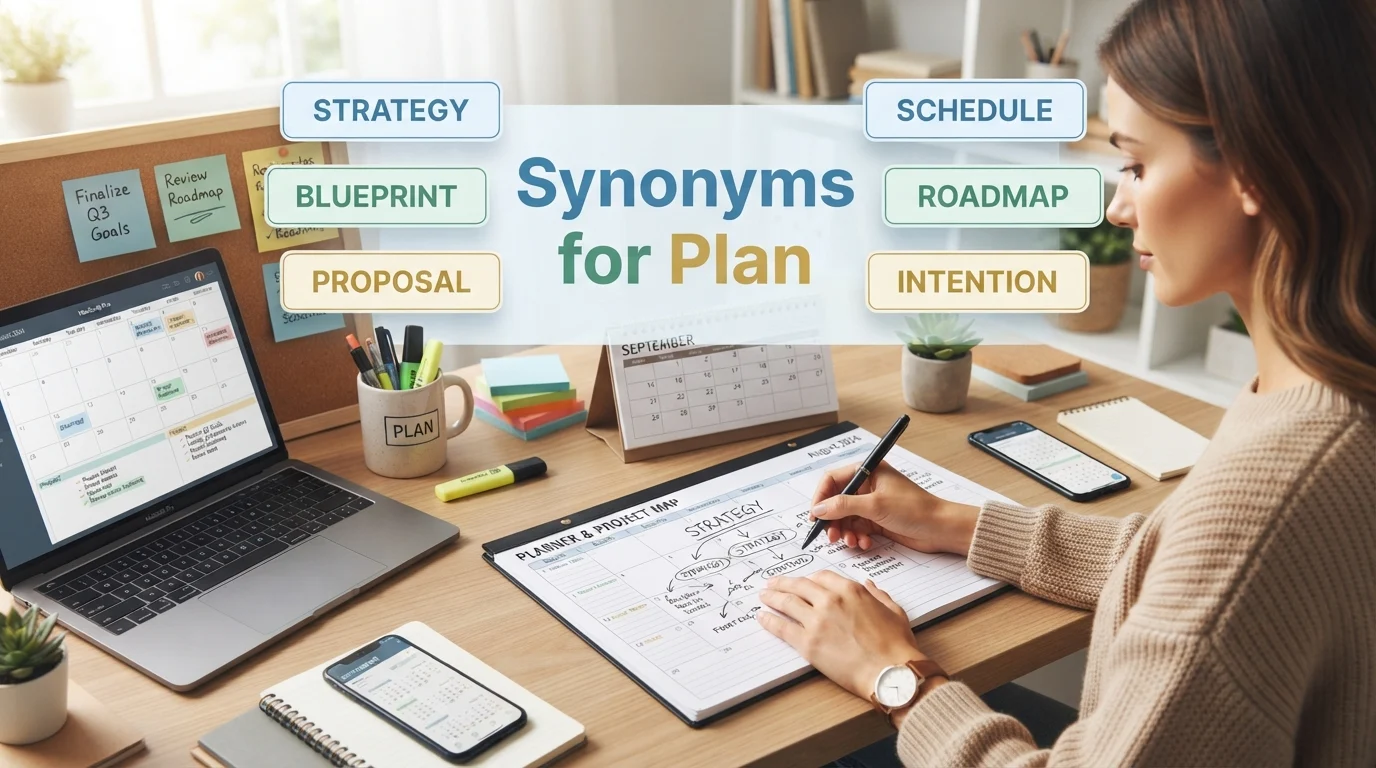
Do you keep using the word “plan” in essays, business reports, project proposals, creative writing, or everyday conversation? While it is one of the most useful and fundamental words in English, repeating it can make your writing feel flat, repetitive, or overly generic.
The good news is that the best alternative depends on what you actually mean. You might be referring to a strategy, a schedule, a blueprint, an intention, a proposal, or a method for achieving a goal.
This guide explains synonyms for “plan” by meaning, tone, context, and usage. You will learn which alternatives work best in academic writing, professional communication, project management, creative expression, and casual conversation.
Quick Answer: What Does “Plan” Mean?
“Plan” refers to a detailed proposal, strategy, or method for achieving something. It can also mean an intention, a diagram, a schedule, or a course of action. Depending on context, alternatives include strategy, scheme, blueprint, proposal, design, program, schedule, intention, objective, and roadmap.
Meaning, Tone, and Context
Simple Definition
“Plan” generally refers to:
- Strategy: a method for achieving a goal
- Proposal: a suggested course of action
- Blueprint: a detailed design or outline
- Schedule: a timeline for tasks or events
- Intention: something you intend to do
- Diagram: a drawing or layout
Part of Speech
“Plan” functions primarily as a noun and a verb.
Noun Examples:
- “We need a plan to increase sales.”
- “The wedding plan is coming together.”
Verb Examples:
- “We plan to launch next month.”
- “She is planning a trip to Europe.”
Related Forms:
- Planned (adjective/verb): arranged in advance
- Planner (noun): a person who plans; a calendar
- Planning (noun): the act of making plans
- Unplanned (adjective): not planned
Positive, Negative, or Neutral Tone
“Plan” is generally neutral. It can be used in positive, negative, or factual contexts.
Positive associations:
- “The plan worked perfectly.”
- “She has a solid plan for the future.”
Negative contexts:
- “The plan failed.”
- “His plan was poorly thought out.”
Formality Level
“Plan” is a standard word that works in both formal and informal English. It is appropriate in academic papers, business reports, creative writing, and casual conversation.
However, more specific alternatives can add precision and variety depending on the context.
Common Use Cases
“Plan” commonly refers to:
- Business: business plan, strategic plan, marketing plan
- Project management: project plan, action plan, implementation plan
- Personal life: life plan, retirement plan, fitness plan
- Events: wedding plan, travel plan, event plan
- Architecture: floor plan, site plan
- Government: economic plan, budget plan
Important Word Forms
- Plan (noun): a detailed proposal or strategy
- Plan (verb): to decide on and arrange in advance
- Planned (adjective): arranged in advance
- Planner (noun): a person who plans; a calendar
- Planning (noun): the act of making plans
- Unplanned (adjective): not planned
When and How to Use “Plan”
Use “plan” when you want to describe a strategy, proposal, intention, or method for achieving something. Because the word is broad, more specific alternatives can add precision depending on the context.
Professional
“We need a clear plan for the next quarter.”
This works naturally in business communication.
Academic
“The study outlines a plan for future research.”
The term is appropriate in academic contexts.
Personal
“Do you have any plans for the weekend?”
The word sounds natural in everyday conversation.
Project Management
“The project plan includes milestones and deadlines.”
This is standard in project management.
Creative
“The villain’s evil plan was finally revealed.”
The word creates dramatic tension in creative writing.
Architecture
“The architect presented the floor plan.”
This is appropriate in architectural contexts.
Another Word for “Plan”
There is no single perfect synonym because “plan” can refer to a strategy, proposal, blueprint, schedule, intention, or diagram.
- Strategy context: strategy, scheme, approach, method, tactics
- Proposal context: proposal, suggestion, recommendation, proposition
- Blueprint context: blueprint, design, outline, framework, layout
- Schedule context: schedule, timetable, agenda, itinerary, timeline
- Intention context: intention, aim, goal, objective, intent
- Diagram context: diagram, sketch, drawing, chart, map
If you need one broad alternative, “strategy” works for achieving goals, “proposal” works for suggestions, and “blueprint” works for detailed designs.
When Not to Use “Plan”
“Plan” can become too vague when you need to specify exactly what kind of plan you are describing.
Consider:
“We have a plan.”
This statement does not tell readers whether the plan is a strategy, a schedule, a proposal, or a blueprint.
A more precise sentence could be:
“We have a detailed action plan with clear milestones and deadlines.”
Similarly, avoid using “plan” when you mean “idea” in a casual context. Use “idea”, “thought”, or “concept” instead.
Words Commonly Confused With “Plan”
Plan vs. Strategy
Strategy emphasizes the overall approach to achieving a goal. Plan can be more specific.
Example:
“Our strategy is to focus on customer retention.” (overall approach)
“Our plan is to launch a loyalty program.” (specific)
Plan vs. Proposal
Proposal emphasizes a suggestion or offer. Plan can be more developed.
Example:
“She submitted a proposal for the new project.” (suggestion)
“She developed a detailed plan for the project.” (developed)
Plan vs. Scheme
Scheme can imply a clever or devious plan. Plan is neutral.
Example:
“The villain hatched a scheme.” (devious)
“We developed a plan.” (neutral)
Plan vs. Schedule
Schedule emphasizes timing. Plan can include timing but is broader.
Example:
“The schedule shows all the deadlines.” (timing)
“The plan outlines the entire project.” (broader)
Plan vs. Intention
Intention emphasizes what you mean to do. Plan can be more developed.
Example:
“My intention is to travel.” (what you mean to do)
“My plan is to travel in June.” (developed)
Plan vs. Blueprint
Blueprint emphasizes a detailed design. Plan can be more general.
Example:
“The blueprint shows the building’s layout.” (detailed design)
“The plan outlines the building’s design.” (general)
Best Synonym by Context for “Plan”
| Context | Best Synonym | Why It Works | Example |
|---|---|---|---|
| Formal writing | Strategy, proposal | Precise and professional | The strategy focuses on long-term growth. |
| Academic writing | Framework, methodology | Standard academic usage | The study outlines a framework for analysis. |
| Business/Professional | Strategy, roadmap, initiative | Professional and clear | The roadmap outlines key milestones. |
| Project management | Blueprint, timeline, schedule | Project-specific | The blueprint details all deliverables. |
| Personal life | Intention, goal, aim | Personal and reflective | My intention is to live abroad. |
| Events | Arrangement, itinerary | Event-specific | The itinerary includes all activities. |
| Architecture | Blueprint, layout, design | Architectural | The blueprint shows the floor plan. |
| Casual conversation | Idea, plan, intention | Natural and informal | What’s the plan for tonight? |
| Government/policy | Policy, program, initiative | Formal and official | The program aims to reduce poverty. |
| Creative writing | Scheme, plot, design | Literary and dramatic | The plot was full of twists. |
| Strategy context | Tactic, approach, method | Strategic and formal | The approach was innovative. |
| Schedule context | Agenda, timetable, calendar | Time-specific | The agenda lists all the meetings. |
Which Synonym Should You Choose?
Start by identifying what kind of “plan” you are describing.
- Strategy: strategy, scheme, approach, method, tactics
- Proposal: proposal, suggestion, recommendation, proposition
- Blueprint: blueprint, design, outline, framework, layout
- Schedule: schedule, timetable, agenda, itinerary, timeline
- Intention: intention, aim, goal, objective, intent
- Diagram: diagram, sketch, drawing, chart, map
10 Key Synonyms for “Plan”
The table below includes accurate alternatives with clear meanings and usage contexts.
| Synonym | Simple Meaning | Best Used For | Example Sentence |
|---|---|---|---|
| Strategy | An overall approach to achieve a goal | Business, military, general | Our strategy focuses on long-term growth. |
| Scheme | A clever or devious plan | Creative, negative contexts | The villain hatched a scheme. |
| Blueprint | A detailed design or outline | Architecture, projects | The blueprint shows the building’s layout. |
| Proposal | A suggested course of action | Business, academic | She submitted a proposal for the new project. |
| Design | A plan or drawing | Architecture, creative | The design includes all the details. |
| Program | An organized set of activities | Government, education | The program aims to reduce poverty. |
| Schedule | A plan for timing | Events, projects | The schedule shows all the deadlines. |
| Intention | Something you mean to do | Personal, formal | My intention is to travel abroad. |
| Objective | A goal or aim | Business, academic | The objective is to increase sales. |
| Roadmap | A strategic plan with milestones | Business, project management | The roadmap outlines key milestones. |
Synonym Groups and Usage Differences
Professional vs. Personal Synonyms
Professional writing benefits from specific terms such as strategy, roadmap, initiative, proposal, and framework.
Personal communication often uses plan itself or casual alternatives like idea, intention, or goal.
Compare:
“What’s the plan for tonight?” (personal)
“The strategic roadmap outlines our objectives.” (professional)
Formal vs. Conversational Synonyms
Plan works in both formal and conversational English.
Formal alternatives: strategy, proposal, framework, blueprint, initiative
Conversational alternatives: idea, intention, goal
Examples:
“The proposal outlines a framework for change.” (formal)
“What’s the plan?” (conversational)
Academic Synonyms
Academic writing should distinguish between plan (general), framework (structure), methodology (research approach), and hypothesis (testable statement).
For example:
“The study outlines a framework for analysis.”
“The methodology describes the research approach.”
Professional and Business Synonyms
Business writing often benefits from phrases such as strategy, roadmap, initiative, proposal, and action plan.
Instead of:
“We need a plan.”
Consider:
“We need a strategic roadmap with clear milestones and deliverables.”
Creative or Literary Synonyms
Creative writing can use scheme, plot, design, contrivance, and machination depending on the context.
For example:
“The villain’s scheme was finally revealed.”
“The plot thickened with each chapter.”
Slang or Modern Synonyms
Game plan is a common casual term for strategy.
The plan is casual.
Idea is casual for intention.
Scheme is casual but can be negative.
Examples:
“What’s the game plan?” (casual)
“I have an idea for the weekend.” (casual)
Strongest vs. Weaker Synonyms
“Plan” synonyms vary in intensity:
Milder: idea, intention, aim
Moderate: plan, strategy, approach
Strong: blueprint, roadmap, framework
Very Strong: master plan, grand design, scheme
Emotional vs. Neutral Synonyms
“Plan” is generally neutral.
Emotional alternatives: dream, vision, aspiration (positive)
Neutral alternatives: strategy, schedule, proposal, blueprint
Examples:
“She has a vision for the future.” (emotional, positive)
“The schedule outlines the timeline.” (neutral)
Antonyms of “Plan”
“Plan” has several antonyms depending on context:
| Antonym | Context | Meaning | Example Sentence |
|---|---|---|---|
| Improvisation | General | Doing something without preparation | The performance was pure improvisation. |
| Spontaneity | General | Acting on impulse | She values spontaneity over planning. |
| Chance | General | Random occurrence | They met by chance. |
| Accident | General | Unplanned event | The discovery was an accident. |
| Impulse | General | Sudden urge | He bought it on impulse. |
| Chaos | General | Lack of order | The event descended into chaos. |
| Disorganization | General | Lack of planning | The office was in disorganization. |
Comparison: “Plan” vs. Similar Words
Plan vs. Strategy
Main difference: Strategy emphasizes the overall approach to achieving a goal. Plan can be more specific.
Examples:
“Our strategy is to focus on customer retention.” (overall approach)
“Our plan is to launch a loyalty program.” (specific)
Plan vs. Proposal
Main difference: Proposal emphasizes a suggestion or offer. Plan can be more developed.
Examples:
“She submitted a proposal for the new project.” (suggestion)
“She developed a detailed plan for the project.” (developed)
Plan vs. Scheme
Main difference: Scheme can imply a clever or devious plan. Plan is neutral.
Examples:
“The villain hatched a scheme.” (devious)
“We developed a plan.” (neutral)
Plan vs. Schedule
Main difference: Schedule emphasizes timing. Plan can include timing but is broader.
Examples:
“The schedule shows all the deadlines.” (timing)
“The plan outlines the entire project.” (broader)
Plan vs. Intention
Main difference: Intention emphasizes what you mean to do. Plan can be more developed.
Examples:
“My intention is to travel.” (what you mean to do)
“My plan is to travel in June.” (developed)
Plan vs. Blueprint
Main difference: Blueprint emphasizes a detailed design. Plan can be more general.
Examples:
“The blueprint shows the building’s layout.” (detailed design)
“The plan outlines the building’s design.” (general)
Common Phrases and Expressions with “Plan”
1. Business plan
Meaning:
A document outlining a business’s goals and strategies.
Example:
“She wrote a detailed business plan.”
2. Action plan
Meaning:
A detailed plan of steps to achieve a goal.
Example:
“We need an action plan for the next quarter.”
3. Strategic plan
Meaning:
A long-term plan for achieving major goals.
Example:
“The company developed a five-year strategic plan.”
4. Game plan
Meaning:
A strategy for achieving a goal (informal).
Example:
“What’s the game plan for tonight?”
5. Floor plan
Meaning:
A diagram of a room or building.
Example:
“The floor plan shows three bedrooms.”
6. Master plan
Meaning:
A comprehensive plan for a large project.
Example:
“The master plan includes all phases of development.”
7. Backup plan
Meaning:
An alternative plan in case the original fails.
Example:
“We need a backup plan.”
8. Plan of action
Meaning:
A detailed plan of steps to take.
Example:
“The committee outlined a plan of action.”
9. Change of plan
Meaning:
A change in what was originally planned.
Example:
“There’s been a change of plan.”
10. Go according to plan
Meaning:
To happen as planned.
Example:
“Everything went according to plan.”
Common Mistakes to Avoid
1. Using “plan” when a more precise term is available
If you mean strategy, proposal, blueprint, or schedule, use the more specific word.
Vague: “We have a plan.”
Precise: “We have a detailed action plan with clear milestones.”
2. Confusing “plan” with “strategy”
Strategy emphasizes the overall approach. Plan can be more specific.
Incorrect: “Our plan is to focus on customer retention.” (if overall approach)
Correct: “Our strategy is to focus on customer retention.”
3. Using “plan” in academic writing when “framework” is needed
Academic writing benefits from precise terms like framework, methodology, and model.
Vague: “The study has a plan.”
Precise: “The study outlines a framework for analysis.”
4. Overusing “plan” in writing
Repetition can make content feel dull. Use alternatives such as strategy, roadmap, blueprint, proposal, and schedule.
5. Choosing a synonym that changes the meaning
Do not replace plan with scheme unless you mean a devious plan.
Do not replace plan with intention unless you mean what you mean to do.
FAQs
What is the best synonym for “plan”?
The best synonym depends on context. Strategy works for overall approach, proposal for suggestions, blueprint for detailed designs, schedule for timing, and intention for personal goals.
What is a formal synonym for “plan”?
Strategy, proposal, framework, blueprint, and initiative are formal synonyms.
What is an informal synonym for “plan”?
Game plan, idea, intention, and scheme are common informal alternatives.
What is another word for “plan” in business writing?
Strategy, roadmap, initiative, proposal, and action plan work well in business writing.
What is the difference between “plan” and “strategy”?
Strategy emphasizes the overall approach to achieving a goal. Plan can be more specific.
What is the opposite of “plan”?
Depending on context, opposites include improvisation, spontaneity, chance, accident, and impulse.
What does “plan” mean in project management?
In project management, a plan is a document that outlines the scope, timeline, resources, and deliverables of a project.
Conclusion
“Plan” is a versatile and essential word that can describe a strategy, proposal, blueprint, schedule, intention, or diagram. The best synonym depends on what you actually mean.
Choose strategy for overall approach, proposal for suggestions, blueprint for detailed designs, schedule for timing, intention for personal goals, and roadmap for strategic plans with milestones.
Most importantly, do not replace “plan” simply to avoid repetition. First identify what kind of plan—strategic, detailed, personal, or scheduled—you are actually describing. Then choose the alternative that communicates that idea most clearly.
For academic, professional, and formal writing, precision is usually more valuable than vocabulary variety. A specific term such as strategy, framework, roadmap, or proposal can tell readers much more than the broad word plan.
Before publishing a vocabulary guide, verify definitions and usage with trusted dictionaries such as Cambridge, Oxford, Merriam-Webster, Collins, or Britannica. This helps ensure that each alternative accurately matches its intended meaning and context.
The practical takeaway is simple: when “plan” feels too general, ask yourself what kind of strategy, design, or intention you are actually describing. Then use the most precise word available.

1 thought on “Synonyms for Plan: 50+ Words to Use Instead”