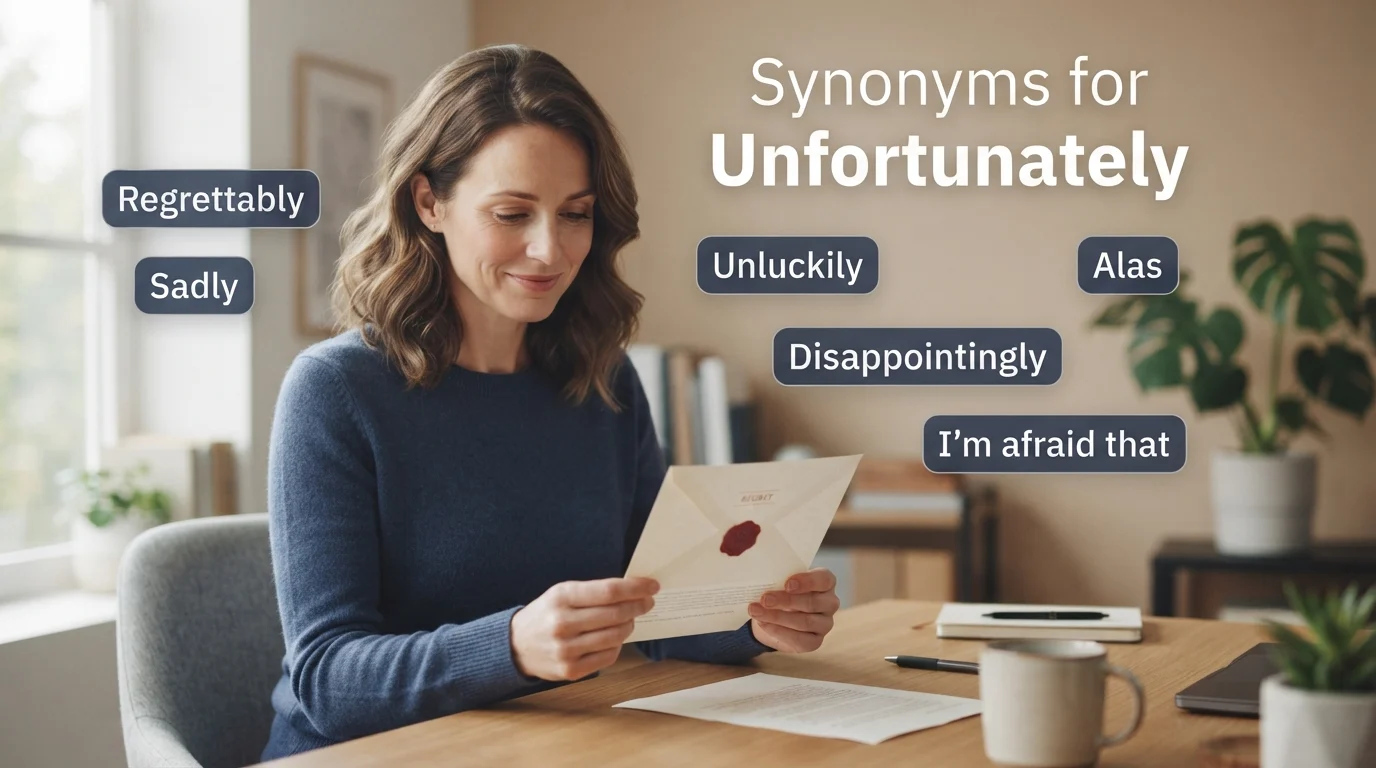
Do you keep using the word “unfortunately” in emails, reports, essays, creative writing, or everyday conversation? While it is a useful and common adverb for expressing disappointment or regret, repeating it can make your writing feel predictable, overly formal, or even insincere.
The good news is that the best alternative depends on what you actually mean. You might be expressing regret, delivering bad news, acknowledging a setback, or pointing out an unlucky turn of events.
This guide explains synonyms for “unfortunately” by meaning, tone, context, and usage. You will learn which alternatives work best in professional communication, academic writing, creative expression, casual conversation, and customer service.
Quick Answer: What Does “Unfortunately” Mean?
“Unfortunately” is an adverb used to express regret, disappointment, or bad luck about a situation. It indicates that something has happened in a way that is unlucky, unsatisfactory, or contrary to what was hoped for or expected. Depending on context, alternatives include regrettably, sadly, unluckily, alas, disappointingly, unhappily, unfavorably, and with regret.
Meaning, Tone, and Context
Simple Definition
“Unfortunately” generally refers to:
- Expressing regret: conveying sorrow or disappointment about a situation
- Delivering bad news: introducing information that is negative or unwelcome
- Acknowledging bad luck: recognizing that something has turned out poorly
- Contrasting with expectations: indicating that reality differs from what was hoped
Part of Speech
“Unfortunately” is an adverb (specifically, a sentence adverb or discourse marker).
Example:
“Unfortunately, the event has been canceled.”
Related Forms:
- Unfortunate (adjective): having bad luck; regrettable
- Unfortunate (noun): a person who experiences bad luck (less common)
- Fortunate (adjective): having good luck (antonym)
- Fortunately (adverb): expressing good luck (antonym)
Positive, Negative, or Neutral Tone
“Unfortunately” is negative in tone. It expresses regret, disappointment, or bad news.
It is often used as a “softener” to make bad news less abrupt or harsh.
Examples:
“Unfortunately, your application was not successful.” (negative news, softened)
“Unfortunately, the weather is going to be terrible tomorrow.” (negative prediction)
Formality Level
“Unfortunately” is a standard word that works in both formal and informal English. However, it is very common in formal and professional writing because it softens bad news.
In casual conversation, alternatives like “sadly” or “oh well” (as an interjection) may sound more natural.
Common Use Cases
“Unfortunately” commonly appears in:
- Bad news delivery: rejection letters, cancellation notices, negative outcomes
- Expressing sympathy: acknowledging someone’s misfortune
- Contrasting expectations: highlighting when things didn’t go as planned
- Customer service: politely delivering negative information
- Professional communication: softening criticism or negative feedback
- Storytelling/narration: introducing a negative turn of events
Important Word Forms
- Unfortunately (adverb): expressing regret or bad luck
- Unfortunate (adjective): having bad luck; regrettable
- Fortune (noun): luck, fate
- Fortunate (adjective): having good luck
- Favorably (adverb): in a positive or advantageous way
- Fortunately (adverb): expressing good luck
When and How to Use “Unfortunately”
Use “unfortunately” when you want to introduce negative information or express regret in a way that softens the blow. Because the word is so common, it’s often used in formal and professional contexts to maintain politeness while delivering bad news.
Professional (Bad News)
“Unfortunately, we will not be able to proceed with your application.”
This is polite and professional in rejection letters or hiring decisions.
Professional (Policy/Logistics)
“Unfortunately, we are unable to offer refunds on sale items.”
This softens a store or business policy.
Academic
“Unfortunately, the data was incomplete, so the results are inconclusive.”
This is appropriate in research or academic writing.
Personal
“Unfortunately, I won’t be able to make it to your party.”
This sounds natural and polite in personal communication.
Customer Service
“Unfortunately, your order has been delayed due to a supply chain issue.”
This softens a negative customer service update.
Creative Writing
“Unfortunately, the knight arrived too late to save the kingdom.”
The term can introduce a negative turn in a story.
News/Press
“Unfortunately, the hurricane is expected to worsen overnight.”
The term can deliver bad news in journalism.
Another Word for “Unfortunately”
There is no single perfect synonym because “unfortunately” has many nuances. The best alternative depends on context, tone, and the degree of regret or formality you want to express.
- Expressing regret: regrettably, sadly, with regret, I regret to say
- Expressing disappointment: disappointingly, to my disappointment
- Expressing bad luck: unluckily, lucklessly, by bad luck
- Formal/archaic: alas, sadly, more’s the pity
- Professional: regrettably, sadly, it is with regret that
- Casual: sadly, oh well, that’s too bad
- Emphasizing contrast: unfortunately, however, alas
If you need one broad alternative, “regrettably” is the closest formal synonym, while “sadly” is the most natural casual alternative.
When Not to Use “Unfortunately”
“Unfortunately” can become too overused, robotic, or insincere if used too frequently.
Consider a customer service email with three “unfortunately”s:
“Unfortunately, your package was delayed. Unfortunately, the item is out of stock. Unfortunately, we can’t offer a discount.”
This sounds repetitive and insincere. Better alternatives:
“Your package was delayed, and we regret to inform you that the item is out of stock. We are unable to offer a discount at this time.”
Similarly, avoid using “unfortunately” for mild inconveniences or when “but” or “however” would be more precise.
Words Commonly Confused With “Unfortunately”
Unfortunately vs. Regrettably
Regrettably is slightly more formal and often implies that the speaker feels personal regret. Unfortunately can be more neutral.
Example:
“Regrettably, I have to decline your invitation.” (personal regret)
“Unfortunately, the store is closed on Sundays.” (neutral fact)
Unfortunately vs. Sadly
Sadly is more emotional and personal. Unfortunately is more formal or neutral.
Example:
“Sadly, she passed away last year.” (emotional)
“Unfortunately, the meeting has been rescheduled.” (neutral/professional)
Unfortunately vs. Unluckily
Unluckily emphasizes bad luck and is more casual. Unfortunately can be more formal.
Example:
“Unluckily, I lost my wallet.” (casual, bad luck)
“Unfortunately, your application was unsuccessful.” (formal)
Unfortunately vs. Alas
Alas is archaic or literary, used in storytelling or dramatic contexts. Unfortunately is standard modern English.
Example:
“Alas, the prince was too late.” (literary/archaic)
“Unfortunately, the package was lost.” (modern/standard)
Unfortunately vs. However
However signals a contrast without expressing regret. Unfortunately implies regret or disappointment.
Example:
“The weather was beautiful; however, it was too hot.” (contrast, neutral)
“The weather was beautiful; unfortunately, it was too hot.” (contrast + regret)
Unfortunately vs. Disappointingly
Disappointingly specifically emphasizes disappointment. Unfortunately is broader.
Example:
“Disappointingly, the team lost in the finals.” (emphasizes disappointment)
“Unfortunately, the venue has been double-booked.” (neutral bad news)
Best Synonym by Context for “Unfortunately”
| Context | Best Synonym | Why It Works | Example |
|---|---|---|---|
| Formal writing/emails | Regrettably | Professional and personal | Regrettably, we cannot approve your request. |
| Professional/corporate | We regret to inform you | Very formal, polite | We regret to inform you that your application was unsuccessful. |
| Academic writing | Regrettably, alas (rare) | Formal and precise | Regrettably, the data was insufficient. |
| Customer service | We apologize, but | Polite and empathetic | We apologize, but the item is out of stock. |
| Casual conversation | Sadly, oh well | Natural and relaxed | Sadly, I can’t make it. |
| Creative writing | Alas, sadly, regretfully | Literary or dramatic | Alas, the hero had fallen. |
| Expressing bad luck | Unluckily, by bad luck | Emphasizes chance | Unluckily, I missed the last train. |
| Expressing disappointment | Disappointingly, to my disappointment | Emphasizes let-down | Disappointingly, the show was canceled. |
| Softening criticism | I’m afraid that, it appears | Polite and diplomatic | I’m afraid that we cannot accept this. |
| Very formal/legal | It is with regret that | Extremely formal | It is with regret that I tender my resignation. |
| Emphasizing contrast | However, despite this | Neutral contrast | The plan was sound; however, it failed. |
| News/Journalism | Sadly, regrettably | Professional yet emotional | Sadly, the victims have been identified. |
Which Synonym Should You Choose?
Start by identifying what kind of “unfortunately” you are expressing:
- Formal/professional bad news: regrettably, we regret to inform you, it is with regret that
- Casual bad news: sadly, oh well, too bad
- Bad luck: unluckily, by bad luck, as luck would have it (ironic)
- Disappointment: disappointingly, to my disappointment, much to my disappointment
- Dramatic/literary: alas, regretfully, sadly
- Polite softening: I’m afraid that, it appears, we are sorry to say
- Neutral contrast: however, nevertheless, but
- Empathetic: we’re sorry to say, it pains me to say
10 Key Synonyms for “Unfortunately”
The table below includes accurate alternatives with clear meanings and usage contexts.
| Synonym | Simple Meaning | Best Used For | Example Sentence |
|---|---|---|---|
| Regrettably | In a way that causes regret | Formal, professional | Regrettably, we must decline your offer. |
| Sadly | In a sad manner; regrettably | Emotional, casual, formal | Sadly, he passed away before the project finished. |
| Unluckily | Due to bad luck | Casual, emphasizing chance | Unluckily, I arrived just as the bus departed. |
| Alas | Expressing sorrow or regret | Literary, dramatic, old-fashioned | Alas, all good things must come to an end. |
| Disappointingly | In a disappointing manner | Emphasizing let-down | Disappointingly, the product didn’t meet expectations. |
| Unhappily | In an unhappy manner | Formal, emotional | Unhappily, their marriage ended in divorce. |
| Regretfully | With regret | Formal, personal | Regretfully, I have decided to resign. |
| Unfavourably | In an unfavorable way | Formal, legal, reviews | The committee viewed the proposal unfavorably. |
| I’m afraid that | I regret to say | Polite, professional | I’m afraid that your application was unsuccessful. |
| Much to my regret | I strongly regret | Formal, personal, emotional | Much to my regret, I cannot attend. |
Synonym Groups and Usage Differences
Professional vs. Personal Synonyms
Professional writing benefits from specific terms such as regrettably, we regret to inform you, it is with regret that, and I’m afraid that.
Personal communication often uses sadly, unluckily, oh well, or too bad.
Compare:
“Unfortunately, I can’t make it.” (personal)
“Regrettably, I must decline your invitation.” (professional)
Formal vs. Conversational Synonyms
Unfortunately works in both formal and conversational contexts, but there are better choices depending on the situation.
Formal alternatives: regrettably, unhappily, with regret, to my regret
Conversational alternatives: sadly, oh well, too bad, unluckily
Examples:
“Regrettably, we are unable to offer a refund.” (formal)
“Sadly, we can’t give you a refund.” (conversational)
Academic Synonyms
Academic writing often uses regrettably, unfortunately itself, or sadly in some contexts. Alas is rarely used in modern academic writing.
For example:
“Regrettably, the sample size was insufficient for statistical significance.”
Professional and Business Synonyms
Business writing often benefits from phrases such as we regret to inform you, it is with regret that, and I’m afraid that.
Instead of:
“Unfortunately, we have decided not to hire you.”
Consider:
“We regret to inform you that we have decided not to move forward with your application.”
Creative or Literary Synonyms
Creative writing can use alas, sadly, regretfully, and unhappily depending on the tone.
For example:
“Alas, the knight had failed his quest.”
“Sadly, the old house had fallen into ruin.”
Slang or Modern Synonyms
Oh well is a common casual interjection expressing resignation.
Too bad is a casual way to express disappointment.
That sucks is informal slang for unfortunate (used very casually).
Examples:
“Oh well, I guess we’ll try again tomorrow.” (resignation)
“Too bad you couldn’t come!” (casual disappointment)
“Ah well, such is life.” (philosophical resignation)
Strongest vs. Weaker Synonyms
“Unfortunately” synonyms vary in emotional intensity:
Milder: however, but, though (contrast without regret)
Moderate: unfortunately, unluckily, disappointingly
Stronger: regrettably, sadly, unhappily
Very Strong: with deep regret, much to my regret, it pains me to say
Emotional vs. Neutral Synonyms
“Unfortunately” is generally negative but not always highly emotional.
Emotional alternatives: sadly, sadly enough, much to my regret, to my disappointment
Neutral alternatives: regrettably, unhappily, unfavorably, however
Examples:
“Sadly, she had to say goodbye.” (emotional)
“The proposal was viewed unfavorably by the committee.” (neutral)
Antonyms and Opposites
“Unfortunately” has several antonyms:
| Antonym | Meaning | Example Sentence |
|---|---|---|
| Fortunately | Expressing good luck or favorable outcome | Fortunately, we arrived just in time. |
| Happily | Expressing happiness or good fortune | Happily, everything worked out in the end. |
| Luckily | Expressing good luck | Luckily, the accident wasn’t serious. |
| Thankfully | Expressing gratitude for good outcome | Thankfully, no one was hurt. |
| Favorably | In a positive or favorable way | The committee viewed the proposal favorably. |
| Fatefully | In a way that is determined by fate | Fatefully, they met again years later. |
Comparison: “Unfortunately” vs. Similar Words
Unfortunately vs. Regrettably
Main difference: Regrettably is slightly more formal and often implies personal regret. Unfortunately can be more neutral.
Examples:
“Regrettably, I have to decline your invitation.” (personal regret)
“Unfortunately, the store is closed.” (neutral fact)
Unfortunately vs. Sadly
Main difference: Sadly is more emotional and personal. Unfortunately is more formal or neutral.
Examples:
“Sadly, she passed away.” (emotional)
“Unfortunately, the meeting has been canceled.” (neutral)
Unfortunately vs. Alas
Main difference: Alas is archaic or literary. Unfortunately is standard modern English.
Examples:
“Alas, the prince was too late.” (literary)
“Unfortunately, the package was lost.” (modern)
Unfortunately vs. However
Main difference: However signals contrast without regret. Unfortunately implies regret.
Examples:
“The weather was beautiful; however, it was too hot.” (contrast, neutral)
“The weather was beautiful; unfortunately, it was too hot.” (contrast + regret)
Unfortunately vs. Disappointingly
Main difference: Disappointingly emphasizes disappointment. Unfortunately is broader.
Examples:
“Disappointingly, the team lost.” (emphasizes disappointment)
“Unfortunately, the venue was double-booked.” (neutral bad news)
Unfortunately vs. Unhappily
Main difference: Unhappily is more emotional and often personal. Unfortunately is more general.
Examples:
“Unhappily, their marriage ended in divorce.” (personal, emotional)
“Unfortunately, the weather forecast is bad.” (general, neutral)
Common Phrases and Expressions with “Unfortunately”
1. Unfortunately for him/her/them
Meaning:
Expressing that something had a negative outcome for a specific person.
Example:
“Unfortunately for her, she arrived too late.”
2. Unfortunately, this means that…
Meaning:
Introducing a negative consequence.
Example:
“Unfortunately, this means we’ll have to start over.”
3. Unfortunately (for us)…
Meaning:
Expressing regret from the speaker’s perspective.
Example:
“Unfortunately for us, the competition was too strong.”
4. A series of unfortunate events
Meaning:
A chain of bad luck or negative occurrences.
Example:
“After a series of unfortunate events, the project was abandoned.”
5. We regret to inform you
Meaning:
A very formal way to deliver bad news.
Example:
“We regret to inform you that your application has been denied.”
6. I’m afraid that…
Meaning:
A polite way to deliver bad news.
Example:
“I’m afraid that we won’t be able to offer you the position.”
7. It pains me to say
Meaning:
An emphatic, personal way to express regret.
Example:
“It pains me to say that we must end this partnership.”
Common Mistakes to Avoid
1. Overusing “unfortunately”
Repeating “unfortunately” multiple times in the same message or piece of writing sounds insincere, robotic, and unprofessional.
Repetitive: “Unfortunately, your order is delayed. Unfortunately, we are out of stock. Unfortunately, we cannot offer a discount.”
Improved: “Your order is delayed, and we regret to inform you that we are out of stock. As a result, we are unable to offer a discount.”
2. Using “unfortunately” for minor inconveniences
If the news is only mildly disappointing, use a milder alternative like “sadly”, “oh well”, or “however”.
Too strong: “Unfortunately, it started raining.” (mild)
Better: “It started raining, so we had to change our plans.”
3. Using “unfortunately” when you mean “however”
If you only mean to express contrast, use “however” or “but”. Reserve “unfortunately” for expressing regret or disappointment.
Incorrect: “The product is high quality; unfortunately, it is very expensive.” (if no regret, just contrast)
Better: “The product is high quality; however, it is very expensive.”
4. Using “unfortunately” in place of a stronger word
If you need to express deep regret, use a stronger phrase like “to my deepest regret” or “I’m truly sorry”.
Weak: “Unfortunately, we made an error.”
Stronger: “We deeply regret the error and apologize sincerely.”
5. Choosing a synonym that changes the meaning
Do not replace “unfortunately” with “however” if you mean to express regret.
Do not replace it with “unluckily” if you are in a formal professional context.
FAQs
What is the best synonym for “unfortunately”?
The best synonym depends on context. Regrettably works for formal contexts, sadly for casual or emotional contexts, unluckily for emphasizing bad luck, and alas for literary contexts.
What is a formal synonym for “unfortunately”?
Regrettably, with regret, to my regret, it is with regret that, and we regret to inform you are formal synonyms.
What is an informal synonym for “unfortunately”?
Sadly, oh well, too bad, and unluckily are common informal alternatives.
What is another word for “unfortunately” in professional writing?
Regrettably, we regret to inform you, I’m afraid that, and unhappily work well in professional writing.
What is the difference between “unfortunately” and “regrettably”?
Regrettably is slightly more formal and often implies personal regret. Unfortunately can be more neutral.
What is the opposite of “unfortunately”?
The opposite is fortunately, luckily, happily, or thankfully.
Can “unfortunately” start a sentence?
Yes, “unfortunately” commonly starts a sentence as a sentence adverb. Example: “Unfortunately, the event has been canceled.”
Conclusion
“Unfortunately” is a versatile and useful word for expressing regret, delivering bad news, and acknowledging bad luck. The best synonym depends on your context, tone, and the degree of regret you want to convey.
Choose regrettably for formal contexts, sadly for casual or emotional contexts, unluckily for emphasizing bad luck, alas for literary contexts, disappointingly for emphasizing disappointment, and I’m afraid that for polite professional communication.
Most importantly, avoid overusing “unfortunately.” Repetition can make your writing sound insincere or robotic. Vary your alternatives based on context and the level of regret you need to express.
For academic, professional, and formal writing, consider stronger or more precise alternatives. For personal and casual contexts, shorter and more emotional alternatives work well.
Before publishing a vocabulary guide, verify definitions and usage with trusted dictionaries such as Cambridge, Oxford, Merriam-Webster, and Collins. This helps ensure that each alternative accurately matches its intended meaning and context.
The practical takeaway is simple: when “unfortunately” feels too overused, too formal, too casual, or too vague, ask yourself what kind of regret, bad luck, or negative news you are actually expressing. Then use the most precise and appropriate word available.
Discover More:-
50+ Synonyms for Curious: Meanings, Examples, and Best Alternatives
50+ Synonyms for Represent: Meanings, Examples, and Best Alternatives

1 thought on “50+ Synonyms for Unfortunately: Meanings, Examples, and Best Alternatives”