Do you keep using the word “long” in essays, business reports, creative writing, everyday conversation, or product descriptions? While it is a simple and useful word, repeating it can make your writing feel monotonous or lack precision.
The good news is that the best alternative depends on what you actually mean. You might be describing physical length, extended duration, an excessive amount, a longing feeling, or even a long vowel sound.
This guide explains synonyms for “long” by meaning, tone, context, and usage. You will learn which alternatives work best in academic writing, professional communication, creative expression, technical content, and casual conversation.
Quick Answer: What Does “Long” Mean?
“Long” refers to something that extends a great distance, lasts for a great amount of time, or is excessive in quantity or degree. Depending on context, alternatives include lengthy, extended, prolonged, protracted, extensive, elongated, long-lasting, enduring, tall, and extensive.
Meaning, Tone, and Context
Simple Definition
“Long” generally refers to:
- Physical length: measuring a great distance from end to end (e.g., a long road, a long rope)
- Time duration: lasting for a great amount of time (e.g., a long movie, a long wait)
- Quantity: having many pages, words, or items (e.g., a long book, a long list)
- Excessive: more than is reasonable or expected (e.g., a long speech)
- Vowel sound: a vowel pronounced with an extended sound (e.g., long “e”)
- Figurative: a strong desire or longing (e.g., long for someone)
Part of Speech
“Long” functions as an adjective, adverb, verb, and noun.
Adjective Examples:
- “She has long hair.” (physical length)
- “We had a long meeting.” (time duration)
Adverb Examples:
- “It won’t take long.” (time)
- “He ran long.” (distance)
Verb Examples:
- “She longs for the old days.” (to desire strongly)
Noun Examples:
- “The long and short of it is…” (the main point)
Related Forms:
- Length (noun): the measurement of how long something is
- Lengthy (adjective): very long in time or extent
- Longer (comparative): more long
- Longest (superlative): most long
- Longing (noun/verb): a strong desire or yearning
Positive, Negative, or Neutral Tone
“Long” is generally neutral.
Positive associations:
- “She has long, beautiful hair.” (positive)
- “We had a long, enjoyable conversation.” (positive)
Negative associations:
- “It was a long, boring meeting.” (negative)
- “The long wait was frustrating.” (negative)
Neutral contexts:
- “The table is two meters long.” (neutral, factual)
- “The movie is three hours long.” (neutral, factual)
Formality Level
“Long” is a standard word that works in both formal and informal English. It is appropriate in academic papers, business reports, casual conversation, and creative writing. However, more specific and formal alternatives like protracted, extended, or elongated can add precision and variety.
Common Use Cases
“Long” commonly refers to:
- Physical dimensions: length, height, distance
- Time duration: extended periods, lengthy processes
- Quantity: long books, long lists, long speeches
- Excessive: too long, overly extended
- Vowel sounds: linguistics, pronunciation
- Desire: longing, yearning
Important Word Forms
- Long (adjective): having great length or duration
- Length (noun): the measurement of distance or time
- Lengthy (adjective): very long, especially in time
- Longer (comparative): more long
- Longest (superlative): most long
- Longing (noun/verb): a strong feeling of wanting something
- Longingly (adverb): in a yearning manner
- Longitude (noun): geographic coordinate
- Longevity (noun): long life or duration
- Elongate (verb): to make longer
When and How to Use “Long”
Use “long” when you want to describe physical length, time duration, quantity, or excess. Because the word is broad, more specific alternatives can add precision.
Professional
“We need a long-term strategy for growth.”
This works naturally in business communication.
Academic
“The study examined the long-term effects of the intervention.”
The term is appropriate in academic research.
Personal
“The movie was too long.”
The word sounds natural in everyday conversation.
Business
“This contract is far too long.”
Here, “long” describes excessive length.
Creative
“The long road stretched into the distance.”
The term is effective in descriptive writing.
Technical
“The cable is 10 meters long.”
This is standard in technical descriptions.
Another Word for “Long”
There is no single perfect synonym because “long” can refer to physical length, time duration, quantity, or desire.
- Physical length: lengthy, extended, elongated, stretched, tall, high
- Time duration: lengthy, prolonged, protracted, extended, long-lasting, enduring
- Quantity: extensive, expansive, voluminous, abundant
- Excessive: overlong, interminable, endless, drawn-out
- Height/tallness: tall, high, towering
- Desire/yearning: longing, yearning, pining
If you need one broad alternative, “lengthy” works well for both physical length and time duration. “Extended” is also a versatile alternative.
When Not to Use “Long”
“Long” can become too vague when you need to specify what kind of length you are describing.
Consider:
“The document is long.”
This statement does not tell readers whether the document has many pages, takes a long time to read, or has excessive detail.
A more precise sentence could be:
“The document is 50 pages long.”
Similarly, avoid using “long” when you mean “tall” for people, buildings, or objects with vertical height. Use tall, high, or towering instead.
Words Commonly Confused With “Long”
Long vs. Lengthy
Lengthy often implies excessive or tedious length in time. Long can be neutral.
Example:
“The long bridge stretched across the river.” (physical, neutral)
“The lengthy speech bored the audience.” (time, excessive)
Long vs. Extended
Extended suggests stretching beyond the usual or expected length. Long can be more general.
Example:
“The extended deadline gave us more time.” (beyond usual)
“The long road was difficult to travel.” (general)
Long vs. Prolonged
Prolonged specifically means lasting longer than usual or expected, often in a negative sense. Long can be neutral.
Example:
“The prolonged drought devastated crops.” (negative, extended)
“The long summer was enjoyable.” (neutral)
Long vs. Protracted
Protracted implies being drawn out or extended beyond the normal time, often tediously. Long is broader.
Example:
“The protracted negotiations lasted for months.” (tedious, extended)
“A long day at work” (general)
Long vs. Tall
Tall refers specifically to vertical height. Long refers to horizontal length or distance.
Example:
“She is very tall.” (vertical)
“The road is very long.” (horizontal)
Long vs. Wide
Wide refers to breadth or width. Long refers to length.
Example:
“The table is two meters long and one meter wide.” (length vs. breadth)
Best Synonym by Context for “Long”
| Context | Best Synonym | Why It Works | Example |
|---|---|---|---|
| Physical length | Lengthy, extended, elongated | Emphasizes measurable distance | The elongated hallway seemed endless. |
| Time duration | Prolonged, protracted, extended | Emphasizes duration | The prolonged meeting exhausted everyone. |
| Excessive time | Interminable, endless, drawn-out | Emphasizes tediousness | The interminable speech put everyone to sleep. |
| Quantity (pages, items) | Extensive, voluminous | Emphasizes large quantity | She wrote an extensive report. |
| Height/tallness | Tall, high, towering | Specifies vertical dimension | The towering skyscraper dominated the skyline. |
| Long-term | Long-lasting, enduring, lasting | Emphasizes duration over time | The enduring legacy of the artist. |
| Formal writing | Extended, protracted, extensive | Professional and precise | The extended deadline was appreciated. |
| Creative writing | Stretching, sprawling, winding | Adds imagery and atmosphere | The winding road disappeared into the distance. |
| Casual conversation | Long (itself), forever | Natural and concise | It took forever to get there. |
| Vowel sounds | Extended vowel, long vowel | Linguistically accurate | The word “beet” has a long “e” sound. |
| Yearning/desire | Longing, yearning, pining | Emotional | She longed for his return. |
Which Synonym Should You Choose?
Start by identifying what kind of “long” you are describing.
- Physical length: lengthy, elongated, stretched, extended
- Time duration: prolonged, protracted, extended, long-lasting
- Excessive length: interminable, endless, drawn-out, overlong
- Quantity: extensive, voluminous, abundant
- Vertical height: tall, high, towering, lofty
- Formal contexts: protracted, extensive, prolonged
- Creative contexts: sprawling, winding, stretching, endless
- Casual contexts: long, forever, ages
- Yearning: longing, yearning, pining
10 Key Synonyms for “Long”
The table below includes accurate alternatives with clear meanings and usage contexts.
| Synonym | Simple Meaning | Best Used For | Example Sentence |
|---|---|---|---|
| Lengthy | Very long, often tediously | Time, documents, processes | The lengthy report took hours to read. |
| Extended | Stretched beyond the usual | Time, deadlines, versions | We requested an extended deadline. |
| Prolonged | Lasting longer than expected | Time, often negative | The prolonged drought affected crops. |
| Protracted | Drawn out, extended tediously | Negotiations, conflicts | The protracted conflict lasted decades. |
| Extensive | Large in scope or amount | Research, reports, areas | She conducted extensive research. |
| Elongated | Stretched or lengthened | Physical objects, shapes | The elongated table filled the room. |
| Enduring | Lasting for a long time | Legacy, relationships, memories | Their enduring friendship lasted a lifetime. |
| Tall | Above average height | People, buildings, structures | He is the tallest person in the room. |
| Towering | Extremely tall or high | Buildings, mountains, figures | The towering mountains blocked the sun. |
| Interminable | Seemingly endless, tedious | Speeches, meetings, waiting | The interminable meeting never ended. |
Synonym Groups and Usage Differences
Professional vs. Personal Synonyms
Professional writing benefits from specific terms such as extended, protracted, extensive, and long-lasting.
Personal communication often uses long, long time, ages, or forever.
Compare:
“The meeting was long.” (personal)
“The meeting was protracted and exhausting.” (professional)
Formal vs. Conversational Synonyms
Long works in both formal and conversational English.
Formal alternatives: protracted, prolonged, extensive, elongated
Conversational alternatives: long, ages, forever, forever and a day
Examples:
“The protracted negotiations continued.” (formal)
“It took forever to get here.” (conversational)
Academic Synonyms
Academic writing should distinguish between prolonged (extended time), extensive (broad scope), protracted (drawn out), and long-term (lasting a long time).
For example:
“The study examined the long-term effects of prolonged exposure to stress.”
Professional and Business Synonyms
Business writing often benefits from phrases such as extended timeframe, long-term strategy, extensive research, and protracted negotiations.
Instead of:
“The project was long.”
Consider:
“The project had an extended timeline.”
Creative or Literary Synonyms
Creative writing can use sprawling, winding, stretching, endless, towering, lofty, and interminable.
For example:
“The sprawling mansion overlooked the valley.”
“The endless desert stretched to the horizon.”
Slang or Modern Synonyms
Ages is informal for a long time.
Forever is informal for a very long time.
Eons is exaggerated informal for a very long time.
Examples:
“I haven’t seen you in ages.”
Strongest vs. Weaker Synonyms
“Long” synonyms vary in intensity:
Milder: long, lengthy, extended
Moderate: prolonged, protracted, extensive
Strong: interminable, endless, infinite
Very Strong: eternal, infinite, ceaseless
Emotional vs. Neutral Synonyms
“Long” is generally neutral.
Positive emotional: longing, yearning (desire)
Negative emotional: interminable, endless, drawn-out (frustration)
Neutral alternatives: long, lengthy, extended, elongated
Examples:
“The long road trip was enjoyable.” (neutral)
“The interminable wait was frustrating.” (negative)
Antonyms of “Long”
“Long” has several antonyms depending on context:
| Antonym | Context | Meaning | Example Sentence |
|---|---|---|---|
| Short | General | Not long | She has short hair. |
| Brief | Time | Lasting only a short time | The brief meeting was efficient. |
| Abbreviated | Time | Shortened | The abbreviated version was easier to read. |
| Compact | Physical | Short and condensed | The compact car was easy to park. |
| Small | Quantity | Limited in size | The small book was easy to carry. |
| Curt | Speech | Rudely brief | His curt reply was dismissive. |
| Instant | Time | Happening immediately | The instant response was helpful. |
| Tiny | Physical | Very small | The tiny house was cozy. |
Comparison: “Long” vs. Similar Words
Long vs. Lengthy
Main difference: Lengthy often implies excessive or tedious length, especially in time. Long can be neutral.
Examples:
“The long bridge was impressive.” (neutral)
“The lengthy presentation was exhausting.” (excessive, tedious)
Long vs. Extended
Main difference: Extended suggests stretching beyond the usual, especially in time. Long can be general.
Examples:
“We requested an extended deadline.” (beyond usual)
“The long day was tiring.” (general)
Long vs. Prolonged
Main difference: Prolonged specifically means lasting longer than usual, often negatively. Long is broader.
Examples:
“The prolonged illness affected his work.” (negative)
“The long summer was enjoyable.” (neutral)
Long vs. Tall
Main difference: Tall refers to vertical height. Long refers to horizontal length or distance.
Examples:
“The building is 200 meters tall.” (vertical)
“The road is 200 kilometers long.” (horizontal)
Long vs. Extensive
Main difference: Extensive refers to large scope, area, or amount. Long refers to length or duration.
Examples:
“The extensive research covered many topics.” (broad scope)
“The long document had many pages.” (length)
Long vs. Interminable
Main difference: Interminable implies seemingly endless length, often tediously. Long is neutral.
Examples:
“The interminable speech lasted forever.” (tedious)
“The long movie was enjoyable.” (neutral)
Common Phrases and Expressions with “Long”
1. Long-term
Meaning:
Relating to a long period of time in the future.
Example:
“We need a long-term plan for growth.”
2. Long-standing
Meaning:
Having existed for a long time.
Example:
“Their long-standing friendship is admirable.”
3. Long-lasting
Meaning:
Continuing for a long time.
Example:
“The long-lasting effects of the treatment were positive.”
4. Long shot
Meaning:
A venture with a small chance of success.
Example:
“It’s a long shot, but we should try.”
5. Long overdue
Meaning:
Should have happened a long time ago.
Example:
“The changes were long overdue.”
6. Long story short
Meaning:
To summarize a long or complex story.
Example:
“Long story short, we decided to move.”
7. Long-winded
Meaning:
Speaking or writing at great length, often tediously.
Example:
“His long-winded speech bored everyone.”
8. Long in the tooth
Meaning:
Old or aging (often used humorously).
Example:
“He’s getting a bit long in the tooth for that kind of work.”
9. In the long run
Meaning:
Over a long period of time; eventually.
Example:
“In the long run, this investment will pay off.”
10. Long face
Meaning:
A sad or disappointed expression.
Example:
“Why the long face? What’s wrong?”
Common Mistakes to Avoid
1. Using “long” when “tall” is more precise
For vertical height, use tall, high, or towering.
Incorrect: “She is very long.”
Correct: “She is very tall.”
2. Using “long” when “lengthy” or “extensive” is better
For excessive time or scope, use lengthy, extended, or extensive.
Vague: “The document was long.”
Precise: “The document was lengthy and detailed.”
3. Confusing “long” with “prolonged” or “protracted”
Prolonged and protracted imply lasting longer than usual, often negatively. Long can be neutral.
Example:
“The prolonged conflict devastated the region.” (negative)
“The long vacation was relaxing.” (neutral)
4. Overusing “long” in writing
Repetition can make content feel dull. Instead, use alternatives such as lengthy, extended, prolonged, protracted, extensive, and elongated.
5. Using “long” when “longing” is the intended meaning
Longing is a noun or verb meaning to yearn or desire. Long is an adjective.
Incorrect: “She had a long for her homeland.”
Correct: “She had a longing for her homeland.”
FAQs
What is the best synonym for “long”?
The best synonym depends on context. Lengthy works for physical or time length, extended for stretching beyond the usual, prolonged for lasting longer than expected, extensive for broad scope, tall for vertical height, and longing for yearning.
What is a formal synonym for “long”?
Protracted, prolonged, extended, extensive, and elongated are formal synonyms. These work well in academic papers, business reports, and professional documents.
What is an informal synonym for “long”?
Ages, forever, and forever and a day are common informal alternatives.
What is another word for “long” in creative writing?
Sprawling, winding, stretching, endless, towering, lofty, and interminable work well in creative writing.
What is the difference between “long” and “lengthy”?
Lengthy often implies excessive or tedious length, especially in time. Long can be neutral.
What is the opposite of “long”?
Depending on context, opposites include short, brief, abbreviated, compact, small, and instant.
What does “long” mean in linguistics?
In linguistics, “long” describes vowel sounds that are pronounced with an extended duration (e.g., the long “e” sound in “beet”).
Conclusion
“Long” is a versatile word that can describe physical length, time duration, quantity, vertical height, and even desire. The best synonym depends on what you actually mean.
Choose lengthy for physical or time length, extended for stretching beyond the usual, prolonged for lasting longer than expected, extensive for broad scope, tall for vertical height, and longing for yearning.
Most importantly, do not replace “long” simply to avoid repetition. First identify what kind of length—physical, temporal, quantitative, vertical, or emotional—you are actually describing. Then choose the alternative that communicates that idea most clearly.
For academic, professional, and formal writing, precision is usually more valuable than vocabulary variety. A specific term such as protracted, extensive, or elongated can tell readers much more than the broad word long.
Before publishing a vocabulary guide, verify definitions and usage with trusted dictionaries such as Cambridge, Oxford, Merriam-Webster, Collins, or Britannica. This helps ensure that each alternative accurately matches its intended meaning and context.
The practical takeaway is simple: when “long” feels too general, ask yourself what kind of length, duration, or scope you are actually describing. Then use the most precise word available.
Meta Title
50+ Synonyms for Long: Meanings, Examples & Best Alternatives
Meta Description
Discover 50+ powerful synonyms for “long” with meanings, examples, and usage tips. Find the perfect alternative for physical length, time duration, quantity, and vertical height.
Feature Image Prompt
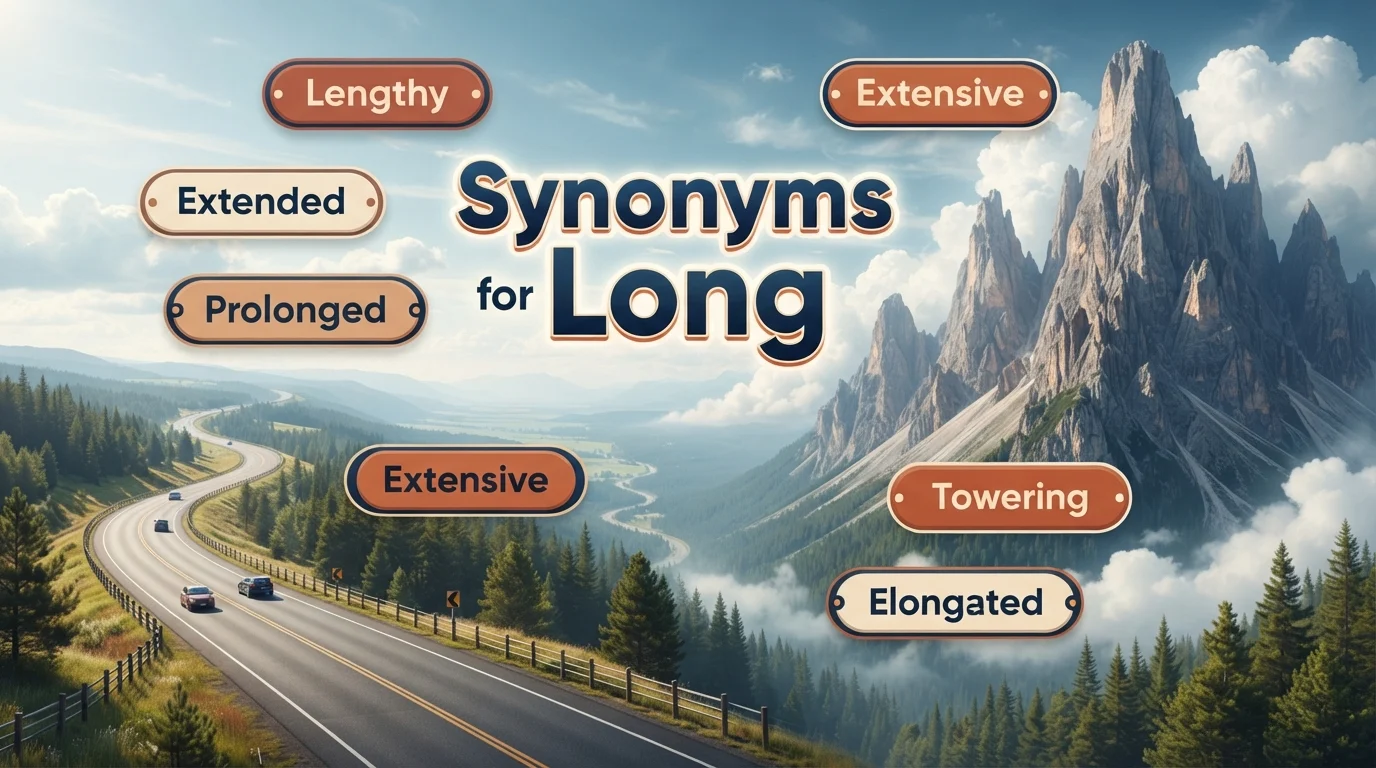
Create a visually striking image featuring a long, winding road stretching into the distance on one side, and a tall towering building or mountain on the other side, visually contrasting horizontal and vertical length. Include the text “Synonyms for Long” in bold, modern typography with warm earth tones and deep blue accents. Surround the main text with floating keywords like “Lengthy,” “Extended,” “Prolonged,” “Extensive,” “Tall,” “Towering,” and “Elongated” in a clean, organized layout. Use depth and perspective to convey length and distance. Style: modern, professional, educational, with a balanced composition suitable for a language learning or writing guide.
Discover More:-
- 50+ Synonyms for Unfortunately: Meanings, Examples, and Best Alternatives
- 50+ Synonyms for Start: Meanings, Examples, and Best Alternatives

4 thoughts on “50+ Synonyms for Long: Meanings, Examples, and Best Alternatives”