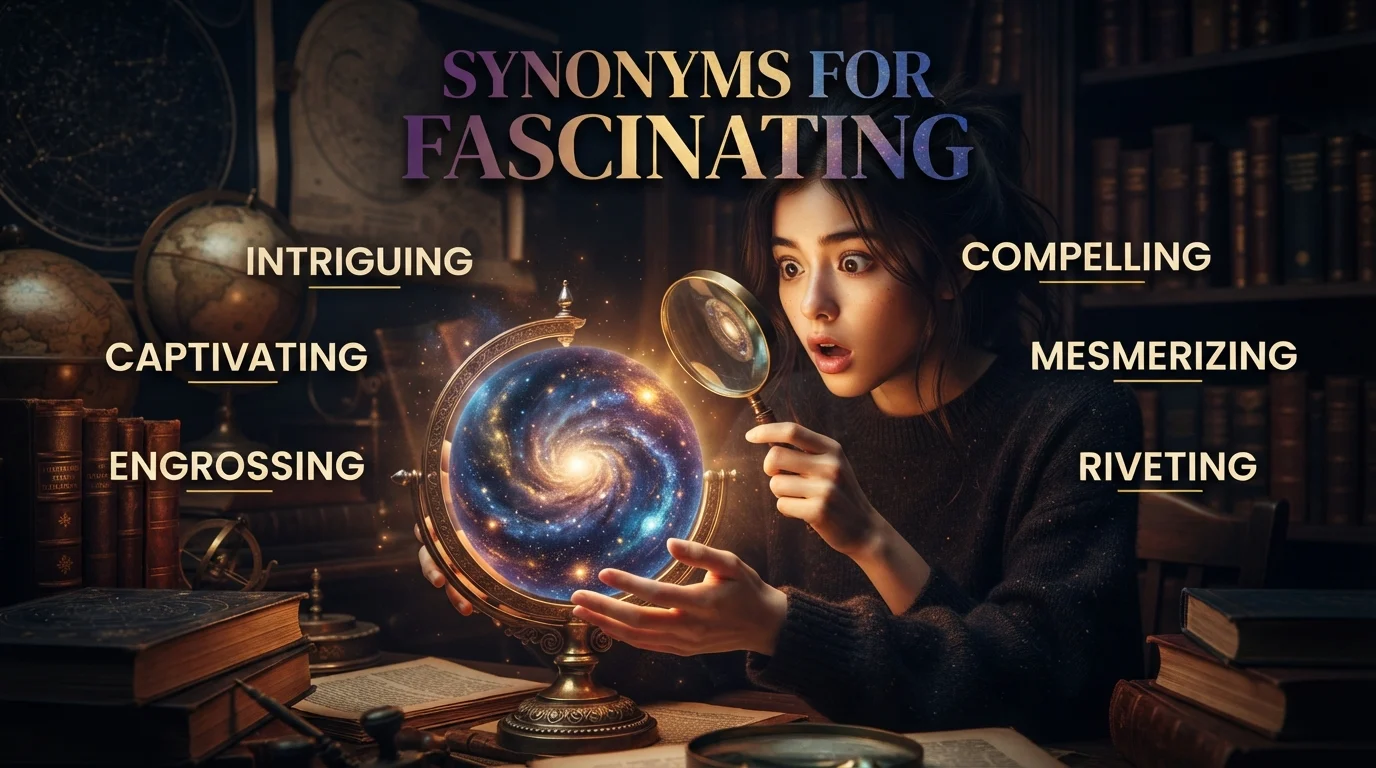
Do you keep using the word “fascinating” in essays, blog posts, book reviews, presentations, or everyday conversation? While it is a strong and expressive word, repeating it can make your writing feel flat, exaggerated, or predictable.
The good news is that the best alternative depends on what you actually mean. You might be describing something deeply interesting, intellectually captivating, visually mesmerizing, mysterious, or surprisingly curious.
This guide explains synonyms for “fascinating” by meaning, tone, context, and usage. You will learn which alternatives work best in academic writing, professional communication, creative expression, reviews, and casual conversation.
Quick Answer: What Does “Fascinating” Mean?
“Fascinating” describes something that captures attention and interest strongly, often because it is unusual, complex, or intriguing. Depending on context, alternatives include intriguing, captivating, engrossing, compelling, absorbing, enthralling, riveting, mesmerizing, curious, and enlightening.
Meaning, Tone, and Context
Simple Definition
“Fascinating” generally refers to:
- Extremely interesting: holding attention strongly
- Intriguing: arousing curiosity or wonder
- Captivating: attracting and holding interest
- Absorbing: taking up all your attention
- Mysterious: strange or puzzling in an interesting way
- Enlightening: providing new insight or understanding
Part of Speech
“Fascinating” functions primarily as an adjective (present participle of “fascinate”).
Examples:
- “The documentary was fascinating.”
- “She has a fascinating story.”
Related Forms:
- Fascinate (verb): to attract and hold the interest of
- Fascinated (adjective): strongly interested
- Fascinatingly (adverb): in a fascinating manner
- Fascination (noun): the state of being fascinated
Positive, Negative, or Neutral Tone
“Fascinating” is generally positive. It suggests strong interest and engagement.
Positive associations:
- “The lecture was fascinating.”
- “She has a fascinating background.”
Neutral or slightly negative contexts:
- “It’s fascinating how easily people are misled.” (intriguing but critical)
- “His fascination with danger worried his friends.” (obsession)
Formality Level
“Fascinating” is a standard word that works in both formal and informal English. It is appropriate in academic papers, business communication, creative writing, reviews, and casual conversation.
However, more specific alternatives can add precision and variety, especially in creative or academic contexts.
Common Use Cases
“Fascinating” commonly refers to:
- Ideas and information: fascinating facts, fascinating research, fascinating theory
- People: fascinating person, fascinating character, fascinating life story
- Places and cultures: fascinating city, fascinating history, fascinating traditions
- Books and media: fascinating book, fascinating documentary, fascinating article
- Science and nature: fascinating phenomenon, fascinating discovery, fascinating species
- Personal interest: fascinating hobby, fascinating subject, fascinating topic
Important Word Forms
- Fascinating (adjective): extremely interesting
- Fascinated (adjective): strongly interested
- Fascinate (verb): to attract and hold interest
- Fascination (noun): the state of being fascinated
- Fascinatingly (adverb): in a fascinating manner
When and How to Use “Fascinating”
Use “fascinating” when you want to describe something that strongly captures attention and interest. Because the word is strong, more specific alternatives can add precision depending on the context.
Professional
“The research presents fascinating insights into consumer behavior.”
This works naturally in business and academic communication.
Academic
“The study reveals fascinating patterns in language acquisition.”
The term is appropriate in academic writing.
Personal
“I read a fascinating book about ancient civilizations.”
The word sounds natural in everyday conversation.
Creative
“The old house had a fascinating history filled with secrets.”
The word creates intrigue in creative writing.
Reviews
“The documentary offers a fascinating look at marine life.”
This is standard in reviews and critiques.
Presentations
“Today I’ll share some fascinating discoveries from our research.”
This is effective in presentations.
Another Word for “Fascinating”
There is no single perfect synonym because “fascinating” can refer to intellectual interest, visual captivation, mystery, or curiosity.
- Intellectual interest: interesting, intriguing, thought-provoking, stimulating
- Strong captivation: captivating, engrossing, absorbing, enthralling, riveting
- Visual/emotional captivation: mesmerizing, spellbinding, bewitching, enchanting
- Mystery/curiosity: curious, puzzling, mysterious, peculiar, odd
- Enlightenment: enlightening, illuminating, revealing, insightful
If you need one broad alternative, “intriguing” works for curiosity, while “captivating” works for strong attention. “Compelling” works for arguments and stories.
When Not to Use “Fascinating”
“Fascinating” can become too strong or vague when you need to specify exactly what kind of interest you are describing.
Consider:
“The article was fascinating.”
This statement does not tell readers whether the article was intellectually stimulating, emotionally captivating, surprising, or beautifully written.
A more precise sentence could be:
“The article offered a thought-provoking analysis of climate policy.”
Similarly, avoid using “fascinating” when you mean simply “interesting” or “useful”. Use “interesting” or “valuable” instead.
Words Commonly Confused With “Fascinating”
Fascinating vs. Interesting
Interesting is milder and more general. Fascinating implies strong, captivating interest.
Example:
“The book was interesting.” (mild)
“The book was fascinating.” (strong)
Fascinating vs. Intriguing
Intriguing emphasizes curiosity and mystery. Fascinating is broader.
Example:
“The mystery was intriguing.” (curiosity)
“The documentary was fascinating.” (broad interest)
Fascinating vs. Captivating
Captivating emphasizes holding attention, often aesthetically. Fascinating can be intellectual.
Example:
“Her performance was captivating.” (aesthetic)
“The lecture was fascinating.” (intellectual)
Fascinating vs. Absorbing
Absorbing emphasizes taking up all your attention. Fascinating is similar but can be less intense.
Example:
“The game was absorbing.” (all-consuming)
“The topic is fascinating.” (interesting)
Fascinating vs. Compelling
Compelling emphasizes being convincing or demanding attention. Fascinating emphasizes interest.
Example:
“The argument was compelling.” (convincing)
“The story was fascinating.” (interesting)
Fascinating vs. Curious
Curious means strange or unusual in an interesting way. Fascinating is broader.
Example:
“It’s a curious custom.” (strange)
“It’s a fascinating custom.” (interesting)
Best Synonym by Context for “Fascinating”
| Context | Best Synonym | Why It Works | Example |
|---|---|---|---|
| Formal writing | Compelling, intriguing | Precise and professional | The report presents compelling evidence. |
| Academic writing | Illuminating, thought-provoking | Standard academic usage | The study offers illuminating insights. |
| Creative writing | Mesmerizing, spellbinding, enchanting | Adds literary depth | The tale was utterly mesmerizing. |
| Reviews | Riveting, engrossing, absorbing | Describes strong engagement | The film is riveting from start to finish. |
| Presentations | Captivating, compelling | Holds audience attention | The speaker gave a captivating presentation. |
| Science/nature | Remarkable, extraordinary | Describes natural wonders | The discovery is truly remarkable. |
| People | Intriguing, charismatic | Describes interesting people | She has an intriguing personality. |
| Books/media | Engrossing, riveting | Describes strong engagement | The novel is utterly engrossing. |
| History/culture | Rich, colorful, intriguing | Describes cultural depth | The city has a rich history. |
| Casual conversation | Cool, amazing, interesting | Natural and informal | That’s really cool! |
| Mystery | Puzzling, curious, mysterious | Describes mystery | The case presents a puzzling mystery. |
| Ideas/theory | Stimulating, thought-provoking | Describes intellectual interest | The theory is thought-provoking. |
Which Synonym Should You Choose?
Start by identifying what kind of “fascinating” you are describing.
- Intellectual interest: interesting, intriguing, thought-provoking, stimulating, illuminating
- Strong captivation: captivating, engrossing, absorbing, enthralling, riveting
- Visual/emotional captivation: mesmerizing, spellbinding, bewitching, enchanting
- Mystery/curiosity: curious, puzzling, mysterious, peculiar, odd
- Enlightenment: enlightening, illuminating, revealing, insightful
- Awe/wonder: remarkable, extraordinary, astonishing, amazing
10 Key Synonyms for “Fascinating”
The table below includes accurate alternatives with clear meanings and usage contexts.
| Synonym | Simple Meaning | Best Used For | Example Sentence |
|---|---|---|---|
| Intriguing | Arousing curiosity | Mysteries, ideas, people | The proposal is intriguing and worth exploring. |
| Captivating | Holding attention strongly | Performances, stories, people | Her speech was utterly captivating. |
| Engrossing | Absorbing all attention | Books, films, games | The novel is engrossing from the first page. |
| Compelling | Demanding attention; convincing | Arguments, evidence, stories | The documentary presents compelling evidence. |
| Absorbing | Taking up all attention | Activities, books | The game was completely absorbing. |
| Enthralling | Captivating and exciting | Performances, stories | The performance was enthralling. |
| Riveting | Extremely engrossing | Films, books, speeches | The finale was absolutely riveting. |
| Mesmerizing | Hypnotically attractive | Visuals, performances | The dance was mesmerizing. |
| Curious | Strange and interesting | Customs, facts, objects | It’s a curious artifact from ancient times. |
| Enlightening | Providing insight | Lectures, books, experiences | The workshop was enlightening. |
Synonym Groups and Usage Differences
Professional vs. Personal Synonyms
Professional writing benefits from specific terms such as compelling, intriguing, illuminating, and thought-provoking.
Personal communication often uses fascinating itself or casual alternatives like cool, amazing, or interesting.
Compare:
“That’s so cool!” (personal)
“The findings are compelling and warrant further study.” (professional)
Formal vs. Conversational Synonyms
Fascinating works in both formal and conversational English.
Formal alternatives: compelling, illuminating, thought-provoking, intriguing
Conversational alternatives: cool, amazing, awesome, interesting
Examples:
“The research is illuminating.” (formal)
“That’s really cool!” (conversational)
Academic Synonyms
Academic writing should distinguish between fascinating (general interest), compelling (convincing), illuminating (providing insight), and thought-provoking (stimulating reflection).
For example:
“The study offers illuminating insights into human behavior.”
“The findings present compelling evidence for the theory.”
Professional and Business Synonyms
Business writing often benefits from phrases such as compelling, insightful, valuable, and noteworthy.
Instead of:
“The report is fascinating.”
Consider:
“The report offers compelling insights into market trends.”
Creative or Literary Synonyms
Creative writing can use mesmerizing, spellbinding, enchanting, bewitching, enthralling, and riveting depending on the context.
For example:
“The dancer’s performance was utterly mesmerizing.”
“The tale was spellbinding from beginning to end.”
Slang or Modern Synonyms
Cool is a common casual alternative.
Awesome means impressive or excellent.
Mind-blowing means extremely impressive or surprising.
Epic means grand or extraordinary.
Examples:
“That’s really cool!” (casual)
“The documentary was mind-blowing.” (modern slang)
Strongest vs. Weaker Synonyms
“Fascinating” synonyms vary in intensity:
Milder: interesting, curious, notable
Moderate: fascinating, intriguing, engaging
Strong: captivating, engrossing, absorbing
Very Strong: mesmerizing, spellbinding, riveting
Emotional vs. Neutral Synonyms
“Fascinating” is generally positive and engaging.
Emotional alternatives: mesmerizing, spellbinding, enchanting (aesthetic)
Neutral alternatives: interesting, intriguing, notable
Examples:
“The performance was mesmerizing.” (emotional, aesthetic)
“The article was interesting.” (neutral)
Antonyms of “Fascinating”
“Fascinating” has several antonyms depending on context:
| Antonym | Context | Meaning | Example Sentence |
|---|---|---|---|
| Boring | General | Not interesting | The lecture was boring. |
| Dull | General | Lacking interest | The party was dull. |
| Tedious | General | Tiresome and boring | The process was tedious. |
| Monotonous | General | Lacking variety | The work was monotonous. |
| Uninteresting | General | Not interesting | The topic is uninteresting. |
| Repetitive | General | Repeating and boring | The speech was repetitive. |
| Mundane | General | Ordinary and dull | The task was mundane. |
| Insipid | General | Lacking flavor or interest | The film was insipid. |
Comparison: “Fascinating” vs. Similar Words
Fascinating vs. Interesting
Main difference: Interesting is milder and more general. Fascinating implies strong, captivating interest.
Examples:
“The book was interesting.” (mild)
“The book was fascinating.” (strong)
Fascinating vs. Intriguing
Main difference: Intriguing emphasizes curiosity and mystery. Fascinating is broader.
Examples:
“The mystery was intriguing.” (curiosity)
“The documentary was fascinating.” (broad interest)
Fascinating vs. Captivating
Main difference: Captivating emphasizes holding attention, often aesthetically. Fascinating can be intellectual.
Examples:
“Her performance was captivating.” (aesthetic)
“The lecture was fascinating.” (intellectual)
Fascinating vs. Absorbing
Main difference: Absorbing emphasizes taking up all your attention. Fascinating is similar but can be less intense.
Examples:
“The game was absorbing.” (all-consuming)
“The topic is fascinating.” (interesting)
Fascinating vs. Compelling
Main difference: Compelling emphasizes being convincing or demanding attention. Fascinating emphasizes interest.
Examples:
“The argument was compelling.” (convincing)
“The story was fascinating.” (interesting)
Fascinating vs. Curious
Main difference: Curious means strange or unusual in an interesting way. Fascinating is broader.
Examples:
“It’s a curious custom.” (strange)
“It’s a fascinating custom.” (interesting)
Common Phrases and Expressions with “Fascinating”
1. Fascinating fact
Meaning:
An interesting piece of information.
Example:
“Here’s a fascinating fact about octopuses.”
2. Fascinating insight
Meaning:
A revealing or interesting understanding.
Example:
“The book offers fascinating insights into human nature.”
3. Fascinating story
Meaning:
An interesting or captivating narrative.
Example:
“She told a fascinating story about her travels.”
4. Fascinating history
Meaning:
An interesting past.
Example:
“The castle has a fascinating history.”
5. Fascinating person
Meaning:
An interesting individual.
Example:
“He’s a fascinating person with many talents.”
6. Fascinating subject
Meaning:
An interesting topic of study.
Example:
“Astrophysics is a fascinating subject.”
7. Find something fascinating
Meaning:
To be strongly interested in something.
Example:
“I find ancient history fascinating.”
8. Utterly fascinating
Meaning:
Completely fascinating.
Example:
“The documentary was utterly fascinating.”
9. A fascinating glimpse into
Meaning:
An interesting view of something.
Example:
“The diary offers a fascinating glimpse into Victorian life.”
10. Fascinating to watch
Meaning:
Interesting to observe.
Example:
“The birds are fascinating to watch.”
Common Mistakes to Avoid
1. Using “fascinating” when a more precise term is available
If you mean intriguing, captivating, compelling, or illuminating, use the more specific word.
Vague: “The article was fascinating.”
Precise: “The article offered a compelling analysis of the crisis.”
2. Overusing “fascinating”
Repetition can make content feel exaggerated or dull. Use alternatives such as intriguing, captivating, engrossing, compelling, and riveting.
3. Confusing “fascinating” with “interesting”
Interesting is milder. Fascinating implies strong interest.
Mild: “The book was interesting.”
Strong: “The book was fascinating.”
4. Using “fascinating” in professional contexts when “insightful” or “valuable” is better
In business writing, use insightful, valuable, noteworthy, or compelling.
Casual: “The report is fascinating.”
Professional: “The report offers valuable insights.”
5. Choosing a synonym that changes the meaning
Do not replace fascinating with curious unless you mean strange or unusual.
Do not replace fascinating with compelling unless you mean convincing or demanding attention.
FAQs
What is the best synonym for “fascinating”?
The best synonym depends on context. Intriguing works for curiosity, captivating for strong attention, engrossing for books and films, compelling for arguments, and mesmerizing for visual captivation.
What is a formal synonym for “fascinating”?
Compelling, illuminating, thought-provoking, intriguing, and noteworthy are formal synonyms.
What is an informal synonym for “fascinating”?
Cool, amazing, awesome, mind-blowing, and epic are common informal alternatives.
What is another word for “fascinating” in creative writing?
Mesmerizing, spellbinding, enchanting, bewitching, enthralling, and riveting work well in creative writing.
What is the difference between “fascinating” and “interesting”?
Interesting is milder and more general. Fascinating implies strong, captivating interest.
What is the opposite of “fascinating”?
Depending on context, opposites include boring, dull, tedious, monotonous, uninteresting, and mundane.
What does “fascinating” mean in an academic context?
In academic contexts, fascinating often describes research or ideas that are intriguing, illuminating, or thought-provoking.
Conclusion
“Fascinating” is a strong, expressive word that can describe intellectual interest, strong captivation, mystery, and enlightenment. The best synonym depends on what you actually mean.
Choose intriguing for curiosity, captivating for strong attention, engrossing for books and films, compelling for arguments, mesmerizing for visual captivation, and illuminating for insight.
Most importantly, do not replace “fascinating” simply to avoid repetition. First identify what kind of interest—intellectual, emotional, visual, or mysterious—you are actually describing. Then choose the alternative that communicates that idea most clearly.
For academic, professional, and formal writing, precision is usually more valuable than vocabulary variety. A specific term such as compelling, illuminating, thought-provoking, or insightful can tell readers much more than the broad word fascinating.
Before publishing a vocabulary guide, verify definitions and usage with trusted dictionaries such as Cambridge, Oxford, Merriam-Webster, Collins, or Britannica. This helps ensure that each alternative accurately matches its intended meaning and context.
The practical takeaway is simple: when “fascinating” feels too general or overused, ask yourself what kind of interest, curiosity, or captivation you are actually describing. Then use the most precise word available.
Discover More:-
- 50+ Synonyms for Especially: Meanings, Examples, and Best Alternatives
- 50+ Synonyms for Long: Meanings, Examples, and Best Alternatives

2 thoughts on “50+ Synonyms for Fascinating: Meanings, Examples, and Best Alternatives 2026”