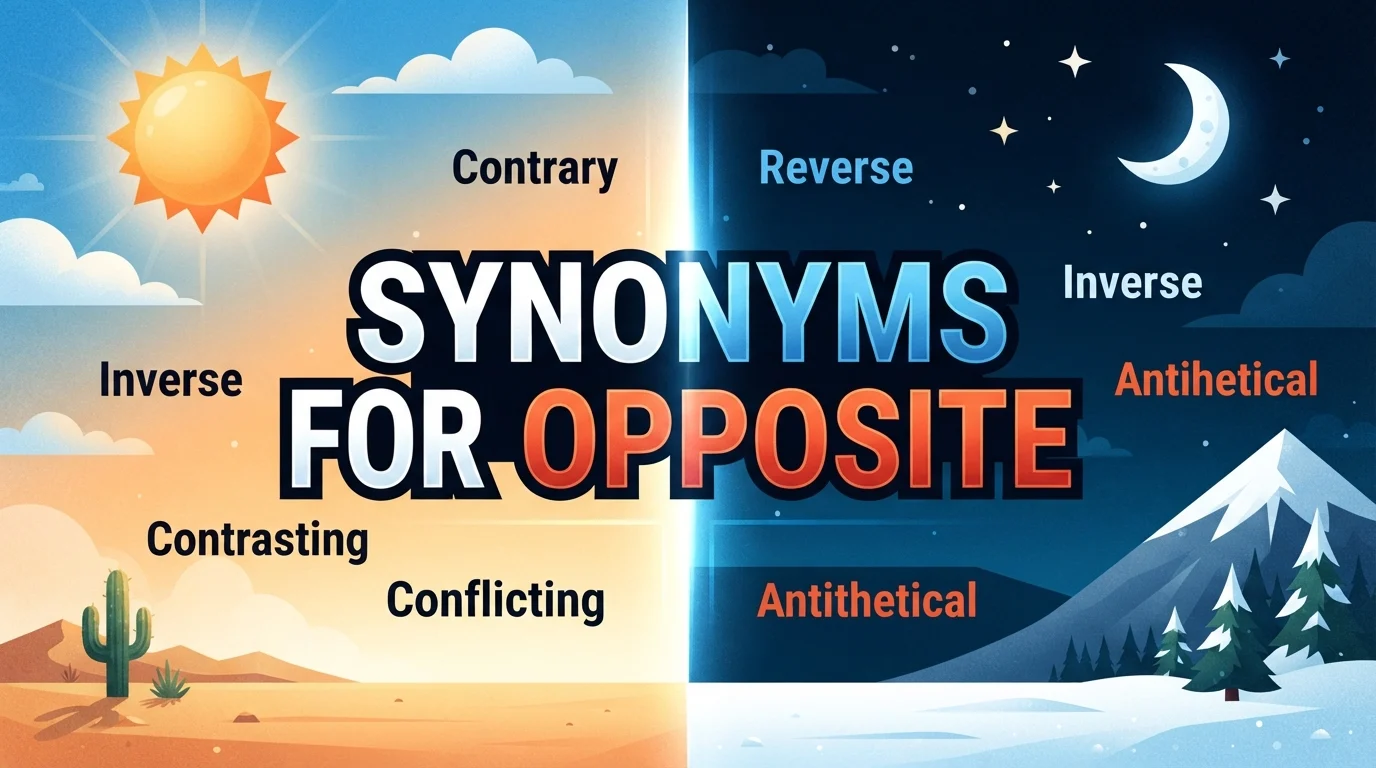
Do you keep using the word “opposite” in essays, business reports, debates, creative writing, or everyday conversation? While it is one of the most useful and fundamental words in English, repeating it can make your writing feel flat, repetitive, or overly simplistic.
The good news is that the best alternative depends on what you actually mean. You might be describing something completely different, directly contrary, facing something else, or standing in direct contrast.
This guide explains synonyms for “opposite” by meaning, tone, context, and usage. You will learn which alternatives work best in academic writing, professional communication, debates, creative expression, and casual conversation.
Quick Answer: What Does “Opposite” Mean?
“Opposite” describes something that is completely different, contrary, or facing something else. It can refer to a position (across from), a quality (completely different), or a relationship (contrasting). Depending on context, alternatives include contrary, reverse, inverse, contrasting, conflicting, antithetical, diametrically opposed, facing, across from, and polar.
Meaning, Tone, and Context
Simple Definition
“Opposite” generally refers to:
- Position: facing or across from something
- Quality: completely different in nature
- Relationship: contrary or reverse
- Logic: directly contradicting
- Direction: moving the other way
Part of Speech
“Opposite” functions as an adjective, noun, adverb, and preposition.
Adjective Examples:
- “They have opposite opinions.”
- “The opposite direction.”
Noun Examples:
- “Hot is the opposite of cold.”
- “She is the opposite of her sister.”
Adverb Examples:
- “He sat opposite me.”
Preposition Examples:
- “The store is opposite the bank.”
Related Forms:
- Opposition (noun): resistance or contrast
- Oppose (verb): to act against
- Opposed (adjective): in contrast or against
- Opposing (adjective): conflicting
Positive, Negative, or Neutral Tone
“Opposite” is generally neutral. It simply describes a relationship of contrast or position.
Positive associations:
- “Our skills are opposite but complementary.”
Negative contexts:
- “They have opposite views on the issue.” (conflict)
Neutral contexts:
- “The opposite side of the street.”
Formality Level
“Opposite” is a standard word that works in both formal and informal English. It is appropriate in academic papers, business reports, creative writing, and casual conversation.
However, more specific alternatives can add precision and variety depending on the context.
Common Use Cases
“Opposite” commonly refers to:
- Position: opposite side, opposite direction, opposite end
- Qualities: opposite meaning, opposite effect, opposite personality
- Opinions: opposite views, opposite beliefs, opposite positions
- Logic: opposite conclusion, opposite result
- Relationships: opposite sex, opposite number
Important Word Forms
- Opposite (adjective/noun/adverb/preposition): facing or contrasting
- Opposition (noun): resistance or contrast
- Oppose (verb): to act against
- Opposed (adjective): in contrast or against
- Opposing (adjective): conflicting
When and How to Use “Opposite”
Use “opposite” when you want to describe something that is completely different, contrary, or facing something else. Because the word is broad, more specific alternatives can add precision depending on the context.
Professional
“The two departments have opposite approaches to the problem.”
This works naturally in business communication.
Academic
“The study found opposite results to the previous research.”
The term is appropriate in academic writing.
Personal
“My brother and I have opposite personalities.”
The word sounds natural in everyday conversation.
Creative
“The opposite side of the mountain held a hidden valley.”
The word creates a sense of contrast and discovery.
Logical
“If one is true, the opposite must be false.”
This is appropriate in logical or philosophical contexts.
Positional
“The pharmacy is opposite the hospital.”
This is standard in giving directions.
Another Word for “Opposite”
There is no single perfect synonym because “opposite” can refer to position, quality, relationship, or logic.
- Position context: facing, across from, fronting, over
- Quality context: contrary, reverse, inverse, antithetical, polar
- Relationship context: contrasting, conflicting, divergent, different
- Logic context: contradictory, contrary, negating, reverse
- Direction context: reverse, inverse, contrary
If you need one broad alternative, “contrary” works for logic and opinions, while “reverse” works for direction and order. “Facing” works for position.
When Not to Use “Opposite”
“Opposite” can become too vague when you need to specify exactly what kind of opposition you are describing.
Consider:
“They have opposite views.”
This statement does not tell readers whether their views are contradictory, different, or simply not the same.
A more precise sentence could be:
“They have diametrically opposed views on economic policy.”
Similarly, avoid using “opposite” when you mean “different” in a simple comparison. Use “different”, “distinct”, or “contrasting” instead.
Words Commonly Confused With “Opposite”
Opposite vs. Contrary
Contrary means directly opposed or opposite in nature. Opposite can be more general.
Example:
“The evidence is contrary to the theory.” (directly opposed)
“The store is opposite the bank.” (position)
Opposite vs. Reverse
Reverse means the opposite in order, direction, or nature. Opposite can be more general.
Example:
“The reverse side of the coin.” (other side)
“The opposite side of the street.” (position)
Opposite vs. Inverse
Inverse means opposite in relation, order, or effect. Opposite can be more general.
Example:
“The inverse relationship between price and demand.” (mathematical)
“The opposite direction.” (general)
Opposite vs. Different
Different simply means not the same. Opposite implies direct contrast.
Example:
“These two colors are different.” (not the same)
“Black and white are opposite colors.” (direct contrast)
Opposite vs. Contrasting
Contrasting means noticeably different, especially when compared. Opposite implies direct opposition.
Example:
“The contrasting colors looked good together.” (different)
“The opposite colors clashed.” (direct opposition)
Opposite vs. Conflicting
Conflicting means incompatible or contradictory. Opposite can be more general.
Example:
“They have conflicting schedules.” (incompatible)
“They have opposite schedules.” (directly different)
Best Synonym by Context for “Opposite”
| Context | Best Synonym | Why It Works | Example |
|---|---|---|---|
| Formal writing | Contrary, antithetical | Precise and professional | The findings are contrary to expectations. |
| Academic writing | Inverse, contrary | Standard academic usage | The study found an inverse relationship. |
| Business communication | Contrasting, opposing | Professional and clear | The two teams have contrasting approaches. |
| Position | Facing, across from | Describes physical location | The cafe is facing the park. |
| Direction | Reverse, inverse | Describes direction | The reverse direction leads home. |
| Opinions | Opposing, conflicting, divergent | Describes disagreement | They hold opposing views on the issue. |
| Logic | Contradictory, contrary | Describes logical opposition | The two statements are contradictory. |
| Creative writing | Antithetical, polar, diametrical | Adds literary depth | They were polar opposites in every way. |
| Casual conversation | Opposite (itself), different | Natural and informal | We have opposite tastes in music. |
| Relationships | Counterpart, opposite number | Describes matching roles | She met her opposite number from the rival company. |
| Qualities | Inverse, reverse | Describes contrasting qualities | The effect was the inverse of what was expected. |
| Extreme contrast | Diametrically opposed, polar | Emphasizes extreme difference | Their beliefs are diametrically opposed. |
Which Synonym Should You Choose?
Start by identifying what kind of “opposite” you are describing.
- Position: facing, across from, fronting, over
- Quality: contrary, reverse, inverse, antithetical, polar
- Relationship: contrasting, conflicting, divergent, different
- Logic: contradictory, contrary, negating, reverse
- Direction: reverse, inverse, contrary
10 Key Synonyms for “Opposite”
The table below includes accurate alternatives with clear meanings and usage contexts.
| Synonym | Simple Meaning | Best Used For | Example Sentence |
|---|---|---|---|
| Contrary | Directly opposed or opposite | Logic, opinions | The evidence is contrary to the theory. |
| Reverse | Opposite in order or direction | Direction, order | The reverse side of the coin. |
| Inverse | Opposite in relation or effect | Mathematics, relationships | There is an inverse relationship between price and demand. |
| Contrasting | Noticeably different | Comparisons, descriptions | They have contrasting personalities. |
| Conflicting | Incompatible or contradictory | Schedules, opinions | They have conflicting views on the matter. |
| Antithetical | Directly opposite in nature | Formal, philosophical | His beliefs are antithetical to mine. |
| Diametrically opposed | Completely opposite | Strong contrast | Their political views are diametrically opposed. |
| Facing | Positioned across from | Position, location | The hotel is facing the beach. |
| Polar | Extremely different | Strong contrast | They are polar opposites in temperament. |
| Contradictory | Mutually opposed | Logic, statements | The two reports are contradictory. |
Synonym Groups and Usage Differences
Professional vs. Personal Synonyms
Professional writing benefits from specific terms such as contrasting, opposing, divergent, and contrary.
Personal communication often uses opposite itself or casual alternatives like different or reverse.
Compare:
“We have opposite tastes.” (personal)
“The two departments have contrasting approaches.” (professional)
Formal vs. Conversational Synonyms
Opposite works in both formal and conversational English.
Formal alternatives: contrary, antithetical, inverse, diametrically opposed
Conversational alternatives: different, reverse, flip side
Examples:
“The findings are antithetical to the hypothesis.” (formal)
“We’re on opposite sides of the argument.” (conversational)
Academic Synonyms
Academic writing should distinguish between opposite (general), contrary (logic), inverse (mathematics), and antithetical (philosophy).
For example:
“The study found an inverse relationship between the variables.”
“The results are contrary to previous findings.”
Professional and Business Synonyms
Business writing often benefits from phrases such as contrasting, opposing, divergent, and converse.
Instead of:
“We have opposite strategies.”
Consider:
“We have contrasting strategic approaches.”
Creative or Literary Synonyms
Creative writing can use antithetical, polar, diametrical, inverse, and reverse depending on the context.
For example:
“They were polar opposites, yet somehow perfect for each other.”
“The antithetical forces clashed in an epic battle.”
Slang or Modern Synonyms
Flip side is a casual way to say opposite.
Other side is casual for the opposite position.
Polar opposite is a common emphatic phrase.
Examples:
“We’re on the flip side of the issue.” (casual)
“They’re polar opposites.” (emphatic)
Strongest vs. Weaker Synonyms
“Opposite” synonyms vary in intensity:
Milder: different, contrasting
Moderate: opposite, reverse, contrary
Strong: antithetical, inverse, contradictory
Very Strong: diametrically opposed, polar, irreconcilable
Emotional vs. Neutral Synonyms
“Opposite” is generally neutral.
Emotional alternatives: conflicting, antagonistic (negative); complementary (positive)
Neutral alternatives: contrary, reverse, inverse
Examples:
“They have conflicting personalities.” (negative)
“Hot and cold are opposite temperatures.” (neutral)
Antonyms of “Opposite”
“Opposite” has several antonyms depending on context:
| Antonym | Context | Meaning | Example Sentence |
|---|---|---|---|
| Same | General | Not different | We have the same opinion. |
| Similar | General | Alike | They have similar tastes. |
| Identical | General | Exactly the same | The two copies are identical. |
| Alike | General | Similar in nature | The twins are very much alike. |
| Corresponding | Position | Matching | The corresponding sections are on page 10. |
| Matching | General | Going well together | They wore matching outfits. |
| Equivalent | General | Equal in value | The two terms are equivalent. |
Comparison: “Opposite” vs. Similar Words
Opposite vs. Contrary
Main difference: Contrary means directly opposed or opposite in nature. Opposite can be more general.
Examples:
“The evidence is contrary to the theory.” (directly opposed)
“The store is opposite the bank.” (position)
Opposite vs. Reverse
Main difference: Reverse means the opposite in order, direction, or nature. Opposite can be more general.
Examples:
“The reverse side of the coin.” (other side)
“The opposite side of the street.” (position)
Opposite vs. Inverse
Main difference: Inverse means opposite in relation, order, or effect. Opposite can be more general.
Examples:
“The inverse relationship between price and demand.” (mathematical)
“The opposite direction.” (general)
Opposite vs. Different
Main difference: Different simply means not the same. Opposite implies direct contrast.
Examples:
“These two colors are different.” (not the same)
“Black and white are opposite colors.” (direct contrast)
Opposite vs. Contrasting
Main difference: Contrasting means noticeably different, especially when compared. Opposite implies direct opposition.
Examples:
“The contrasting colors looked good together.” (different)
“The opposite colors clashed.” (direct opposition)
Opposite vs. Conflicting
Main difference: Conflicting means incompatible or contradictory. Opposite can be more general.
Examples:
“They have conflicting schedules.” (incompatible)
“They have opposite schedules.” (directly different)
Common Phrases and Expressions with “Opposite”
1. The opposite of
Meaning:
The direct contrast to something.
Example:
“Hot is the opposite of cold.”
2. Opposite direction
Meaning:
The reverse direction.
Example:
“She walked in the opposite direction.”
3. Opposite side
Meaning:
The other side.
Example:
“The pharmacy is on the opposite side of the street.”
4. Opposite effect
Meaning:
The reverse result.
Example:
“The medicine had the opposite effect.”
5. Opposite number
Meaning:
A person with a matching role in another organization.
Example:
“She met her opposite number from the rival company.”
6. Polar opposite
Meaning:
Something completely different.
Example:
“They are polar opposites in personality.”
7. Just the opposite
Meaning:
The exact reverse.
Example:
“I thought he’d be angry, but it was just the opposite.”
8. Opposite sex
Meaning:
The other gender.
Example:
“The event is open to both sexes.”
9. Opposite attract
Meaning:
People who are very different are often drawn to each other.
Example:
“They say opposites attract.”
10. Play opposite
Meaning:
To act in a role opposite another actor.
Example:
“She played opposite him in the film.”
Common Mistakes to Avoid
1. Using “opposite” when “different” is more appropriate
Different simply means not the same. Opposite implies direct contrast.
Incorrect: “These two colors are opposite.”
Correct: “These two colors are different.”
Correct: “Black and white are opposite colors.”
2. Confusing “opposite” with “contrary”
Contrary means directly opposed in nature. Opposite can be more general.
Incorrect: “The store is contrary the bank.”
Correct: “The store is opposite the bank.”
3. Using “opposite” in formal writing when “contrary” is more precise
Formal and academic writing often benefits from more precise terms.
Vague: “The results are opposite to the hypothesis.”
Precise: “The results are contrary to the hypothesis.”
4. Overusing “opposite” in writing
Repetition can make content feel dull. Use alternatives such as contrary, reverse, inverse, contrasting, conflicting, and antithetical.
5. Choosing a synonym that changes the meaning
Do not replace opposite with different unless you mean simply not the same.
Do not replace opposite with conflicting unless you mean incompatible.
FAQs
What is the best synonym for “opposite”?
The best synonym depends on context. Contrary works for logic, reverse for direction, inverse for mathematics, contrasting for comparisons, and facing for position.
What is a formal synonym for “opposite”?
Contrary, antithetical, inverse, contradictory, and diametrically opposed are formal synonyms.
What is an informal synonym for “opposite”?
Different, reverse, flip side, and other side are common informal alternatives.
What is another word for “opposite” in creative writing?
Antithetical, polar, diametrical, inverse, and reverse work well in creative writing.
What is the difference between “opposite” and “contrary”?
Contrary means directly opposed in nature. Opposite can be more general and can refer to position.
What is the opposite of “opposite”?
Depending on context, opposites include same, similar, identical, alike, and matching.
What does “opposite” mean in a mathematical context?
In mathematics, opposite often refers to inverse relationships or negative values (e.g., the opposite of 5 is -5).
Conclusion
“Opposite” is a versatile and fundamental word that can describe position, quality, relationship, logic, and direction. The best synonym depends on what you actually mean.
Choose contrary for logic, reverse for direction, inverse for mathematics, contrasting for comparisons, conflicting for incompatibility, and facing for position.
Most importantly, do not replace “opposite” simply to avoid repetition. First identify what kind of opposition—positional, qualitative, logical, or relational—you are actually describing. Then choose the alternative that communicates that idea most clearly.
For academic, professional, and formal writing, precision is usually more valuable than vocabulary variety. A specific term such as contrary, inverse, antithetical, or diametrically opposed can tell readers much more than the broad word opposite.
Before publishing a vocabulary guide, verify definitions and usage with trusted dictionaries such as Cambridge, Oxford, Merriam-Webster, Collins, or Britannica. This helps ensure that each alternative accurately matches its intended meaning and context.
The practical takeaway is simple: when “opposite” feels too general, ask yourself what kind of contrast or position you are actually describing. Then use the most precise word available.
Discover More:-
- 50+ Synonyms for Efficient: Meanings, Examples, and Best Alternatives
- 50+ Synonyms for Highlight: Meanings, Examples, and Best Alternatives

1 thought on “50+ Synonyms for Opposite: Meanings, Examples, and Best Alternatives”