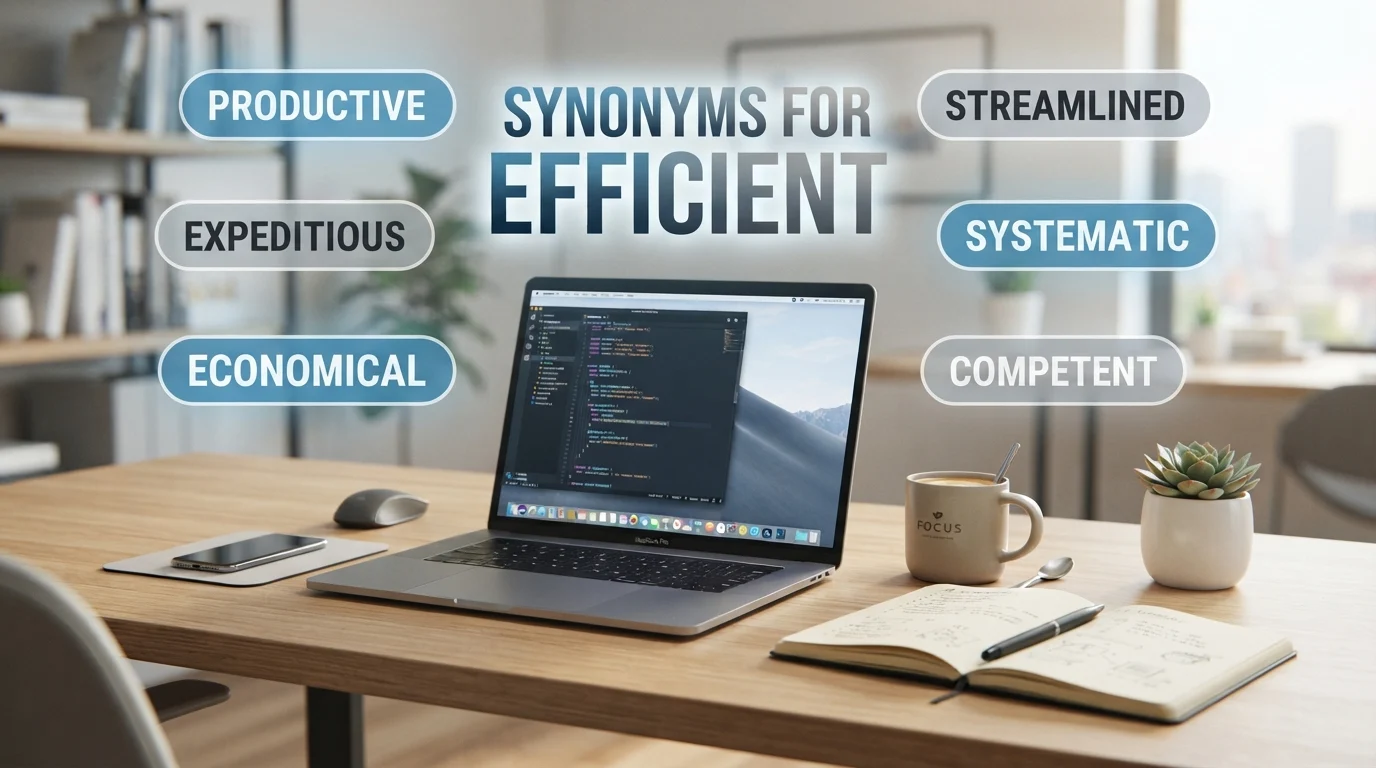
Do you keep using the word “efficient” in essays, business reports, resumes, performance reviews, or everyday conversation? While it is one of the most valuable and widely used words in professional English, repeating it can make your writing feel flat, generic, or overly technical.
The good news is that the best alternative depends on what you actually mean. You might be describing someone who works productively, a system that runs smoothly, a process that saves time, a machine that uses minimal energy, or a method that delivers results without waste.
This guide explains synonyms for “efficient” by meaning, tone, context, and usage. You will learn which alternatives work best in academic writing, professional communication, resumes, technical documentation, creative expression, and casual conversation.
Quick Answer: What Does “Efficient” Mean?
“Efficient” describes something or someone that achieves maximum productivity with minimum wasted effort, time, or resources. It suggests effectiveness, competence, and optimal performance. Depending on context, alternatives include productive, effective, streamlined, systematic, competent, capable, resourceful, economical, expeditious, and well-organized.
Meaning, Tone, and Context
Simple Definition
“Efficient” generally refers to:
- Productivity: achieving results with minimal wasted effort
- Time-saving: completing tasks quickly and effectively
- Resource-saving: using minimal resources (money, energy, materials)
- Systematic: organized and methodical
- Competence: capable and skilled
- Economical: avoiding waste
- Optimal performance: functioning at the highest level
Part of Speech
“Efficient” is primarily an adjective.
Examples:
- “She is an efficient worker.”
- “The new system is more efficient than the old one.”
Related Forms:
- Efficiently (adverb): in an efficient manner
- Efficiency (noun): the quality of being efficient
- Inefficient (adjective): not efficient; wasteful
- Efficiency (noun): the state or quality of being efficient
Positive, Negative, or Neutral Tone
“Efficient” is generally positive. It suggests competence, productivity, and smart use of resources.
Positive associations:
- “The team is highly efficient.”
- “This is a more efficient way to work.”
Neutral or technical contexts:
- “The engine is fuel-efficient.”
- “The algorithm is computationally efficient.”
Formality Level
“Efficient” is a standard word that works in both formal and informal English. It is especially common in professional, academic, and technical contexts.
However, more specific alternatives can add precision and variety depending on the context.
Common Use Cases
“Efficient” commonly refers to:
- People: efficient workers, efficient managers, efficient assistants
- Systems: efficient processes, efficient workflows, efficient operations
- Machines: fuel-efficient cars, energy-efficient appliances
- Methods: efficient methods, efficient techniques, efficient approaches
- Organizations: efficient companies, efficient teams, efficient departments
- Technology: efficient algorithms, efficient software, efficient systems
Important Word Forms
- Efficient (adjective): achieving maximum productivity with minimum waste
- Efficiently (adverb): in an efficient manner
- Efficiency (noun): the quality of being efficient
- Inefficient (adjective): not efficient; wasteful
- Inefficiency (noun): the quality of being inefficient
- Efficiencies (noun, plural): ways to improve efficiency
When and How to Use “Efficient”
Use “efficient” when you want to describe someone or something that achieves results with minimal waste of time, effort, or resources. Because the word is broad, more specific alternatives can add precision depending on the context.
Professional
“She is an efficient manager who always meets deadlines.”
This works naturally in business communication and performance reviews.
Academic
“The study examined efficient methods for data processing.”
The term is appropriate in academic research.
Personal
“I try to be efficient with my time.”
The word sounds natural in everyday conversation.
Technical
“The new algorithm is more efficient than the previous version.”
This is standard in technical documentation.
Business
“Our company is committed to efficient operations and cost reduction.”
This is appropriate in business contexts.
Resume
“Efficient professional with a track record of improving processes.”
This is common in resumes and cover letters.
Another Word for “Efficient”
There is no single perfect synonym because “efficient” can refer to productivity, time-saving, resource-saving, systematic organization, competence, or economy.
- Productivity context: productive, effective, high-performing, result-oriented
- Time-saving context: expeditious, prompt, quick, timely, swift
- Resource-saving context: economical, cost-effective, energy-efficient, frugal
- Systematic context: systematic, methodical, organized, streamlined
- Competence context: competent, capable, skilled, proficient, adept
- Optimal performance: optimal, high-functioning, well-oiled, finely tuned
If you need one broad alternative, “productive” works in many contexts, but it’s not a complete replacement. “Streamlined” works for processes, while “competent” works for people.
When Not to Use “Efficient”
“Efficient” can become too vague when you need to specify exactly what kind of efficiency you are describing.
Consider:
“She is efficient.”
This statement does not tell readers whether she is productive, organized, time-saving, cost-effective, or skilled.
A more precise sentence could be:
“She is highly organized and consistently meets deadlines.”
Similarly, avoid using “efficient” when you mean “effective” in a context where results matter more than resource use.
Words Commonly Confused With “Efficient”
Efficient vs. Effective
Effective means achieving the desired result. Efficient means achieving results with minimal waste.
Example:
“The medicine was effective.” (achieved the result)
“The process was efficient.” (minimal waste)
Efficient vs. Productive
Productive means producing a lot of results. Efficient means producing results with minimal waste.
Example:
“She is a productive worker.” (produces a lot)
“She is an efficient worker.” (produces with minimal waste)
Efficient vs. Competent
Competent means having the necessary skills or ability. Efficient means working with minimal waste.
Example:
“He is a competent accountant.” (skilled)
“He is an efficient accountant.” (works quickly and accurately)
Efficient vs. Organized
Organized means arranged in a systematic way. Efficient means achieving results with minimal waste.
Example:
“Her desk is organized.” (tidy)
“She is an efficient worker.” (productive)
Efficient vs. Economical
Economical means avoiding waste, especially of money. Efficient is broader.
Example:
“This car is economical.” (saves money on fuel)
“This car is efficient.” (performs well with minimal waste)
Efficient vs. Streamlined
Streamlined means simplified and made more efficient. Efficient is the broader quality.
Example:
“The process was streamlined.” (simplified)
“The process was efficient.” (productive)
Best Synonym by Context for “Efficient”
| Context | Best Synonym | Why It Works | Example |
|---|---|---|---|
| Formal writing | Productive, effective | Precise and professional | The team is highly productive. |
| Academic writing | Optimal, systematic | Standard academic usage | The study examined optimal methods. |
| Resume | Results-driven, productive | Emphasizes achievement | Results-driven professional with a track record of success. |
| Business | Streamlined, cost-effective | Emphasizes process improvement | The company implemented streamlined operations. |
| Time-saving | Expeditious, prompt, timely | Emphasizes speed | The expeditious service impressed customers. |
| Resource-saving | Economical, frugal, energy-efficient | Emphasizes resource use | The new appliance is energy-efficient. |
| People | Competent, capable, proficient | Emphasizes skill | She is a competent and capable manager. |
| Systems | Streamlined, well-oiled, systematic | Emphasizes smooth operation | The well-oiled machine ran without issues. |
| Creative writing | Adroit, deft, skillful | Adds literary depth | He was adroit at managing complex tasks. |
| Casual conversation | Efficient (itself), quick, on top of things | Natural and informal | She’s really on top of things. |
| Technical | Optimized, high-performance | Emphasizes performance | The optimized algorithm runs faster. |
| Organizational | Organized, methodical, systematic | Emphasizes structure | The methodical approach saved time. |
Which Synonym Should You Choose?
Start by identifying what kind of “efficient” you are describing.
- Productivity: productive, effective, high-performing, result-oriented
- Time-saving: expeditious, prompt, quick, timely, swift
- Resource-saving: economical, cost-effective, energy-efficient, frugal
- Systematic: systematic, methodical, organized, streamlined
- Competence: competent, capable, skilled, proficient, adept
- Optimal performance: optimal, high-functioning, well-oiled, finely tuned
10 Key Synonyms for “Efficient”
The table below includes accurate alternatives with clear meanings and usage contexts.
| Synonym | Simple Meaning | Best Used For | Example Sentence |
|---|---|---|---|
| Productive | Producing a lot of results | Work, teams, people | She is a highly productive employee. |
| Effective | Achieving the desired result | Methods, treatments, strategies | The new strategy proved highly effective. |
| Streamlined | Simplified and made more efficient | Processes, systems, operations | The streamlined workflow saved hours. |
| Systematic | Organized and methodical | Approaches, methods | He took a systematic approach to the problem. |
| Competent | Having the necessary skills | People, professionals | She is a competent and reliable manager. |
| Capable | Having the ability to do something | People, teams | He is a capable leader. |
| Resourceful | Able to find quick and clever solutions | People, problem-solving | She is resourceful and always finds a way. |
| Economical | Avoiding waste, especially money | Cars, methods, choices | The car is economical on fuel. |
| Expeditious | Quick and efficient | Actions, responses | The expeditious handling of complaints impressed customers. |
| Well-organized | Arranged in an orderly way | People, events, systems | She is well-organized and never misses a deadline. |
Synonym Groups and Usage Differences
Professional vs. Personal Synonyms
Professional writing, especially in resumes and business communication, benefits from specific terms such as results-driven, streamlined, productive, systematic, and cost-effective.
Personal communication often uses efficient itself or casual alternatives like quick, on top of things, or organized.
Compare:
“She’s really efficient.” (personal)
“She consistently delivers results with minimal supervision.” (professional)
Formal vs. Conversational Synonyms
Efficient works in both formal and conversational English.
Formal alternatives: expeditious, systematic, proficient, economical
Conversational alternatives: quick, organized, on top of things
Examples:
“The expeditious processing of applications is a priority.” (formal)
“She’s quick and organized.” (conversational)
Academic Synonyms
Academic writing should distinguish between efficient (minimal waste), effective (achieving results), optimal (best possible), and systematic (methodical).
For example:
“The study examined efficient methods for data processing.”
“The intervention was effective in reducing symptoms.”
Professional and Business Synonyms
Business writing often benefits from phrases such as streamlined, cost-effective, results-driven, productive, and optimized.
Instead of:
“Our team is efficient.”
Consider:
“Our team is results-driven and consistently delivers high-quality work on time.”
Creative or Literary Synonyms
Creative writing can use adroit, deft, skillful, proficient, and masterful depending on the context.
For example:
“She was adroit at handling difficult situations.”
“His deft management kept the project on track.”
Slang or Modern Synonyms
On top of things is a common casual phrase.
On the ball means alert and efficient.
Quick is a simple casual alternative.
Organized is a common casual term.
Examples:
“She’s really on the ball.” (casual)
“He’s quick and organized.” (casual)
Strongest vs. Weaker Synonyms
“Efficient” synonyms vary in intensity:
Milder: organized, capable, methodical
Moderate: efficient, productive, competent
Strong: streamlined, systematic, results-driven
Very Strong: optimal, finely tuned, high-performing
Emotional vs. Neutral Synonyms
“Efficient” is generally neutral or positive.
Emotional alternatives: impressive, remarkable (positive)
Neutral alternatives: productive, effective, systematic
Examples:
“Her efficiency is impressive.” (emotional, positive)
“The process is systematic.” (neutral)
Antonyms of “Efficient”
“Efficient” has several antonyms depending on context:
| Antonym | Context | Meaning | Example Sentence |
|---|---|---|---|
| Inefficient | General | Wasting time or resources | The old system was inefficient. |
| Wasteful | Resources | Using more than necessary | The process was wasteful and costly. |
| Unproductive | Work | Not producing results | The meeting was unproductive. |
| Disorganized | Systems | Lacking order | The disorganized office lost important documents. |
| Slow | Time | Taking too long | The slow service frustrated customers. |
| Ineffective | Results | Not achieving the desired result | The treatment was ineffective. |
| Clumsy | People | Awkward and inefficient | His clumsy approach wasted time. |
Comparison: “Efficient” vs. Similar Words
Efficient vs. Effective
Main difference: Effective means achieving the desired result. Efficient means achieving results with minimal waste.
Examples:
“The medicine was effective.” (achieved the result)
“The process was efficient.” (minimal waste)
Efficient vs. Productive
Main difference: Productive means producing a lot of results. Efficient means producing results with minimal waste.
Examples:
“She is a productive worker.” (produces a lot)
“She is an efficient worker.” (produces with minimal waste)
Efficient vs. Competent
Main difference: Competent means having the necessary skills or ability. Efficient means working with minimal waste.
Examples:
“He is a competent accountant.” (skilled)
“He is an efficient accountant.” (works quickly and accurately)
Efficient vs. Organized
Main difference: Organized means arranged in a systematic way. Efficient means achieving results with minimal waste.
Examples:
“Her desk is organized.” (tidy)
“She is an efficient worker.” (productive)
Efficient vs. Economical
Main difference: Economical means avoiding waste, especially of money. Efficient is broader.
Examples:
“This car is economical.” (saves money on fuel)
“This car is efficient.” (performs well with minimal waste)
Efficient vs. Streamlined
Main difference: Streamlined means simplified and made more efficient. Efficient is the broader quality.
Examples:
“The process was streamlined.” (simplified)
“The process was efficient.” (productive)
Common Phrases and Expressions with “Efficient”
1. Efficient use of time
Meaning:
Using time wisely and productively.
Example:
“Her efficient use of time allowed her to complete the project early.”
2. Fuel-efficient
Meaning:
Using less fuel to operate.
Example:
“This car is highly fuel-efficient.”
3. Energy-efficient
Meaning:
Using less energy to perform the same function.
Example:
“The new appliances are energy-efficient.”
4. Cost-effective
Meaning:
Giving good value for the money spent.
Example:
“The new software is more cost-effective.”
5. Efficient market
Meaning:
A market where prices reflect all available information.
Example:
“Economists debate whether the stock market is truly efficient.”
6. Efficient frontier
Meaning:
A concept in finance about optimal portfolios.
Example:
“Investors aim to be on the efficient frontier.”
7. Efficient cause
Meaning:
The agent that brings something about (philosophy).
Example:
“Aristotle distinguished between efficient and final causes.”
8. Run efficiently
Meaning:
Operate smoothly and productively.
Example:
“The factory runs efficiently with minimal downtime.”
9. Efficient worker
Meaning:
A person who works productively and with minimal waste.
Example:
“She is known as an efficient worker.”
10. Efficient system
Meaning:
A system that operates smoothly and productively.
Example:
“The new filing system is much more efficient.”
Common Mistakes to Avoid
1. Confusing “efficient” with “effective”
Effective means achieving the desired result. Efficient means achieving results with minimal waste.
Incorrect: “The medicine was efficient.” (if it worked)
Correct: “The medicine was effective.”
Correct: “The process was efficient.” (minimal waste)
2. Using “efficient” when “productive” is more appropriate
Productive means producing a lot of results. Efficient means producing with minimal waste.
Incorrect: “The meeting was efficient.” (if a lot was accomplished)
Correct: “The meeting was productive.”
3. Using “efficient” in casual contexts when simpler words work
In casual conversation, quick, organized, or on top of things sound more natural.
Formal: “She is an efficient worker.”
Casual: “She’s really on top of things.”
4. Overusing “efficient” in writing
Repetition can make content feel dull. Use alternatives such as productive, streamlined, systematic, competent, and cost-effective.
5. Choosing a synonym that changes the meaning
Do not replace efficient with effective unless you mean achieving a result.
Do not replace efficient with economical unless you mean saving money.
FAQs
What is the best synonym for “efficient”?
The best synonym depends on context. Productive works for work, streamlined for processes, competent for people, economical for resource use, and systematic for methods.
What is a formal synonym for “efficient”?
Expeditious, systematic, proficient, economical, and optimal are formal synonyms.
What is an informal synonym for “efficient”?
Quick, organized, on top of things, and on the ball are common informal alternatives.
What is another word for “efficient” in creative writing?
Adroit, deft, skillful, proficient, and masterful work well in creative writing.
What is the difference between “efficient” and “effective”?
Effective means achieving the desired result. Efficient means achieving results with minimal waste.
What is the opposite of “efficient”?
Depending on context, opposites include inefficient, wasteful, unproductive, disorganized, and slow.
What does “efficient” mean in a business context?
In business, efficient often means streamlined, cost-effective, productive, or results-driven—operating with minimal waste and maximum output.
Conclusion
“Efficient” is a versatile and valuable word that can describe productivity, time-saving, resource-saving, systematic organization, competence, and optimal performance. The best synonym depends on what you actually mean.
Choose productive for work, streamlined for processes, competent for people, economical for resource use, systematic for methods, and expeditious for speed.
Most importantly, do not replace “efficient” simply to avoid repetition. First identify what kind of efficiency—time, resource, process, or personal—you are actually describing. Then choose the alternative that communicates that idea most clearly.
For academic, professional, and technical writing, precision is usually more valuable than vocabulary variety. A specific term such as streamlined, systematic, cost-effective, or results-driven can tell readers much more than the broad word efficient.
Before publishing a vocabulary guide, verify definitions and usage with trusted dictionaries such as Cambridge, Oxford, Merriam-Webster, Collins, or Britannica. This helps ensure that each alternative accurately matches its intended meaning and context.
The practical takeaway is simple: when “efficient” feels too general, ask yourself what kind of productivity, resource use, or organization you are actually describing. Then use the most precise word available.
Discover More :-
- 50+ Synonyms for “Something”: Meanings, Examples, and Best Alternatives
- 50+ Synonyms for Happiness: Meanings, Examples, and Best Alternatives

2 thoughts on “50+ Synonyms for Efficient: Meanings, Examples, and Best Alternatives”