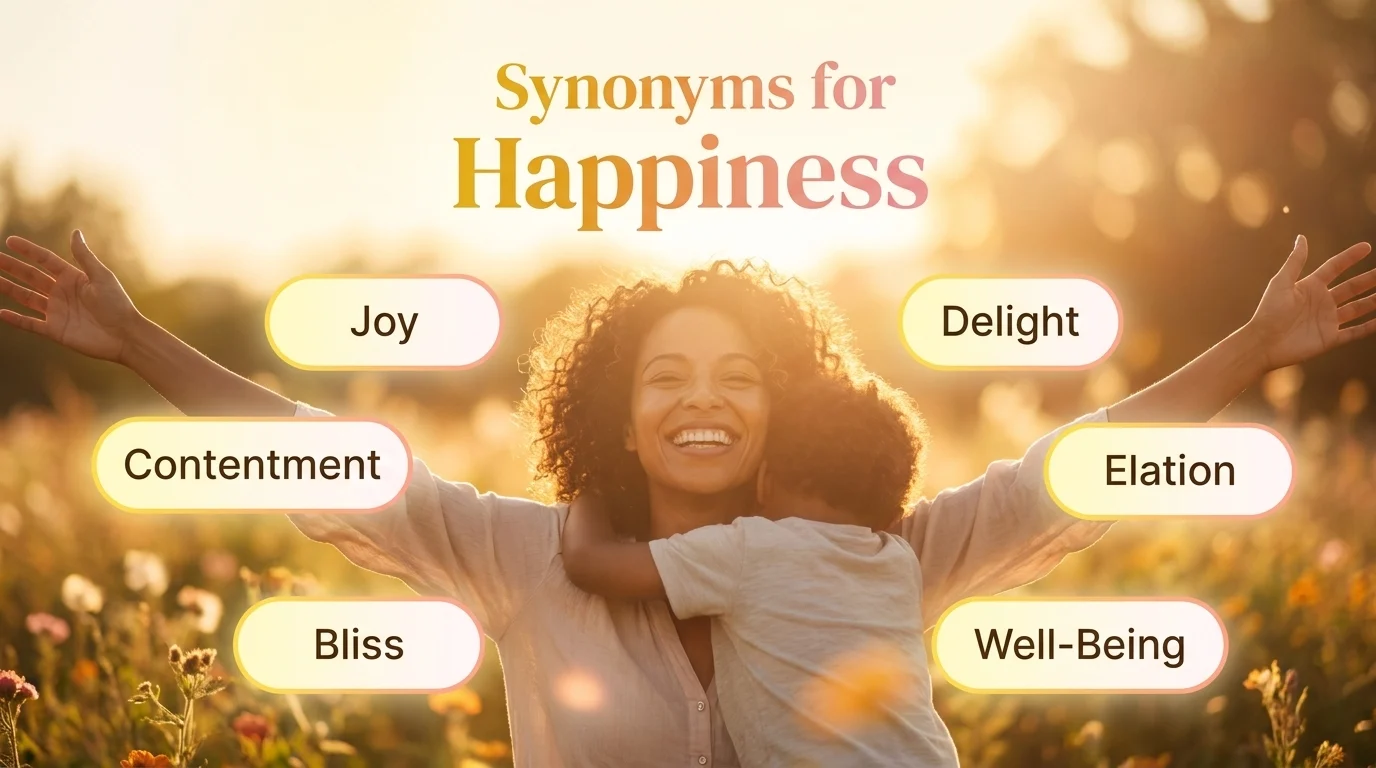
Do you keep using the word “happiness” in essays, blog posts, creative writing, mental health content, or everyday conversation? While it is one of the most beautiful and universally understood words in English, repeating it can make your writing feel flat, vague, or overly simplistic.
The good news is that the best alternative depends on what you actually mean. You might be describing deep contentment, fleeting joy, exuberant delight, quiet satisfaction, or spiritual bliss.
This guide explains synonyms for “happiness” by meaning, tone, context, and usage. You will learn which alternatives work best in academic writing, professional communication, creative expression, mental health content, and casual conversation.
Quick Answer: What Does “Happiness” Mean?
“Happiness” refers to a state of well-being, contentment, and positive emotion. It can describe a fleeting feeling of joy, a deep sense of satisfaction, or a lasting state of fulfillment. Depending on context, alternatives include joy, contentment, delight, bliss, elation, glee, satisfaction, euphoria, cheerfulness, and well-being.
Meaning, Tone, and Context
Simple Definition
“Happiness” generally refers to:
- Emotional state: feeling pleasure, joy, or contentment
- Life satisfaction: a sense of fulfillment and well-being
- Momentary joy: a brief feeling of delight or elation
- Deep contentment: lasting peace and satisfaction
- Spiritual joy: a sense of inner peace or blessedness
Part of Speech
“Happiness” is primarily a noun.
Examples:
- “Her happiness was contagious.”
- “He found happiness in simple things.”
Related Forms:
- Happy (adjective): feeling or showing pleasure
- Happily (adverb): in a happy manner
- Unhappy (adjective): not happy
- Happiness (noun): the state of being happy
Positive, Negative, or Neutral Tone
“Happiness” is strongly positive. It describes one of the most desirable emotional states.
Positive associations:
- “Her happiness lit up the room.”
- “They found happiness together.”
Neutral or philosophical contexts:
- “The pursuit of happiness is a fundamental right.”
- “Happiness is subjective.”
Formality Level
“Happiness” is a standard word that works in both formal and informal English. It is appropriate in academic papers, business communication, creative writing, and casual conversation.
However, more specific alternatives can add precision and variety, especially in creative or academic contexts.
Common Use Cases
“Happiness” commonly refers to:
- Emotional states: joy, delight, elation, glee
- Life satisfaction: contentment, fulfillment, well-being
- Moments of joy: bliss, ecstasy, euphoria
- Quiet happiness: contentment, peace, serenity
- Social happiness: cheerfulness, merriment, joviality
- Spiritual happiness: blessedness, beatitude, inner peace
Important Word Forms
- Happiness (noun): the state of being happy
- Happy (adjective): feeling or showing pleasure
- Happily (adverb): in a happy manner
- Unhappiness (noun): the state of being unhappy
- Happy-go-lucky (adjective): carefree and cheerful
When and How to Use “Happiness”
Use “happiness” when you want to describe a state of well-being, contentment, or positive emotion. Because the word is broad, more specific alternatives can add precision depending on the context.
Professional
“Employee happiness is linked to productivity and retention.”
This works naturally in business and HR communication.
Academic
“The study examined the relationship between gratitude and happiness.”
The term is appropriate in academic research.
Personal
“Her happiness means everything to me.”
The word sounds natural in everyday conversation.
Creative
“A quiet happiness settled over the village as the sun set.”
The word creates a peaceful, positive image.
Mental Health
“The pursuit of happiness is a common goal in therapy.”
This is appropriate in mental health contexts.
Philosophical
“Happiness is often considered the ultimate goal of human life.”
The term works well in philosophical discussions.
Another Word for “Happiness”
There is no single perfect synonym because “happiness” can refer to fleeting joy, deep contentment, exuberant delight, or spiritual bliss.
- Fleeting joy: joy, delight, glee, elation, thrill
- Deep contentment: contentment, satisfaction, fulfillment, peace, serenity
- Exuberant happiness: ecstasy, euphoria, rapture, bliss, jubilation
- Quiet happiness: contentment, peace, serenity, tranquility, ease
- Social happiness: cheerfulness, merriment, joviality, mirth, gaiety
- Spiritual happiness: blessedness, beatitude, grace, inner peace
If you need one broad alternative, “joy” works in most contexts, but it often implies a more intense or momentary feeling. “Contentment” works for deep, lasting happiness.
When Not to Use “Happiness”
“Happiness” can become too vague when you need to specify what kind of happiness you are describing.
Consider:
“She found happiness.”
This statement does not tell readers whether she found momentary joy, lasting contentment, spiritual peace, or social fulfillment.
A more precise sentence could be:
“She found deep contentment in her quiet life.”
Similarly, avoid using “happiness” when you mean “pleasure” in a physical or sensory context.
Words Commonly Confused With “Happiness”
Happiness vs. Joy
Joy often implies a more intense, momentary feeling of delight. Happiness can be more lasting.
Example:
“She felt a surge of joy when she saw him.” (momentary)
“She found happiness in her marriage.” (lasting)
Happiness vs. Contentment
Contentment implies a quiet, peaceful satisfaction. Happiness can be more active or expressive.
Example:
“He felt contentment sitting by the fire.” (quiet)
“She radiated happiness at the party.” (expressive)
Happiness vs. Pleasure
Pleasure often refers to physical or sensory enjoyment. Happiness is more emotional.
Example:
“The meal gave him great pleasure.” (sensory)
“Her happiness was evident to everyone.” (emotional)
Happiness vs. Joy vs. Bliss
Joy is intense and often momentary. Bliss is perfect, complete happiness.
Example:
“The joy of victory was short-lived.” (momentary)
“They lived in wedded bliss.” (perfect)
Happiness vs. Satisfaction
Satisfaction implies fulfillment of a need or desire. Happiness is broader.
Example:
“He felt satisfaction after completing the project.” (fulfillment)
“Happiness is not about achievement alone.” (broader)
Happiness vs. Well-being
Well-being refers to overall health and prosperity. Happiness is an emotional state.
Example:
“The program promotes employee well-being.” (holistic)
“Happiness is one component of well-being.” (emotional)
Best Synonym by Context for “Happiness”
| Context | Best Synonym | Why It Works | Example |
|---|---|---|---|
| Formal writing | Contentment, well-being | Precise and professional | The survey measured employee well-being. |
| Academic writing | Subjective well-being, life satisfaction | Standard academic usage | The study examined subjective well-being. |
| Creative writing | Joy, bliss, delight, rapture | Adds literary depth | A quiet joy filled her heart. |
| Fleeting happiness | Joy, delight, glee, thrill | Emphasizes momentary feeling | The children squealed with delight. |
| Deep contentment | Contentment, fulfillment, peace | Emphasizes lasting state | He found contentment in simple living. |
| Exuberant happiness | Elation, euphoria, ecstasy, jubilation | Emphasizes intense feeling | The crowd erupted in jubilation. |
| Quiet happiness | Serenity, tranquility, peace | Emphasizes calm | A sense of serenity washed over her. |
| Social happiness | Cheerfulness, merriment, mirth, gaiety | Emphasizes social joy | The party was filled with merriment. |
| Spiritual happiness | Blessedness, beatitude, grace | Emphasizes spiritual joy | She radiated a sense of blessedness. |
| Casual conversation | Happy (itself), good vibes | Natural and informal | I’m just feeling really happy today. |
| Mental health | Well-being, positive affect | Professional and clinical | The therapy improved her overall well-being. |
| Philosophical | Eudaimonia, flourishing | Classical and philosophical | Aristotle wrote about eudaimonia. |
Which Synonym Should You Choose?
Start by identifying what kind of “happiness” you are describing.
- Fleeting joy: joy, delight, glee, elation, thrill
- Deep contentment: contentment, satisfaction, fulfillment, peace, serenity
- Intense happiness: ecstasy, euphoria, rapture, bliss, jubilation
- Quiet happiness: serenity, tranquility, peace, ease
- Social happiness: cheerfulness, merriment, joviality, mirth, gaiety
- Spiritual happiness: blessedness, beatitude, grace, inner peace
- Philosophical happiness: eudaimonia, flourishing, well-being
- Clinical/mental health: subjective well-being, positive affect, life satisfaction
10 Key Synonyms for “Happiness”
The table below includes accurate alternatives with clear meanings and usage contexts.
| Synonym | Simple Meaning | Best Used For | Example Sentence |
|---|---|---|---|
| Joy | Intense, momentary delight | Creative, emotional contexts | The joy of seeing her again was overwhelming. |
| Contentment | Quiet, lasting satisfaction | Peaceful, reflective contexts | He found contentment in his simple life. |
| Delight | Great pleasure or joy | Reactions, moments | She squealed with delight at the surprise. |
| Bliss | Perfect, complete happiness | Romantic, spiritual, poetic | They lived in wedded bliss. |
| Elation | Great happiness and excitement | Achievements, victories | He felt a surge of elation after winning. |
| Glee | Exuberant, often playful joy | Children, celebrations | The children laughed with glee. |
| Satisfaction | Fulfillment of a need or desire | Work, achievements | She felt deep satisfaction after completing the project. |
| Euphoria | Intense excitement and happiness | Peak moments, achievements | The team was in a state of euphoria after the win. |
| Cheerfulness | Positive, optimistic mood | Social, everyday contexts | Her cheerfulness brightened the room. |
| Well-being | Overall health and happiness | Professional, academic | The program promotes employee well-being. |
Synonym Groups and Usage Differences
Professional vs. Personal Synonyms
Professional writing benefits from specific terms such as well-being, satisfaction, morale, and engagement.
Personal communication often uses happiness itself or casual alternatives like joy, good vibes, or feeling great.
Compare:
“I’m so happy today.” (personal)
“Employee well-being is a priority.” (professional)
Formal vs. Conversational Synonyms
Happiness works in both formal and conversational English.
Formal alternatives: contentment, well-being, satisfaction, fulfillment
Conversational alternatives: joy, good vibes, feeling great, bliss
Examples:
“The study measured life satisfaction.” (formal)
“I’m on cloud nine!” (conversational)
Academic Synonyms
Academic writing should distinguish between happiness (general), subjective well-being (psychological measure), life satisfaction (cognitive evaluation), and positive affect (emotional state).
For example:
“The study examined the relationship between gratitude and subjective well-being.”
“Life satisfaction is a key component of happiness.”
Professional and Business Synonyms
Business writing often benefits from phrases such as employee well-being, job satisfaction, morale, and engagement.
Instead of:
“Employee happiness is important.”
Consider:
“Employee well-being and job satisfaction are linked to retention.”
Creative or Literary Synonyms
Creative writing can use bliss, rapture, elation, glee, merriment, mirth, jubilation, and euphoria depending on the context.
For example:
“A quiet rapture filled her soul.”
“The streets were alive with merriment.”
Slang or Modern Synonyms
Good vibes is a modern casual term for positive feelings.
On cloud nine means extremely happy.
Over the moon means delighted.
Walking on air means elated.
Examples:
“I’m getting good vibes from this place.” (modern)
“She was over the moon about the news.” (idiom)
Strongest vs. Weaker Synonyms
“Happiness” synonyms vary in intensity:
Milder: contentment, satisfaction, cheerfulness
Moderate: happiness, joy, delight
Strong: elation, glee, jubilation
Very Strong: ecstasy, euphoria, rapture, bliss
Emotional vs. Neutral Synonyms
“Happiness” is strongly emotional and positive.
Emotional alternatives: joy, bliss, rapture, euphoria
Neutral alternatives: well-being, satisfaction, contentment
Examples:
“She was in a state of pure bliss.” (emotional)
“The survey measured life satisfaction.” (neutral)
Antonyms of “Happiness”
“Happiness” has several antonyms depending on context:
| Antonym | Context | Meaning | Example Sentence |
|---|---|---|---|
| Sadness | General | Feeling sorrow | A deep sadness filled her heart. |
| Unhappiness | General | State of being unhappy | His unhappiness was evident. |
| Misery | General | Great suffering | The refugees lived in misery. |
| Sorrow | Emotional | Deep sadness | She was overcome with sorrow. |
| Melancholy | Emotional | Pensive sadness | A melancholy mood settled over him. |
| Despair | Emotional | Complete loss of hope | He sank into despair. |
| Gloom | Atmosphere | Darkness or sadness | A sense of gloom hung over the room. |
| Depression | Clinical | Mental health condition | She was diagnosed with depression. |
Comparison: “Happiness” vs. Similar Words
Happiness vs. Joy
Main difference: Joy is often more intense and momentary. Happiness can be more lasting.
Examples:
“She felt a surge of joy when she saw him.” (momentary)
“She found happiness in her marriage.” (lasting)
Happiness vs. Contentment
Main difference: Contentment implies a quiet, peaceful satisfaction. Happiness can be more active or expressive.
Examples:
“He felt contentment sitting by the fire.” (quiet)
“She radiated happiness at the party.” (expressive)
Happiness vs. Pleasure
Main difference: Pleasure often refers to physical or sensory enjoyment. Happiness is more emotional.
Examples:
“The meal gave him great pleasure.” (sensory)
“Her happiness was evident to everyone.” (emotional)
Happiness vs. Bliss
Main difference: Bliss is perfect, complete happiness. Happiness can be more ordinary.
Examples:
“They lived in wedded bliss.” (perfect)
“She found happiness in her daily routine.” (ordinary)
Happiness vs. Satisfaction
Main difference: Satisfaction implies fulfillment of a need or desire. Happiness is broader.
Examples:
“He felt satisfaction after completing the project.” (fulfillment)
“Happiness is not about achievement alone.” (broader)
Happiness vs. Well-being
Main difference: Well-being refers to overall health and prosperity. Happiness is an emotional state.
Examples:
“The program promotes employee well-being.” (holistic)
“Happiness is one component of well-being.” (emotional)
Common Phrases and Expressions with “Happiness”
1. Pursuit of happiness
Meaning:
The right to seek happiness, famously in the U.S. Declaration of Independence.
Example:
“The pursuit of happiness is a fundamental human right.”
2. Find happiness
Meaning:
To discover or achieve a state of happiness.
Example:
“She finally found happiness after years of struggle.”
3. Happiness is…
Meaning:
A philosophical or reflective statement about what happiness means.
Example:
“Happiness is a warm cup of tea on a cold day.”
4. Tears of happiness
Meaning:
Crying from joy.
Example:
“She shed tears of happiness at the wedding.”
5. Wish someone happiness
Meaning:
To express a desire for someone’s well-being.
Example:
“I wish you all the happiness in the world.”
6. Bursting with happiness
Meaning:
Overflowing with joy.
Example:
“She was bursting with happiness after the news.”
7. Happiness and health
Meaning:
A common phrase wishing someone well.
Example:
“Wishing you happiness and health in the new year.”
8. Choose happiness
Meaning:
A motivational phrase about making choices that lead to happiness.
Example:
“Every day, you can choose happiness.”
9. Source of happiness
Meaning:
Something or someone that brings joy.
Example:
“Her children are her greatest source of happiness.”
10. True happiness
Meaning:
Deep, lasting happiness.
Example:
“True happiness comes from within.”
Common Mistakes to Avoid
1. Using “happiness” when a more precise term is available
If you mean joy, contentment, bliss, or well-being, use the more specific word.
Vague: “She found happiness.”
Precise: “She found deep contentment in her new life.”
2. Using “happiness” in clinical contexts when “well-being” is needed
Mental health and clinical writing should use well-being, subjective well-being, or life satisfaction.
Clinical: “The therapy improved her subjective well-being.”
Casual: “She found happiness in her hobby.”
3. Confusing “happiness” with “pleasure”
Pleasure is often physical or sensory. Happiness is more emotional.
Incorrect: “The massage gave her happiness.”
Correct: “The massage gave her pleasure.”
4. Overusing “happiness” in writing
Repetition can make content feel dull. Use alternatives such as joy, contentment, delight, bliss, elation, and well-being.
5. Choosing a synonym that changes the meaning
Do not replace happiness with pleasure unless you mean sensory enjoyment.
Do not replace happiness with satisfaction unless you mean fulfillment of a need.
FAQs
What is the best synonym for “happiness”?
The best synonym depends on context. Joy works for intense feeling, contentment for lasting peace, delight for momentary pleasure, bliss for perfect happiness, and well-being for professional contexts.
What is a formal synonym for “happiness”?
Contentment, well-being, satisfaction, fulfillment, and subjective well-being are formal synonyms.
What is an informal synonym for “happiness”?
Good vibes, feeling great, on cloud nine, over the moon, and bliss are common informal alternatives.
What is another word for “happiness” in creative writing?
Bliss, rapture, elation, glee, merriment, mirth, and jubilation work well in creative writing.
What is the difference between “happiness” and “joy”?
Joy is often more intense and momentary. Happiness can be more lasting and general.
What is the opposite of “happiness”?
Depending on context, opposites include sadness, unhappiness, misery, sorrow, melancholy, and despair.
What does “happiness” mean in a philosophical context?
In philosophy, happiness often refers to eudaimonia (flourishing) or the ultimate goal of human life.
Conclusion
“Happiness” is a beautiful, versatile word that can describe fleeting joy, deep contentment, exuberant delight, and spiritual bliss. The best synonym depends on what you actually mean.
Choose joy for intense feeling, contentment for lasting peace, delight for momentary pleasure, bliss for perfect happiness, elation for achievement, and well-being for professional contexts.
Most importantly, do not replace “happiness” simply to avoid repetition. First identify what kind of happiness—fleeting, lasting, quiet, exuberant, or spiritual—you are actually describing. Then choose the alternative that communicates that idea most clearly.
For academic, professional, and formal writing, precision is usually more valuable than vocabulary variety. A specific term such as subjective well-being, life satisfaction, or contentment can tell readers much more than the broad word happiness.
Before publishing a vocabulary guide, verify definitions and usage with trusted dictionaries such as Cambridge, Oxford, Merriam-Webster, Collins, or Britannica. This helps ensure that each alternative accurately matches its intended meaning and context.
The practical takeaway is simple: when “happiness” feels too general, ask yourself what kind of joy, contentment, or well-being you are actually describing. Then use the most precise word available.
Discover More:-
- 50+ Synonyms for Safe: Meanings, Examples, and Best Alternatives
- 50+ Synonyms for Highlights: Meanings, Examples, and Best Alternatives

4 thoughts on “50+ Synonyms for Happiness: Meanings, Examples, and Best Alternatives”