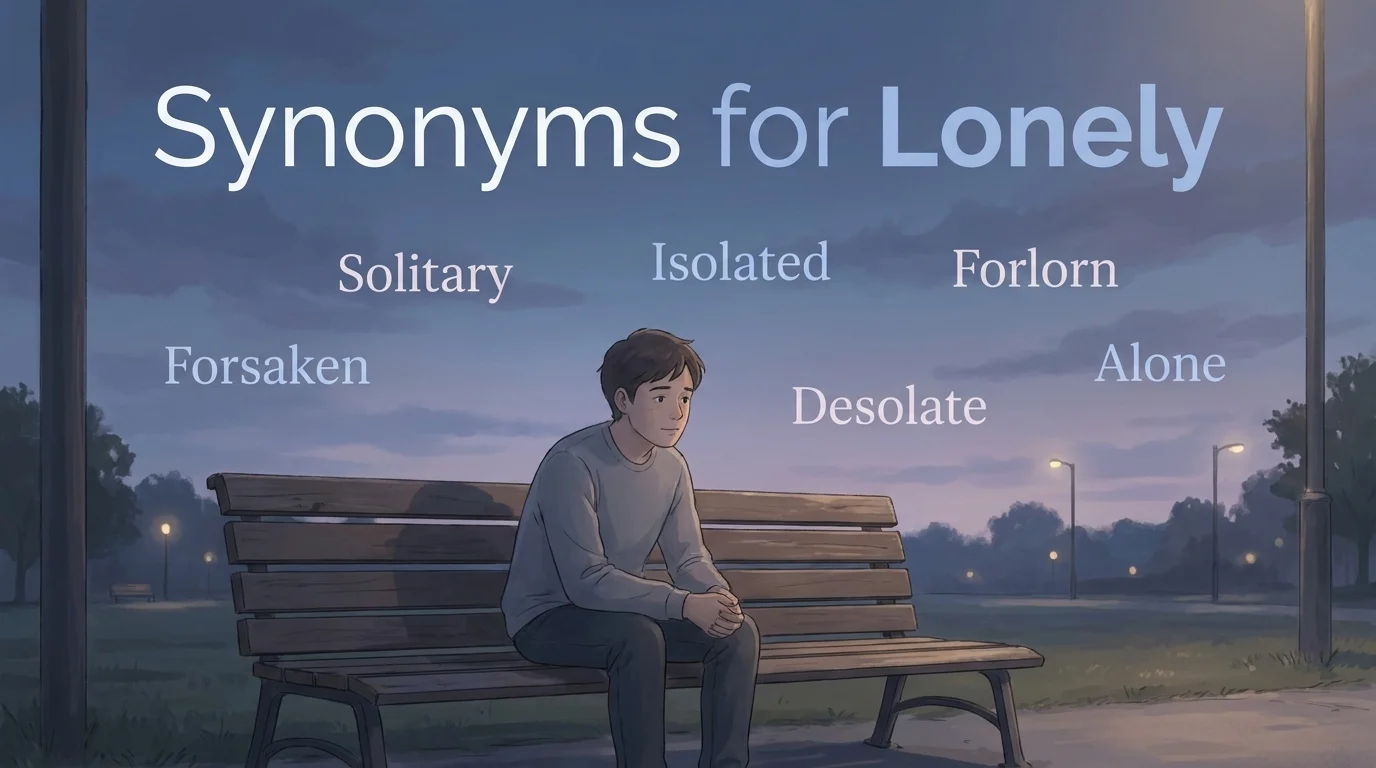
Do you keep using the word “lonely” in essays, creative writing, mental health content, personal journals, or everyday conversation? While it is a deeply meaningful and universally understood word, repeating it can make your writing feel flat, vague, or emotionally repetitive.
The good news is that the best alternative depends on what you actually mean. You might be describing physical isolation, emotional emptiness, social disconnection, quiet solitude, or a deep sense of abandonment.
This guide explains synonyms for “lonely” by meaning, tone, context, and usage. You will learn which alternatives work best in academic writing, creative expression, mental health content, professional communication, and casual conversation.
Important Note: Loneliness is a serious emotional and mental health concern. When writing about loneliness, use precise, respectful, and empathetic language. Avoid romanticizing or trivializing the experience.
Quick Answer: What Does “Lonely” Mean?
“Lonely” describes a feeling of sadness or emptiness caused by a lack of companionship or connection. It can refer to physical isolation, emotional disconnection, or a deep sense of being alone. Depending on context, alternatives include solitary, isolated, forsaken, abandoned, desolate, forlorn, friendless, reclusive, secluded, and alone.
Meaning, Tone, and Context
Simple Definition
“Lonely” generally refers to:
- Emotional state: feeling sad or empty due to lack of connection
- Physical isolation: being alone or separated from others
- Social disconnection: lacking friends or companionship
- Deep abandonment: feeling forsaken or deserted
- Quiet solitude: being alone by choice (can be positive or negative)
Part of Speech
“Lonely” functions primarily as an adjective.
Examples:
- “She felt lonely after moving to a new city.”
- “The house stood lonely on the hill.”
Related Forms:
- Loneliness (noun): the state of being lonely
- Lonely (adjective): feeling sad from lack of company
- Alone (adjective/adverb): without others (neutral)
- Lonesome (adjective): feeling lonely (especially American English)
- Loner (noun): a person who prefers to be alone
Positive, Negative, or Neutral Tone
“Lonely” is negative in tone. It describes a painful emotional state.
Negative associations:
- “He felt lonely and abandoned.”
- “The lonely old man had no visitors.”
Neutral or positive contexts:
- “She enjoyed a lonely walk in the woods.” (quiet solitude)
- “The lonely lighthouse stood on the cliff.” (descriptive)
Formality Level
“Lonely” is a standard word that works in both formal and informal English. It is appropriate in academic writing, creative expression, mental health content, and casual conversation.
However, more specific alternatives can add precision and emotional depth.
Common Use Cases
“Lonely” commonly refers to:
- Emotional loneliness: feeling sad from lack of connection
- Social loneliness: lacking friends or social contact
- Physical isolation: being alone in a place
- Existential loneliness: feeling disconnected from others or the world
- Quiet solitude: being alone by choice (positive or neutral)
- Abandonment: feeling deserted or forsaken
Important Word Forms
- Lonely (adjective): feeling sad from lack of company
- Loneliness (noun): the state of being lonely
- Lonesome (adjective): feeling lonely (American English)
- Alone (adjective/adverb): without others (neutral)
- Solitude (noun): the state of being alone (often positive)
- Solitary (adjective): done alone; being alone
- Loner (noun): a person who prefers to be alone
When and How to Use “Lonely”
Use “lonely” when you want to describe a feeling of sadness or emptiness caused by lack of companionship or connection. Because the word is broad, more specific alternatives can add precision depending on the context.
Professional (Mental Health)
“The client reported feeling lonely and isolated after retirement.”
This is appropriate in clinical or therapeutic settings.
Academic
“The study examined the effects of loneliness on cognitive health in older adults.”
The term is appropriate in academic research.
Personal
“I’ve been feeling lonely since my best friend moved away.”
The word sounds natural in personal conversation.
Creative
“The lonely figure stood at the window, watching the world pass by.”
The word creates a vivid, emotional image.
Descriptive
“The lonely road stretched endlessly into the desert.”
Here, “lonely” describes a desolate place.
Social Commentary
“Loneliness has become an epidemic in modern society.”
The term is appropriate for social analysis.
Another Word for “Lonely”
There is no single perfect synonym because “lonely” can refer to emotional sadness, physical isolation, social disconnection, or quiet solitude.
- Emotional loneliness: forlorn, desolate, heartsick, woeful
- Social loneliness: friendless, isolated, disconnected, alienated
- Physical isolation: solitary, secluded, reclusive, sequestered
- Abandonment: forsaken, abandoned, deserted, neglected
- Quiet solitude: alone, solitary, secluded (neutral or positive)
- Deep loneliness: despondent, despairing, bereft, grief-stricken
If you need one broad alternative, “solitary” works for physical isolation, but it doesn’t carry the emotional weight of “lonely.” “Forlorn” captures the sadness of loneliness.
When Not to Use “Lonely”
“Lonely” can become too vague or emotionally heavy when you need to specify what kind of loneliness you are describing.
Consider:
“She is lonely.”
This statement does not tell readers whether she is physically alone, emotionally disconnected, socially isolated, or feeling abandoned.
A more precise sentence could be:
“She feels emotionally disconnected despite being surrounded by people.”
Similarly, avoid using “lonely” when you mean “alone” in a neutral context. “Alone” is neutral; “lonely” is emotional.
Words Commonly Confused With “Lonely”
Lonely vs. Alone
Alone means without others; it is neutral or factual. Lonely means feeling sad from lack of company.
Example:
“She lives alone.” (neutral)
“She feels lonely.” (emotional)
Lonely vs. Solitary
Solitary means being alone or done alone; it can be neutral or positive. Lonely is negative.
Example:
“He enjoys solitary walks.” (positive)
“He feels lonely without his friends.” (negative)
Lonely vs. Isolated
Isolated means separated from others; it can be physical or social. Lonely is emotional.
Example:
“The village is isolated in the mountains.” (physical)
“She felt lonely in the crowded city.” (emotional)
Lonely vs. Forlorn
Forlorn means pitifully sad and abandoned. It is stronger than lonely.
Example:
“The forlorn puppy waited by the door.” (pitiful)
“She felt lonely after the party.” (sad)
Lonely vs. Desolate
Desolate means empty, barren, or without comfort. It can describe places or feelings.
Example:
“The desolate landscape stretched for miles.” (barren)
“He felt desolate after losing his wife.” (emotional)
Lonely vs. Reclusive
Reclusive means preferring to live alone; it can be a choice. Lonely is an emotional state.
Example:
“The reclusive author rarely left his home.” (choice)
“She felt lonely despite her success.” (emotion)
Best Synonym by Context for “Lonely”
| Context | Best Synonym | Why It Works | Example |
|---|---|---|---|
| Formal writing | Isolated, solitary | Precise and professional | The elderly often feel isolated. |
| Academic writing | Socially isolated, disconnected | Standard academic usage | Socially isolated individuals are at higher risk. |
| Mental health | Lonely, socially disconnected | Clinical and empathetic | The patient reported feeling lonely. |
| Creative writing | Forlorn, desolate, forsaken | Adds literary depth | A forlorn figure wandered the empty streets. |
| Physical isolation | Solitary, secluded, reclusive | Emphasizes being alone | He led a solitary life in the mountains. |
| Abandonment | Forsaken, abandoned, deserted | Emphasizes being left behind | The forsaken child longed for comfort. |
| Deep sadness | Desolate, heartsick, woeful | Emphasizes emotional pain | She felt desolate after the loss. |
| Quiet solitude | Alone, solitary, secluded | Neutral or positive | He enjoyed solitary evenings by the fire. |
| Social disconnection | Alienated, disconnected, friendless | Emphasizes lack of social ties | The immigrant felt alienated in the new country. |
| Casual conversation | Lonely (itself), lonesome | Natural and informal | I’ve been feeling a bit lonesome lately. |
| Descriptive (places) | Desolate, remote, isolated | Describes empty places | The desolate house stood on the cliff. |
Which Synonym Should You Choose?
Start by identifying what kind of “lonely” you are describing.
- Emotional loneliness: forlorn, desolate, heartsick, woeful, grief-stricken
- Social loneliness: friendless, isolated, alienated, disconnected
- Physical isolation: solitary, secluded, reclusive, sequestered, remote
- Abandonment: forsaken, abandoned, deserted, neglected
- Quiet solitude: alone, solitary, secluded (neutral or positive)
- Deep loneliness: despondent, despairing, bereft, empty
- Existential loneliness: alienated, disconnected, estranged
- Descriptive (places): desolate, remote, isolated, barren
10 Key Synonyms for “Lonely”
The table below includes accurate alternatives with clear meanings and usage contexts.
| Synonym | Simple Meaning | Best Used For | Example Sentence |
|---|---|---|---|
| Solitary | Being alone; done alone | Physical isolation, neutral | He led a solitary life in the countryside. |
| Isolated | Separated from others | Social or physical separation | The elderly often feel isolated. |
| Forsaken | Abandoned or deserted | Emotional abandonment | She felt forsaken by her friends. |
| Abandoned | Left behind; deserted | Emotional or physical | The abandoned puppy waited by the road. |
| Desolate | Empty, barren, without comfort | Emotional or physical emptiness | He felt desolate after the loss. |
| Forlorn | Pitifully sad and alone | Creative, emotional | The forlorn figure sat alone in the rain. |
| Friendless | Having no friends | Social isolation | He felt friendless in the new city. |
| Reclusive | Preferring to be alone | Lifestyle, choice | The reclusive writer rarely gave interviews. |
| Secluded | Private, away from others | Physical isolation | They lived in a secluded cottage. |
| Alone | Without others (neutral) | Neutral, factual | She lives alone but doesn’t feel lonely. |
Synonym Groups and Usage Differences
Professional vs. Personal Synonyms
Professional writing, especially in mental health or social work, benefits from terms such as socially isolated, disconnected, alienated, and lacking social support.
Personal communication often uses lonely, lonesome, or feeling down.
Compare:
“I’m feeling lonely.” (personal)
“The patient reports feeling socially isolated.” (professional)
Formal vs. Conversational Synonyms
Lonely works in both formal and conversational English.
Formal alternatives: isolated, solitary, alienated, disconnected
Conversational alternatives: lonesome, alone, feeling down
Examples:
“Socially isolated individuals face greater health risks.” (formal)
“I’ve been feeling lonesome lately.” (conversational)
Academic Synonyms
Academic writing should distinguish between loneliness (perceived social isolation), social isolation (objective lack of contact), solitude (being alone, often positive), and alienation (feeling estranged).
For example:
“The study measured loneliness using the UCLA Loneliness Scale.”
“Social isolation is an objective measure, while loneliness is subjective.”
Professional and Business Synonyms
Business and HR writing often benefits from phrases such as socially disconnected, lacking support, isolated, and remote.
Instead of:
“Remote workers often feel lonely.”
Consider:
“Remote workers often experience social disconnection and isolation.”
Creative or Literary Synonyms
Creative writing can use forlorn, desolate, forsaken, woeful, bereft, solitary, sequestered, and secluded.
For example:
“A forlorn wind blew through the empty streets.”
“She felt bereft and utterly alone.”
Slang or Modern Synonyms
Feeling down can mean lonely or sad.
Left out means excluded socially.
Fifth wheel means feeling unnecessary in a group.
Ghosted means being suddenly ignored by someone.
Examples:
“I’m feeling a bit down lately.” (casual)
“I felt like a fifth wheel at the party.” (casual)
Strongest vs. Weaker Synonyms
“Lonely” synonyms vary in intensity:
Milder: alone, solitary, secluded
Moderate: lonely, isolated, friendless
Strong: forlorn, desolate, forsaken
Very Strong: abandoned, bereft, despondent
Emotional vs. Neutral Synonyms
“Lonely” is strongly emotional.
Emotional alternatives: forlorn, desolate, forsaken, heartsick
Neutral alternatives: alone, solitary, secluded
Examples:
“She felt utterly forsaken.” (emotional)
“He lives a solitary life.” (neutral)
Antonyms of “Lonely”
“Lonely” has several antonyms depending on context:
| Antonym | Context | Meaning | Example Sentence |
|---|---|---|---|
| Connected | Social | Having social ties | She felt connected to her community. |
| Accompanied | Physical | With others | He was accompanied by friends. |
| Social | General | Enjoying company | She has a social personality. |
| Supported | Emotional | Having support | He felt supported by his family. |
| Included | Social | Part of a group | She felt included in the team. |
| Surrounded | Physical | Having people around | He was surrounded by loved ones. |
| Companionable | Emotional | Friendly and sociable | The atmosphere was warm and companionable. |
| Belonging | Emotional | Feeling accepted | She finally felt a sense of belonging. |
Comparison: “Lonely” vs. Similar Words
Lonely vs. Alone
Main difference: Alone is neutral and factual. Lonely is emotional and negative.
Examples:
“She lives alone.” (neutral)
“She feels lonely.” (emotional)
Lonely vs. Solitary
Main difference: Solitary can be neutral or positive. Lonely is negative.
Examples:
“He enjoys solitary walks.” (positive)
“He feels lonely without his friends.” (negative)
Lonely vs. Isolated
Main difference: Isolated can be physical or social. Lonely is emotional.
Examples:
“The village is isolated.” (physical)
“She felt lonely in the city.” (emotional)
Lonely vs. Forlorn
Main difference: Forlorn is stronger and implies abandonment. Lonely is more general.
Examples:
“The forlorn puppy waited by the door.” (pitiful, abandoned)
“She felt lonely after the party.” (sad)
Lonely vs. Desolate
Main difference: Desolate can describe places or deep emotional emptiness. Lonely is more personal.
Examples:
“The desolate landscape stretched for miles.” (barren)
“He felt desolate after losing his wife.” (emotional)
Lonely vs. Reclusive
Main difference: Reclusive implies a choice to be alone. Lonely is an emotional state.
Examples:
“The reclusive author rarely left his home.” (choice)
“She felt lonely despite her success.” (emotion)
Common Phrases and Expressions with “Lonely”
1. Lonely hearts
Meaning:
People who are lonely and seeking companionship.
Example:
“The club is a meeting place for lonely hearts.”
2. Lonely at the top
Meaning:
Success can be isolating.
Example:
“Being the CEO can be lonely at the top.”
3. Lonely road
Meaning:
A difficult or isolated path in life.
Example:
“He walked the lonely road of recovery alone.”
4. Feel lonely in a crowd
Meaning:
Feeling disconnected even when surrounded by people.
Example:
“She felt lonely in a crowd of strangers.”
5. Lonely planet
Meaning:
A travel guidebook series; also, a metaphor for isolation.
Example:
“He felt like he was on a lonely planet.”
6. A lonely existence
Meaning:
A life characterized by isolation.
Example:
“He lived a lonely existence in the countryside.”
7. Lonely vigil
Meaning:
Waiting alone, often in sorrow.
Example:
“She kept a lonely vigil by his bedside.”
Common Mistakes to Avoid
1. Confusing “lonely” with “alone”
Alone is neutral and factual. Lonely is emotional and negative.
Incorrect: “She lives lonely.” (grammatically incorrect)
Correct: “She lives alone.” (factual)
Correct: “She feels lonely.” (emotional)
2. Using “lonely” casually
Using “lonely” for mild feelings of boredom or temporary solitude minimizes a serious emotional state.
Casual, problematic: “I’m so lonely, there’s nothing to do.”
Better: “I’m bored and have nothing to do.”
3. Using “lonely” in clinical writing when “socially isolated” is more precise
Mental health and clinical writing should use socially isolated, lacking social support, or experiencing loneliness.
Clinical: “The patient reports experiencing loneliness.”
Casual: “She feels lonely.”
4. Overusing “lonely” in writing
Repetition can make content feel dull or overly sentimental. Use alternatives such as isolated, forlorn, solitary, desolate, and disconnected.
5. Choosing a synonym that changes the meaning
Do not replace lonely with alone unless you mean neutral physical isolation.
Do not replace lonely with solitary unless you mean being alone (neutral or positive).
FAQs
What is the best synonym for “lonely”?
The best synonym depends on context. Isolated works for social contexts, solitary for physical isolation, forlorn for emotional sadness, forsaken for abandonment, and desolate for deep emptiness.
What is a formal synonym for “lonely”?
Isolated, solitary, alienated, disconnected, and socially isolated are formal synonyms.
What is an informal synonym for “lonely”?
Lonesome, alone, feeling down, and left out are common informal alternatives.
What is another word for “lonely” in creative writing?
Forlorn, desolate, forsaken, woeful, bereft, and secluded work well in creative writing.
What is the difference between “lonely” and “alone”?
Alone means without others; it is neutral. Lonely means feeling sad from lack of company; it is emotional.
What is the opposite of “lonely”?
Depending on context, opposites include connected, accompanied, social, supported, included, and belonging.
Is loneliness a mental health concern?
Yes. Chronic loneliness is linked to depression, anxiety, and other health issues. It is a serious concern that deserves empathetic and accurate language.
Conclusion
“Lonely” is a deeply emotional word that can describe physical isolation, social disconnection, emotional emptiness, or quiet solitude. The best synonym depends on what you actually mean.
Choose solitary for physical isolation, isolated for social separation, forlorn for emotional sadness, forsaken for abandonment, desolate for deep emptiness, and reclusive for a chosen lifestyle.
Most importantly, use precise and empathetic language when discussing loneliness. Avoid romanticizing or trivializing the experience.
For academic, clinical, and professional writing, precision is essential. A specific term such as socially isolated, experiencing loneliness, or lacking social support provides critical clarity.
Before publishing a vocabulary guide, verify definitions and usage with trusted dictionaries such as Cambridge, Oxford, Merriam-Webster, Collins, or the UCLA Loneliness Scale for clinical accuracy. This helps ensure that each alternative accurately matches its intended meaning and context.
The practical takeaway is simple: when “lonely” feels too general, ask yourself what kind of isolation, disconnection, or emotional pain you are actually describing. Then use the most precise and respectful word available.
Discover More:-
- 50+ Synonyms for Various: Meanings, Examples, and Best Alternatives
- 50+ Synonyms for Eager: Meanings, Examples, and Best Alternatives

1 thought on “50+ Synonyms for Lonely: Meanings, Examples, and Best Alternatives”