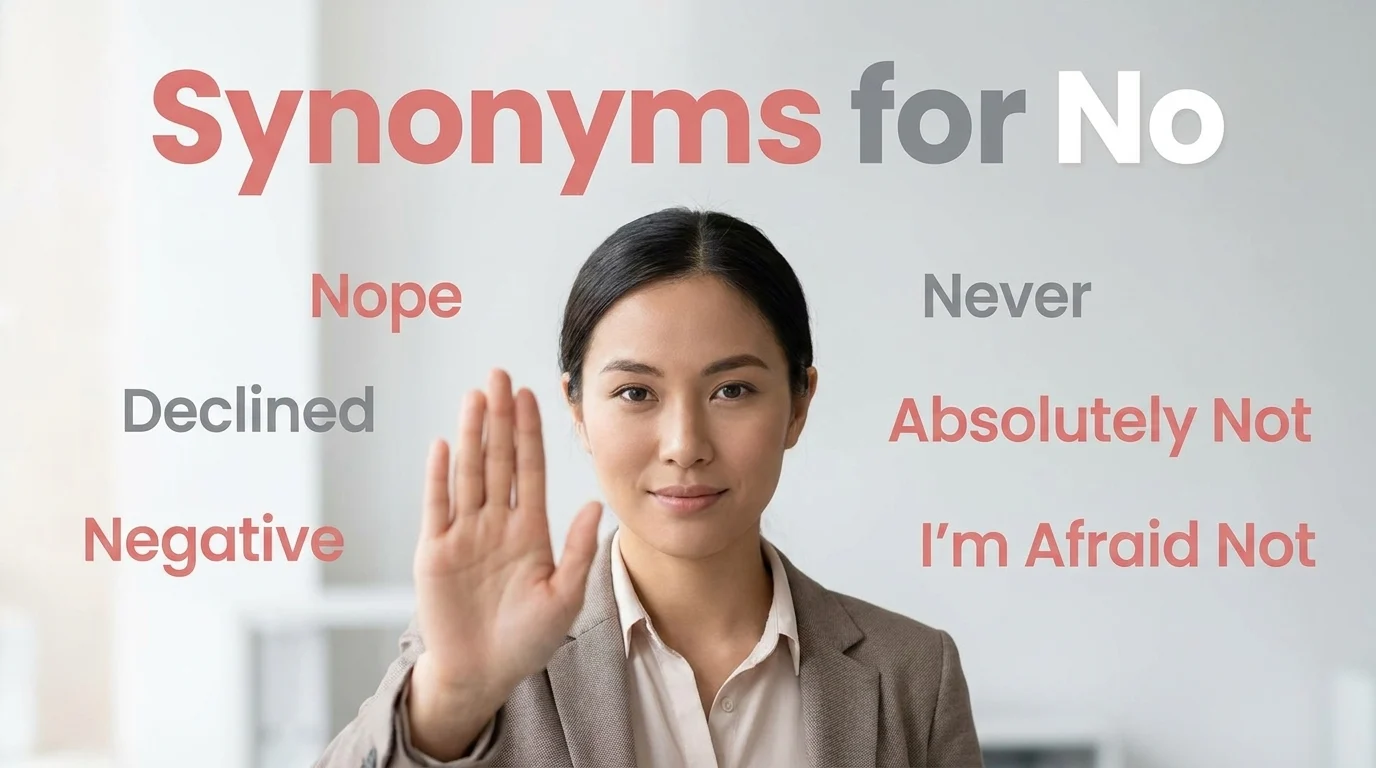
Do you keep using the word “no” in emails, conversations, negotiations, creative writing, or professional communication? While it is one of the simplest and most powerful words in English, repeating it can make your writing feel blunt, repetitive, or unnecessarily harsh.
The good news is that the best alternative depends on what you actually mean and how you want to sound. You might be giving a firm refusal, a polite decline, a gentle rejection, an absolute denial, or a simple negative response.
This guide explains synonyms for “no” by meaning, tone, context, and usage. You will learn which alternatives work best in professional communication, customer service, negotiations, creative writing, and casual conversation.
Quick Answer: What Does “No” Mean?
“No” is a negative response used to express denial, refusal, disagreement, or absence. It can indicate that something is not true, not allowed, not available, or not wanted. Depending on context, alternatives include nope, nay, never, not at all, negative, declined, refused, denied, absolutely not, and by no means.
Meaning, Tone, and Context
Simple Definition
“No” generally refers to:
- Refusal: declining a request or offer
- Denial: stating that something is not true
- Disagreement: expressing opposition or difference of opinion
- Absence: indicating that something is not present or available
- Prohibition: indicating that something is not allowed
Part of Speech
“No” functions as an adverb, adjective, noun, and interjection.
Adverb Examples:
- “No, I don’t want any.”
- “She said no to the offer.”
Adjective Examples:
- “There is no milk left.”
- “He has no money.”
Noun Examples:
- “The answer was a firm no.”
- “She gave a definite no.”
Interjection Examples:
- “No! Don’t do that!”
- “No, thank you.”
Positive, Negative, or Neutral Tone
“No” is negative in tone, but the strength and politeness can vary greatly depending on context and delivery.
Direct and firm:
- “No, I won’t do that.”
Polite and soft:
- “I’m afraid that won’t be possible.”
Formality Level
“No” is a standard word that works in both formal and informal English. However, in professional and formal contexts, softer or more polite alternatives are often preferred.
Common Use Cases
“No” commonly appears in:
- Refusals: declining requests, offers, or invitations
- Denials: rejecting accusations or statements
- Disagreements: expressing opposition
- Prohibitions: indicating something is not allowed
- Absence: indicating lack of something
- Negotiations: rejecting terms or proposals
Important Word Forms
- No (adverb/adjective/noun/interjection): negative response
- Nope (adverb, informal): casual no
- Nay (adverb/noun, archaic/formal): no, especially in voting
- None (pronoun): not any
- Nothing (pronoun): not anything
- Nobody (pronoun): no person
- Nowhere (adverb): in no place
When and How to Use “No”
Use “no” when you want to give a negative response, express refusal, deny something, or indicate absence. Because the word is direct, softer alternatives are often preferred in professional and polite contexts.
Professional (Soft Refusal)
“I’m afraid we won’t be able to accommodate that request.”
This is more polite than a direct “no” in business contexts.
Professional (Firm Refusal)
“No, we cannot proceed with those terms.”
This is appropriate when firmness is necessary.
Academic
“There is no evidence to support that claim.”
The word is appropriate in academic writing for indicating absence.
Personal
“No, thank you. I’ve had enough.”
The word sounds natural in everyday conversation.
Customer Service
“Unfortunately, that option is not available at this time.”
This softens the “no” in customer service.
Negotiations
“We are not in a position to accept that offer.”
This is a diplomatic way to say no in negotiations.
Another Word for “No”
There is no single perfect synonym because “no” can be used in many different ways and with different levels of politeness.
- Casual refusal: nope, nah, no way, not happening
- Formal refusal: negative, declined, not possible, unable to comply
- Strong refusal: absolutely not, by no means, under no circumstances, never
- Polite refusal: I’m afraid not, unfortunately not, not at this time
- Denial: not true, false, incorrect, unfounded
- Absence: none, nothing, zero, not any
- Prohibition: not allowed, forbidden, prohibited
- Disagreement: I disagree, I don’t think so, not necessarily
If you need one broad alternative, “nope” works for casual contexts, while “I’m afraid not” works for polite professional contexts.
When Not to Use “No”
“No” can become problematic when it is too blunt, harsh, or dismissive.
Consider:
“No, that’s a terrible idea.”
This is direct and potentially offensive. A more diplomatic sentence could be:
“I have some concerns about that approach.”
Similarly, avoid using a flat “no” in customer service or professional contexts where a softer alternative would maintain the relationship.
Words Commonly Confused With “No”
No vs. Not
Not is an adverb used to negate verbs, adjectives, and adverbs. No is used as a determiner or interjection.
Example:
“There is no milk.” (determiner)
“There is not any milk.” (adverb)
No vs. None
None is a pronoun meaning “not any” or “no one.” No is a determiner.
Example:
“None of the students passed.” (pronoun)
“No students passed.” (determiner)
No vs. Never
Never means at no time. No is a general negative response.
Example:
“I never go there.” (at no time)
“No, I don’t go there.” (negative response)
No vs. Nay
Nay is an archaic or formal way to say no, especially in voting.
Example:
“The vote was 50 yea and 30 nay.” (formal voting)
“No, I disagree.” (standard)
No vs. Negative
Negative is a formal way to say no, often used in military or technical contexts.
Example:
“Negative, the target is not in range.” (formal/military)
“No, that’s not correct.” (standard)
Best Synonym by Context for “No”
| Context | Best Synonym | Why It Works | Example |
|---|---|---|---|
| Casual conversation | Nope, nah | Natural and informal | Nope, I’m not interested. |
| Formal writing | Negative, declined | Professional and precise | The proposal was declined. |
| Polite refusal | I’m afraid not | Polite and respectful | I’m afraid that won’t be possible. |
| Firm refusal | Absolutely not | Clear and emphatic | Absolutely not, that’s out of the question. |
| Customer service | Unfortunately, not | Empathetic and professional | Unfortunately, that option isn’t available. |
| Negotiations | Not in a position to | Diplomatic | We’re not in a position to accept. |
| Denial | Not true, false | Direct and factual | That claim is simply not true. |
| Absence | None, nothing, zero | Emphasizes lack | There is none left. |
| Prohibition | Not allowed, forbidden | Authoritative | That is strictly forbidden. |
| Voting/formal | Nay | Formal and traditional | The nays have it. |
| Emphatic refusal | Under no circumstances | Very strong | Under no circumstances will we agree. |
| Disagreement | I don’t think so | Polite and measured | I don’t think that’s the right approach. |
Which Synonym Should You Choose?
Start by identifying what kind of “no” you are expressing.
- Casual refusal: nope, nah, no way
- Polite refusal: I’m afraid not, unfortunately not, not at this time
- Firm refusal: absolutely not, by no means, under no circumstances
- Formal refusal: negative, declined, not possible
- Denial: not true, false, incorrect, unfounded
- Absence: none, nothing, zero, not any
- Prohibition: not allowed, forbidden, prohibited
- Disagreement: I disagree, I don’t think so, not necessarily
- Diplomatic refusal: not in a position to, unable to comply
10 Key Synonyms for “No”
The table below includes accurate alternatives with clear meanings and usage contexts.
| Synonym | Simple Meaning | Best Used For | Example Sentence |
|---|---|---|---|
| Nope | Casual no | Informal conversation | Nope, I’m not going. |
| Nay | Formal no (voting) | Voting, formal contexts | The nays have it. |
| Never | At no time | Strong refusal | Never, not in a million years. |
| Negative | Formal no | Military, technical | Negative, the target is not in range. |
| Declined | Refused politely | Business, formal | The proposal was declined. |
| Refused | Rejected firmly | General, formal | She refused the offer. |
| Denied | Stated as untrue | Legal, formal | The claim was denied. |
| Not at all | Polite refusal | Polite contexts | Not at all, I’m happy to help. |
| Absolutely not | Emphatic refusal | Strong refusal | Absolutely not, that’s out of the question. |
| By no means | Strong negative | Formal, emphatic | By no means is that acceptable. |
Synonym Groups and Usage Differences
Professional vs. Personal Synonyms
Professional writing benefits from terms such as declined, not possible, unable to comply, and negative.
Personal communication often uses no, nope, or nah.
Compare:
“Nope, can’t do it.” (personal)
“Unfortunately, we are unable to accommodate that request.” (professional)
Formal vs. Conversational Synonyms
No works in both formal and conversational English.
Formal alternatives: negative, declined, refused, denied, nay
Conversational alternatives: nope, nah, no way
Examples:
“The application was denied.” (formal)
“Nope, not happening.” (conversational)
Polite vs. Blunt Synonyms
Polite alternatives soften the refusal and maintain relationships. Blunt alternatives are direct and can be harsh.
Polite: I’m afraid not, unfortunately not, not at this time
Blunt: No, nope, no way, absolutely not
Examples:
“I’m afraid that won’t be possible.” (polite)
“No, that’s wrong.” (blunt)
Academic Synonyms
Academic writing often uses no evidence, no significant difference, none, and not supported rather than a direct “no.”
For example:
“There is no evidence to support this hypothesis.”
“None of the participants reported side effects.”
Professional and Business Synonyms
Business writing often benefits from phrases such as unable to, not in a position to, declined, and not feasible.
Instead of:
“No, we can’t do that.”
Consider:
“Unfortunately, we are unable to accommodate that request.”
Creative or Literary Synonyms
Creative writing can use nay, never, not a chance, no way, and not for all the world depending on the tone.
For example:
“Nay, I shall not yield.”
“Not for all the world would she agree.”
Slang or Modern Synonyms
Nah is a casual no.
No way is emphatic and informal.
Not happening means it won’t occur.
Nope is a casual, often playful no.
Hard pass means a firm rejection.
Examples:
“Nah, I’m good.” (casual)
“Hard pass on that idea.” (slang, firm)
Strongest vs. Weaker Synonyms
“No” synonyms vary in intensity:
Milder: not really, not particularly, I’d rather not
Moderate: no, nope, not at this time
Strong: absolutely not, by no means, never
Very Strong: under no circumstances, not in a million years
Emotional vs. Neutral Synonyms
“No” is generally neutral but can be emotional depending on delivery.
Emotional alternatives: absolutely not, no way, never
Neutral alternatives: declined, negative, not possible
Examples:
“Absolutely not!” (emotional, emphatic)
“The request was declined.” (neutral, formal)
Antonyms and Opposites
“No” has several antonyms depending on context:
| Antonym | Context | Meaning | Example Sentence |
|---|---|---|---|
| Yes | General | Affirmative response | Yes, I agree. |
| Yea | Voting | Affirmative vote | The yeas have it. |
| Absolutely | Emphasis | Strong affirmative | Absolutely, I’d love to. |
| Certainly | Formal | Polite affirmative | Certainly, I can help. |
| Agreed | Negotiation | Expressing agreement | Agreed, let’s proceed. |
| Affirmative | Formal/military | Yes | Affirmative, target acquired. |
| All | Quantity | Every one | All of them passed. |
| Everything | Quantity | All things | Everything is ready. |
Comparison: “No” vs. Similar Words
No vs. Not
Main difference: Not is an adverb used to negate verbs, adjectives, and adverbs. No is a determiner or interjection.
Examples:
“There is no milk.” (determiner)
“There is not any milk.” (adverb)
No vs. None
Main difference: None is a pronoun meaning “not any.” No is a determiner.
Examples:
“None of the students passed.” (pronoun)
“No students passed.” (determiner)
No vs. Never
Main difference: Never means at no time. No is a general negative response.
Examples:
“I never go there.” (at no time)
“No, I don’t go there.” (negative response)
No vs. Nay
Main difference: Nay is archaic or formal, especially in voting. No is standard.
Examples:
“The vote was 50 yea and 30 nay.” (formal voting)
“No, I disagree.” (standard)
No vs. Negative
Main difference: Negative is a formal way to say no, often used in military or technical contexts.
Examples:
“Negative, the target is not in range.” (formal)
“No, that’s not correct.” (standard)
Common Phrases and Expressions with “No”
1. No way
Meaning:
Emphatic refusal or disbelief.
Example:
“No way am I going to do that.”
2. No thanks
Meaning:
Polite refusal.
Example:
“No thanks, I’ve already eaten.”
3. No problem
Meaning:
It’s fine; no difficulty.
Example:
“No problem, I can help you with that.”
4. No doubt
Meaning:
Certainly; without question.
Example:
“No doubt, she’s the best candidate.”
5. No longer
Meaning:
Not anymore.
Example:
“He is no longer with the company.”
6. No sooner said than done
Meaning:
Something happened immediately.
Example:
“No sooner said than done, the task was complete.”
7. No strings attached
Meaning:
Without conditions or obligations.
Example:
“The offer comes with no strings attached.”
8. In no time
Meaning:
Very quickly.
Example:
“She finished the project in no time.”
9. No go
Meaning:
Not possible; not happening.
Example:
“The plan is a no go.”
10. No can do
Meaning:
Informal way to say it’s not possible.
Example:
“Sorry, that’s a no can do.”
Common Mistakes to Avoid
1. Using “no” too bluntly in professional contexts
A flat “no” can sound harsh. Use softer alternatives.
Blunt: “No, we can’t do that.”
Polite: “Unfortunately, we are unable to accommodate that request.”
2. Confusing “no” with “not”
No is a determiner or interjection. Not is an adverb.
Incorrect: “There is not milk.”
Correct: “There is no milk.”
3. Using “no” when “none” is grammatically correct
None is a pronoun. No is a determiner.
Incorrect: “No of the students passed.”
Correct: “None of the students passed.”
4. Overusing “no” in customer service
Repetition of “no” can frustrate customers. Use positive alternatives.
Repetitive: “No, that’s not available. No, we can’t do that.”
Better: “That option isn’t available, but here’s what we can do…”
5. Choosing a synonym that changes the meaning
Do not replace no with never unless you mean at no time.
Do not replace no with none unless you mean not any.
FAQs
What is the best synonym for “no”?
The best synonym depends on context. Nope works for casual conversation, I’m afraid not for polite refusals, absolutely not for firm refusals, and declined for formal contexts.
What is a formal synonym for “no”?
Negative, declined, refused, denied, and nay are formal synonyms.
What is an informal synonym for “no”?
Nope, nah, no way, and not happening are common informal alternatives.
What is another word for “no” in creative writing?
Nay, never, not a chance, and not for all the world work well in creative writing.
What is the difference between “no” and “not”?
No is a determiner or interjection. Not is an adverb used to negate verbs, adjectives, and adverbs.
What is the opposite of “no”?
Depending on context, opposites include yes, yea, absolutely, certainly, and affirmative.
How do you say “no” politely?
Polite alternatives include I’m afraid not, unfortunately not, not at this time, and I’d rather not.
Conclusion
“No” is a simple but powerful word that can express refusal, denial, disagreement, absence, and prohibition. The best synonym depends on what you actually mean and how you want to sound.
Choose nope for casual conversation, I’m afraid not for polite refusals, absolutely not for firm refusals, declined for formal contexts, none for absence, and nay for voting.
Most importantly, consider the tone and relationship when saying no. In professional and customer service contexts, softer alternatives maintain relationships and reduce friction.
For academic, professional, and formal writing, precision and politeness are essential. A specific term such as declined, not feasible, or unable to comply can convey more than a blunt “no.”
Before publishing a vocabulary guide, verify definitions and usage with trusted dictionaries such as Cambridge, Oxford, Merriam-Webster, Collins, or Britannica. This helps ensure that each alternative accurately matches its intended meaning and context.
The practical takeaway is simple: when “no” feels too blunt, too casual, or too vague, ask yourself what kind of refusal, denial, or absence you are expressing. Then use the most appropriate word for the situation.
Discover More:-
- 50+ Synonyms for Normal: Meanings, Examples, and Best Alternatives
- 50+ Synonyms for Highlight: Meanings, Examples, and Best Alternatives

1 thought on “50+ Synonyms for No: Meanings, Examples, and Best Alternatives”