Do you keep using the word “legacy” in essays, business reports, speeches, creative writing, or everyday conversation? While it is a powerful and meaningful word, repeating it can make your writing feel flat, repetitive, or overly formal.
The good news is that the best alternative depends on what you actually mean. You might be describing an inheritance, a lasting impact, a cultural tradition, a financial bequest, a historical reputation, or something passed down through generations.
This guide explains synonyms for “legacy” by meaning, tone, context, and usage. You will learn which alternatives work best in academic writing, professional communication, creative expression, legal contexts, and casual conversation.
Quick Answer: What Does “Legacy” Mean?
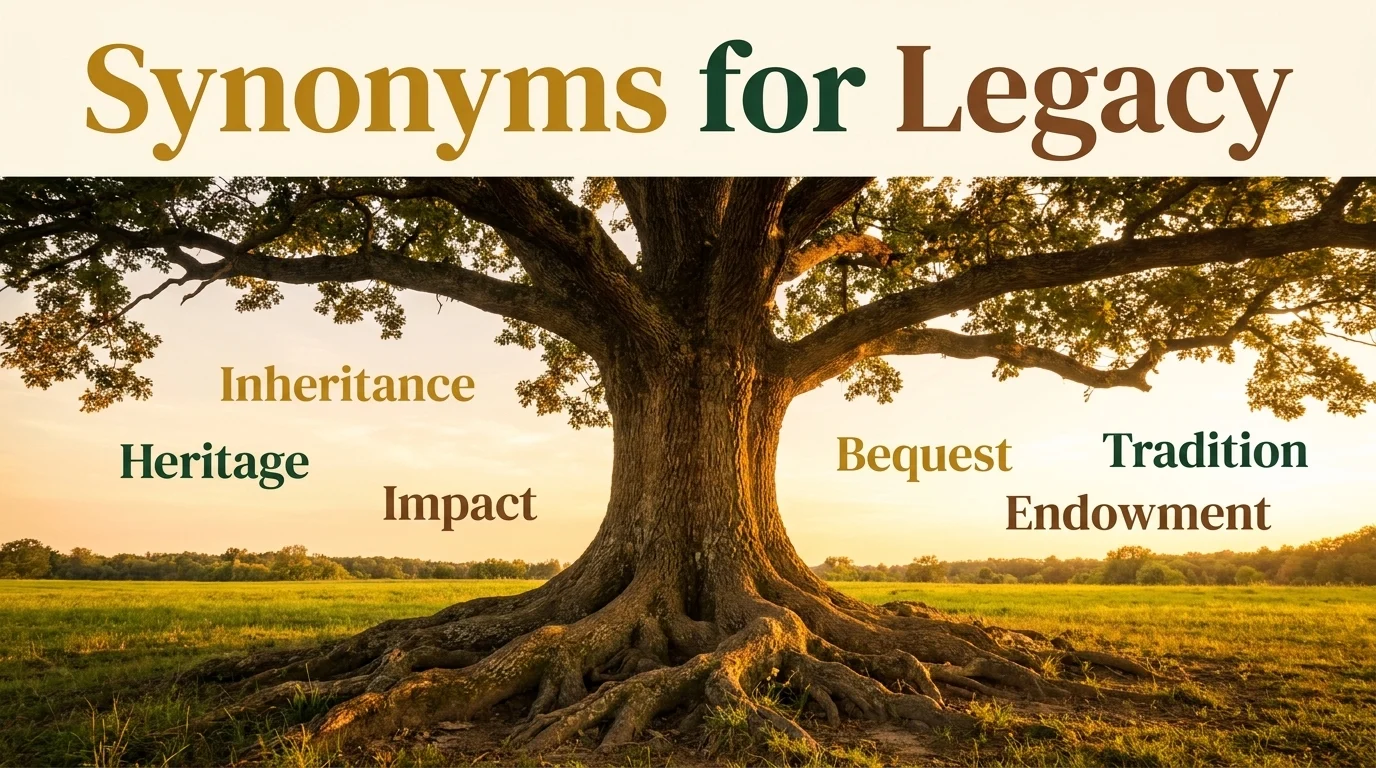
“Legacy” refers to something handed down from the past, such as an inheritance, a lasting impact, a tradition, or a reputation. It can describe financial assets, cultural heritage, historical influence, or the enduring results of someone’s actions. Depending on context, alternatives include inheritance, heritage, bequest, endowment, impact, influence, tradition, birthright, patrimony, and aftermath.
Meaning, Tone, and Context
Simple Definition
“Legacy” generally refers to:
- Inheritance: money, property, or assets left by someone in a will
- Heritage: cultural, historical, or family traditions passed down
- Lasting impact: the enduring effect of someone’s actions or work
- Reputation: how someone is remembered by future generations
- Bequest: a specific gift left in a will
- Birthright: something inherited by right of birth
Part of Speech
“Legacy” is primarily a noun.
Examples:
- “Her legacy of kindness lives on.”
- “He left a generous legacy to the university.”
Related Forms:
- Legacy (adjective): relating to old or inherited systems (e.g., legacy software)
- Legacies (plural): multiple inheritances or impacts
Positive, Negative, or Neutral Tone
“Legacy” is generally positive or neutral, but it can be negative depending on context.
Positive associations:
- “Her legacy of philanthropy continues to inspire.”
- “The legacy of the civil rights movement endures.”
Negative or neutral contexts:
- “The dictator left a legacy of oppression.”
- “The company struggled with its legacy of debt.”
Formality Level
“Legacy” is a standard word that works in both formal and informal English. It is particularly common in legal, academic, business, and ceremonial contexts.
However, more specific alternatives can add precision and variety.
Common Use Cases
“Legacy” commonly refers to:
- Financial inheritance: money, property, assets left in a will
- Cultural heritage: traditions, language, customs passed down
- Historical impact: the enduring influence of a person or event
- Business context: brand legacy, company legacy, legacy systems
- Sports: a player’s legacy, Olympic legacy
- Family: family legacy, generational legacy
- Technology: legacy software, legacy systems (outdated but still in use)
Important Word Forms
- Legacy (noun): something handed down or left behind
- Legacies (plural): multiple inheritances or impacts
- Legacy (adjective): relating to old or inherited systems
- Legatee (noun): a person who receives a legacy
- Legator (noun): a person who leaves a legacy
When and How to Use “Legacy”
Use “legacy” when you want to describe something handed down from the past, whether it is financial, cultural, historical, or personal. Because the word is broad, more specific alternatives can add precision depending on the context.
Professional
“The CEO’s legacy of innovation transformed the company.”
This works naturally in business communication.
Academic
“The study examines the legacy of colonialism in modern education systems.”
The term is appropriate in academic research.
Personal
“Her grandmother’s legacy of kindness lives on in the family.”
The word sounds natural in everyday conversation.
Legal
“The deceased left a legacy of $50,000 to her nephew.”
This is standard legal terminology.
Creative
“The old house was a legacy of a bygone era.”
The word creates a sense of history and continuity.
Sports
“The athlete’s legacy extends far beyond his records.”
The term is common in sports journalism.
Another Word for “Legacy”
There is no single perfect synonym because “legacy” can refer to financial inheritance, cultural heritage, lasting impact, or historical reputation.
- Financial inheritance: inheritance, bequest, endowment, estate, assets
- Cultural heritage: heritage, tradition, patrimony, birthright, custom
- Lasting impact: impact, influence, effect, consequence, aftermath
- Reputation: reputation, name, memory, renown, standing
- Historical context: historical impact, enduring influence, contribution
- Spiritual/philosophical: testament, gift, blessing, benediction
If you need one broad alternative, “inheritance” works for financial contexts, “heritage” for cultural contexts, and “impact” for lasting influence.
When Not to Use “Legacy”
“Legacy” can become too vague when you need to specify what kind of legacy you are describing.
Consider:
“He left a legacy.”
This statement does not tell readers whether he left money, a tradition, a reputation, or a lasting impact.
A more precise sentence could be:
“He left a legacy of generous philanthropy that funded three schools.”
Similarly, avoid using “legacy” when you mean “inheritance” in a strictly legal context, or “tradition” in a cultural context.
Words Commonly Confused With “Legacy”
Legacy vs. Inheritance
Inheritance specifically refers to money, property, or assets received from someone who has died. Legacy can be broader.
Example:
“She received a large inheritance from her grandfather.” (financial)
“Her legacy of kindness continues to inspire.” (broader impact)
Legacy vs. Heritage
Heritage refers to cultural traditions, values, and practices passed down through generations. Legacy can include heritage but is broader.
Example:
“The country’s cultural heritage is celebrated each year.” (cultural)
“His legacy as a leader is still debated.” (reputation/impact)
Legacy vs. Bequest
Bequest specifically refers to a gift left in a will. Legacy can be broader.
Example:
“The library received a bequest of rare books.” (legal gift)
“The artist’s legacy includes hundreds of paintings.” (broader)
Legacy vs. Impact
Impact refers to the effect or influence of something. Legacy often implies something passed down over time.
Example:
“The policy had a significant impact on education.” (effect)
“The legacy of the policy continues to shape education today.” (enduring effect)
Legacy vs. Tradition
Tradition refers to customs or practices passed down through generations. Legacy can include traditions but also includes financial, historical, and reputational aspects.
Example:
“Thanksgiving is a family tradition.” (custom)
“His legacy includes both wealth and wisdom.” (broader)
Legacy vs. Reputation
Reputation refers to how someone is perceived by others. Legacy often refers to how someone is remembered after death or retirement.
Example:
“She has a reputation for honesty.” (current perception)
“His legacy as a reformer is secure.” (historical memory)
Best Synonym by Context for “Legacy”
| Context | Best Synonym | Why It Works | Example |
|---|---|---|---|
| Formal writing | Inheritance, endowment | Precise and professional | The university received a generous endowment. |
| Academic writing | Heritage, historical impact | Standard academic usage | The study examines the heritage of ancient civilizations. |
| Legal contexts | Bequest, estate, inheritance | Technically accurate | The will included a bequest to charity. |
| Cultural contexts | Heritage, tradition, patrimony | Emphasizes cultural continuity | The festival celebrates the nation’s cultural heritage. |
| Business contexts | Impact, influence, contribution | Emphasizes lasting effect | The founder’s impact on the industry is undeniable. |
| Sports contexts | Record, reputation, impact | Emphasizes athletic achievement | The athlete’s record remains unbroken. |
| Family contexts | Birthright, tradition, inheritance | Emphasizes family continuity | The family business is his birthright. |
| Creative writing | Testament, gift, blessing | Adds literary depth | The garden was a testament to her love of nature. |
| Historical contexts | Aftermath, consequence, influence | Emphasizes historical significance | The aftermath of the war shaped generations. |
| Casual conversation | What someone left behind | Natural and informal | She left behind a wonderful legacy of kindness. |
| Spiritual/philosophical | Blessing, testament, gift | Emphasizes spiritual meaning | His life was a testament to faith and service. |
| Technology | Legacy system, outdated system | Technical context | The company still uses legacy software. |
Which Synonym Should You Choose?
Start by identifying what kind of “legacy” you are describing.
- Financial inheritance: inheritance, bequest, endowment, estate, assets
- Cultural heritage: heritage, tradition, patrimony, birthright, custom
- Lasting impact: impact, influence, effect, consequence, aftermath
- Reputation: reputation, name, memory, renown, standing
- Historical context: historical impact, enduring influence, contribution
- Spiritual/philosophical: testament, gift, blessing, benediction
- Technology: legacy system, outdated system, inherited system
10 Key Synonyms for “Legacy”
The table below includes accurate alternatives with clear meanings and usage contexts.
| Synonym | Simple Meaning | Best Used For | Example Sentence |
|---|---|---|---|
| Inheritance | Money or property received from someone who died | Legal, financial contexts | She received a large inheritance from her uncle. |
| Heritage | Cultural traditions passed down | Cultural, historical contexts | The museum preserves the nation’s heritage. |
| Bequest | A gift left in a will | Legal, formal contexts | The library received a bequest of rare manuscripts. |
| Impact | A lasting effect or influence | Business, social contexts | The founder’s impact on the industry is undeniable. |
| Influence | The power to affect others | General, historical contexts | His influence on modern art is immense. |
| Tradition | Customs passed down through generations | Cultural, family contexts | The family tradition continues to this day. |
| Birthright | Something inherited by right of birth | Family, legal contexts | The estate was his birthright. |
| Patrimony | Inherited property or heritage | Formal, cultural contexts | The cathedral is part of the nation’s patrimony. |
| Endowment | A gift or fund donated to an institution | Academic, financial contexts | The university received a generous endowment. |
| Aftermath | The consequences or aftereffects of an event | Historical, social contexts | The aftermath of the war shaped generations. |
Synonym Groups and Usage Differences
Professional vs. Personal Synonyms
Professional writing benefits from specific terms such as endowment, impact, contribution, and legacy itself.
Personal communication often uses what someone left behind, inheritance, or tradition.
Compare:
“She left a beautiful legacy.” (personal)
“The foundation received a substantial endowment.” (professional)
Formal vs. Conversational Synonyms
Legacy works in both formal and conversational English.
Formal alternatives: inheritance, bequest, patrimony, endowment
Conversational alternatives: what someone left behind, gift, tradition
Examples:
“The university received a generous bequest.” (formal)
“He left behind a wonderful gift for his family.” (conversational)
Academic Synonyms
Academic writing should distinguish between legacy (general), heritage (cultural), historical impact (historical), and inheritance (financial/legal).
For example:
“The study examines the cultural heritage of indigenous communities.”
“The historical impact of the treaty continues to be debated.”
Professional and Business Synonyms
Business writing often benefits from phrases such as lasting impact, enduring influence, contribution, and legacy.
Instead of:
“The CEO left a legacy.”
Consider:
“The CEO’s lasting impact on the company’s culture is undeniable.”
Creative or Literary Synonyms
Creative writing can use testament, gift, blessing, bequest, patrimony, and aftermath depending on the context.
For example:
“The garden was a living testament to her love of nature.”
“The aftermath of the revolution shaped the nation’s identity.”
Slang or Modern Synonyms
What someone left behind is a common casual phrase.
Legacy itself is standard.
Impact is common in modern business and social contexts.
Examples:
“She left behind an amazing legacy.” (casual)
“His impact on the team was huge.” (modern)
Strongest vs. Weaker Synonyms
“Legacy” synonyms vary in intensity:
Milder: gift, tradition, memory
Moderate: legacy, inheritance, heritage
Strong: impact, influence, contribution
Very Strong: enduring impact, lasting legacy, historical significance
Emotional vs. Neutral Synonyms
“Legacy” is generally neutral or positive.
Emotional alternatives: testament, blessing, gift, birthright
Neutral alternatives: inheritance, bequest, endowment, aftermath
Examples:
“His life was a testament to courage.” (emotional)
“The estate was divided among the heirs.” (neutral)
Antonyms of “Legacy”
“Legacy” does not have exact antonyms, but depending on context, the following words represent opposites:
| Antonym | Context | Meaning | Example Sentence |
|---|---|---|---|
| Disinheritance | Legal | Being deprived of inheritance | The will included a clause of disinheritance. |
| Oblivion | Historical | Being completely forgotten | The dictator’s name faded into oblivion. |
| Nothingness | General | Having no lasting impact | He feared leaving nothing behind. |
| Present | Temporal | The current moment | She focused on the present, not the past. |
| Future | Temporal | Time yet to come | The future is yet to be written. |
| Ephemera | Cultural | Things that are short-lived | The trend was just ephemera. |
Comparison: “Legacy” vs. Similar Words
Legacy vs. Inheritance
Main difference: Inheritance specifically refers to money, property, or assets received from someone who died. Legacy can be broader.
Examples:
“She received a large inheritance.” (financial)
“Her legacy of kindness continues.” (broader impact)
Legacy vs. Heritage
Main difference: Heritage refers to cultural traditions, values, and practices passed down through generations. Legacy can include heritage but is broader.
Examples:
“The country’s cultural heritage is celebrated.” (cultural)
“His legacy as a leader is still debated.” (reputation/impact)
Legacy vs. Bequest
Main difference: Bequest specifically refers to a gift left in a will. Legacy can be broader.
Examples:
“The library received a bequest of rare books.” (legal gift)
“The artist’s legacy includes hundreds of paintings.” (broader)
Legacy vs. Impact
Main difference: Impact refers to the effect or influence of something. Legacy often implies something passed down over time.
Examples:
“The policy had a significant impact on education.” (effect)
“The legacy of the policy continues to shape education today.” (enduring)
Legacy vs. Tradition
Main difference: Tradition refers to customs or practices passed down through generations. Legacy can include traditions but also includes financial, historical, and reputational aspects.
Examples:
“Thanksgiving is a family tradition.” (custom)
“His legacy includes both wealth and wisdom.” (broader)
Legacy vs. Reputation
Main difference: Reputation refers to how someone is perceived by others. Legacy often refers to how someone is remembered after death or retirement.
Examples:
“She has a reputation for honesty.” (current)
“His legacy as a reformer is secure.” (historical)
Common Phrases and Expressions with “Legacy”
1. Leave a legacy
Meaning:
To create something that will be remembered or passed down.
Example:
“She left a legacy of generosity that continues to inspire.”
2. Lasting legacy
Meaning:
An impact or inheritance that endures over time.
Example:
“The founder’s lasting legacy is the company’s commitment to innovation.”
3. Legacy of
Meaning:
The enduring impact or inheritance of a person, event, or period.
Example:
“The legacy of the civil rights movement continues to shape society.”
4. Family legacy
Meaning:
Traditions, assets, or reputation passed down through a family.
Example:
“The family legacy includes a successful business and a commitment to charity.”
5. Legacy system
Meaning:
Outdated technology or software that is still in use.
Example:
“The company still relies on legacy systems for its operations.”
6. Olympic legacy
Meaning:
The lasting impact of hosting the Olympic Games.
Example:
“The Olympic legacy includes new sports facilities and improved infrastructure.”
7. Legacy of slavery
Meaning:
The enduring impact of slavery on society.
Example:
“The legacy of slavery continues to affect race relations today.”
8. Build a legacy
Meaning:
To create something that will be remembered.
Example:
“He worked hard to build a legacy for his children.”
Common Mistakes to Avoid
1. Using “legacy” when a more precise term is available
If you mean inheritance, heritage, impact, or tradition, use the more specific word.
Vague: “He left a legacy.”
Precise: “He left a generous inheritance to his grandchildren.”
2. Using “legacy” in legal contexts when “bequest” or “inheritance” is needed
Legal documents require precise language. Use bequest, inheritance, or estate.
Vague: “She left a legacy to the charity.”
Precise: “She left a bequest of $50,000 to the charity.”
3. Confusing “legacy” with “heritage”
Heritage refers to cultural traditions. Legacy is broader.
Incorrect: “The festival celebrates the town’s legacy.”
Correct: “The festival celebrates the town’s heritage.”
4. Overusing “legacy” in writing
Repetition can make content feel dull. Use alternatives such as inheritance, heritage, impact, influence, and tradition.
5. Choosing a synonym that changes the meaning
Do not replace legacy with inheritance unless you mean financial assets.
Do not replace legacy with tradition unless you mean cultural customs.
FAQs
What is the best synonym for “legacy”?
The best synonym depends on context. Inheritance works for financial contexts, heritage for cultural contexts, impact for lasting influence, bequest for legal contexts, and tradition for cultural customs.
What is a formal synonym for “legacy”?
Inheritance, bequest, endowment, patrimony, and heritage are formal synonyms.
What is an informal synonym for “legacy”?
someone left behind, gift, and impact are common informal alternatives.
What is the opposite of “legacy”?
Depending on context, opposites include disinheritance, oblivion, nothingness, and ephemera.
What does “legacy” mean in a business context?
In business, legacy often refers to the lasting impact of a leader or founder, or to legacy systems (outdated technology still in use).
Conclusion
“Legacy” is a powerful, versatile word that can describe financial inheritance, cultural heritage, lasting impact, and historical reputation. The best synonym depends on what you actually mean.
Choose inheritance for financial contexts, heritage for cultural contexts, bequest for legal contexts, impact for lasting influence, tradition for cultural customs, and endowment for institutional gifts.
Most importantly, do not replace “legacy” simply to avoid repetition. First identify what kind of legacy—financial, cultural, historical, or personal—you are actually describing. Then choose the alternative that communicates that idea most clearly.
For academic, professional, and legal writing, precision is usually more valuable than vocabulary variety. A specific term such as bequest, endowment, heritage, or impact can tell readers much more than the broad word legacy.
Before publishing a vocabulary guide, verify definitions and usage with trusted dictionaries such as Cambridge, Oxford, Merriam-Webster, Collins, or Britannica. This helps ensure that each alternative accurately matches its intended meaning and context.
The practical takeaway is simple: when “legacy” feels too general, ask yourself what kind of inheritance, impact, or tradition you are actually describing. Then use the most precise word available.
Discover More:-
- 50+ Synonyms for Happiness: Meanings, Examples, and Best Alternatives
- 50+ Synonyms for Possible: Meanings, Examples, and Best Alternatives

1 thought on “50+ Synonyms for Legacy: Meanings, Examples, and Best Alternatives”