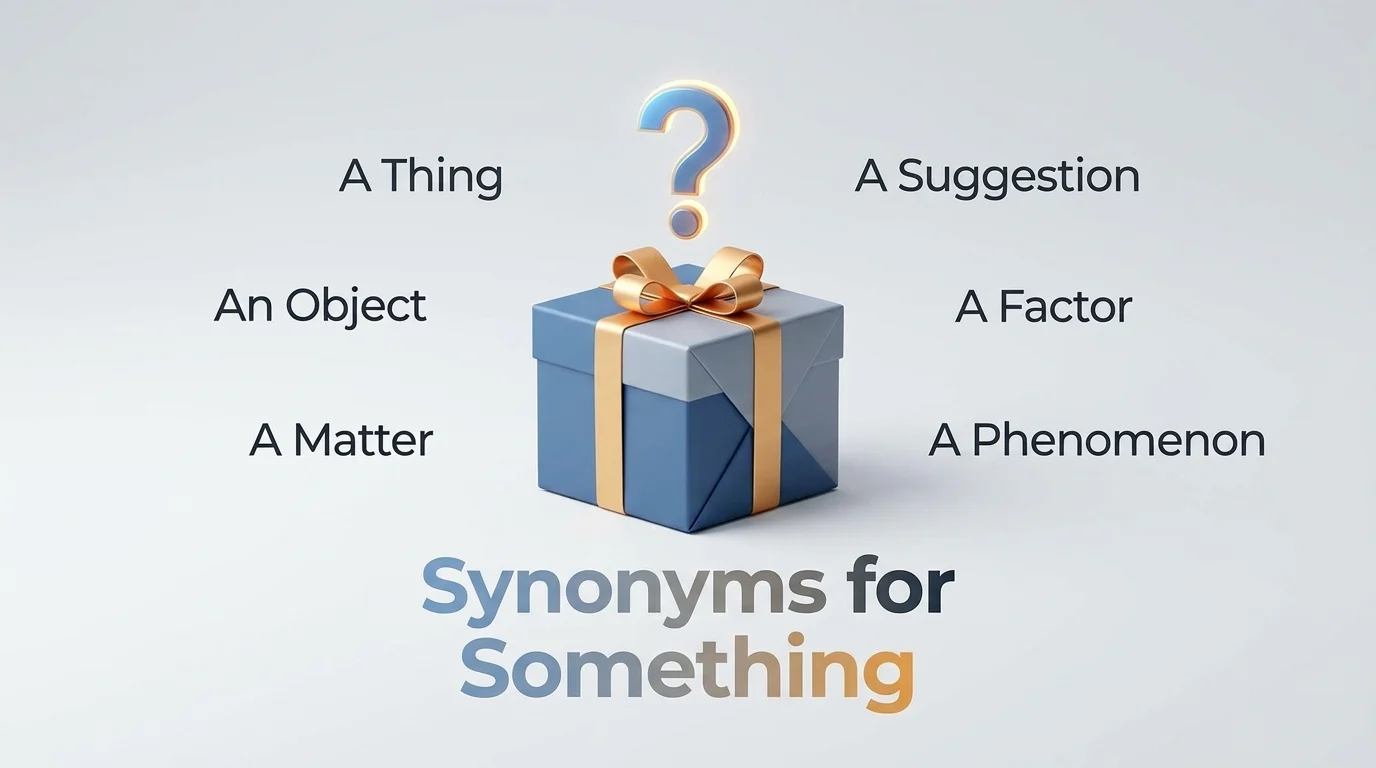
Do you keep using the word “something” in essays, emails, creative writing, presentations, or everyday conversation? While it is one of the most common and flexible words in English, repeating it can make your writing feel vague, flat, or imprecise.
The good news is that the best alternative depends on what you actually mean. You might be referring to an unspecified object, an unknown thing, an indefinite quantity, a suggestion, or an approximate amount.
This guide explains synonyms for “something” by meaning, tone, context, and usage. You will learn which alternatives work best in academic writing, professional communication, creative expression, and casual conversation.
Quick Answer: What Does “Something” Mean?
“Something” is an indefinite pronoun used to refer to an unspecified or unknown thing, object, idea, or amount. Depending on context, alternatives include anything, a thing, an object, an item, a matter, a substance, a quantity, a suggestion, and a certain thing.
Meaning, Tone, and Context
Simple Definition
“Something” generally refers to:
- An unspecified thing: an object or idea that is not named
- An unknown thing: something the speaker cannot or does not identify
- An indefinite amount: a quantity that is not specified
- A suggestion or offer: something proposed or available
- An approximate idea: a thing that is roughly understood
Part of Speech
“Something” is primarily an indefinite pronoun. It can also function as a noun and, in some informal contexts, an adverb.
Pronoun Examples:
- “I have something to tell you.”
- “There’s something in my eye.”
Noun Examples:
- “That’s really something!” (impressive)
- “He has a certain something about him.” (charm)
Adverb Examples (informal):
- “He was acting something strange.” (somewhat strange, dialectal)
Related Forms:
- Something (pronoun): an unspecified thing
- Anything (pronoun): any thing at all
- Nothing (pronoun): no thing
- Everything (pronoun): all things
- Somewhat (adverb): to some degree
Positive, Negative, or Neutral Tone
“Something” is generally neutral. Its tone depends on the surrounding context.
Neutral associations:
- “I need something from the store.”
- “There’s something on your shirt.”
Positive associations:
- “That’s really something!” (impressive)
- “She has a certain something.” (charm)
Negative associations:
- “Something is wrong.”
- “There’s something suspicious about him.”
Formality Level
“Something” is a standard word that works in both formal and informal English. It is appropriate in academic papers, business communication, creative writing, and casual conversation.
However, in formal writing, more specific alternatives are often preferred to avoid vagueness.
Common Use Cases
“Something” commonly refers to:
- Unspecified objects: something in the box
- Unknown things: something is wrong
- Suggestions or offers: something to eat
- Indefinite amounts: something like twenty dollars
- Impressive qualities: that’s really something
- Vague ideas: something about the situation
Important Word Forms
- Something (pronoun): an unspecified thing
- Anything (pronoun): any thing at all
- Nothing (pronoun): no thing
- Everything (pronoun): all things
- Somewhat (adverb): to some degree
When and How to Use “Something”
Use “something” when you want to refer to an unspecified or unknown thing. Because the word is vague by nature, more specific alternatives can add precision depending on the context.
Professional
“We need to do something about the declining sales.”
This works in business communication when the exact solution is unknown.
Academic
“The study found something interesting about human behavior.”
The term is appropriate when the finding is not yet specified.
Personal
“I have something to tell you.”
The word sounds natural in everyday conversation.
Creative
“There was something unsettling about the old house.”
The word creates mystery and intrigue.
Informal
“That’s really something!”
The word expresses admiration or surprise.
Another Word for “Something”
There is no single perfect synonym because “something” is an indefinite pronoun that can refer to objects, ideas, amounts, or suggestions.
- Unspecified object: a thing, an object, an item, an article, an entity
- Unknown thing: a thing, a matter, an affair, a circumstance
- Indefinite amount: a quantity, a portion, an amount, a bit, a touch
- Suggestion or offer: a suggestion, an offer, a proposal, an option
- Impressive quality: a wonder, a marvel, a sensation
- Vague idea: a thing, a matter, an issue, a point
If you need one broad alternative, “a thing” works in many contexts, but it is less idiomatic. “Anything” works in negative and question contexts.
When Not to Use “Something”
“Something” can become too vague when the reader needs to know exactly what you mean.
Consider:
“We need to change something.”
This statement does not tell readers what needs to change—the strategy, the product, the team, or the process.
A more precise sentence could be:
“We need to revise our marketing strategy.”
Similarly, avoid using “something” in formal writing when a specific noun would be clearer.
Words Commonly Confused With “Something”
Something vs. Anything
Something is used in positive statements and offers. Anything is used in negative statements and questions.
Example:
“I have something for you.” (positive)
“I don’t have anything for you.” (negative)
“Do you have anything for me?” (question)
Something vs. Nothing
Something means an unspecified thing. Nothing means no thing at all.
Example:
“There’s something in the box.” (an object)
“There’s nothing in the box.” (empty)
Something vs. Everything
Something refers to one unspecified thing. Everything refers to all things.
Example:
“I need something from the store.” (one item)
“I need everything from the store.” (all items)
Something vs. Somewhat
Something is a pronoun. Somewhat is an adverb meaning “to some degree.”
Example:
“I have something to say.” (pronoun)
“I am somewhat tired.” (adverb)
Something vs. A thing
A thing is more specific and countable. Something is indefinite and uncountable in this sense.
Example:
“There’s a thing on the table.” (specific object)
“There’s something on the table.” (unspecified)
Best Synonym by Context for “Something”
| Context | Best Synonym | Why It Works | Example |
|---|---|---|---|
| Formal writing | A matter, an issue, a point | Precise and professional | There is a matter we must discuss. |
| Academic writing | A phenomenon, a factor, a variable | Standard academic usage | The study identified a factor affecting outcomes. |
| Creative writing | A presence, a force, an entity | Adds mystery | There was a presence in the room. |
| Unspecified object | An object, an item, an article | More specific | She placed an object on the table. |
| Unknown thing | A thing, a matter, an affair | General | There’s a matter I need to address. |
| Suggestion/offer | A suggestion, an offer, an option | Emphasizes choice | May I offer a suggestion? |
| Indefinite amount | A quantity, a portion, a bit | Emphasizes amount | Add a bit of sugar. |
| Impressive quality | A wonder, a marvel, a sensation | Emphasizes admiration | That’s a marvel of engineering. |
| Vague idea | A thing, a matter, a point | General | There’s a point I want to make. |
| Casual conversation | Something (itself) | Natural and concise | I have something to tell you. |
| Negative context | Anything | Negative statements | I don’t have anything to say. |
| Question context | Anything | Questions | Do you have anything to eat? |
Which Synonym Should You Choose?
Start by identifying what kind of “something” you are describing.
- Unspecified object: a thing, an object, an item, an article, an entity
- Unknown thing: a matter, an affair, a circumstance, a situation
- Suggestion or offer: a suggestion, an offer, a proposal, an option
- Indefinite amount: a quantity, a portion, a bit, a touch
- Impressive quality: a wonder, a marvel, a sensation, a phenomenon
- Vague idea: a thing, a matter, an issue, a point
- Question/negative: anything (in questions and negatives)
- Formal writing: a matter, an issue, a factor, a variable
10 Key Synonyms for “Something”
The table below includes accurate alternatives with clear meanings and usage contexts.
| Synonym | Simple Meaning | Best Used For | Example Sentence |
|---|---|---|---|
| A thing | An unspecified object or matter | General, informal | There’s a thing I need to tell you. |
| An object | A material thing | Physical contexts | She found an object in the drawer. |
| An item | A single article or unit | Lists, inventories | Please select an item from the menu. |
| A matter | A subject or situation | Formal, professional | There is a matter we must discuss. |
| A suggestion | An idea or proposal | Offers, advice | May I offer a suggestion? |
| A quantity | An amount or portion | Measurements, amounts | Add a quantity of flour to the mixture. |
| A bit | A small amount | Informal, amounts | I’m feeling a bit tired. |
| A wonder | An amazing thing | Admiration, surprise | The Grand Canyon is a wonder of nature. |
| A phenomenon | An observable fact or event | Academic, scientific | The aurora is a natural phenomenon. |
| Anything | Any thing at all | Questions, negatives | Do you have anything to eat? |
Synonym Groups and Usage Differences
Professional vs. Personal Synonyms
Professional writing benefits from specific terms such as a matter, an issue, a factor, a point, and a variable.
Personal communication often uses something itself or casual alternatives like a thing or a bit.
Compare:
“I have something to tell you.” (personal)
“There is a matter I need to address.” (professional)
Formal vs. Conversational Synonyms
Something works in both formal and conversational English.
Formal alternatives: a matter, an issue, a factor, a phenomenon
Conversational alternatives: a thing, a bit, a touch
Examples:
“There is a factor we must consider.” (formal)
“There’s a thing I want to show you.” (conversational)
Academic Synonyms
Academic writing should distinguish between something (general), a factor (variable), a phenomenon (observable event), and a variable (measurable element).
For example:
“The study identified a factor that influenced the results.”
“The phenomenon was observed in multiple trials.”
Professional and Business Synonyms
Business writing often benefits from phrases such as a matter, an issue, a point, a concern, and a factor.
Instead of:
“We need to discuss something.”
Consider:
“We need to discuss a matter of importance.”
Creative or Literary Synonyms
Creative writing can use a presence, a force, an entity, a wonder, and a marvel depending on the context.
For example:
“There was a presence in the old house.”
“That’s a marvel of modern engineering.”
Slang or Modern Synonyms
A thing is common casual English.
A bit means a small amount.
A touch means a small amount.
Something else means extraordinary.
Examples:
“There’s a thing I need to do.” (casual)
“Her performance was something else!” (extraordinary)
Strongest vs. Weaker Synonyms
“Something” synonyms vary in specificity:
Vaguest: something, a thing
Moderate: an object, an item, a matter
Specific: a factor, a phenomenon, a suggestion
Very Specific: a variable, a phenomenon, an entity
Emotional vs. Neutral Synonyms
“Something” is generally neutral.
Emotional alternatives: a wonder, a marvel, a presence, a force
Neutral alternatives: a thing, an object, an item, a matter
Examples:
“There’s something in the room.” (neutral)
“There’s a presence in the room.” (emotional, mysterious)
Antonyms of “Something”
“Something” has several antonyms depending on context:
| Antonym | Context | Meaning | Example Sentence |
|---|---|---|---|
| Nothing | General | No thing | There’s nothing in the box. |
| Anything | Questions/negatives | Any thing | I don’t have anything to say. |
| Everything | General | All things | Everything is ready. |
| None | Quantity | Not any | None of the items were found. |
| Nobody | People | No person | Nobody was there. |
| Nowhere | Place | No place | There’s nowhere to go. |
Comparison: “Something” vs. Similar Words
Something vs. Anything
Main difference: Something is used in positive statements and offers. Anything is used in negative statements and questions.
Examples:
“I have something for you.” (positive)
“I don’t have anything for you.” (negative)
“Do you have anything for me?” (question)
Something vs. Nothing
Main difference: Something means an unspecified thing. Nothing means no thing at all.
Examples:
“There’s something in the box.” (an object)
“There’s nothing in the box.” (empty)
Something vs. Everything
Main difference: Something refers to one unspecified thing. Everything refers to all things.
Examples:
“I need something from the store.” (one item)
“I need everything from the store.” (all items)
Something vs. Somewhat
Main difference: Something is a pronoun. Somewhat is an adverb meaning “to some degree.”
Examples:
“I have something to say.” (pronoun)
“I am somewhat tired.” (adverb)
Something vs. A thing
Main difference: A thing is more specific and countable. Something is indefinite and uncountable in this sense.
Examples:
“There’s a thing on the table.” (specific object)
“There’s something on the table.” (unspecified)
Common Phrases and Expressions with “Something”
1. Something else
Meaning:
Extraordinary or exceptional; also, a different thing.
Example:
“Her performance was something else!”
2. Something like
Meaning:
Approximately; similar to.
Example:
“It costs something like twenty dollars.”
3. Something to eat
Meaning:
Food or a meal.
Example:
“Would you like something to eat?”
4. Something to think about
Meaning:
A matter worth considering.
Example:
“Here’s something to think about.”
5. Something wrong
Meaning:
A problem or issue.
Example:
“There’s something wrong with the engine.”
6. Something in common
Meaning:
A shared interest or quality.
Example:
“We have something in common.”
7. Something of a
Meaning:
Somewhat; to a certain degree.
Example:
“He’s something of an expert.”
8. Or something
Meaning:
Used to indicate uncertainty or approximation.
Example:
“Let’s meet at seven or something.”
9. Really something
Meaning:
Impressive or remarkable.
Example:
“That sunset was really something.”
10. Something tells me
Meaning:
I have a feeling or intuition.
Example:
“Something tells me she’s not coming.”
Common Mistakes to Avoid
1. Using “something” when a more precise term is available
If you mean a factor, an issue, a suggestion, or a phenomenon, use the more specific word.
Vague: “There’s something we need to discuss.”
Precise: “There’s an important issue we need to discuss.”
2. Using “something” in formal writing when “a matter” is better
Formal and academic writing benefits from specific terms like a matter, an issue, a factor, or a point.
Informal: “We need to talk about something.”
Formal: “We need to discuss a matter of importance.”
3. Confusing “something” with “anything”
Something is used in positive statements. Anything is used in questions and negatives.
Incorrect: “I don’t have something to say.”
Correct: “I don’t have anything to say.”
4. Overusing “something” in writing
Repetition can make content feel vague. Use alternatives such as a thing, an object, a matter, a factor, and a phenomenon.
5. Choosing a synonym that changes the meaning
Do not replace something with everything unless you mean all things.
Do not replace something with nothing unless you mean no thing.
FAQs
What is the best synonym for “something”?
The best synonym depends on context. A thing works for general use, a matter for formal contexts, a factor for academic writing, a suggestion for offers, and a phenomenon for scientific contexts.
What is a formal synonym for “something”?
A matter, an issue, a factor, a point, and a phenomenon are formal synonyms.
What is an informal synonym for “something”?
A thing, a bit, a touch, and something else are common informal alternatives.
What is another word for “something” in creative writing?
A presence, a force, an entity, a wonder, and a marvel work well in creative writing.
What is the difference between “something” and “anything”?
Something is used in positive statements and offers. Anything is used in negative statements and questions.
What is the opposite of “something”?
Depending on context, opposites include nothing, anything, everything, and none.
Can “something” be used in formal writing?
Yes, but more specific alternatives are often preferred to avoid vagueness.
Conclusion
“Something” is a versatile indefinite pronoun that can refer to objects, ideas, amounts, suggestions, and phenomena. The best synonym depends on what you actually mean.
Choose a thing for general use, a matter for formal contexts, a factor for academic writing, a suggestion for offers, a phenomenon for scientific contexts, and a presence for creative writing.
Most importantly, do not replace “something” simply to avoid repetition. First identify what kind of something—object, matter, amount, or suggestion—you are actually describing. Then choose the alternative that communicates that idea most clearly.
For academic, professional, and formal writing, precision is usually more valuable than vocabulary variety. A specific term such as a factor, a matter, or a phenomenon can tell readers much more than the vague word something.
Before publishing a vocabulary guide, verify definitions and usage with trusted dictionaries such as Cambridge, Oxford, Merriam-Webster, Collins, or Britannica. This helps ensure that each alternative accurately matches its intended meaning and context.
The practical takeaway is simple: when “something” feels too vague, ask yourself what kind of thing, matter, or suggestion you are actually describing. Then use the most precise word available.
Discover More:-
- 50+ Synonyms for “On the Other Hand”: Meanings, Examples, and Best Alternatives
- 50+ Synonyms for Provide: Meanings, Examples, and Best Alternatives

3 thoughts on “50+ Synonyms for “Something”: Meanings, Examples, and Best Alternatives”