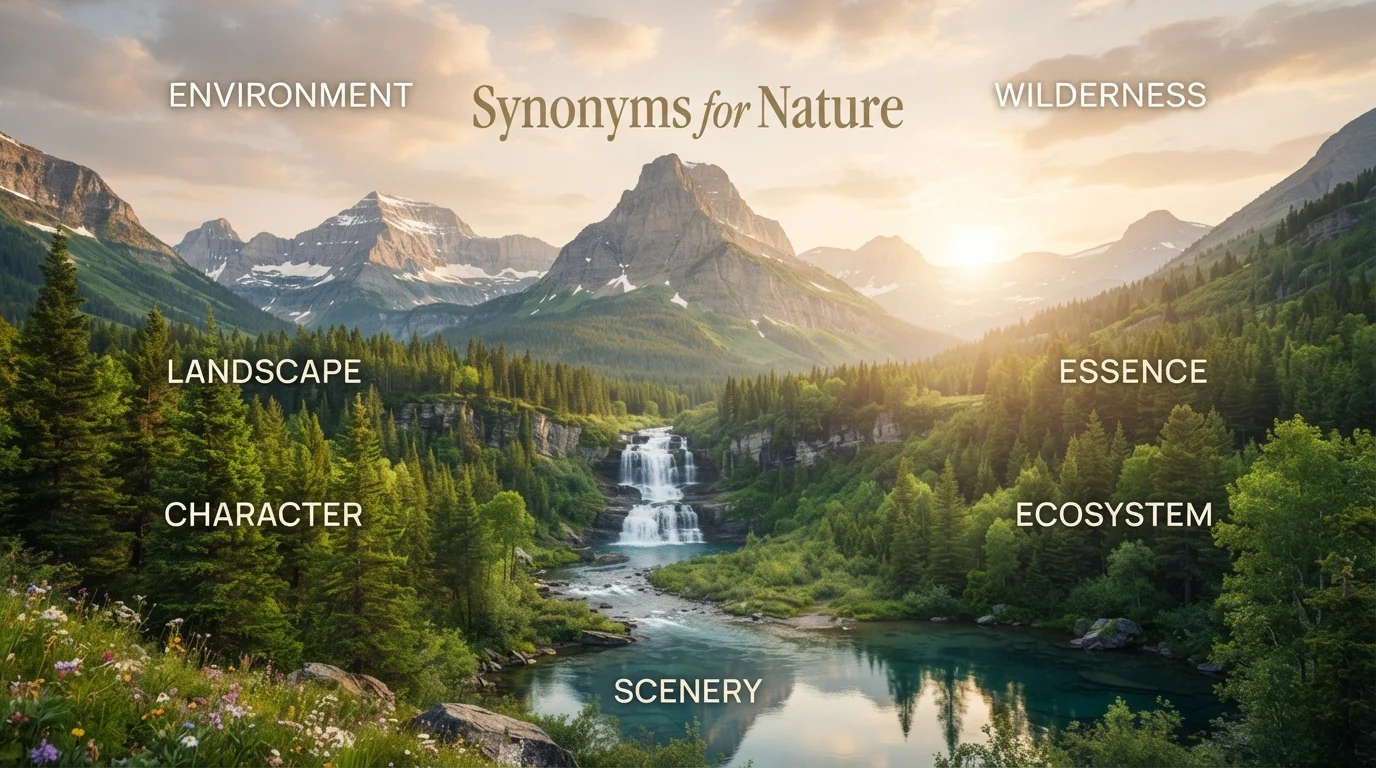
Do you keep using the word “nature” in essays, travel writing, scientific papers, philosophical discussions, or everyday conversation? While it is a beautiful and essential word, repeating it can make your writing feel vague or lack nuance.
The good news is that the best alternative depends on what you actually mean. You might be referring to the natural world and landscapes, the inherent qualities of something, the forces of the universe, or the character and temperament of a person.
This guide explains synonyms for “nature” by meaning, tone, context, and usage. You will learn which alternatives work best in academic writing, creative expression, professional communication, environmental content, and casual conversation.
Quick Answer: What Does “Nature” Mean?
“Nature” refers to the physical world and its phenomena, the inherent qualities or characteristics of something, or the basic forces that shape the universe. Depending on context, alternatives include environment, world, landscape, character, essence, temperament, disposition, the outdoors, creation, and wilderness.
Meaning, Tone, and Context
Simple Definition
“Nature” generally refers to:
- The physical world: mountains, forests, oceans, animals, plants, and natural phenomena
- The essential qualities of something: the inherent character or basic nature of a person, object, or concept
- The forces of the universe: the laws, patterns, and processes that govern existence
- The outdoors: the natural environment as opposed to human-made or urban settings
Part of Speech
“Nature” is primarily a noun.
Examples:
- “The beauty of nature is breathtaking.” (the physical world)
- “Her kind nature makes her popular.” (character, temperament)
- “The nature of the problem is complex.” (essential quality)
Related Forms:
- Natural (adjective): existing in or derived from nature
- Naturally (adverb): in a natural manner; by nature
- Naturalist (noun): a person who studies nature
- Naturalize (verb): to adapt to a new environment
Positive, Negative, or Neutral Tone
“Nature” is generally neutral or positive.
Positive associations:
- “The peace and tranquility of nature is healing.”
- “She has a generous nature.”
Neutral or technical contexts:
- “The nature of the chemical reaction was analyzed.”
- “His thoughtful nature makes him a good leader.”
Formality Level
“Nature” is a standard word that works in both formal and informal English. It is appropriate in academic papers, literary works, business reports, and casual conversation. However, more specific alternatives can add precision and variety.
Common Use Cases
“Nature” commonly refers to:
- The natural world: ecosystems, wildlife, plants, geological formations
- Outdoor settings: forests, mountains, oceans, meadows, parks
- Inherent qualities: character, temperament, disposition, essence
- Universal forces: laws of nature, natural selection, the elements
- Unspoiled environments: wilderness, wild places, untouched landscapes
- Philosophical and spiritual concepts: creation, Mother Nature, the cosmos
Important Word Forms
- Nature (noun): the physical world; inherent qualities
- Natural (adjective): existing in or produced by nature
- Naturally (adverb): in a natural way; as expected
- Naturalist (noun): someone who studies or enjoys nature
- Naturalism (noun): a philosophical or artistic movement focused on nature
- Naturalize (verb): to bring into a new environment or make natural
When and How to Use “Nature”
Use “nature” when you want to refer to the physical world, the essential qualities of something, or the forces that shape existence. Because the word is broad, more specific alternatives can add precision.
Professional
“The nature of our business requires constant innovation.”
This works naturally in professional communication.
Academic
“The study examined the relationship between human activity and the natural world.”
The term is appropriate in academic research.
Personal
“I love spending time in nature.”
The word sounds natural in everyday conversation.
Environmental
“Protecting nature is essential for future generations.”
Here, “nature” refers to the environment and ecosystems.
Philosophical
“The nature of consciousness has been debated for centuries.”
The term describes essential qualities and fundamental questions.
Creative
“The wild nature of the storm was both terrifying and beautiful.”
The word describes untamed force and power.
Another Word for “Nature”
There is no single perfect synonym because “nature” can refer to many different things.
- The physical world: environment, world, earth, planet, cosmos
- Landscapes and settings: scenery, landscape, countryside, wilderness, outdoors
- Plants and animals: wildlife, flora and fauna, ecosystem, biosphere
- Inherent qualities: character, essence, temperament, disposition, personality
- Universal forces: creation, the elements, the universe, Mother Nature
- Undeveloped areas: wilderness, wilds, backcountry, bush
- General outdoor spaces: the outdoors, the open air, green spaces
If you need one broad alternative, “environment” works well for the physical world, while “character” or “essence” works better for inherent qualities.
When Not to Use “Nature”
“Nature” can become too vague when you need to specify exactly what you are referring to.
Consider:
“She has a good nature.”
This statement does not tell readers whether she is kind, patient, generous, or something else.
A more precise sentence could be:
“She has a kind and generous nature.”
Similarly, avoid using “nature” when you mean the physical environment if a more specific term like forest, ocean, or mountain is more appropriate.
Words Commonly Confused With “Nature”
Nature vs. Environment
Environment emphasizes the surroundings or conditions in which something exists. Nature emphasizes the physical world without human intervention.
Example:
“The natural environment is diverse.” (surroundings)
“The beauty of nature inspires artists.” (physical world)
Nature vs. Character
Character emphasizes moral or ethical qualities. Nature can be broader, including personality traits.
Example:
“Her moral character is impeccable.” (ethics)
“Her gentle nature makes her a good friend.” (temperament)
Nature vs. Essence
Essence emphasizes the most fundamental or core quality of something. Nature can be broader.
Example:
“The essence of leadership is integrity.” (core quality)
“The nature of the job is demanding.” (characteristics)
Nature vs. Wilderness
Wilderness specifically means undeveloped, uninhabited natural land. Nature is broader.
Example:
“The wilderness of Alaska is breathtaking.” (undeveloped)
“The beauty of nature can be found anywhere.” (broad)
Nature vs. Landscape
Landscape emphasizes the visible features of an area. Nature can include all aspects of the physical world.
Example:
“The landscape was painted in stunning detail.” (visual features)
“The nature of the region is shaped by its climate.” (broader)
Nature vs. Creation
Creation emphasizes the act of creating or the created world. Nature can be more neutral.
Example:
“The beauty of creation is inspiring.” (spiritual)
“The nature of the world is complex.” (neutral)
Best Synonym by Context for “Nature”
| Context | Best Synonym | Why It Works | Example |
|---|---|---|---|
| The physical world | Environment, the outdoors, the natural world | Emphasizes the natural realm | We must protect the environment. |
| Landscapes | Landscape, scenery, countryside | Emphasizes visual features | The landscape is breathtaking. |
| Wilderness | Wilderness, wilds, backcountry | Emphasizes undeveloped areas | She explored the wilderness of Canada. |
| Inherent qualities | Character, essence, temperament | Emphasizes personal attributes | Her generous character is well known. |
| Personality | Disposition, temperament, personality | Emphasizes human traits | Her disposition is friendly. |
| Universal forces | Creation, the elements, the universe | Emphasizes cosmic or spiritual forces | The elements can be powerful. |
| Plants and animals | Wildlife, flora and fauna, ecosystem | Emphasizes living organisms | The ecosystem is diverse. |
| Outdoor spaces | Outdoors, green spaces, open air | Emphasizes outdoor experience | She enjoys spending time outdoors. |
| Philosophical context | The cosmos, creation, existence | Emphasizes fundamental questions | The cosmos is vast and mysterious. |
| Casual conversation | Nature itself | Natural and concise | I love being in nature. |
| Creative writing | The wild, the elements, creation | Adds poetic or dramatic effect | The wild was untamed and beautiful. |
Which Synonym Should You Choose?
Start by identifying what kind of “nature” you are describing.
- Physical environment: environment, world, earth, ecosystem, biosphere
- Landscapes: landscape, scenery, countryside, terrain
- Undeveloped areas: wilderness, wilds, backcountry
- Inherent qualities: character, essence, temperament, disposition, personality
- Universal forces: creation, the elements, the universe, cosmos
- Outdoor experience: outdoors, open air, green spaces
- Living things: wildlife, flora and fauna, ecosystem
10 Key Synonyms for “Nature”
The table below includes accurate alternatives with clear meanings and usage contexts.
| Synonym | Simple Meaning | Best Used For | Example Sentence |
|---|---|---|---|
| Environment | Surroundings and conditions | Professional, academic, scientific | The environment needs protection. |
| Wilderness | Undeveloped natural areas | Adventure, travel, conservation | She hiked through the wilderness. |
| Character | Moral or personal qualities | Personal descriptions, ethics | His character is impeccable. |
| Essence | Core or fundamental quality | Philosophical, abstract contexts | The essence of life is connection. |
| Landscape | Visible features of an area | Art, geography, description | The landscape was painted in gold. |
| Temperament | Natural disposition | Personal descriptions, psychology | Her calm temperament is admirable. |
| Creation | The created world | Spiritual, philosophical contexts | The beauty of creation inspires awe. |
| Ecosystem | Community of living organisms | Scientific, environmental contexts | The ecosystem is fragile and diverse. |
| Scenery | Scenic views | Travel, art, description | The scenery along the coast is stunning. |
| Outdoors | The open air environment | Casual, recreational contexts | She loves spending time outdoors. |
Synonym Groups and Usage Differences
Professional vs. Personal Synonyms
Professional writing benefits from specific terms such as environment, ecosystem, character, disposition, and essence.
Personal communication often uses nature itself or casual alternatives like outdoors, scenery, or character.
Compare:
“The nature of the problem is complex.” (professional)
“The problem’s character is complex.” (professional alternative)
“I love nature.” (personal)
Formal vs. Conversational Synonyms
Nature works in both formal and conversational English.
Formal alternatives: character, essence, disposition, environment, ecosystem
Conversational alternatives: outdoors, scenery, the wild, personality
Examples:
“The disposition of the subject was observed.” (formal)
“Her personality is charming.” (conversational)
Academic Synonyms
Academic writing should distinguish between nature (as a broad concept), environment (physical surroundings), ecosystem (living community), character (inherent qualities), and essence (core nature).
For example, biology papers might use “ecosystem” and “biodiversity”, while philosophy papers might use “essence” and “character”.
Professional and Business Synonyms
Business writing often benefits from phrases such as character, nature (of the business), environment (market environment), and ecosystem (business ecosystem).
Instead of:
“The nature of our business is changing.”
Consider:
“The character of our business is evolving due to market forces.”
Creative or Literary Synonyms
Creative writing can use wilderness, the wild, the elements, creation, the cosmos, and the world depending on the context.
For example:
“The wild called to her with a voice as old as time.”
“The elements raged against the small ship.”
Slang or Modern Synonyms
The wild can be used casually to refer to nature.
Mother Nature is a personification used in casual or poetic contexts.
The great outdoors is a common phrase for nature.
Examples:
“Get back to nature.” (classic phrase)
“Mother Nature wasn’t kind today.” (casual)
“Explore the great outdoors.” (recreational phrase)
Strongest vs. Weaker Synonyms
“Nature” synonyms vary in intensity and specificity:
Milder: scenery, view, landscape
Moderate: environment, character, personality
Strong: wilderness, essence, creation, cosmos
Very Strong: the elements, the wild, creation
Emotional vs. Neutral Synonyms
“Nature” is generally neutral or positive.
Emotional alternatives: wilderness (adventurous), creation (spiritual), the elements (dramatic), beauty (aesthetic)
Neutral alternatives: environment, character, essence, ecosystem
Examples:
“The environment was studied.” (neutral)
“The wilderness was both terrifying and beautiful.” (emotional)
Antonyms of “Nature”
“Nature” has several antonyms depending on context:
| Antonym | Context | Meaning | Example Sentence |
|---|---|---|---|
| City | Environment | Urban environment | She prefers the city to the countryside. |
| Urban | Environment | Built-up area | Urban areas are very different from natural ones. |
| Culture | Human-made | Human art, society, and achievements | Nature vs. culture is a classic debate. |
| Artifice | Inherent quality | Artificial or contrived quality | His charm was artifice, not nature. |
| Fake | Character | Not genuine | Her kindness was fake, not her true nature. |
| Concrete jungle | Environment | Urban environment (informal) | She escaped the concrete jungle. |
Comparison: “Nature” vs. Similar Words
Nature vs. Environment
Main difference: Environment emphasizes surroundings and conditions. Nature emphasizes the physical world without human intervention.
Examples:
“We need to protect the environment.” (surroundings)
“The beauty of nature inspires artists.” (physical world)
Nature vs. Character
Main difference: Character often emphasizes moral or ethical qualities. Nature can be broader.
Examples:
“Her moral character is strong.” (ethics)
“Her gentle nature makes her a good friend.” (temperament)
Nature vs. Essence
Main difference: Essence emphasizes the most fundamental core quality. Nature can be broader.
Examples:
“The essence of leadership is integrity.” (core quality)
“The nature of the job is demanding.” (characteristics)
Nature vs. Wilderness
Main difference: Wilderness specifically means undeveloped, uninhabited natural land. Nature is broader.
Examples:
“The wilderness of Alaska is pristine.” (undeveloped)
“The beauty of nature can be found in gardens.” (any natural setting)
Nature vs. Landscape
Main difference: Landscape emphasizes the visible features of an area. Nature can include all aspects.
Examples:
“The landscape was painted in stunning detail.” (visual)
“The nature of the region is shaped by climate.” (broader)
Nature vs. Ecosystem
Main difference: Ecosystem emphasizes the interaction between living organisms and their environment. Nature is broader.
Examples:
“The ecosystem is fragile.” (interaction)
“The nature of the world is diverse.” (broad)
Common Phrases and Expressions with “Nature”
1. Mother Nature
Meaning:
A personification of nature as a creative and nurturing force.
Example:
“Mother Nature can be both beautiful and destructive.”
2. The call of nature
Meaning:
The natural urge to use the toilet (informal).
Example:
“He excused himself to answer the call of nature.”
3. Back to nature
Meaning:
Returning to a simpler, more natural way of living.
Example:
“After years in the city, he wanted to go back to nature.”
4. Force of nature
Meaning:
A powerful and unstoppable person or force.
Example:
“Her energy is a force of nature.”
5. Nature vs. nurture
Meaning:
The debate about whether genetics (nature) or environment (nurture) shapes human development.
Example:
“The nature vs. nurture debate is centuries old.”
6. In the nature of things
Meaning:
As part of the natural order or way things are.
Example:
“Change is in the nature of things.”
7. Nature’s way
Meaning:
The natural process or order.
Example:
“Death is nature’s way of making room for new life.”
8. A love of nature
Meaning:
An appreciation for the natural world.
Example:
“Her love of nature inspired her to become an environmentalist.”
9. On a nature walk
Meaning:
A walk taken to enjoy and observe nature.
Example:
“The students went on a nature walk to identify local plants.”
10. Second nature
Meaning:
A habit or behavior that has become automatic or instinctive.
Example:
“After years of practice, playing the piano became second nature to her.”
Common Mistakes to Avoid
1. Using “nature” when “wilderness” or “landscape” is more precise
If you are referring to specific natural features, use a more precise term.
Vague: “I love nature.”
Precise: “I love exploring the wilderness.” or “I love the landscape of the region.”
2. Using “nature” when “character” or “essence” is more appropriate
If you are describing inherent qualities, use a more precise term.
Vague: “His nature is good.”
Precise: “His character is kind.” or “His essence is generous.”
3. Confusing “nature” with “environment”
Environment can include human-made elements. Nature usually implies the natural world without human intervention.
Example:
“The environment includes both natural and urban areas.” (broad)
“Nature is untouched by human development.” (specific)
4. Overusing “nature” in writing
Repetition can make content feel dull. Instead, use alternatives such as environment, landscape, wilderness, character, essence, temperament, and ecosystem.
5. Choosing a synonym that changes the meaning
Do not replace nature with environment if you mean inherent qualities.
Do not replace nature with character if you mean the physical world.
Physical: “The nature of the region is diverse.” (physical)
Character: “The character of the region is shaped by history.” (inherent qualities)
FAQs
What is the best synonym for “nature”?
The best synonym depends on context. Environment works for the physical world, wilderness for undeveloped areas, character or essence for inherent qualities, landscape for visible features, and ecosystem for living communities.
What is a formal synonym for “nature”?
Character, essence, disposition, environment, and ecosystem are formal synonyms. These work well in academic papers, business reports, and professional documents.
What is an informal synonym for “nature”?
The outdoors, the wild, scenery, and Mother Nature are common informal alternatives.
What is another word for “nature” in creative writing?
Wilderness, the wild, the elements, creation, the cosmos, and the world work well in creative writing.
What is the difference between “nature” and “environment”?
Nature refers to the physical world without human intervention. Environment is broader and can include human-made surroundings and conditions.
What is the opposite of “nature”?
Depending on context, opposites include city, urban, culture, artifice, and concrete jungle.
What does “nature” mean in a philosophical context?
In philosophy, nature often refers to the essential qualities of things, the forces of the universe, or the fundamental order of existence.
Conclusion
“Nature” is a rich and versatile word that can describe the physical world, inherent qualities, universal forces, and personal characteristics. The best synonym depends on what you actually mean.
Choose environment for the physical surroundings, wilderness for undeveloped areas, landscape for visible features, character or essence for inherent qualities, temperament for personal disposition, and ecosystem for living communities.
Most importantly, do not replace “nature” simply to avoid repetition. First identify what kind of nature—physical, inherent, cosmic, or personal—you are actually describing. Then choose the alternative that communicates that idea most clearly.
For academic, professional, and formal writing, precision is usually more valuable than vocabulary variety. A specific term such as ecosystem, essence, disposition, or landscape can tell readers much more than the broad word nature.
Before publishing a vocabulary guide, verify definitions and usage with trusted dictionaries such as Cambridge, Oxford, Merriam-Webster, Collins, or Britannica. This helps ensure that each alternative accurately matches its intended meaning and context.
The practical takeaway is simple: when “nature” feels too general, ask yourself what kind of world, quality, or force you are actually describing. Then use the most precise word available.
Discover More:-
- 50+ Synonyms for Run: Meanings, Examples, and Best Alternatives
- 50+ Synonyms for Fancy: Meanings, Examples, and Best Alternatives

2 thoughts on “50+ Synonyms for Nature: Meanings, Examples, and Best Alternatives”