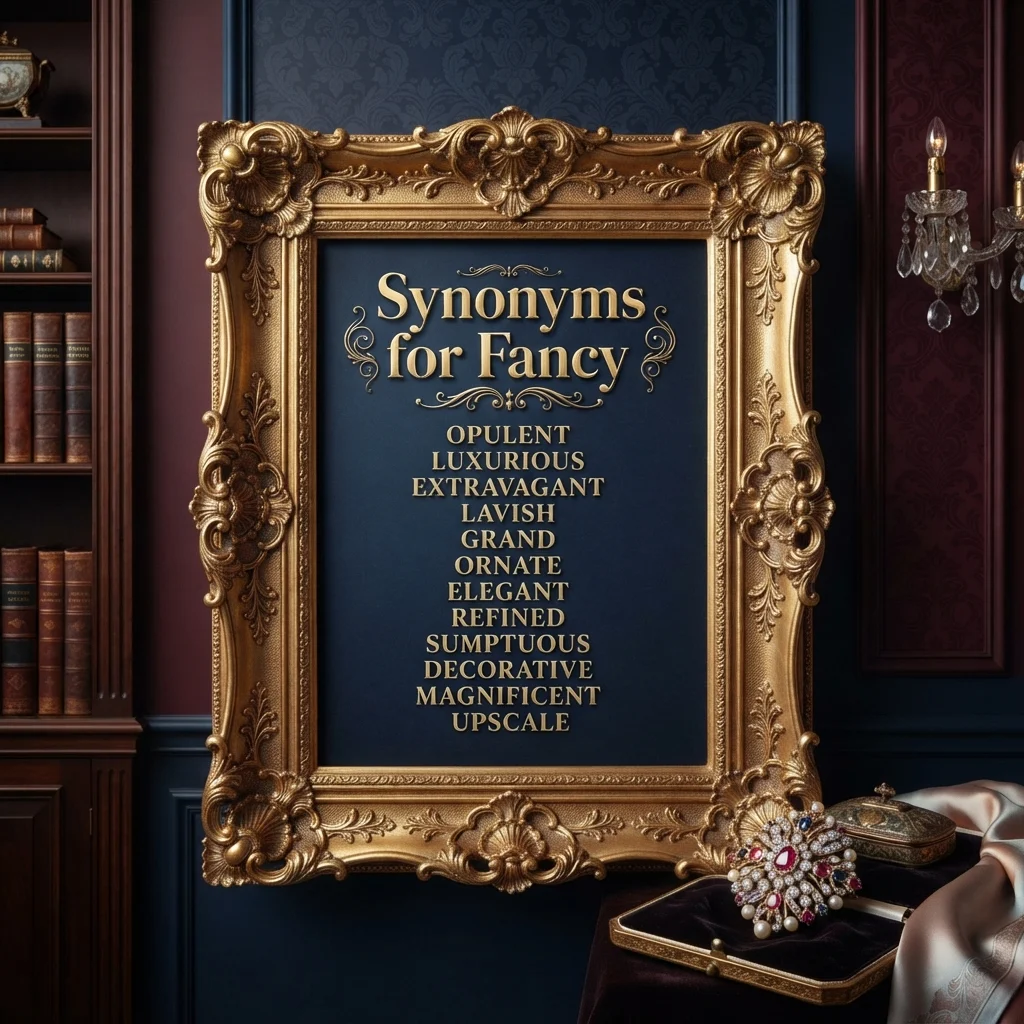
Do you keep using the word “fancy” in essays, blog posts, creative writing, professional communication, or everyday conversations? While it is a wonderfully versatile word, repeating it can make your writing feel imprecise or unimaginative.
The good news is that the best alternative depends on what you actually mean. You might be describing something ornate and decorative, a sudden liking or desire, a whimsical idea or imagination, or the act of imagining or wanting something .
This guide explains synonyms for fancy by meaning, tone, context, and usage, following the successful structure of our previous synonym guides. You will learn which alternatives work best in academic writing, creative expression, professional communication, and casual conversation.
Quick Answer: What Does “Fancy” Mean?
Fancy is a remarkably flexible word with three main uses. As an adjective, it’s the opposite of plain and describes something decorative, elaborate, or high-quality. As a noun, it can mean a sudden liking, a whim, or the power of imagination. As a verb, it means to imagine, to want, or to be attracted to someone . Depending on context, alternatives include ornate, elaborate, classy, whim, liking, imagination, envision, and desire.
Meaning, Tone, and Context
Simple Definition
Fancy can be used in three primary ways:
- Adjective (Elaborate/High-Quality): Not plain; decorative, ornamental, or of superior quality . This can describe clothing, food, events, or even ideas.
- Noun (A Liking or Imagination): A sudden or irrational liking for a person or thing; a capricious idea; the power of creative imagination .
- Verb (To Imagine or Want): To picture in one’s mind; to suppose; to have a wish for or be attracted to someone .
Part of Speech
Fancy functions as an adjective, noun, and verb.
Adjective Examples:
Noun Examples:
Verb Examples:
Tone: Positive, Negative, or Neutral
Fancy is generally neutral, but its tone depends heavily on context.
- Positive: It suggests something elegant, high-quality, or desirable. (“a fancy new car”)
- Neutral: It can simply describe a decorative or non-plain item. (“fancy handwriting”)
- Negative (or Ironic): It can imply ostentation, pretentiousness, or being overpriced. (“fancy four-syllable words” or “fancy fees”)
Formality Level
Fancy is a standard word, but its use varies.
- Formal contexts: The adjective elaborate or ornate, the noun inclination, and the verb desire are often more formal.
- Informal contexts: “Fancy” is common in British English for “like” or “want” (“I fancy a walk”) . In American English, it’s often used as an adjective or to express mild surprise (“Fancy that!”).
Common Use Cases
Fancy commonly refers to:
- Description: ornate decorations, elegant clothing, intricate designs
- Desire: a wish for a particular food or item
- Attraction: a crush on someone
- Imagination: a creative idea, fantasy, or daydream
- Opinion: a notion or supposition (“I fancy it will rain”)
Important Word Forms
- Fancy (adjective/noun/verb): the base word
- Fancier (comparative adjective): more elaborate or stylish
- Fanciest (superlative adjective): most elaborate or stylish
- Fancily (adverb): in a fancy manner
- Fanciness (noun): the quality of being fancy
- Fancied (verb past tense): imagined, wanted, or liked
- Fancying (verb present participle): imagining or wanting
When and How to Use “Fancy”
Because the word is broad and versatile, it is especially useful when discussing general concepts. However, specific contexts benefit from more precise alternatives.
Professional
“The marketing campaign featured a fancy new design.”
A more professional version might be:
“The marketing campaign featured an elegant and eye-catching new design.”
Academic
“Coleridge distinguished between fancy and imagination.”
This is a classic use of “fancy” in literary theory .
Personal
“I fancy a cup of tea after that long walk.”
This is perfectly natural and polite in British English.
Business
“Our company sells fancy furniture for luxury homes.”
A more precise version could be:
“Our company sells bespoke, high-end furniture for luxury homes.”
Creative
“The story is a wild mix of fact and fancy.”
This works well to describe a work of fiction or imagination.
Social Media
“Fancy some new content? Follow us for daily updates!”
This is a catchy and casual call to action.
Another Word for “Fancy”
There is no single perfect synonym because fancy can refer to elaborate decoration, a sudden liking, or the act of imagining.
- Elaborate context: ornate, lavish, intricate
- Quality context: classy, luxurious, opulent
- Liking context: fondness, preference, penchant
- Whim context: caprice, notion, impulse
- Imagination context: fantasy, creativity, vision
- Desire context: want, wish, desire, crave
- Imagination (verb): envision, imagine, picture
- Attraction (verb): desire, like, be attracted to
If you need one broad alternative for the adjective, ornate works well when describing something decorative. For the noun, liking is a solid choice. For the verb, imagine or envision is often the most direct translation .
When Not to Use “Fancy”
“Fancy” can become too vague or informal when the reader needs to know exactly what you mean.
Consider:
“She wore a fancy dress.”
This statement does not tell readers whether the dress was elegant, flashy, expensive, or simply not plain .
A more precise sentence could be:
“She wore an elegant, beaded evening gown.”
Similarly, avoid using fancy in formal writing when you mean a specific type of desire, like “a desire for knowledge,” or a specific imaginative process, like “creative imagination.” The word “fancy” can sometimes sound too casual or whimsical for serious academic or professional reports .
Words Commonly Confused With “Fancy”
Fancy vs. Imagination
Coleridge famously distinguished between the two: fancy is more casual and superficial, assembling images and ideas without deep creative power, while imagination is a more profound, creative, and unifying force .
Example:
“Fancy combines images, while imagination creates new realities.”
Fancy vs. Fantasy
Fantasy now usually suggests a more unrestrained or extravagant fancy, often leading to caprice or a complete departure from reality . Fancy is often a simpler, more playful idea.
Example:
“His fancy was to paint a picture; her fantasy was to quit her job and travel the world.”
Fancy vs. Elaborate
Elaborate is a more formal synonym for fancy as an adjective. It means “marked by complexity and richness of detail” .
Example:
“an elaborate design” (complex) vs. “a fancy design” (decorative but maybe not complex)
Fancy vs. Desire
Desire is a strong, often formal synonym for the verb “to want.” Fancy as a verb is often more casual or sudden .
Example:
“I desire a better world.” (formal, strong) vs. “I fancy an ice cream.” (casual)
Fancy vs. Notion
Notion is a synonym for the noun “fancy” when it means a vague or whimsical idea . “Notion” can be slightly more serious.
Example:
“She had a fancy to fly to Paris.” vs. “She had a notion to reorganize the entire office.”
Best Synonym by Context for “Fancy”
Which Synonym Should You Choose?
Start by identifying what part of speech and what meaning of “fancy” you are using.
- If you mean “elaborately decorated”: ornate, elaborate, adorned, decorative
- If you mean “of high quality and style”: classy, luxurious, opulent, high-end, elegant
- If you mean “a sudden liking”: whim, caprice, inclination, impulse
- If you mean “a lasting liking”: fondness, preference, penchant, partiality
- If you mean “creative imagination”: imagination, fantasy, creativity, vision
- If you mean “to picture in your mind”: envision, imagine, picture, visualize
- If you mean “to have a desire for”: desire, want, wish, crave
- If you mean “to be attracted to”: be attracted to, like, admire
- If you mean “to suppose”: suppose, think, believe, guess
Real Life Examples of “Fancy” in Sentences
School
“The art project featured a fancy design made from recycled materials.”
A more descriptive version could be:
“The art project featured an intricate, elaborate design made from recycled materials.”
Workplace
“Her fancy presentation helped secure the new client.”
A more precise version could be:
“Her polished, professional presentation helped secure the new client.”
Writing
“The author’s work is known for its rich mixture of fact and fancy.”
For a more descriptive literary context:
“The author’s work is known for its rich mixture of reality and imaginative fantasy.”
Conversation
“I’ve really taken a fancy to that new coffee shop.”
A more direct statement:
“I’ve really grown to like that new coffee shop.”
Social Media
“Fancy a look inside our latest collection? Click the link below!”
This is a common and engaging call to action.
Resume
Avoid using “fancy” in resumes. Instead, focus on more impactful words like “designed,” “created,” or “implemented.”
Business
“Our company invested in some fancy new technology.”
A stronger business version:
“Our company invested in advanced, high-performance new technology.”
Storytelling
“The king lived in a palace so fancy it would take your breath away.”
A more descriptive version:
“The king lived in a palatial, opulent estate that dazzled all who saw it.”
10 Key Synonyms for “Fancy”
The table below includes accurate alternatives and related terms. Since fancy has a broad meaning, some choices work as contextual alternatives rather than exact replacements.
Synonym Groups and Usage Differences
Professional vs. Personal Synonyms
Professional writing benefits from specific terms such as sophisticated, high-end, bespoke, and advanced. In a professional context, “fancy” is often seen as too casual or imprecise.
Personal communication often uses fancy, like, want, or imagine.
Compare:
“Our company needs a fancy new design.” (personal/vague)
“Our company requires a sophisticated new design solution.” (professional)
Formal vs. Conversational Synonyms
Formal alternatives: elaborate, desire, inclination, suppose, envision
Conversational alternatives: fancy, like, want, guess, picture
Examples:
“The nation has a desire for change.” (formal)
“I fancy a change of scene.” (conversational)
Academic Synonyms
Academic writing on literature and philosophy often distinguishes between fancy and imagination. In this context, “fancy” is used with its precise historical meaning, as defined by Coleridge: a more superficial and casual form of imagination .
Business Synonyms
Business writing often benefits from phrases such as advanced technology, luxury goods, premium options, or bespoke services .
Instead of:
“Our store sells fancy goods.”
Consider:
“Our store specializes in premium, bespoke goods.”
Creative or Literary Synonyms
Creative writing can use ornate, opulent, whimsical, fantastical, imaginative, and capricious depending on the setting and mood.
For example:
“The palace was an opulent maze of ornate, gold-leafed rooms, a testament to the king’s capricious fancy.”
Slang or Modern Synonyms
In casual speech, “fancy” is commonly used in British English. In American English, synonyms like swanky, deluxe, or simply nice are more common.
Examples:
“a swanky new restaurant”
“a deluxe apartment”
“a nice hotel”
Strongest vs. Weaker Synonyms
“Fancy” as an adjective can range in intensity.
Milder: nice, pleasant, decorative
Moderate: stylish, classy, elegant, high-end
Strong: ornate, opulent, lavish, extravagant
Emotional vs. Neutral Synonyms
“Fancy” is often a neutral descriptor, but it can carry positive or negative connotations .
Positive: elegant, luxurious, beautiful
Neutral: decorative, non-plain, complex
Negative: ostentatious, flashy, overpriced
Examples:
“The house was decorated in an elegant style.” (positive)
“The room had a decorative feature.” (neutral)
“He drove a flashy car to show off.” (negative)
Antonyms of “Fancy”
Depending on context, the following words represent opposites:
Comparison: “Fancy” vs. Similar Words
Fancy vs. Elaborate
Main difference: Both can describe something complex. However, elaborate emphasizes the complexity and detail of the planning or design (“an elaborate security system”), while fancy often emphasizes the decorative or stylish aspect (“a fancy dress”).
Fancy vs. Ornate
Main difference: Ornate specifically means heavily decorated, often with small, intricate details (“an ornate picture frame”). Fancy is a more general term for something that is not plain .
Fancy vs. Whim
Main difference: As a noun, a fancy can be a lasting preference or a creative idea, while a whim is a sudden, impulsive, and often irrational decision .
Fancy vs. Liked
Main difference: Fancy as a verb in British English is a synonym for “like,” but it can also mean “to want.” “Like” is more common and neutral in American English.
Fancy vs. Imagine
Main difference: Imagine is a direct and common synonym for the verb “to fancy.” “Fancy” as a verb is older and can sound more formal or old-fashioned when used in this sense (“Fancy that!”) .
Common Phrases and Expressions with “Fancy”
1. Flight of fancy
Meaning:
A creative and unrealistic idea or goal.
Example:
“He has flights of fancy about becoming a movie star.”
2. Take a fancy to
Meaning:
To start liking someone or something suddenly.
Example:
“She took a fancy to the little cottage in the countryside.”
3. Fancy that!
Meaning:
An exclamation of mild surprise or disbelief.
Example:
“They invited you, too? Fancy that!”
4. A passing fancy
Meaning:
A temporary and not very serious interest.
Example:
“I thought I loved him, but it was just a passing fancy.”
5. Strike someone’s fancy
Meaning:
To attract or appeal to someone.
Example:
“I’ll have whatever pizza strikes your fancy.”
6. Fancy footwork
Meaning:
Clever, intricate, or skillful movements, often in dance or sports.
Example:
“The boxer used some fancy footwork to avoid a punch.”
7. Fancy prices
Meaning:
Very high prices; exorbitant costs.
Example:
“They charge fancy prices for their designer clothes.”
8. Fancy goods
Meaning:
Decorative or ornamental items, often for gift-giving.
Common Mistakes to Avoid
1. Using “fancy” when a precise term is available
If you mean ornate, classy, whim, like, or imagine, use the more specific word. Specific vocabulary makes writing more informative.
2. Using “fancy” in formal contexts without consideration
In formal or professional writing, words like desire, incline, suppose, or elaborate may be more appropriate than the often casual “fancy.”
Example:
“fancy a new car” vs. “desire a new car”
3. Confusing fancy with imagination in academic writing
In literary theory, fancy and imagination have distinct meanings. Coleridge saw fancy as a more superficial, assembling force, while imagination is a deeper, creative, and unifying power . Using them interchangeably in this context can change the meaning of your sentence.
4. Overusing “fancy”
Repetition can make content feel vague. Instead, identify whether you mean something is elaborate, high-quality, a sudden liking, a creative idea, or the act of wanting.
5. Choosing a synonym that changes the meaning
Do not replace fancy with elaborate, whim, or desire simply because the words are related. Always check whether the replacement communicates the same idea.
6. Misunderstanding the British vs. American usage
“Fancy” is more common as a verb for “like” or “want” in British English. Using it that way in American English might sound a bit British or old-fashioned. In American English, it’s most often used as an adjective.
FAQs
What is the best synonym for “fancy”?
The best synonym depends on context. Ornate or elaborate works for the adjective, whim or liking for the noun, and imagine or desire for the verb .
What is a formal synonym for “fancy”?
Elaborate (adj.), inclination (n.), and desire (v.) are more formal synonyms .
What is an informal synonym for “fancy”?
Fancy itself is common in informal British English. In American English, like and want are more common.
What is the difference between “fancy” and “imagination”?
In literary and philosophical contexts, fancy is considered a more casual, superficial form of imagination. Imagination is a deeper, more creative, and unifying force .
What is another word for “fancy” in creative writing?
Ornate, whimsical, capricious, fantastical, and imaginative are great alternatives in creative writing .
What is the opposite of “fancy”?
The primary opposite of “fancy” (adj.) is plain or simple .
What does “take a fancy to” mean?
It means to develop a sudden liking for someone or something .
Conclusion
Fancy is a wonderfully versatile word, but its power comes from knowing how and when to use its precise synonyms. The best alternative depends on what you actually mean: if you’re describing something decorative, choose ornate; for high quality, use luxurious; for a sudden idea, pick whim; for a mental image, select envision; and to express a wish, use desire.
Most importantly, do not replace fancy simply to avoid repetition. First identify the specific idea behind the word, then choose the alternative that communicates that idea most clearly.
For academic, professional, and technical writing, precision is usually more valuable than vocabulary variety. A specific term such as elaborate, opulent, inclination, or suppose can tell readers much more than the broad word fancy.
Before publishing a vocabulary guide, verify definitions and usage with trusted dictionaries such as Cambridge, Oxford, Merriam-Webster, Collins, or Britannica. This helps ensure that each alternative accurately matches its intended meaning and context.
The practical takeaway is simple: when fancy feels too vague, ask yourself what part of speech you are using and what specific meaning you intend. Then use the most precise word available.
