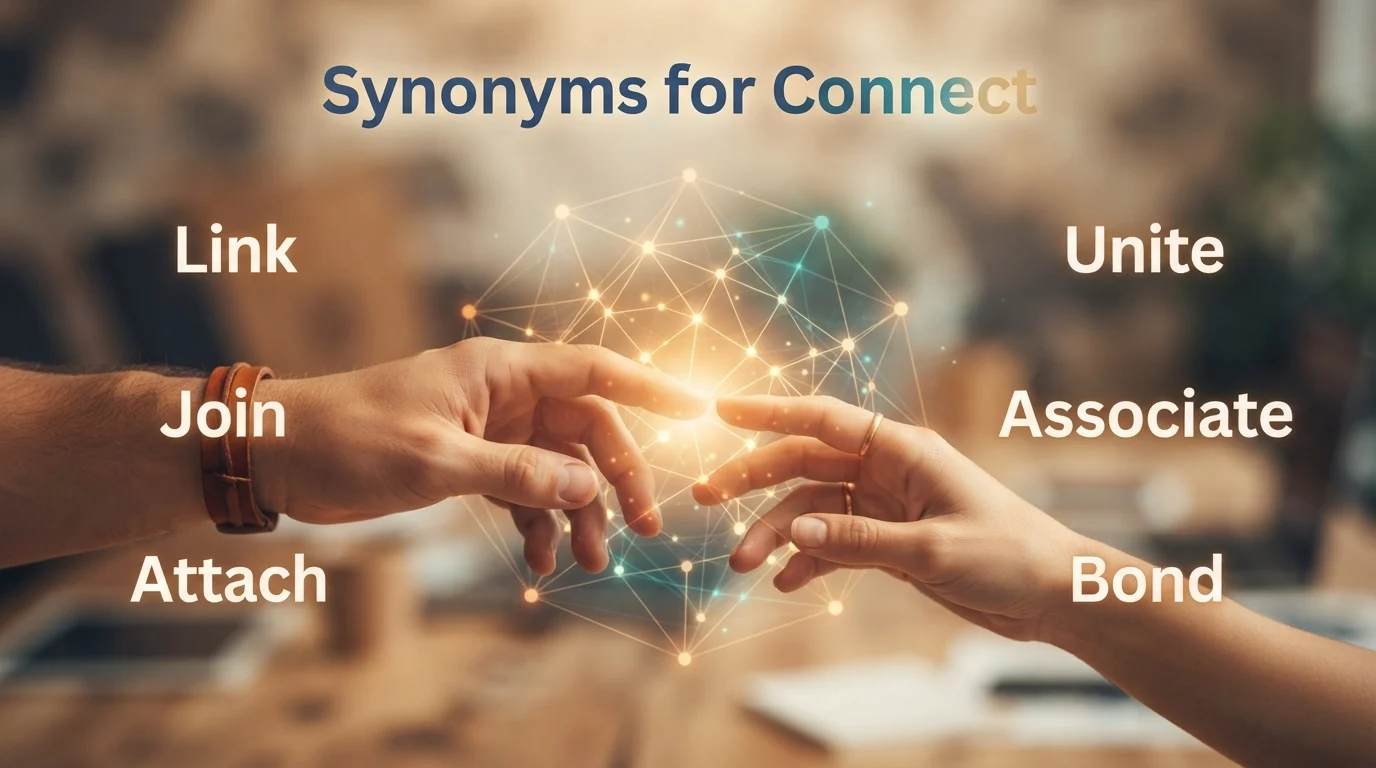
Do you keep using the word “connect” in essays, emails, business reports, technical documentation, or everyday conversation? While it is one of the most useful and versatile verbs in English, repeating it can make your writing feel flat, repetitive, or overly generic.
The good news is that the best alternative depends on what you actually mean. You might be describing linking two things, joining people together, relating ideas, attaching devices, or establishing a relationship.
This guide explains synonyms for “connect” by meaning, tone, context, and usage. You will learn which alternatives work best in academic writing, professional communication, technical documentation, creative expression, and casual conversation.
Quick Answer: What Does “Connect” Mean?
“Connect” means to join, link, or bring together two or more things, people, or ideas. It can refer to physical joining, establishing relationships, linking concepts, attaching devices, or associating one thing with another. Depending on context, alternatives include link, join, unite, attach, associate, relate, bind, couple, merge, and bridge.
Meaning, Tone, and Context
Simple Definition
“Connect” generally refers to:
- Physical joining: linking two objects together
- Relationships: establishing a bond between people
- Ideas: showing how concepts are related
- Technology: attaching devices or systems
- Transportation: linking routes or networks
- Communication: putting people in touch
Part of Speech
“Connect” functions primarily as a verb.
Examples:
- “Connect the cable to the port.”
- “She connected with her audience.”
- “The bridge connects the two cities.”
Related Forms:
- Connection (noun): a link or relationship
- Connected (adjective): joined or linked
- Connective (adjective): serving to connect
- Connector (noun): something that connects
- Connectivity (noun): the state of being connected
Positive, Negative, or Neutral Tone
“Connect” is generally neutral but can be positive in social and emotional contexts.
Positive associations:
- “She connected with her students.”
- “The community is well connected.”
Neutral or technical contexts:
- “Connect the device to the network.”
- “The two events are connected.”
Formality Level
“Connect” is a standard word that works in both formal and informal English. It is appropriate in academic writing, business communication, technical documentation, creative writing, and casual conversation.
However, more specific alternatives can add precision and variety depending on the context.
Common Use Cases
“Connect” commonly refers to:
- Technology: connecting devices, connecting to the internet, connecting cables
- Relationships: connecting with people, connecting emotionally
- Ideas: connecting concepts, connecting the dots, connecting theory to practice
- Transportation: connecting flights, connecting routes, connecting roads
- Business: connecting with clients, connecting networks, connecting supply chains
- Communication: connecting calls, connecting people
Important Word Forms
- Connect (verb): to join or link
- Connection (noun): a link or relationship
- Connected (adjective): joined or linked
- Connective (adjective): serving to connect
- Connector (noun): something that connects
- Connectivity (noun): the state of being connected
- Disconnect (verb): to separate or break a link
- Interconnect (verb): to connect with each other
When and How to Use “Connect”
Use “connect” when you want to describe joining, linking, or bringing together things, people, or ideas. Because the word is broad, more specific alternatives can add precision depending on the context.
Professional
“We need to connect our marketing and sales teams.”
This works naturally in business communication.
Academic
“The study connects economic inequality to health outcomes.”
The term is appropriate in academic research.
Technical
“Connect the router to the modem using an Ethernet cable.”
This is standard in technical documentation.
Personal
“I really connected with her at the party.”
The word sounds natural in everyday conversation.
Transportation
“This flight connects to Paris.”
This is standard in travel contexts.
Creative
“The novel connects past and present through parallel narratives.”
The word creates a sense of relationship and unity.
Another Word for “Connect”
There is no single perfect synonym because “connect” can refer to physical joining, relationships, ideas, technology, or communication.
- Physical joining: link, join, attach, fasten, couple, unite
- Relationships: bond, relate, empathize, identify, click
- Ideas: associate, relate, correlate, tie, link
- Technology: link, network, interface, integrate, sync
- Transportation: link, join, bridge, span
- Communication: put through, patch through, contact, reach
If you need one broad alternative, “link” works in most contexts, while “join” works for physical connections. “Relate” works for ideas.
When Not to Use “Connect”
“Connect” can become too vague when you need to specify exactly what kind of connection you are describing.
Consider:
“The two events are connected.”
This statement does not tell readers whether the events are causally related, temporally linked, or merely similar.
A more precise sentence could be:
“The two events are causally linked through a common factor.”
Similarly, avoid using “connect” when you mean “unite” in a political or social context. Use “unite” or “bring together” instead.
Words Commonly Confused With “Connect”
Connect vs. Link
Link often implies a chain or relationship. Connect is broader.
Example:
“The two cities are linked by a bridge.” (physical)
“The two ideas are connected.” (conceptual)
Connect vs. Join
Join emphasizes bringing together into one unit. Connect can be less permanent.
Example:
“Join the two pieces.” (unite)
“Connect the two pieces.” (link)
Connect vs. Attach
Attach emphasizes fastening one thing to another. Connect can be more abstract.
Example:
“Attach the label to the package.” (fasten)
“Connect the printer to the computer.” (link)
Connect vs. Associate
Associate emphasizes mental linking. Connect can be physical or mental.
Example:
“I associate summer with beaches.” (mental)
“The bridge connects the two islands.” (physical)
Connect vs. Relate
Relate emphasizes showing a relationship between things. Connect can be more direct.
Example:
“The study relates diet to health.” (shows relationship)
“The study connects diet to health.” (links)
Connect vs. Unite
Unite emphasizes bringing together for a common purpose. Connect can be more neutral.
Example:
“The community united to rebuild.” (common purpose)
“The bridge connects the community.” (physical link)
Best Synonym by Context for “Connect”
| Context | Best Synonym | Why It Works | Example |
|---|---|---|---|
| Formal writing | Link, associate | Precise and professional | The report links climate change to economic policy. |
| Academic writing | Correlate, relate | Standard academic usage | The study correlates sleep quality with productivity. |
| Technical documentation | Attach, interface, integrate | Technical and precise | Attach the sensor to the main unit. |
| Business communication | Link, network, integrate | Professional and clear | The platform integrates with existing tools. |
| Relationships | Bond, click, empathize | Social and emotional | They bonded over shared interests. |
| Ideas | Associate, relate, tie | Conceptual | The theory ties together several disciplines. |
| Transportation | Link, join, bridge | Travel and infrastructure | The new rail line links the two cities. |
| Casual conversation | Click, hit it off, get along | Natural and informal | We really clicked at the party. |
| Technology | Sync, pair, interface | Tech contexts | Sync your phone with your laptop. |
| Communication | Put through, patch through | Phone and radio | I’ll put you through to the manager. |
| Creative writing | Bridge, weave, intertwine | Literary and expressive | The author weaves together multiple storylines. |
| Networking | Network, link up | Business and social | She networked with industry leaders. |
Which Synonym Should You Choose?
Start by identifying what kind of “connect” you are describing.
- Physical joining: link, join, attach, fasten, couple
- Relationships: bond, relate, empathize, click, get along
- Ideas: associate, relate, correlate, tie, link
- Technology: link, network, interface, integrate, sync, pair
- Transportation: link, join, bridge, span
- Communication: put through, patch through, contact, reach
10 Key Synonyms for “Connect”
The table below includes accurate alternatives with clear meanings and usage contexts.
| Synonym | Simple Meaning | Best Used For | Example Sentence |
|---|---|---|---|
| Link | Join or relate | General, ideas | The study links stress to heart disease. |
| Join | Bring together | Physical, general | Join the two wires together. |
| Unite | Bring together for a purpose | Social, political | The crisis united the community. |
| Attach | Fasten or join | Technical, physical | Attach the file to the email. |
| Associate | Mentally link | Ideas, concepts | I associate fall with cozy sweaters. |
| Relate | Show a relationship | Academic, personal | The report relates income to education. |
| Bond | Form a close relationship | Emotional, social | The team bonded during the retreat. |
| Integrate | Combine into one system | Technical, business | The software integrates with existing tools. |
| Bridge | Connect two things | General, creative | The agreement bridges the gap between the two sides. |
| Network | Connect with others | Business, social | She networked with potential clients. |
Synonym Groups and Usage Differences
Professional vs. Personal Synonyms
Professional writing benefits from specific terms such as link, integrate, associate, correlate, and network.
Personal communication often uses connect itself or casual alternatives like click, bond, or get along.
Compare:
“We really clicked at the party.” (personal)
“The report links the two variables.” (professional)
Formal vs. Conversational Synonyms
Connect works in both formal and conversational English.
Formal alternatives: link, associate, correlate, integrate, relate
Conversational alternatives: click, bond, get along, hit it off
Examples:
“The study correlates income with life expectancy.” (formal)
“We hit it off immediately.” (conversational)
Academic Synonyms
Academic writing should distinguish between connect (general), correlate (statistical relationship), associate (mental link), and relate (show relationship).
For example:
“The study correlates sleep quality with academic performance.”
“The theory associates economic growth with innovation.”
Professional and Business Synonyms
Business writing often benefits from phrases such as link, integrate, network, align, and bridge.
Instead of:
“We need to connect our systems.”
Consider:
“We need to integrate our systems to improve efficiency.”
Creative or Literary Synonyms
Creative writing can use bridge, weave, intertwine, bind, and unite depending on the context.
For example:
“The novel weaves together multiple storylines.”
“The experience bound them together forever.”
Slang or Modern Synonyms
Click means to connect instantly with someone.
Hit it off means to connect well immediately.
Vibe means to connect on a personal level.
Sync means to connect or coordinate.
Examples:
“We really clicked at the party.” (casual)
“We’re totally in sync.” (modern)
Strongest vs. Weaker Synonyms
“Connect” synonyms vary in intensity:
Milder: associate, relate, link
Moderate: connect, join, attach
Strong: bond, unite, integrate
Very Strong: fuse, merge, consolidate
Emotional vs. Neutral Synonyms
“Connect” is generally neutral.
Emotional alternatives: bond, click, empathize (positive)
Neutral alternatives: link, attach, associate, join
Examples:
“They bonded over their shared experiences.” (emotional)
“The bridge connects the two cities.” (neutral)
Antonyms of “Connect”
“Connect” has several antonyms depending on context:
| Antonym | Context | Meaning | Example Sentence |
|---|---|---|---|
| Disconnect | General | Separate or break a link | Disconnect the cable before moving. |
| Separate | General | Keep apart | The wall separates the two rooms. |
| Detach | Physical | Remove or unfasten | Detach the label from the package. |
| Divide | General | Split into parts | The river divides the city. |
| Disjoin | General | Separate | The two parts were disjoined. |
| Disunite | Social | Break apart | The conflict disunited the group. |
| Isolate | Social | Set apart | The patient was isolated. |
Comparison: “Connect” vs. Similar Words
Connect vs. Link
Main difference: Link often implies a chain or relationship. Connect is broader.
Examples:
“The two cities are linked by a bridge.” (physical)
“The two ideas are connected.” (conceptual)
Connect vs. Join
Main difference: Join emphasizes bringing together into one unit. Connect can be less permanent.
Examples:
“Join the two pieces.” (unite)
“Connect the two pieces.” (link)
Connect vs. Attach
Main difference: Attach emphasizes fastening one thing to another. Connect can be more abstract.
Examples:
“Attach the label to the package.” (fasten)
“Connect the printer to the computer.” (link)
Connect vs. Associate
Main difference: Associate emphasizes mental linking. Connect can be physical or mental.
Examples:
“I associate summer with beaches.” (mental)
“The bridge connects the two islands.” (physical)
Connect vs. Relate
Main difference: Relate emphasizes showing a relationship between things. Connect can be more direct.
Examples:
“The study relates diet to health.” (shows relationship)
“The study connects diet to health.” (links)
Connect vs. Unite
Main difference: Unite emphasizes bringing together for a common purpose. Connect can be more neutral.
Examples:
“The community united to rebuild.” (common purpose)
“The bridge connects the community.” (physical link)
Common Phrases and Expressions with “Connect”
1. Connect the dots
Meaning:
To understand how different pieces of information are related.
Example:
“Once you connect the dots, the whole story makes sense.”
2. Connect with
Meaning:
To establish a relationship with someone.
Example:
“She connected with her mentor immediately.”
3. Connect to
Meaning:
To link to something.
Example:
“Connect your phone to the Wi-Fi network.”
4. Well-connected
Meaning:
Having many useful contacts.
Example:
“He is well-connected in the industry.”
5. Connect the pieces
Meaning:
To assemble or understand how things fit together.
Example:
“The detective connected the pieces of evidence.”
6. Human connection
Meaning:
The emotional bond between people.
Example:
“Human connection is essential for well-being.”
7. Connect the dots
Meaning:
To understand the relationship between separate things.
Example:
“Can you connect the dots between these two events?”
8. Connect up
Meaning:
To join things together.
Example:
“Connect up the cables to the power supply.”
9. Connect in
Meaning:
To join a network or system.
Example:
“Users can connect in from anywhere.”
10. Connecting flight
Meaning:
A flight that links to another for a single journey.
Example:
“I have a connecting flight in Chicago.”
Common Mistakes to Avoid
1. Using “connect” when a more precise term is available
If you mean link, join, attach, bond, or integrate, use the more specific word.
Vague: “The two systems are connected.”
Precise: “The two systems are integrated through a shared API.”
2. Confusing “connect” with “unite”
Unite implies a common purpose. Connect can be physical or neutral.
Incorrect: “The community connected to fight the policy.”
Correct: “The community united to fight the policy.”
3. Using “connect” in technical writing when “attach” or “interface” is needed
Technical documents require precise language. Use attach, interface, or sync.
Vague: “Connect the device.”
Precise: “Attach the device to the mounting bracket.”
4. Overusing “connect” in writing
Repetition can make content feel dull. Use alternatives such as link, join, associate, integrate, and bond.
5. Choosing a synonym that changes the meaning
Do not replace connect with unite unless you mean common purpose.
Do not replace connect with attach unless you mean fastening.
FAQs
What is the best synonym for “connect”?
The best synonym depends on context. Link works for general use, join for physical connection, bond for emotional connection, integrate for systems, and associate for ideas.
What is a formal synonym for “connect”?
Link, associate, correlate, integrate, and relate are formal synonyms.
What is an informal synonym for “connect”?
Click, hit it off, bond, get along, and vibe are common informal alternatives.
What is another word for “connect” in technical writing?
Attach, interface, integrate, sync, and pair work well in technical writing.
What is the difference between “connect” and “link”?
Link often implies a chain or relationship. Connect is broader.
What is the opposite of “connect”?
Depending on context, opposites include disconnect, separate, detach, divide, and isolate.
What does “connect” mean in a business context?
In business, connect often means network, integrate, align, or bridge—establishing relationships or linking systems.
Conclusion
“Connect” is a versatile and essential word that can describe joining, linking, relating, bonding, attaching, and integrating. The best synonym depends on what you actually mean.
Choose link for general use, join for physical connection, bond for emotional connection, integrate for systems, associate for ideas, and bridge for creative writing.
Most importantly, do not replace “connect” simply to avoid repetition. First identify what kind of connection—physical, emotional, conceptual, or technological—you are actually describing. Then choose the alternative that communicates that idea most clearly.
For academic, professional, and technical writing, precision is usually more valuable than vocabulary variety. A specific term such as correlate, integrate, associate, or attach can tell readers much more than the broad word connect.
Before publishing a vocabulary guide, verify definitions and usage with trusted dictionaries such as Cambridge, Oxford, Merriam-Webster, Collins, or Britannica. This helps ensure that each alternative accurately matches its intended meaning and context.
The practical takeaway is simple: when “connect” feels too general, ask yourself what kind of connection—physical, emotional, or conceptual—you are actually describing. Then use the most precise word available.
Discover More:-
- 50+ Synonyms for Give: Meanings, Examples, and Best Alternatives
- 50+ Synonyms for Together: Meanings, Examples, and Best Alternatives
