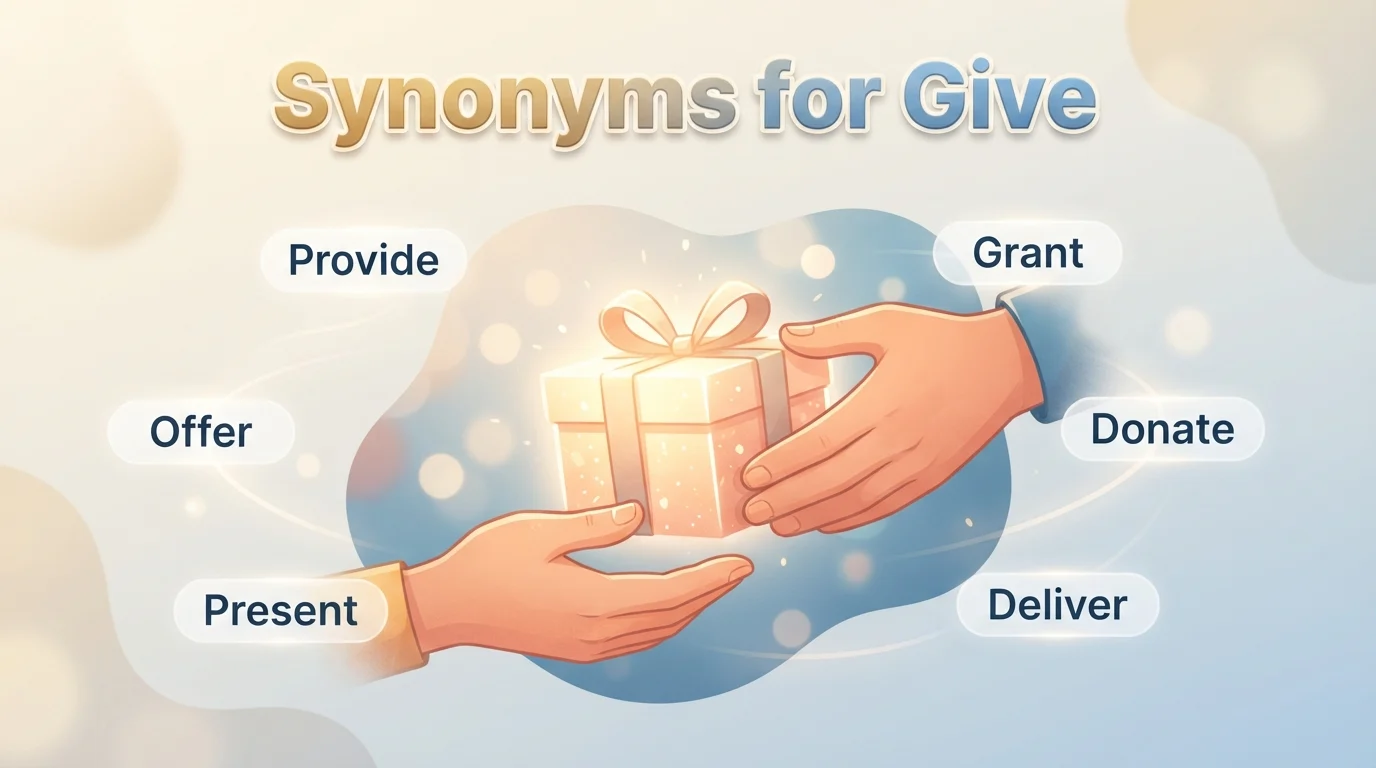
Do you keep using the word “give” in essays, business emails, creative writing, presentations, or everyday conversation? While it is one of the most common and flexible verbs in English, repeating it can make your writing feel flat or repetitive.
The good news is that the best alternative depends on what you actually mean. You might be handing something to someone, offering help, providing information, granting permission, donating to a cause, or presenting an idea.
This guide explains synonyms for “give” by meaning, tone, context, and usage. You will learn which alternatives work best in academic writing, professional communication, creative expression, casual conversation, and formal contexts.
Quick Answer: What Does “Give” Mean?
“Give” means to transfer something to someone, to provide or supply something, to offer or present something, to grant or allow something, or to yield or produce something. Depending on context, alternatives include provide, offer, present, grant, donate, supply, deliver, hand over, bestow, and contribute.
Meaning, Tone, and Context
Simple Definition
“Give” generally refers to:
- Transfer: handing something to someone physically
- Provide: supplying something that is needed
- Offer: presenting something for acceptance
- Grant: allowing or permitting something
- Donate: giving to a cause or charity
- Deliver: presenting formally (a speech, a verdict)
- Yield: producing or resulting in something
- Bestow: giving something of high value or honor
Part of Speech
“Give” is primarily a verb. It can also function as a noun in informal contexts.
Verb Examples:
- “She gave him a book.” (transferred)
- “The teacher gave us homework.” (assigned)
- “The tree gives shade.” (provides)
Noun Example:
- “The leather has a lot of give.” (flexibility)
Related Forms:
- Give (verb): to transfer, provide, or offer
- Giving (adjective/noun): generous; the act of giving
- Giver (noun): a person who gives
- Given (past participle): provided or assumed
- Gift (noun/verb): a present; to present something
Positive, Negative, or Neutral Tone
“Give” is generally neutral, but tone can shift based on context.
Positive associations:
- “She gave generously to the charity.” (generous)
- “He gave his time to help others.” (selfless)
Neutral or negative contexts:
- “He gave a forced apology.” (insincere)
- “The teacher gave a harsh punishment.” (negative)
Formality Level
“Give” is a standard word that works in both formal and informal English. More formal alternatives like bestow, grant, confer, and provide are often preferred in academic and professional writing.
Common Use Cases
“Give” commonly refers to:
- Physical transfer: handing over an object
- Providing: supplying information, help, or resources
- Offering: presenting something for acceptance
- Granting: allowing or permitting
- Donating: contributing to a cause
- Communicating: giving a speech, a presentation, or an answer
- Producing: yielding results or effects
Important Word Forms
- Give (verb): base form
- Gave (verb): past tense
- Given (verb): past participle
- Giving (verb): present participle
- Giver (noun): one who gives
- Gift (noun/verb): a present; to give as a gift
- Forgive (verb): to pardon (related form)
When and How to Use “Give”
Use “give” when you want to describe the act of transferring, providing, offering, or granting something. Because the word is broad, more specific alternatives can add precision.
Professional
“We need to give clear instructions to the team.”
This works naturally in business communication.
Academic
“The study gives evidence for a strong correlation.”
The term is appropriate in academic writing, though provides may sound more formal.
Personal
“She gave me a beautiful gift for my birthday.”
The word sounds natural in everyday conversation.
Business
“The company gave a generous donation to the local school.”
Here, “gave” describes a charitable contribution.
Creative
“The sunset gave the sky a golden glow.”
The word describes producing an effect.
Formal
“The committee gave its approval to the proposal.”
This is standard formal usage.
Another Word for “Give”
There is no single perfect synonym because “give” can refer to many different actions and contexts.
- Physical transfer: hand, pass, deliver, hand over
- Providing: provide, supply, furnish, equip
- Offering: offer, present, proffer, extend
- Granting: grant, allow, permit, accord, confer
- Donating: donate, contribute, gift, bequeath
- Communicating: deliver, present, announce, impart
- Producing: yield, produce, generate, emit
- Bestowing: bestow, confer, award, endow
If you need one broad alternative, “provide” works for supplying something, “offer” works for presenting something, and “grant” works for permission or requests.
When Not to Use “Give”
“Give” can become too vague when you need to be specific about what is being transferred, provided, or granted.
Consider:
“He gave a speech.”
This statement does not tell readers whether he delivered a formal address, presented a proposal, or made an informal talk.
A more precise sentence could be:
“He delivered a keynote address at the conference.”
Similarly, avoid using “give” when you mean “donate” in formal writing about charity, or “grant” when discussing permissions.
Words Commonly Confused With “Give”
Give vs. Provide
Provide emphasizes supplying something that is needed. Give is broader.
Example:
“The company provides health insurance.” (supplies a necessity)
“She gave him a book.” (transferred a gift)
Give vs. Offer
Offer emphasizes presenting something for acceptance or rejection. Give implies the transfer has occurred.
Example:
“He offered to help.” (presented for acceptance)
“He gave his help willingly.” (actually provided)
Give vs. Grant
Grant emphasizes giving permission or formally agreeing to a request. Give is broader.
Example:
“The judge granted the motion.” (formal permission)
“She gave her permission.” (less formal)
Give vs. Donate
Donate specifically means giving to a charitable cause or organization.
Example:
“She donated $500 to the Red Cross.” (charity)
“She gave $500 to her friend.” (general)
Give vs. Present
Present emphasizes formally giving or showing something to an audience.
Example:
“He presented the award to the winner.” (formal ceremony)
“He gave the award to the winner.” (general)
Give vs. Bestow
Bestow is a formal, literary word meaning to give something of high value or honor.
Example:
“The queen bestowed knighthood on him.” (formal honor)
“She gave him a gift.” (general)
Best Synonym by Context for “Give”
| Context | Best Synonym | Why It Works | Example |
|---|---|---|---|
| Formal writing | Provide, grant, confer | Precise and professional | The report provides a detailed analysis. |
| Academic writing | Provide, offer, present | Standard academic usage | The study provides evidence for the theory. |
| Business communication | Provide, supply, deliver | Professional and clear | We will deliver the report by Friday. |
| Physical transfer | Hand, pass, hand over | Describes actual transfer | Please hand me the keys. |
| Charity/donation | Donate, contribute, gift | Emphasizes generosity | She donated her savings to the shelter. |
| Permission | Grant, allow, permit, accord | Formal permission | The board granted the request. |
| Communication | Deliver, present, impart | Formal speaking | He delivered a powerful speech. |
| Producing results | Yield, produce, generate | Cause and effect | The experiment yielded promising results. |
| Recognition/awards | Award, bestow, confer | Formal honors | The university conferred an honorary degree. |
| Casual conversation | Give (itself), hand | Natural and concise | Give me a second. |
| Help/assistance | Offer, extend, lend | Supportive contexts | She extended a helping hand. |
Which Synonym Should You Choose?
Start by identifying what kind of “giving” you are describing.
- Physical transfer: hand, pass, hand over, deliver
- Providing necessities: provide, supply, furnish, equip
- Offering something: offer, present, proffer, extend
- Granting permission: grant, allow, permit, accord, confer
- Donating to charity: donate, contribute, gift, bequeath
- Communicating formally: deliver, present, impart, announce
- Producing results: yield, produce, generate, emit
- Awarding honors: bestow, confer, award, endow
- Casual contexts: give (itself), hand, pass
- Help/support: offer, extend, lend
10 Key Synonyms for “Give”
The table below includes accurate alternatives with clear meanings and usage contexts.
| Synonym | Simple Meaning | Best Used For | Example Sentence |
|---|---|---|---|
| Provide | To supply something needed | Formal, professional, academic | The company provides free training. |
| Offer | To present for acceptance | Help, suggestions, opportunities | She offered to help with the project. |
| Present | To give formally | Speeches, awards, ideas | He presented his findings to the board. |
| Grant | To give permission or agree | Formal requests, permissions | The judge granted the appeal. |
| Donate | To give to a cause | Charity, nonprofits | They donated clothes to the shelter. |
| Deliver | To give or present formally | Speeches, packages, results | She delivered an inspiring speech. |
| Supply | To provide systematically | Goods, resources, equipment | The farm supplies fresh vegetables. |
| Hand over | To give physically | Documents, objects, control | He handed over the keys. |
| Contribute | To give along with others | Team efforts, charity, ideas | Everyone contributed to the success. |
| Bestow | To give honorably | Awards, honors, formal recognition | The queen bestowed a medal on the soldier. |
Synonym Groups and Usage Differences
Professional vs. Personal Synonyms
Professional writing benefits from specific terms such as provide, deliver, supply, grant, and present.
Personal communication often uses give itself or casual alternatives like hand or pass.
Compare:
“Give me the book.” (personal, casual)
“Please provide the document by Friday.” (professional)
Formal vs. Conversational Synonyms
Give works in both formal and conversational English.
Formal alternatives: provide, grant, confer, bestow, contribute
Conversational alternatives: give, hand, pass
Examples:
“The university conferred an honorary degree.” (formal)
“She gave me a ride home.” (conversational)
Academic Synonyms
Academic writing should distinguish between provide (supply evidence), offer (present a suggestion), present (formally show), and yield (produce results).
For example:
“The data provides compelling evidence.”
“The theory offers a new perspective.”
Professional and Business Synonyms
Business writing often benefits from phrases such as provide, deliver, supply, grant, and allocate.
Instead of:
“We gave the client the report.”
Consider:
“We delivered the report to the client.”
Creative or Literary Synonyms
Creative writing can use bestow, impart, grant, render, yield, and afford depending on the context.
For example:
“The stars bestowed a silvery glow on the lake.”
“The experience imparted a deep sense of gratitude.”
Slang or Modern Synonyms
Hand over is common in casual speech.
Fork over means to give reluctantly (slang).
Cough up means to give money reluctantly (slang).
Hook up can mean to give someone something (informal).
Examples:
“Fork over the cash.” (slang, reluctant)
“Cough up the money you owe me.” (slang)
Strongest vs. Weaker Synonyms
“Give” synonyms vary in specificity:
Broad: give, hand, pass
More focused: provide, offer, supply
Very specific: donate, grant, bestow, confer
Emotional vs. Neutral Synonyms
“Give” is generally neutral.
Emotional alternatives: bestow (honor), donate (generosity), impart (wisdom)
Neutral alternatives: provide, supply, hand, pass
Examples:
“She donated her entire savings.” (emotional, generous)
“She provided the necessary documents.” (neutral)
Antonyms of “Give”
“Give” has several antonyms depending on context:
| Antonym | Context | Meaning | Example Sentence |
|---|---|---|---|
| Take | General | To receive or acquire | He took the book from the shelf. |
| Receive | General | To be given something | She received a gift. |
| Withhold | General | To refuse to give | The company withheld the information. |
| Keep | General | To retain possession | He kept the money for himself. |
| Retain | Formal | To continue to hold | The company retained control. |
| Deny | Permission | To refuse to give | The request was denied. |
| Refuse | General | To decline to give | She refused to help. |
| Seize | Forceful | To take by force | The government seized the property. |
Comparison: “Give” vs. Similar Words
Give vs. Provide
Main difference: Provide emphasizes supplying something needed. Give is broader and can include gifts, permission, or communication.
Examples:
“The school provides free lunches.” (supplies a need)
“She gave him a birthday present.” (transferred a gift)
Give vs. Offer
Main difference: Offer emphasizes presenting something for acceptance or rejection. Give implies the transfer has occurred.
Examples:
“He offered to drive her home.” (suggested, not yet done)
“He gave her a ride home.” (actually did it)
Give vs. Grant
Main difference: Grant emphasizes formal permission or agreement to a request. Give is more general.
Examples:
“The judge granted the request.” (formal permission)
“She gave her permission.” (general)
Give vs. Donate
Main difference: Donate specifically means giving to a charitable cause or organization.
Examples:
“He donated $1,000 to the hospital.” (charity)
“He gave $1,000 to his brother.” (personal)
Give vs. Present
Main difference: Present emphasizes formally giving or showing something to an audience.
Examples:
“She presented the award to the winner.” (formal ceremony)
“She gave the award to the winner.” (general)
Give vs. Bestow
Main difference: Bestow is a formal, literary term meaning to give something of high value or honor.
Examples:
“The king bestowed a title on him.” (formal honor)
“She gave him a compliment.” (general)
Common Phrases and Expressions with “Give”
1. Give up
Meaning:
To quit or surrender.
Example:
“He gave up smoking last year.”
2. Give in
Meaning:
To yield or surrender.
Example:
“She finally gave in to their demands.”
3. Give away
Meaning:
To donate or reveal.
Example:
“They gave away all their old furniture.”
4. Give back
Meaning:
To return or contribute to society.
Example:
“She gives back to her community through volunteering.”
5. Give out
Meaning:
To distribute or stop working.
Example:
“The teacher gave out the exam papers.”
“My legs gave out after the marathon.”
6. Give thanks
Meaning:
To express gratitude.
Example:
“We give thanks for our blessings.”
7. Give a hand
Meaning:
To help.
Example:
“Can you give me a hand with these boxes?”
8. Give it a shot
Meaning:
To try something.
Example:
“I’ve never done this before, but I’ll give it a shot.”
9. Give or take
Meaning:
Approximately.
Example:
“It will take an hour, give or take.”
10. Give someone a break
Meaning:
To stop being critical; to give someone a chance.
Example:
“Give him a break—he’s new at this.”
Common Mistakes to Avoid
1. Using “give” when “provide” or “offer” is more precise
In formal or academic writing, use more specific alternatives.
Vague: “The study gives evidence.”
Precise: “The study provides evidence.”
2. Using “give” when “donate” is more appropriate
If you are talking about charity, use donate or contribute.
Incorrect: “She gave money to the orphanage.” (acceptable but less formal)
Correct: “She donated money to the orphanage.” (more precise)
3. Confusing “give” with “offer”
Give implies the action has been completed. Offer implies it is presented for acceptance.
Example:
“He offered to help.” (may or may not happen)
“He gave his help.” (it happened)
4. Overusing “give” in writing
Repetition can make content feel dull. Use alternatives such as provide, offer, present, deliver, supply, grant, and contribute.
5. Using “give” when “grant” is required in formal contexts
If you are talking about permissions or formal requests, use grant.
Informal: “The judge gave the request.”
Formal: “The judge granted the request.”
FAQs
What is the best synonym for “give”?
The best synonym depends on context. Provide works for supplying needs, offer for presenting for acceptance, grant for permissions, donate for charity, present for formal speeches, and deliver for formal giving.
What is a formal synonym for “give”?
Provide, grant, confer, bestow, and contribute are formal synonyms. These work well in academic papers, business reports, and professional documents.
What is an informal synonym for “give”?
Hand, pass, and give itself are common informal alternatives. Fork over and cough up are slang for giving reluctantly.
What is another word for “give” in the sense of a speech?
Deliver is the most common synonym. Present and give also work.
What is the difference between “give” and “provide”?
Provide emphasizes supplying something that is needed. Give is broader and can include gifts, permission, or communication.
What is the opposite of “give”?
Depending on context, opposites include take, receive, withhold, keep, retain, deny, and refuse.
What does “give” mean in the context of permission?
In the context of permission, “give” means to grant or allow something, as in “She gave her permission.”
Conclusion
“Give” is a remarkably versatile verb that can describe physical transfer, providing, offering, granting, donating, communicating, and producing results. The best synonym depends on what you actually mean.
Choose provide for supplying needs, offer for presenting something, present for formal occasions, grant for permissions, donate for charity, deliver for speeches, supply for goods, and bestow for honors.
Most importantly, do not replace “give” simply to avoid repetition. First identify what kind of giving—physical transfer, provision, permission, donation, or communication—you are actually describing. Then choose the alternative that communicates that idea most clearly.
For academic, professional, and formal writing, precision is usually more valuable than vocabulary variety. A specific term such as provides, grants, confers, or contributes can tell readers much more than the broad word give.
Before publishing a vocabulary guide, verify definitions and usage with trusted dictionaries such as Cambridge, Oxford, Merriam-Webster, Collins, or Britannica. This helps ensure that each alternative accurately matches its intended meaning and context.
The practical takeaway is simple: when “give” feels too general, ask yourself what kind of providing, offering, or granting you are actually describing. Then use the most precise word available.
Discover More:-
- 50+ Synonyms for Light: Meanings, Examples, and Best Alternatives
- 50+ Synonyms for Technology: Meanings, Examples, and Best Alternatives

3 thoughts on “50+ Synonyms for Give: Meanings, Examples, and Best Alternatives”