Do you keep using the word “excess” in essays, business reports, health content, creative writing, or everyday conversation? While it is a precise and useful noun, repeating it can make your writing feel flat or overly technical.
The good news is that the best alternative depends on what you actually mean. You might be describing an overflow of something, an unnecessary amount, indulgent behavior, a surplus in accounting, or an extreme beyond what is reasonable.
This guide explains synonyms for “excess” by meaning, tone, context, and usage. You will learn which alternatives work best in academic writing, professional communication, creative expression, health content, and casual conversation.
Quick Answer: What Does “Excess” Mean?
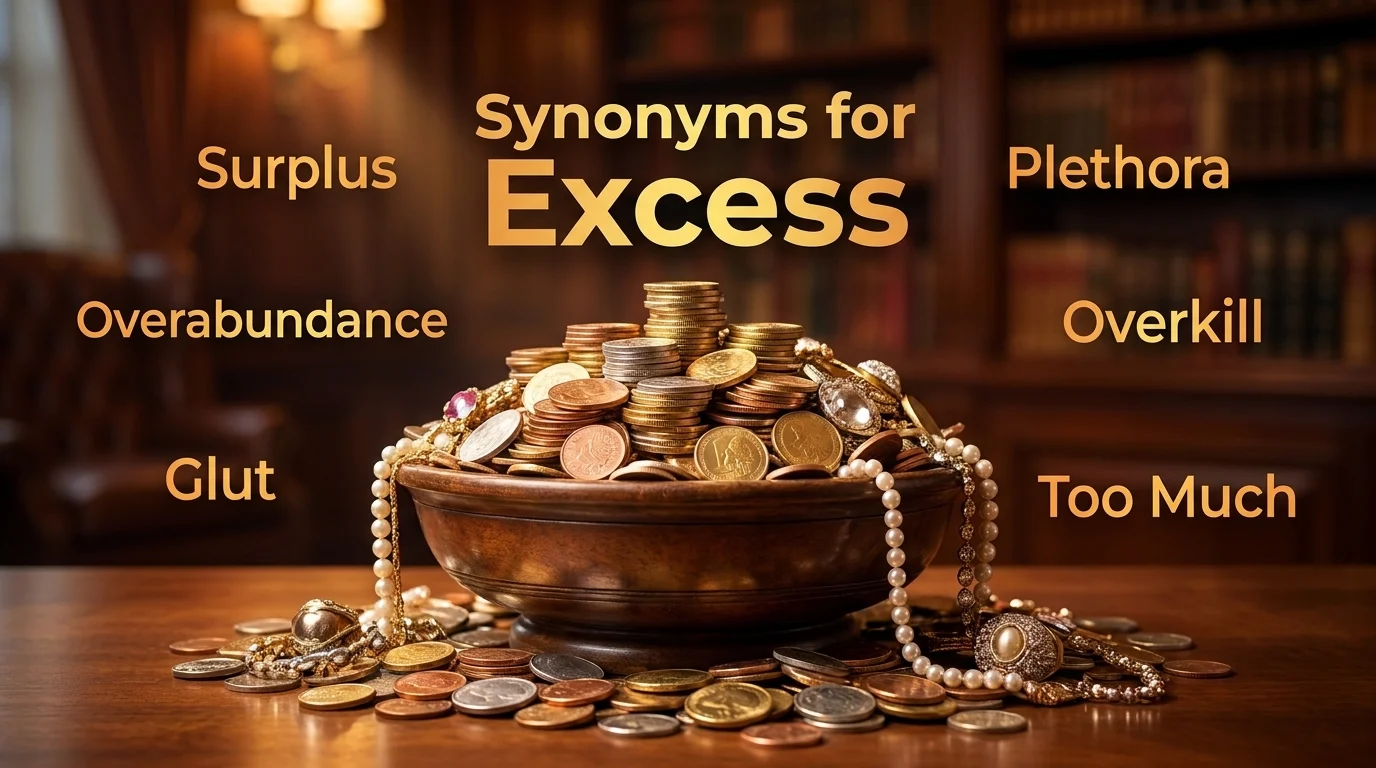
“Excess” refers to an amount that is more than necessary, usual, or permitted. It can describe a surplus, an overflow, an overabundance, or an extreme amount of something. Depending on context, alternatives include surplus, overflow, abundance, overabundance, glut, surfeit, overkill, extravagance, immoderation, and too much.
Meaning, Tone, and Context
Simple Definition
“Excess” generally refers to:
- An amount more than needed: extra quantity beyond what is required
- Overindulgence: excessive behavior, especially in eating, drinking, or spending
- Surplus in accounting: an amount remaining after deductions
- Extreme degree: going beyond reasonable limits
- Overflow: something that spills over or exceeds capacity
Part of Speech
“Excess” functions primarily as a noun and as an adjective.
Noun Examples:
- “An excess of sugar can lead to health problems.”
- “The company sold its excess inventory.”
Adjective Examples:
- “Excess baggage will be charged extra.”
- “Excess weight can strain the heart.”
Related Forms:
- Excessive (adjective): more than is necessary or reasonable
- Excessively (adverb): in an excessive manner
- Exceed (verb): to go beyond a limit
- Excess (noun): an amount more than necessary
Positive, Negative, or Neutral Tone
“Excess” is generally negative or neutral, depending on context.
Negative associations:
- “He drank to excess.” (overindulgence)
- “Excess sugar is harmful.” (health risk)
Neutral or technical contexts:
- “The excess was returned to the supplier.” (surplus)
- “Excess inventory was sold at a discount.” (business)
Formality Level
“Excess” is a standard word that works in both formal and informal English. It is common in academic writing, business reports, health content, and legal documents.
In casual conversation, alternatives like too much, extra, or overkill are more natural.
Common Use Cases
“Excess” commonly refers to:
- Health/medicine: excess weight, excess sugar, excess alcohol
- Business/finance: excess inventory, excess profits, excess capacity
- Behavior: drinking to excess, eating to excess
- Accounting/insurance: excess payment, policy excess
- General: excess of anything beyond what is needed
Important Word Forms
- Excess (noun): an amount more than necessary
- Excess (adjective): more than usual or permitted
- Excessive (adjective): more than is necessary or reasonable
- Excessively (adverb): in an excessive manner
- Exceed (verb): to go beyond a limit
- Excesses (plural noun): excessive behaviors or amounts
When and How to Use “Excess”
Use “excess” when you want to describe an amount that is more than necessary, usual, or permitted. Because the word is broad, more specific alternatives can add precision.
Professional
“The company sold its excess inventory at a discount.”
This works naturally in business communication.
Academic
“The study examined the effects of excess sugar consumption on metabolic health.”
The term is appropriate in academic research.
Personal
“He tends to eat to excess during the holidays.”
The word sounds natural in everyday conversation.
Health/Medical
“Excess weight is a risk factor for several chronic diseases.”
This is standard medical language.
Business/Finance
“The excess of revenue over expenses was reinvested.”
Here, “excess” describes a surplus.
Creative
“The excess of the feast was almost obscene.”
The word describes overindulgence or extravagance.
Another Word for “Excess”
There is no single perfect synonym because “excess” can refer to surplus, overindulgence, overflow, or extreme degree.
- Surplus context: surplus, remainder, leftover, extra, overage
- Overabundance context: abundance, overabundance, glut, surfeit, plethora
- Overflow context: overflow, spillover, overspill, flood
- Overindulgence context: overindulgence, intemperance, immoderation, extravagance
- Extreme degree context: overkill, too much, extreme, beyond measure
- Financial context: surplus, overage, margin, profit
If you need one broad alternative, “surplus” works for financial or inventory contexts, “overabundance” for abundance, and “overindulgence” for behavior.
When Not to Use “Excess”
“Excess” can become too technical or vague when you need to specify exactly what kind of excess you are describing.
Consider:
“The excess was a problem.”
This statement does not tell readers what kind of excess—inventory, weight, spending, or something else.
A more precise sentence could be:
“The excess inventory was sold at a discount.”
Similarly, avoid using “excess” when you mean “too much” in casual contexts. Use “too much” or “extra” instead.
Words Commonly Confused With “Excess”
Excess vs. Surplus
Surplus specifically means an amount left over after requirements are met. Excess is broader and can mean too much or overindulgence.
Example:
“The budget surplus was used to pay down debt.” (leftover)
“The excess of spending over income caused problems.” (too much)
Excess vs. Abundance
Abundance means a large quantity, often positive. Excess implies more than needed, often negative.
Example:
“The garden produced an abundance of vegetables.” (positive)
“An excess of sugar is harmful.” (negative)
Excess vs. Overabundance
Overabundance means an excessive amount, similar to excess but more emphatic.
Example:
“An overabundance of choices can be overwhelming.” (too many)
“The excess was donated to charity.” (leftover)
Excess vs. Glut
Glut specifically means an excessive supply of something, especially in economics.
Example:
“There is a glut of oil on the market.” (oversupply)
“The excess was stored in the warehouse.” (extra)
Excess vs. Overkill
Overkill means excessive action or effort beyond what is needed, often in casual contexts.
Example:
“Using a flamethrower to kill weeds is overkill.” (excessive)
“The excess was unnecessary.” (more than needed)
Excess vs. Extravagance
Extravagance means excessive spending or luxury. Excess is broader.
Example:
“Her extravagance led to financial ruin.” (spending)
“The excess of the party was criticized.” (overindulgence)
Best Synonym by Context for “Excess”
| Context | Best Synonym | Why It Works | Example |
|---|---|---|---|
| Formal writing | Surplus, overabundance | Precise and professional | The surplus was reinvested in the company. |
| Academic writing | Excessive amount, overabundance | Standard academic usage | An excessive amount of sugar can lead to health issues. |
| Business/finance | Surplus, overage, margin | Business terminology | The surplus was used to fund new projects. |
| Health/medicine | Excessive, too much | Medical context | Excessive alcohol consumption damages the liver. |
| Behavior | Overindulgence, intemperance | Describes excessive behavior | His overindulgence in food led to weight gain. |
| Economics | Glut, oversupply | Economic terminology | A glut of oil drove prices down. |
| Casual conversation | Too much, extra, overkill | Natural and informal | That’s too much sugar! |
| Creative writing | Surfeit, plethora, profusion | Literary and evocative | A surfeit of riches led to his downfall. |
| Insurance/legal | Deductible, excess payment | Technical terminology | The policy excess is $500. |
| General overabundance | Plethora, glut, surfeit | Emphasizes too much | There was a plethora of options. |
Which Synonym Should You Choose?
Start by identifying what kind of “excess” you are describing.
- Surplus/leftover: surplus, remainder, leftover, extra, overage
- Overabundance: abundance, overabundance, glut, surfeit, plethora
- Overflow: overflow, spillover, overspill, flood
- Overindulgence: overindulgence, intemperance, immoderation, extravagance
- Extreme degree: overkill, too much, extreme, beyond measure
- Financial: surplus, overage, margin, profit
- Insurance/legal: deductible, excess payment
- Casual: too much, extra, overkill, more than enough
10 Key Synonyms for “Excess”
The table below includes accurate alternatives with clear meanings and usage contexts.
| Synonym | Simple Meaning | Best Used For | Example Sentence |
|---|---|---|---|
| Surplus | Amount left over after requirements are met | Business, finance, inventory | The company sold its surplus equipment. |
| Overabundance | More than enough; excessive quantity | General overabundance | An overabundance of caution slowed the process. |
| Glut | Excessive supply, especially in markets | Economics, markets | A glut of housing drove prices down. |
| Surfeit | An excessive amount, especially of food | Formal, literary | A surfeit of rich food made him ill. |
| Plethora | A large or excessive amount | Formal, general | There was a plethora of choices. |
| Overkill | Excessive action or effort | Casual, criticism | Using a sledgehammer was overkill. |
| Overindulgence | Excessive indulgence in something | Behavior, lifestyle | His overindulgence in sweets caused health issues. |
| Intemperance | Lack of moderation, especially in alcohol | Formal, behavioral | His intemperance led to social problems. |
| Extravagance | Excessive spending or luxury | Financial, lifestyle | Their extravagance knew no bounds. |
| Too much | An excessive amount (informal) | Casual conversation | That’s too much sugar! |
Synonym Groups and Usage Differences
Professional vs. Personal Synonyms
Professional writing benefits from specific terms such as surplus, overage, excess capacity, and overabundance.
Personal communication often uses too much, extra, or overkill.
Compare:
“There’s too much salt in this soup.” (personal)
“The surplus salt was discarded.” (professional)
Formal vs. Conversational Synonyms
Excess works in both formal and conversational English, though it can sound technical.
Formal alternatives: surplus, surfeit, plethora, overabundance, intemperance
Conversational alternatives: too much, extra, overkill
Examples:
“The surfeit of options made decision-making difficult.” (formal)
“There were way too many choices.” (conversational)
Academic Synonyms
Academic writing should distinguish between excess (general), surplus (leftover), overabundance (too much), and glut (oversupply).
For example:
“The study examined the effects of excess sugar on metabolic health.”
“The economic glut led to falling prices.”
Professional and Business Synonyms
Business writing often benefits from phrases such as surplus, overage, excess inventory, and excess capacity.
Instead of:
“We have too much stock.”
Consider:
“We have excess inventory that needs to be liquidated.”
Creative or Literary Synonyms
Creative writing can use surfeit, plethora, profusion, glut, and overabundance depending on the context.
For example:
“A surfeit of riches had made him complacent.”
“The profusion of colors was overwhelming.”
Slang or Modern Synonyms
Too much is the most common casual alternative.
Overkill means excessive action or effort.
Extra can mean excessive or unnecessary in modern slang.
OD (overdose) is slang for too much of something.
Examples:
“That’s too much!” (casual)
“Wearing a tuxedo to a casual party is overkill.” (casual)
“She’s so extra.” (slang, excessive behavior)
Strongest vs. Weaker Synonyms
“Excess” synonyms vary in intensity:
Milder: extra, more than enough, surplus
Moderate: excess, overabundance, surplus
Strong: glut, surfeit, plethora
Very Strong: intemperance, extravagance, immoderation
Emotional vs. Neutral Synonyms
“Excess” is generally neutral or slightly negative.
Emotional alternatives: overindulgence, intemperance, extravagance (negative)
Neutral alternatives: surplus, overage, extra (neutral)
Examples:
“The surplus was donated to charity.” (neutral)
“His overindulgence was criticized.” (negative)
Antonyms of “Excess”
“Excess” has several antonyms depending on context:
| Antonym | Context | Meaning | Example Sentence |
|---|---|---|---|
| Deficiency | General | Lack or shortage | A deficiency of vitamin C causes scurvy. |
| Shortage | Supply | Not enough | There was a shortage of clean water. |
| Lack | General | Absence or insufficiency | The lack of evidence was troubling. |
| Insufficiency | General | Not enough | The insufficiency of funds halted the project. |
| Moderation | Behavior | Avoiding extremes | Moderation in all things is wise. |
| Restraint | Behavior | Holding back | He showed restraint in his spending. |
| Frugality | Finance | Avoiding waste | Her frugality helped her save money. |
| Scarcity | Supply | Insufficient supply | The scarcity of resources caused conflict. |
Comparison: “Excess” vs. Similar Words
Excess vs. Surplus
Main difference: Surplus specifically means an amount left over after requirements are met. Excess is broader and can mean too much or overindulgence.
Examples:
“The budget surplus was used to pay down debt.” (leftover)
“The excess of spending over income caused problems.” (too much)
Excess vs. Abundance
Main difference: Abundance means a large quantity, often positive. Excess implies more than needed, often negative.
Examples:
“The garden produced an abundance of vegetables.” (positive)
“An excess of sugar is harmful.” (negative)
Excess vs. Glut
Main difference: Glut specifically means an excessive supply of something, especially in economics.
Examples:
“There is a glut of oil on the market.” (oversupply)
“The excess was stored in the warehouse.” (extra)
Excess vs. Overkill
Main difference: Overkill means excessive action or effort beyond what is needed, often in casual contexts.
Examples:
“Using a flamethrower to kill weeds is overkill.” (excessive action)
“The excess was unnecessary.” (more than needed)
Excess vs. Extravagance
Main difference: Extravagance means excessive spending or luxury. Excess is broader.
Examples:
“Her extravagance led to financial ruin.” (spending)
“The excess of the party was criticized.” (overindulgence)
Excess vs. Plethora
Main difference: Plethora means a large or excessive amount, often used formally.
Examples:
“There was a plethora of options.” (many options)
“The excess was donated.” (extra amount)
Common Phrases and Expressions with “Excess”
1. In excess of
Meaning:
More than; exceeding.
Example:
“The cost was in excess of $1,000.”
2. To excess
Meaning:
To an excessive degree; too much.
Example:
“He drank to excess at the party.”
3. Excess baggage
Meaning:
Luggage that exceeds the allowed weight or amount; also, emotional burdens.
Example:
“The airline charged for excess baggage.”
4. Excess capacity
Meaning:
More capacity than is currently needed.
Example:
“The factory had excess capacity after demand fell.”
5. Excess inventory
Meaning:
More stock than can be sold.
Example:
“The store discounted excess inventory.”
6. Excess profits
Meaning:
Profits beyond what is considered normal or fair.
Example:
“The government taxed excess profits during the war.”
7. Excesses of youth
Meaning:
The wild or excessive behavior of young people.
Example:
“He regretted the excesses of his youth.”
Common Mistakes to Avoid
1. Using “excess” when “too much” is more natural in casual contexts
In casual conversation, “too much” is more natural than “excess.”
Formal: “An excess of sugar is harmful.”
Casual: “Too much sugar is bad for you.”
2. Confusing “excess” with “access”
Excess means too much. Access means the ability to enter or use.
Incorrect: “He had excess to the building.”
Correct: “He had access to the building.”
3. Confusing “excess” with “exceed”
Excess is a noun or adjective. Exceed is a verb meaning to go beyond.
Incorrect: “The cost will excess the budget.”
Correct: “The cost will exceed the budget.”
4. Overusing “excess” in writing
Repetition can make content feel technical. Use a variety of alternatives such as surplus, overabundance, glut, overkill, and too much.
5. Choosing a synonym that changes the meaning
Do not replace excess with abundance if you mean a negative overabundance.
Do not replace excess with surplus if you mean overindulgence.
FAQs
What is the best synonym for “excess”?
The best synonym depends on context. Surplus works for business/finance, overabundance for general use, glut for economics, overindulgence for behavior, and too much for casual conversation.
What is a formal synonym for “excess”?
Surplus, surfeit, plethora, overabundance, and intemperance are formal synonyms.
What is an informal synonym for “excess”?
Too much, extra, and overkill are common informal alternatives.
What is another word for “excess” in business?
Surplus, overage, excess inventory, and excess capacity are common business terms.
What is the difference between “excess” and “surplus”?
Surplus specifically means an amount left over after requirements are met. Excess is broader and can mean too much or overindulgence.
What is the opposite of “excess”?
Depending on context, opposites include deficiency, shortage, lack, insufficiency, moderation, and restraint.
What does “excess” mean in insurance?
In insurance, an excess (or deductible) is the amount the policyholder must pay before the insurer covers the rest.
Conclusion
“Excess” is a versatile word that can describe surplus, overabundance, overflow, overindulgence, or extreme degree. The best synonym depends on what you actually mean.
Choose surplus for business/finance, overabundance for general use, glut for economics, overindulgence for behavior, overkill for casual criticism, and too much for casual conversation.
Most importantly, do not replace “excess” simply to avoid repetition. First identify what kind of excess—surplus, overabundance, overflow, or overindulgence—you are actually describing. Then choose the alternative that communicates that idea most clearly.
For academic, professional, and technical writing, precision is usually more valuable than vocabulary variety. A specific term such as surplus, glut, surfeit, or plethora can tell readers much more than the broad word excess.
Before publishing a vocabulary guide, verify definitions and usage with trusted dictionaries such as Cambridge, Oxford, Merriam-Webster, Collins, or Britannica. This helps ensure that each alternative accurately matches its intended meaning and context.
The practical takeaway is simple: when “excess” feels too general or too technical, ask yourself what kind of surplus, overabundance, or overindulgence you are actually describing. Then use the most precise word available.
Discover More:-
- 50+ Synonyms for Inspire: Meanings, Examples, and Best Alternatives
- 50+ Synonyms for Confidence: Meanings, Examples, and Best Alternatives

2 thoughts on “50+ Synonyms for Excess: Meanings, Examples, and Best Alternatives”