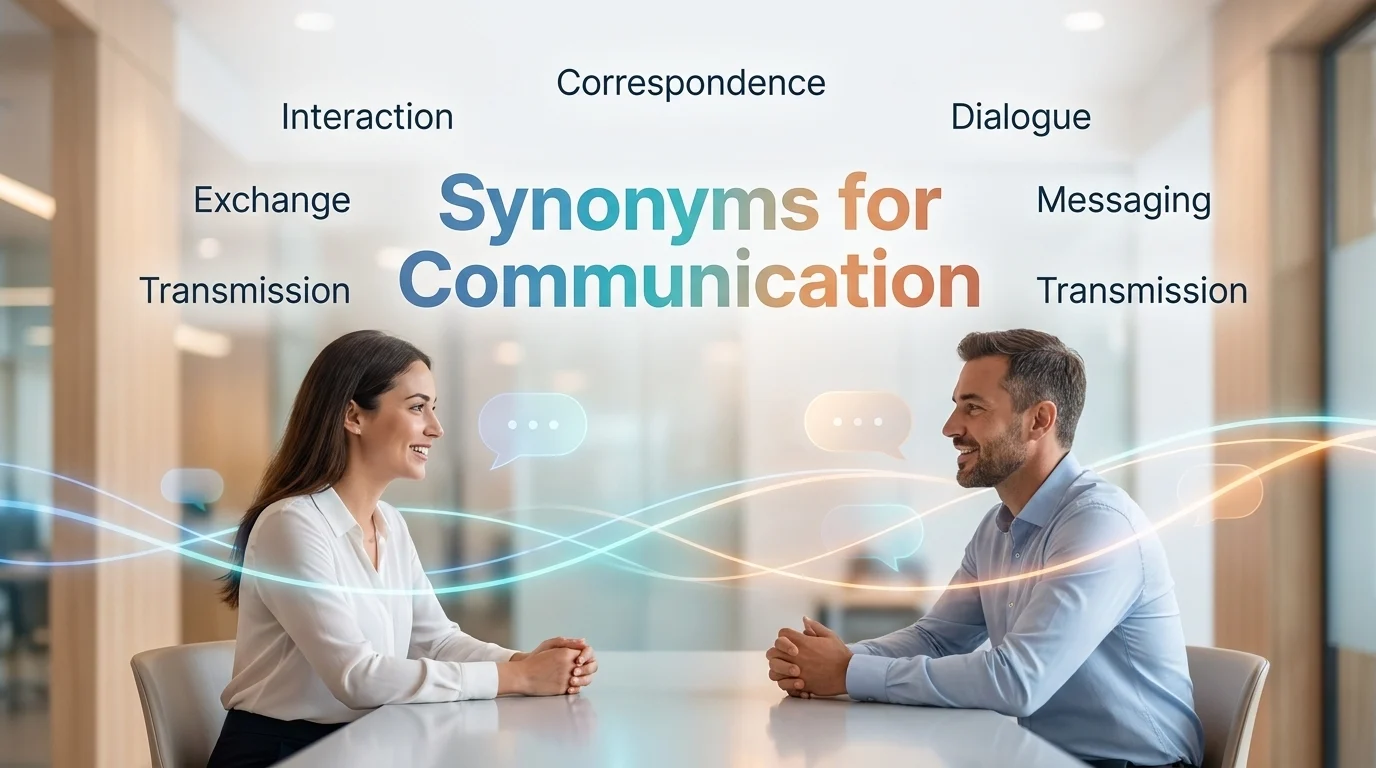
Do you keep using the word “communication” in essays, business reports, presentations, academic papers, or everyday conversation? While it is one of the most important and widely used words in modern English, repeating it can make your writing feel broad, repetitive, or predictable.
The good news is that the best alternative depends on what you actually mean. You might be referring to the exchange of information, a conversation, written correspondence, a formal announcement, interpersonal connection, or the transmission of signals.
This guide explains synonyms for “communication” by meaning, tone, context, and usage. You will learn which alternatives work best in academic writing, professional communication, technical content, creative expression, and casual conversation.
Quick Answer: What Does “Communication” Mean?
“Communication” refers to the act of exchanging information, ideas, thoughts, or feelings through speech, writing, signals, or behavior. It encompasses verbal and nonverbal interaction, formal and informal exchange, and the transmission of messages between people, organizations, or systems. Depending on context, alternatives include interaction, correspondence, dialogue, exchange, messaging, discourse, transmission, conversation, connection, and signaling.
Meaning, Tone, and Context
Simple Definition
“Communication” generally refers to:
- Exchange of information: sharing ideas, facts, or feelings
- Verbal interaction: speaking, conversing, discussing
- Written correspondence: letters, emails, messages, reports
- Nonverbal signals: body language, gestures, facial expressions
- Formal announcements: official statements, press releases, memos
- Technical transmission: signals, data transfer, telecommunications
Part of Speech
“Communication” is primarily a noun.
Examples:
- “Effective communication is essential in the workplace.”
- “The communication between the two teams was poor.”
Related Forms:
- Communicate (verb): to share or exchange information
- Communicative (adjective): willing to talk and share information
- Communicator (noun): a person who communicates well
- Communications (noun): systems and methods of sending information; the field of study
Positive, Negative, or Neutral Tone
“Communication” is generally neutral. However, the surrounding language can create a positive or negative tone.
Positive associations:
- “Open communication builds trust.”
- “Clear communication prevents misunderstandings.”
Negative contexts:
- “Poor communication led to the project’s failure.”
- “There was a breakdown in communication.”
Formality Level
“Communication” is a standard word that works in both formal and informal English. It is appropriate in academic papers, business reports, technical documentation, casual conversation, and creative writing.
However, more specific alternatives can add precision and variety depending on the context.
Common Use Cases
“Communication” commonly refers to:
- Business communication: emails, meetings, reports, presentations
- Interpersonal communication: conversations, listening, empathy
- Mass communication: media, journalism, broadcasting
- Technical communication: manuals, documentation, user guides
- Digital communication: social media, messaging apps, email
- Nonverbal communication: body language, gestures, eye contact
- Organizational communication: internal memos, announcements, policies
- Cross-cultural communication: interacting across different cultures
Important Word Forms
- Communication (noun): the act of exchanging information
- Communicate (verb): to share or exchange information
- Communicative (adjective): willing to communicate
- Communicator (noun): a person skilled at communication
- Communications (noun): systems or field of study
- Miscommunication (noun): failure to communicate clearly
- Telecommunication (noun): long-distance communication technology
When and How to Use “Communication”
Use “communication” when you want to describe the exchange of information, ideas, or feelings. Because the word is broad, more specific alternatives can add precision depending on the context.
Professional
“Effective communication is key to successful teamwork.”
This works naturally in business communication.
Academic
“The study examines nonverbal communication in cross-cultural settings.”
The term is appropriate in academic research.
Personal
“Communication is important in any relationship.”
The word sounds natural in everyday conversation.
Technical
“The device enables wireless communication between sensors.”
The term is standard in technical documentation.
Business
“The company’s internal communication needs improvement.”
Here, communication refers to organizational information flow.
Creative
“Their communication was a silent exchange of glances.”
The word can describe subtle or nonverbal interaction.
Another Word for “Communication”
There is no single perfect synonym because “communication” can refer to many different types of exchange.
- Verbal interaction: conversation, dialogue, discussion, talk
- Written exchange: correspondence, messaging, letters, emails
- Formal announcements: statements, declarations, notices, briefings
- Nonverbal: signals, gestures, body language, cues
- Technical transmission: transmission, signaling, data transfer
- Interpersonal connection: interaction, connection, rapport, exchange
- Organizational: information flow, messaging, internal relations
- Mass/media: broadcasting, media, journalism, dissemination
If you need one broad alternative, “interaction” works in many contexts, but it emphasizes the exchange rather than the content. “Correspondence” works well for written communication.
When Not to Use “Communication”
“Communication” can become too broad when the reader needs to know exactly what type of communication you mean.
Consider:
“The communication was poor.”
This statement does not tell readers whether the emails were unclear, the meetings were unproductive, the body language was confusing, or the messages were delayed.
A more precise sentence could be:
“The email correspondence was unclear and often delayed.”
Similarly, avoid using “communication” when you mean “conversation”, “message”, or “announcement” in specific contexts.
Words Commonly Confused With “Communication”
Communication vs. Conversation
Conversation specifically refers to spoken exchange between people. Communication is broader and includes writing, signals, and behavior.
Example:
“We had a long conversation about the project.” (spoken)
“Communication between departments has improved.” (general)
Communication vs. Correspondence
Correspondence refers specifically to written communication, especially letters and emails. Communication is broader.
Example:
“The correspondence between the two companies was formal.” (written)
“Communication is essential for teamwork.” (general)
Communication vs. Dialogue
Dialogue emphasizes a two-way exchange, often with the goal of understanding or resolving differences. Communication can be one-way.
Example:
“The two leaders engaged in a productive dialogue.” (two-way)
“The company’s communication with customers improved.” (general)
Communication vs. Message
Message refers to the specific content being communicated. Communication is the process.
Example:
“Her message was clear and direct.” (content)
“Communication between the teams was effective.” (process)
Communication vs. Interaction
Interaction emphasizes the mutual exchange between people or systems. Communication can be one-directional.
Example:
“Social interaction is important for well-being.” (mutual)
“Sending the report was an act of communication.” (one-way possible)
Communication vs. Discourse
Discourse refers to formal, extended discussion or written treatment of a subject. Communication is broader and more everyday.
Example:
“Academic discourse on the topic is extensive.” (formal discussion)
“Daily communication with colleagues is essential.” (general)
Best Synonym by Context for “Communication”
| Context | Best Synonym | Why It Works | Example |
|---|---|---|---|
| Formal writing | Correspondence, discourse | Precise and professional | The correspondence between the parties was documented. |
| Academic writing | Discourse, interaction | Standard academic usage | The study analyzed classroom discourse. |
| Business communication | Information flow, messaging, correspondence | Professional and clear | Internal messaging has improved this quarter. |
| Interpersonal | Interaction, exchange, dialogue | Emphasizes mutual exchange | Their interaction was warm and genuine. |
| Casual conversation | Talk, chat, conversation | Natural and informal | We had a good talk about it. |
| Written communication | Correspondence, writing, messaging | Specifies written form | Please keep all correspondence on file. |
| Nonverbal | Signals, cues, body language | Describes unspoken communication | His body language sent mixed signals. |
| Technical/Telecom | Transmission, signaling, data transfer | Technically precise | The transmission was interrupted by interference. |
| Mass media | Broadcasting, dissemination, media | Describes public communication | The dissemination of information was rapid. |
| Organizational | Information flow, internal relations | Business-focused | Information flow between departments is critical. |
| Digital | Messaging, online interaction | Modern digital contexts | Online messaging has replaced many phone calls. |
| Creative writing | Exchange, rapport, connection | Adds literary depth | A silent exchange passed between them. |
Which Synonym Should You Choose?
Start by identifying what kind of communication you are describing.
- Spoken exchange: conversation, dialogue, discussion, talk, chat
- Written exchange: correspondence, messaging, writing, emails
- Formal announcement: statement, declaration, notice, briefing
- Nonverbal: signals, cues, gestures, body language
- Technical transmission: transmission, signaling, data transfer
- Interpersonal connection: interaction, exchange, rapport, connection
- Organizational: information flow, messaging, internal relations
- Mass/media: broadcasting, dissemination, media, journalism
10 Key Synonyms for “Communication”
The table below includes accurate alternatives with clear meanings and usage contexts.
| Synonym | Simple Meaning | Best Used For | Example Sentence |
|---|---|---|---|
| Interaction | Mutual exchange between people | General, interpersonal | Positive interaction between team members improves morale. |
| Correspondence | Written exchange, especially letters/emails | Business, formal, legal | All correspondence should be kept on file. |
| Dialogue | Two-way conversation | Formal discussions, diplomacy | The two sides engaged in a constructive dialogue. |
| Exchange | Giving and receiving information | General, interpersonal | There was a lively exchange of ideas. |
| Messaging | Sending written messages | Digital, business, casual | Instant messaging has become the norm. |
| Discourse | Formal discussion or written treatment | Academic, formal | Academic discourse on the topic is extensive. |
| Transmission | Sending signals or data | Technical, telecom | The transmission was interrupted by interference. |
| Conversation | Informal spoken exchange | Casual, personal | We had a long conversation about our plans. |
| Connection | Relationship or link between people | Emotional, interpersonal | Their connection was evident to everyone. |
| Signaling | Sending signals or cues | Technical, nonverbal | The signaling between the devices was seamless. |
Synonym Groups and Usage Differences
Professional vs. Personal Synonyms
Professional writing benefits from specific terms such as correspondence, information flow, messaging, discourse, and briefing.
Personal communication often uses talk, chat, conversation, or connection.
Compare:
“We had a good talk.” (personal)
“The correspondence was documented.” (professional)
Formal vs. Conversational Synonyms
Communication works in both formal and conversational English.
Formal alternatives: correspondence, discourse, dialogue, transmission
Conversational alternatives: talk, chat, conversation, messaging
Examples:
“The dialogue between the two nations was productive.” (formal)
“We had a nice chat.” (conversational)
Academic Synonyms
Academic writing should distinguish between communication (general), discourse (formal discussion), interaction (mutual exchange), and transmission (technical sending).
For example:
“The study analyzed classroom discourse.”
“Nonverbal interaction plays a key role in communication.”
Professional and Business Synonyms
Business writing often benefits from phrases such as information flow, internal messaging, correspondence, briefing, and stakeholder engagement.
Instead of:
“Communication needs improvement.”
Consider:
“Internal information flow and stakeholder messaging need improvement.”
Creative or Literary Synonyms
Creative writing can use exchange, rapport, connection, communion, and interplay depending on the context.
For example:
“A silent exchange passed between them.”
“There was an unspoken communion in their gaze.”
Slang or Modern Synonyms
Chat is a common casual term.
Talk is simple and informal.
DM (direct message) is modern digital slang.
Ping means to send a quick message.
Examples:
“Let’s have a chat about it.” (casual)
“Just ping me when you’re ready.” (modern slang)
Strongest vs. Weaker Synonyms
“Communication” synonyms vary in formality and specificity:
Broad: communication, interaction, exchange
More specific: conversation, correspondence, dialogue
Very specific: transmission, signaling, messaging
Emotional vs. Neutral Synonyms
“Communication” is generally neutral.
Emotional alternatives: connection, rapport, communion, bond
Neutral alternatives: interaction, exchange, correspondence, transmission
Examples:
“Their connection was undeniable.” (emotional)
“The transmission was successful.” (neutral)
Antonyms of “Communication”
“Communication” does not have exact antonyms, but depending on context, the following words represent opposites:
| Antonym | Context | Meaning | Example Sentence |
|---|---|---|---|
| Silence | General | Absence of communication | The silence between them was awkward. |
| Isolation | Social | Lack of contact | Isolation can harm mental health. |
| Disconnection | Interpersonal | Loss of connection | The disconnection between teams caused problems. |
| Miscommunication | General | Failure to communicate clearly | Miscommunication led to the error. |
| Withholding | Information | Not sharing information | Withholding information is a form of poor communication. |
| Concealment | Information | Hiding information | Concealment damaged trust. |
Comparison: “Communication” vs. Similar Words
Communication vs. Conversation
Main difference: Conversation specifically refers to spoken exchange. Communication is broader and includes writing, signals, and behavior.
Examples:
“We had a long conversation.” (spoken)
“Communication between departments has improved.” (general)
Communication vs. Correspondence
Main difference: Correspondence refers specifically to written communication. Communication is broader.
Examples:
“The correspondence was formal.” (written)
“Communication is essential for teamwork.” (general)
Communication vs. Dialogue
Main difference: Dialogue emphasizes a two-way exchange, often with the goal of understanding. Communication can be one-way.
Examples:
“The two leaders engaged in dialogue.” (two-way)
“The company’s communication improved.” (general)
Communication vs. Message
Main difference: Message refers to the specific content being communicated. Communication is the process.
Examples:
“Her message was clear.” (content)
“Communication between the teams was effective.” (process)
Communication vs. Interaction
Main difference: Interaction emphasizes mutual exchange. Communication can be one-directional.
Examples:
“Social interaction is important.” (mutual)
“Sending the report was an act of communication.” (one-way possible)
Communication vs. Discourse
Main difference: Discourse refers to formal, extended discussion. Communication is broader and more everyday.
Examples:
“Academic discourse on the topic is extensive.” (formal)
“Daily communication with colleagues is essential.” (general)
Common Phrases and Expressions with “Communication”
1. Effective communication
Meaning:
Communication that achieves its intended purpose clearly and efficiently.
Example:
“Effective communication is key to successful leadership.”
2. Open communication
Meaning:
Honest and transparent exchange of information.
Example:
“Open communication builds trust within teams.”
3. Breakdown in communication
Meaning:
Failure of communication that leads to problems.
Example:
“A breakdown in communication caused the delay.”
4. Communication skills
Meaning:
Abilities related to expressing and receiving information effectively.
Example:
“Strong communication skills are essential for this role.”
5. Lines of communication
Meaning:
Channels through which information is exchanged.
Example:
“Keep the lines of communication open during the project.”
6. Mass communication
Meaning:
Communication to large audiences through media.
Example:
“Mass communication has been transformed by the internet.”
7. Nonverbal communication
Meaning:
Communication without words, such as body language and gestures.
Example:
“Nonverbal communication can convey more than words.”
8. Cross-cultural communication
Meaning:
Communication between people from different cultural backgrounds.
Example:
“Cross-cultural communication requires sensitivity and awareness.”
9. Communication channel
Meaning:
A medium through which information is transmitted.
Example:
“Email is the primary communication channel for the team.”
10. Two-way communication
Meaning:
Communication in which both parties exchange information.
Example:
“Two-way communication ensures everyone’s voice is heard.”
Common Mistakes to Avoid
1. Using “communication” when a more precise term is available
If you mean conversation, correspondence, message, or announcement, use the more specific word.
Vague: “The communication was unclear.”
Precise: “The email correspondence was unclear.”
2. Using “communication” in technical writing when “transmission” or “signaling” is more precise
Technical documents require precise language. Use transmission, signaling, or data transfer.
Vague: “Communication between the devices was interrupted.”
Precise: “The wireless transmission between the devices was interrupted.”
3. Confusing “communication” with “communications”
Communication refers to the act or process. Communications often refers to systems, technology, or the field of study.
Example:
“Communication is important.” (process)
“The company’s communications department handles PR.” (systems/field)
4. Overusing “communication” in writing
Repetition can make content feel dull. Use a variety of alternatives such as interaction, correspondence, dialogue, exchange, and messaging.
5. Choosing a synonym that changes the meaning
Do not replace communication with conversation unless you mean spoken exchange.
Do not replace communication with transmission unless you mean technical sending.
FAQs
What is the best synonym for “communication”?
The best synonym depends on context. Interaction works for general use, correspondence for written communication, dialogue for formal discussions, conversation for casual spoken exchange, and transmission for technical contexts.
What is a formal synonym for “communication”?
Correspondence, discourse, dialogue, and transmission are formal synonyms.
What is an informal synonym for “communication”?
Talk, chat, conversation, and messaging are common informal alternatives.
What is another word for “communication” in business writing?
Information flow, internal messaging, correspondence, briefing, and stakeholder engagement work well in business writing.
What is the difference between “communication” and “conversation”?
Conversation specifically refers to spoken exchange. Communication is broader and includes writing, signals, and behavior.
What is the opposite of “communication”?
Depending on context, opposites include silence, isolation, disconnection, miscommunication, and withholding.
What does “communication” mean in a technical context?
In technical contexts, communication often refers to transmission, signaling, or data transfer between devices or systems.
Conclusion
“Communication” is a broad and essential word that can describe spoken exchange, written correspondence, formal announcements, nonverbal signals, technical transmission, and interpersonal connection. The best synonym depends on what you actually mean.
Choose interaction for general exchange, correspondence for written communication, dialogue for formal discussions, conversation for casual talk, messaging for digital contexts, and transmission for technical sending.
Most importantly, do not replace “communication” simply to avoid repetition. First identify what kind of communication—spoken, written, nonverbal, technical, or organizational—you are actually describing. Then choose the alternative that communicates that idea most clearly.
For academic, professional, and technical writing, precision is usually more valuable than vocabulary variety. A specific term such as correspondence, discourse, information flow, or transmission can tell readers much more than the broad word communication.
Before publishing a vocabulary guide, verify definitions and usage with trusted dictionaries such as Cambridge, Oxford, Merriam-Webster, Collins, or Britannica. This helps ensure that each alternative accurately matches its intended meaning and context.
The practical takeaway is simple: when “communication” feels too general, ask yourself what type of exchange, message, or transmission you are actually describing. Then use the most precise word available.
Discover More:-
- 50+ Synonyms for Excess: Meanings, Examples, and Best Alternatives
- 50+ Synonyms for Terrible: Meanings, Examples, and Best Alternatives

1 thought on “50+ Synonyms for Communication: Meanings, Examples, and Best Alternatives”