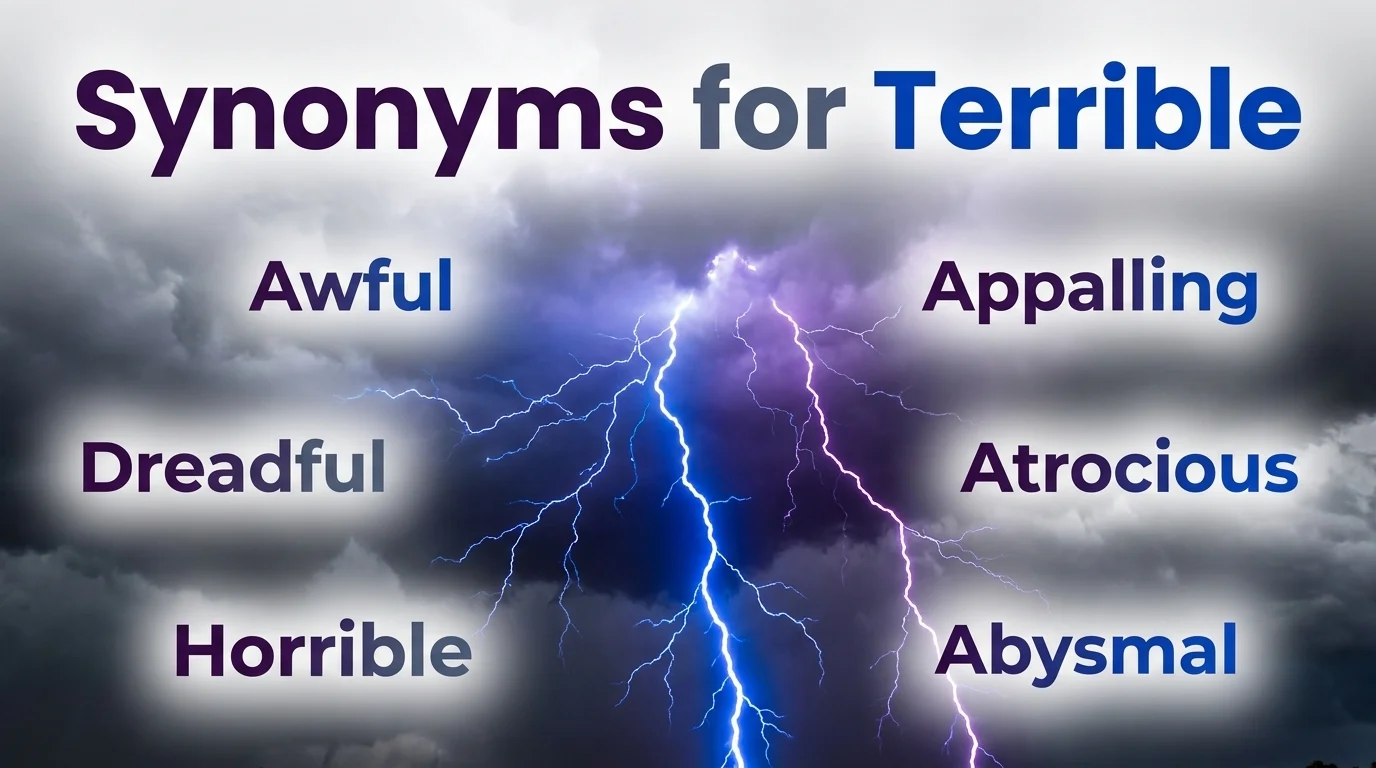
Do you keep using the word “terrible” in essays, business reports, creative writing, reviews, or everyday conversation? While it is a strong and useful word, repeating it can make your writing feel flat, exaggerated, or lacking in nuance.
The good news is that the best alternative depends on what you actually mean. You might be describing something of very low quality, something frightening, something morally shocking, something physically painful, or simply something very unpleasant.
This guide explains synonyms for “terrible” by meaning, tone, context, and usage. You will learn which alternatives work best in academic writing, professional communication, creative expression, reviews, and casual conversation.
Quick Answer: What Does “Terrible” Mean?
“Terrible” describes something extremely bad, unpleasant, frightening, or of very low quality. It can refer to poor performance, awful conditions, shocking behavior, intense fear, or severe pain. Depending on context, alternatives include awful, dreadful, horrible, appalling, atrocious, abysmal, dire, frightful, ghastly, and deplorable.
Meaning, Tone, and Context
Simple Definition
“Terrible” generally refers to:
- Very bad quality: poor, substandard, or unsatisfactory
- Extremely unpleasant: causing discomfort, distress, or disgust
- Frightening: causing fear or terror
- Morally shocking: appalling or deplorable behavior
- Severe or intense: extreme in a negative way (pain, weather, conditions)
Part of Speech
“Terrible” is primarily an adjective.
Adjective Examples:
- “The weather was terrible.”
- “She had a terrible accident.”
Related Forms:
- Terribly (adverb): in a terrible manner; very (informal intensifier)
- Terrific (adjective): originally meant causing terror, now means excellent (false friend)
- Terror (noun): extreme fear
- Terrify (verb): to cause extreme fear
- Terrifying (adjective): causing extreme fear
Positive, Negative, or Neutral Tone
“Terrible” is strongly negative.
It expresses clear disapproval, distress, or shock. The strength of the word makes it effective but can also make it feel exaggerated or emotional in some contexts.
Examples:
- “The food was terrible.” (negative, quality)
- “It was a terrible tragedy.” (negative, emotional)
Formality Level
“Terrible” is a standard word that works in both formal and informal English. However, in very formal or academic writing, more precise alternatives like deplorable, egregious, or abysmal may be more appropriate.
In casual conversation, alternatives like awful, horrible, or dreadful are common.
Common Use Cases
“Terrible” commonly refers to:
- Quality: terrible food, terrible movie, terrible performance
- Conditions: terrible weather, terrible traffic, terrible living conditions
- Behavior: terrible behavior, terrible mistake, terrible decision
- Events: terrible accident, terrible tragedy, terrible news
- Feelings: terrible pain, terrible fear, terrible sadness
- Moral judgment: terrible injustice, terrible crime, terrible cruelty
Important Word Forms
- Terrible (adjective): extremely bad or unpleasant
- Terribly (adverb): in a terrible manner; very (informal)
- Terrific (adjective): excellent (note: originally meant causing terror)
- Terror (noun): extreme fear
- Terrify (verb): to cause extreme fear
- Terrifying (adjective): causing extreme fear
When and How to Use “Terrible”
Use “terrible” when you want to describe something that is extremely bad, unpleasant, frightening, or shocking. Because the word is strong, more specific alternatives can add precision and variety.
Professional
“The project suffered from terrible planning and poor execution.”
This works in professional communication, though more formal alternatives may be preferred.
Academic
“The study examined the terrible consequences of the policy on vulnerable populations.”
The term is appropriate in academic contexts when describing severe negative outcomes.
Personal
“I had a terrible day at work.”
The word sounds natural in everyday conversation.
Creative
“The terrible storm destroyed everything in its path.”
The word creates a dramatic, negative image.
Reviews
“The service was terrible, and the food was even worse.”
This is standard in customer reviews.
News/Journalism
“The victims suffered terrible injuries in the attack.”
This is appropriate in news reporting for severe negative events.
Another Word for “Terrible”
There is no single perfect synonym because “terrible” can refer to bad quality, extreme unpleasantness, fear, moral shock, or severity.
- Bad quality: awful, dreadful, poor, substandard, atrocious, abysmal
- Extremely unpleasant: horrible, horrid, nasty, foul, revolting
- Frightening: terrifying, frightful, horrifying, dreadful, alarming
- Morally shocking: appalling, deplorable, despicable, heinous, egregious
- Severe/intense: dire, severe, extreme, intense, excruciating
- General negative: lousy, rotten, crummy, pathetic, woeful
If you need one broad alternative, “awful” works in most contexts, while “appalling” works better for moral shock and “abysmal” for extremely poor quality.
When Not to Use “Terrible”
“Terrible” can become too strong or vague when the reader needs to know exactly what you mean.
Consider:
“The movie was terrible.”
This statement does not tell readers whether the movie was poorly acted, badly written, boring, offensive, or technically flawed.
A more precise sentence could be:
“The movie had a predictable plot and wooden acting.”
Similarly, avoid using “terrible” in formal or professional contexts where a more measured alternative like “unsatisfactory”, “inadequate”, or “poor” might be more appropriate.
Words Commonly Confused With “Terrible”
Terrible vs. Terrific
Terrific originally meant causing terror but now means excellent. This is a false friend.
Example:
“The food was terrific.” (excellent)
“The food was terrible.” (very bad)
Terrible vs. Horrible
Horrible emphasizes causing horror or fear. Terrible can be broader.
Example:
“The horrible crime shocked the nation.” (causing horror)
“The terrible weather ruined our plans.” (very bad)
Terrible vs. Awful
Awful is a common synonym for terrible. It can also mean inspiring awe (archaic).
Example:
“The traffic was awful.” (very bad)
“The awful majesty of the mountains.” (archaic, awe-inspiring)
Terrible vs. Dreadful
Dreadful emphasizes causing dread or fear. Terrible can be broader.
Example:
“The dreadful news devastated the family.” (causing dread)
“The food was terrible.” (very bad)
Terrible vs. Appalling
Appalling emphasizes moral shock or outrage. Terrible can be broader.
Example:
“The appalling conditions in the prison.” (morally shocking)
“The terrible traffic made us late.” (very bad)
Terrible vs. Abysmal
Abysmal emphasizes extreme poor quality. Terrible can be broader.
Example:
“The team’s performance was abysmal.” (extremely poor)
“The weather was terrible.” (very bad)
Best Synonym by Context for “Terrible”
| Context | Best Synonym | Why It Works | Example |
|---|---|---|---|
| Formal writing | Deplorable, egregious | Precise and professional | The deplorable conditions were documented. |
| Academic writing | Adverse, detrimental | Standard academic usage | The policy had adverse effects on the community. |
| Bad quality | Awful, dreadful, atrocious | Emphasizes poor quality | The food was awful. |
| Extremely poor quality | Abysmal, pathetic, woeful | Emphasizes extreme poor quality | The performance was abysmal. |
| Frightening | Terrifying, horrifying, frightful | Emphasizes fear | The terrifying experience haunted her. |
| Morally shocking | Appalling, deplorable, heinous | Emphasizes moral outrage | The appalling cruelty shocked everyone. |
| Severe/intense | Dire, severe, extreme | Emphasizes intensity | The refugees were in dire need of help. |
| Casual conversation | Awful, horrible, lousy | Natural and informal | That movie was lousy. |
| Emotional pain | Excruciating, agonizing | Emphasizes intense pain | The pain was excruciating. |
| Weather/conditions | Dreadful, foul, nasty | Describes bad weather | The weather was dreadful. |
| Behavior/conduct | Unacceptable, inexcusable, reprehensible | Emphasizes moral judgment | His behavior was inexcusable. |
| Reviews | Disappointing, substandard, poor | Emphasizes low quality | The service was disappointing. |
Which Synonym Should You Choose?
Start by identifying what kind of “terrible” you are describing.
- Bad quality: awful, dreadful, poor, substandard, atrocious, abysmal
- Extremely unpleasant: horrible, horrid, nasty, foul, revolting
- Frightening: terrifying, frightful, horrifying, dreadful, alarming
- Morally shocking: appalling, deplorable, despicable, heinous, egregious
- Severe/intense: dire, severe, extreme, intense, excruciating
- Casual speech: lousy, rotten, crummy, pathetic, woeful
- Weather/conditions: dreadful, foul, nasty, miserable, harsh
- Pain: excruciating, agonizing, unbearable, severe
10 Key Synonyms for “Terrible”
The table below includes accurate alternatives with clear meanings and usage contexts.
| Synonym | Simple Meaning | Best Used For | Example Sentence |
|---|---|---|---|
| Awful | Very bad or unpleasant | General, informal | The traffic was awful this morning. |
| Dreadful | Causing dread; very bad | Weather, news, conditions | The weather was dreadful all week. |
| Horrible | Causing horror; very unpleasant | Events, experiences, quality | It was a horrible accident. |
| Appalling | Shocking and morally wrong | Moral outrage, conditions | The appalling conditions were condemned. |
| Atrocious | Extremely bad or cruel | Quality, behavior, crimes | The service was atrocious. |
| Abysmal | Extremely poor or bad | Performance, quality | The team’s performance was abysmal. |
| Dire | Extremely serious or urgent | Situations, consequences | The refugees were in dire need. |
| Frightful | Causing fear; very bad | Experiences, weather | The frightful storm damaged homes. |
| Ghastly | Causing horror; very unpleasant | Appearance, events | The ghastly scene was disturbing. |
| Deplorable | Shockingly bad; morally wrong | Behavior, conditions | The deplorable treatment of animals. |
Synonym Groups and Usage Differences
Professional vs. Personal Synonyms
Professional writing benefits from specific terms such as inadequate, unsatisfactory, deplorable, egregious, and detrimental.
Personal communication often uses terrible, awful, horrible, or lousy.
Compare:
“The service was terrible.” (personal)
“The service was unsatisfactory and fell below our standards.” (professional)
Formal vs. Conversational Synonyms
Terrible works in both formal and conversational English, though the word is strong.
Formal alternatives: deplorable, egregious, reprehensible, abysmal
Conversational alternatives: awful, horrible, lousy, crummy, rotten
Examples:
“The deplorable conditions were documented.” (formal)
“The conditions were just awful.” (conversational)
Academic Synonyms
Academic writing should distinguish between terrible (general), adverse (harmful), detrimental (damaging), and deleterious (harmful).
For example:
“The policy had adverse effects on low-income families.”
“The chemical had deleterious effects on the environment.”
Professional and Business Synonyms
Business writing often benefits from phrases such as unsatisfactory, inadequate, substandard, poor, and below expectations.
Instead of:
“The results were terrible.”
Consider:
“The results were unsatisfactory and fell below expectations.”
Creative or Literary Synonyms
Creative writing can use ghastly, frightful, horrid, loathsome, abominable, and dire depending on the context.
For example:
“The ghastly apparition appeared at the window.”
“The dire warnings went unheeded.”
Slang or Modern Synonyms
Lousy is a common casual alternative.
Crummy is informal for poor quality.
Rotten is informal for very bad.
Sucks is very informal slang.
Examples:
“The food was lousy.” (casual)
“That movie really sucks.” (very informal)
Strongest vs. Weaker Synonyms
“Terrible” synonyms vary in intensity:
Milder: poor, unsatisfactory, disappointing
Moderate: bad, awful, dreadful, horrible
Strong: terrible, appalling, atrocious
Very Strong: abysmal, deplorable, heinous, egregious
Emotional vs. Neutral Synonyms
“Terrible” is generally emotional.
Emotional alternatives: horrible, horrifying, appalling, devastating
Neutral alternatives: unsatisfactory, inadequate, substandard, poor
Examples:
“The news was devastating.” (emotional)
“The results were unsatisfactory.” (neutral)
Antonyms of “Terrible”
“Terrible” has several antonyms depending on context:
| Antonym | Context | Meaning | Example Sentence |
|---|---|---|---|
| Excellent | Quality | Extremely good | The food was excellent. |
| Wonderful | General | Inspiring wonder or delight | We had a wonderful time. |
| Fantastic | General | Extremely good | The performance was fantastic. |
| Pleasant | General | Giving pleasure | The weather was pleasant. |
| Superb | Quality | Excellent | The service was superb. |
| Delightful | General | Causing delight | The experience was delightful. |
| Outstanding | Quality | Exceptionally good | Her performance was outstanding. |
| Marvelous | General | Causing wonder | The view was marvelous. |
Comparison: “Terrible” vs. Similar Words
Terrible vs. Horrible
Main difference: Horrible emphasizes causing horror or fear. Terrible can be broader.
Examples:
“The horrible crime shocked the nation.” (causing horror)
“The terrible weather ruined our plans.” (very bad)
Terrible vs. Awful
Main difference: Awful is a common synonym. It can also mean inspiring awe (archaic).
Examples:
“The traffic was awful.” (very bad)
“The awful majesty of the mountains.” (archaic)
Terrible vs. Dreadful
Main difference: Dreadful emphasizes causing dread or fear. Terrible can be broader.
Examples:
“The dreadful news devastated the family.” (causing dread)
“The food was terrible.” (very bad)
Terrible vs. Appalling
Main difference: Appalling emphasizes moral shock or outrage. Terrible can be broader.
Examples:
“The appalling conditions in the prison.” (morally shocking)
“The terrible traffic made us late.” (very bad)
Terrible vs. Abysmal
Main difference: Abysmal emphasizes extremely poor quality. Terrible can be broader.
Examples:
“The team’s performance was abysmal.” (extremely poor)
“The weather was terrible.” (very bad)
Terrible vs. Dire
Main difference: Dire emphasizes extreme seriousness or urgency. Terrible can be broader.
Examples:
“The refugees were in dire need.” (urgent)
“The situation was terrible.” (very bad)
Common Phrases and Expressions with “Terrible”
1. Terrible twos
Meaning:
A developmental stage in toddlers characterized by tantrums.
Example:
“My son is going through the terrible twos.”
2. Terrible news
Meaning:
Very bad or tragic news.
Example:
“I have terrible news—the store is closing.”
3. Terrible mistake
Meaning:
A very serious or costly error.
Example:
“Hiring him was a terrible mistake.”
4. Terrible timing
Meaning:
An inconvenient or unfortunate moment.
Example:
“Your call came at terrible timing.”
5. Feel terrible
Meaning:
To feel very unwell or very guilty.
Example:
“I feel terrible about what happened.”
6. Terrible shape
Meaning:
In very poor condition.
Example:
“The car is in terrible shape.”
7. Terrible influence
Meaning:
A person or thing that has a bad effect on someone.
Example:
“He’s a terrible influence on his friends.”
8. Terrible at something
Meaning:
Very bad at a particular skill.
Example:
“I’m terrible at math.”
Common Mistakes to Avoid
1. Using “terrible” when a more precise term is available
If you mean abysmal, appalling, dire, or atrocious, use the more specific word.
Vague: “The performance was terrible.”
Precise: “The performance was abysmal.”
2. Confusing “terrible” with “terrific”
Terrific means excellent. Terrible means very bad. These are false friends.
Incorrect: “The food was terrific.” (if you mean it was bad)
Correct: “The food was terrible.” (very bad)
3. Using “terrible” in formal contexts without consideration
In formal or professional contexts, stronger words like deplorable, reprehensible, or egregious may be more appropriate.
Informal: “His terrible behavior…”
Formal: “His reprehensible behavior…”
4. Overusing “terrible” in writing
Repetition can make content feel lazy. Use a variety of alternatives such as awful, dreadful, appalling, atrocious, and abysmal.
5. Choosing a synonym that changes the meaning
Do not replace terrible with unpleasant if you want to express strong negativity.
Do not replace terrible with appalling unless you mean morally shocking.
FAQs
What is the best synonym for “terrible”?
The best synonym depends on context. Awful works for general use, appalling for moral shock, abysmal for extremely poor quality, dire for urgent situations, and dreadful for weather or news.
What is a formal synonym for “terrible”?
Deplorable, egregious, reprehensible, abysmal, and detrimental are formal synonyms.
What is an informal synonym for “terrible”?
Awful, horrible, lousy, crummy, rotten, and sucks are common informal alternatives.
What is another word for “terrible” in creative writing?
Ghastly, frightful, horrid, loathsome, abominable, and dire work well in creative writing.
What is the difference between “terrible” and “horrible”?
Horrible emphasizes causing horror or fear. Terrible can be broader.
What is the opposite of “terrible”?
Depending on context, opposites include excellent, wonderful, fantastic, pleasant, superb, and outstanding.
What does “terrible” mean in a moral context?
In a moral context, terrible often means appalling, deplorable, or reprehensible—shockingly bad or wrong.
Conclusion
“Terrible” is a powerful word that can describe bad quality, extreme unpleasantness, fear, moral shock, and severity. The best synonym depends on what you actually mean.
Choose awful for general use, appalling for moral outrage, abysmal for extremely poor quality, dire for urgent situations, dreadful for weather or news, and atrocious for shocking behavior.
Most importantly, do not replace “terrible” simply to avoid repetition. First identify what kind of negativity—quality, fear, moral shock, or severity—you are actually describing. Then choose the alternative that communicates that idea most clearly.
For academic, professional, and formal writing, precision is usually more valuable than vocabulary variety. A specific term such as deplorable, egregious, adverse, or abysmal can tell readers much more than the broad word terrible.
Before publishing a vocabulary guide, verify definitions and usage with trusted dictionaries such as Cambridge, Oxford, Merriam-Webster, Collins, or Britannica. This helps ensure that each alternative accurately matches its intended meaning and context.
The practical takeaway is simple: when “terrible” feels too general, ask yourself what kind of badness—quality, morality, fear, or severity—you are actually describing. Then use the most precise word available.
Discover More:-
- 50+ Synonyms for Quality: Meanings, Examples, and Best Alternatives
- 50+ Synonyms for “Cause”: Meanings, Examples, and Best Alternatives

2 thoughts on “50+ Synonyms for Terrible: Meanings, Examples, and Best Alternatives”